Hemispherectomy: Types, Procedure, Recovery and Outcomes

Updated: 2 days ago
Written and medically reviewed by Dr. Baraa Alnahhal, MD · Last reviewed: November 2026 · How we review
Quick Answer: What is a hemispherectomy?
A hemispherectomy is a rare brain surgery that removes or disconnects one half of the brain from the other to stop seizures that medicine cannot control. It's done mainly in children. The operation takes five hours, the hospital stay is 5 to 7 days, and studies show that more than 66% to over 80% of children become seizure-free.
What the research says
Both surgical types control seizures in about 8 of 10 patients. An individual patient data meta-analysis of 145 people with hemimegalencephaly from 26 studies found that 77% of those who had a functional hemispherectomy and 81% of those who had an anatomic hemispherectomy reached the best seizure outcome (Engel I) at a median follow-up of about 44 months; the functional approach carried a lower risk of fluid buildup in the brain (hydrocephalus). (Goel et al., Neurosurgery, 2024) [2]
Adults can benefit too. A systematic review of 90 adult hemispherectomies found that 80% of patients became seizure-free; 10% had new or added speech or language problems, 21% reported some worsening of one-sided weakness, and no patient lost the ability to walk. (Schusse et al., Journal of Neurosurgery, 2018) [3]
Language skills need close follow-up after surgery in childhood. A systematic review of 205 people who had a hemispherectomy before age 18 found a high risk of language impairment, especially after left-sided surgery, with outcomes strongly shaped by the underlying cause; the authors recommend specialist language assessment soon after surgery. (Nahum and Liégeois, Neurology, 2020) [4]
Key takeaways
A hemispherectomy removes or disconnects half of the brain to treat seizures that medicine cannot control. [1]
There are two main types, functional and anatomic, with similar success rates. [1]
Surgery takes about five hours, followed by at least 2 to 3 days in intensive care and a total hospital stay of 5 to 7 days. [1]
More than 66% to over 80% of children become completely seizure-free, and most of the rest have fewer seizures. [1]
What is a hemispherectomy?
The brain has two halves, called hemispheres. A hemispherectomy, also called a radical hemispherectomy, is a rare surgery that removes or disconnects the affected half from the other half. It mainly treats children, and occasionally adults, whose seizures do not respond to medicine. [1]
It is one of several types of brain surgery for seizures. Our guide to epilepsy surgery explains how surgeons decide which operation fits each person.
What are the types of hemispherectomy?
There are two main types of hemispherectomy, and studies show they have similar success rates: [1]

The two main types of hemispherectomy.
Type | What is done | Risk profile |
Functional (disconnective) | Removes a smaller area and disconnects that side of the brain from the rest | Lower risk of complications |
Anatomic | Removes the frontal, parietal, temporal and occipital lobes on one side | Higher risk, including more blood loss and fluid buildup |
Sources: [1]
An anatomic hemispherectomy is usually done when seizures continue after a functional procedure. In children whose seizures persisted after a functional hemispherectomy, a follow-up anatomic procedure stopped seizures in about one-third. [1]
Who needs a hemispherectomy?
A healthcare provider may recommend a hemispherectomy for someone with: [1]
Seizures that medicine cannot control
Weakness on one side of the body, loss of vision in part of the visual field, or less use of one hand
Brain MRI changes that affect one side of the brain
Developmental delay caused by seizures
Conditions that may lead to a hemispherectomy include: [1]
Malformations of cortical development, such as cortical dysplasia
Perinatal stroke (a stroke around the time of birth)
How do you prepare for a hemispherectomy?
Before surgery, the care team will give you instructions on: [1]
When to stop eating and drinking
How to adjust medicines
Washing the hair before surgery; part of the head will be shaved
Child life specialists may help prepare a child for the operation in a way they can understand. [1]
What happens during a hemispherectomy?
A hemispherectomy is done in the hospital under general anesthesia, so the patient is fully asleep. It usually takes about five hours, sometimes longer, and families usually get updates along the way. [1]

The main steps of a hemispherectomy.
The surgeon removes a piece of the skull to reach the brain (craniotomy).
The affected brain tissue is removed or disconnected.
The surgeon cuts the fibers that connect the two halves of the brain (corpus callosotomy).
The piece of skull is put back in place.
Sources: [1]
The fiber-cutting step is also done on its own as a separate surgery. Read more in our guide to corpus callosotomy.
Hemispherectomy at a glance
Item | Typical detail |
Anesthesia | General (fully asleep) |
Operating time | About 5 hours, sometimes longer |
Intensive care | At least 2 to 3 days in the pediatric ICU |
Hospital stay | Usually 5 to 7 days |
Follow-up care | Rehabilitation with physical, occupational and speech therapy |
Complete seizure freedom | More than 66% to over 80% of children |
Sources: [1]
What happens after a hemispherectomy?
After surgery, the patient spends at least 2 to 3 days in the pediatric intensive care unit (ICU) and keeps taking antiseizure medicine. A brain CT scan or MRI is usually done the morning after surgery. Once the drains are removed, the patient moves to a pediatric hospital floor. [1]
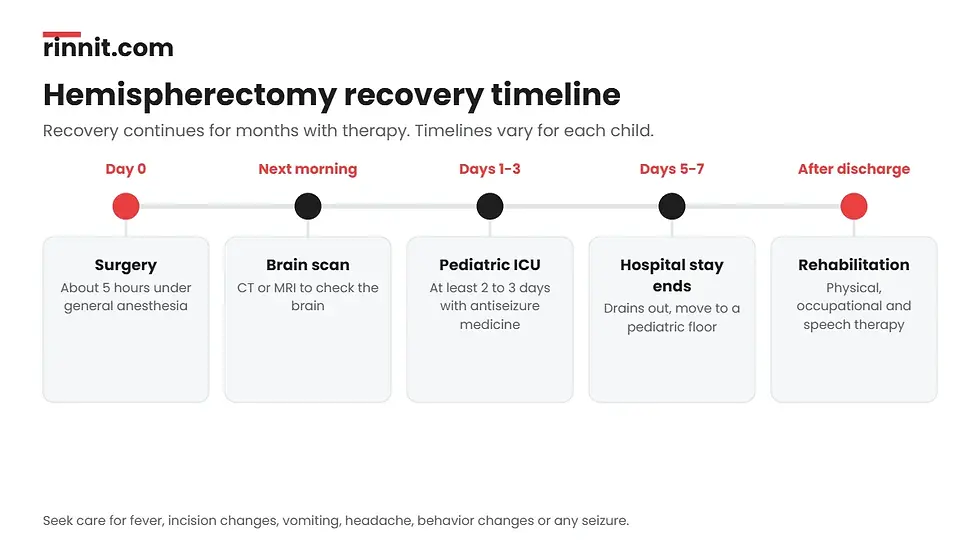
A typical hemispherectomy recovery timeline.
Recovery continues with physical, occupational and speech therapy. After leaving the hospital, some children go to a rehabilitation facility first, then home or to outpatient therapy. [1]
Outcomes for walking, reading and behavior are usually good, although some loss of vision is expected. [1] Medicines that keep seizures under control are covered in our guide to antiseizure medications.
What are the benefits and risks of a hemispherectomy?
The main benefit is seizure control. Studies show that more than 66% to over 80% of children become completely seizure-free after a hemispherectomy, and most of the others have fewer seizures. Children whose seizures continue may be evaluated for another surgery. [1]
Possible risks include: [1]
Risk | What it means |
Bleeding or blood loss | Heavy blood loss may need a blood transfusion |
Electrolyte changes | Shifts in salts and minerals in the blood |
Low body temperature | The body gets colder than normal after surgery |
Aseptic meningitis | Inflammation of the brain's lining without infection |
Infection | Germs enter the surgical wound or brain area |
Hydrocephalus | Fluid buildup in the brain; under 5% after functional procedures and somewhat higher after anatomic ones, treated with a shunt |
Sources: [1]
Does a hemispherectomy affect life expectancy?
Epilepsy can shorten life in general. Stopping seizures with a hemispherectomy likely improves quality of life and may help people live longer. [1]
When should you call a doctor after a hemispherectomy?
Get medical care right away after a hemispherectomy for: [1]
Signs of infection, such as fever, pus or discoloration at the incision
Signs of hydrocephalus, such as vomiting, headache or changes in behavior
Any seizure
Conclusion
A hemispherectomy is a rare but highly effective surgery for children, and sometimes adults, whose seizures come from one half of the brain and do not respond to medicine. Most children become seizure-free, and with intensive rehabilitation many do well with walking, reading and behavior.
If your child has seizures that medicines have not controlled, ask a pediatric epilepsy specialist whether an evaluation for epilepsy surgery, including hemispherectomy, makes sense.
Keep learning: Read our epilepsy guide for an overview of seizure types, causes and treatment options.
FAQ
What is a hemispherectomy?
A hemispherectomy is a rare surgery that removes or disconnects one half of the brain from the other to stop seizures that medicine cannot control.
Who needs a hemispherectomy?
A hemispherectomy is mainly for children, and sometimes adults, with drug-resistant seizures coming from one side of the brain.
What are the types of hemispherectomy?
The two main types are functional (disconnective) hemispherectomy, which removes a smaller area, and anatomic hemispherectomy, which removes four lobes on one side.
How long does a hemispherectomy take?
A hemispherectomy takes about five hours, sometimes longer, under general anesthesia.
How long is the hospital stay after a hemispherectomy?
The hospital stay after a hemispherectomy is usually 5 to 7 days, including at least 2 to 3 days in the pediatric ICU.
How successful is a hemispherectomy?
Studies show more than 66% to over 80% of children become completely seizure-free after a hemispherectomy, and most others have fewer seizures.
What are the risks of a hemispherectomy?
Risks of a hemispherectomy include bleeding, electrolyte changes, low body temperature, aseptic meningitis, infection and hydrocephalus.
Can a child walk after a hemispherectomy?
Outcomes for walking, reading and behavior are usually good after a hemispherectomy, although some vision loss is expected.
What therapy is needed after a hemispherectomy?
Recovery after a hemispherectomy includes physical, occupational and speech therapy, sometimes starting in a rehabilitation facility.
How do I prepare my child for a hemispherectomy?
Your child can't have food or water after a certain time the day before, and the provider tells you which medicines to give or stop. [1] Staff wash your child's hair and cut or shave part of it, a child life specialist can help prepare your child, and you may want someone to wait with you during surgery. [1]
Does a hemispherectomy hurt, and what anesthesia is used?
A hemispherectomy is done under general anesthesia, so your child is asleep and won't feel pain during the procedure. [1]
When should I call the doctor after a hemispherectomy?
Seek care after a hemispherectomy for fever or incision changes, vomiting, headache, behavior changes or any seizure.
Related Reading
Epilepsy: Seizures, Symptoms, Causes, and Treatment explains the seizure disorder that a hemispherectomy is used to treat.
Rasmussen’s Encephalitis: Managing Seizures and Brain Inflammation covers one of the conditions most often treated with a hemispherectomy.
Hemimegalencephaly: Understanding One-Sided Brain Overgrowth describes the malformation in which one half of the brain grows abnormally large.
Sturge-Weber Syndrome: Symptoms, Causes, and Lifelong Management explains a birth condition that can cause one-sided seizures.
Cortical Dysplasia: Symptoms, Causes, Diagnosis, Treatment and Outlook — What You Need to Know covers malformations of cortical development that can lead to surgery.
References
Cleveland Clinic. Hemispherectomy: What It Is, Procedure & Side Effects. Cleveland Clinic. Last updated October 5, 2023. https://my.clevelandclinic.org/health/procedures/17092-hemispherectomy
Goel K, Ghadiyaram A, Krishnakumar A, et al. Hemimegalencephaly: A Systematic Comparison of Functional and Anatomic Hemispherectomy for Drug-Resistant Epilepsy. Neurosurgery. 2024;94(4):666-678. PMID 37975663. https://doi.org/10.1227/neu.0000000000002759
Schusse CM, Smith K, Drees C. Outcomes after hemispherectomy in adult patients with intractable epilepsy: institutional experience and systematic review of the literature. J Neurosurg. 2018;128(3):853-861. PMID 28452614. https://doi.org/10.3171/2016.9.JNS151778
Nahum AS, Liégeois FJ. Language after childhood hemispherectomy: A systematic review. Neurology. 2020;95(23):1043-1056. PMID 33087498. https://doi.org/10.1212/WNL.0000000000011073
Medical disclaimer
This article is for general education only and does not replace advice from a qualified healthcare professional. Talk to your doctor about your own diagnosis and treatment, and seek emergency care right away for severe or sudden symptoms.



Comments