Cardiac CT Scan (Heart CT): Purpose, Preparation, Calcium Score and Risks

Updated: 2 days ago
Written and medically reviewed by Dr. Baraa Alnahhal, MD · Last reviewed: November 2026 · How we review
Quick Answer: What is a cardiac CT scan?
A cardiac CT scan (heart CT) uses X-rays taken from many angles to build detailed 3D images of the heart, its major blood vessels and nearby structures. It can show plaque and calcium in the coronary arteries. A calcium score of 0 means no calcium was seen in the coronary arteries and a low heart attack risk. [1]
What the research says
Adding a heart CT to usual care lowered the 5-year rate of heart attack or heart death. In 4,146 people with stable chest pain, those who had coronary CT angiography had a 2.3% rate of coronary death or heart attack over 5 years, compared with 3.9% with standard care alone, without more invasive angiograms or stents overall. (SCOT-HEART Investigators, The New England Journal of Medicine, 2018) [2]
Starting with CT instead of an invasive angiogram was similarly safe for the heart and had fewer complications. In 3,561 people with stable chest pain, major cardiovascular events occurred in 2.1% after CT and 3.0% after invasive coronary angiography, a difference that was not significant, while major procedure-related complications were 0.5% versus 1.9%. (DISCHARGE Trial Group, The New England Journal of Medicine, 2022) [3]
Key takeaways
A cardiac CT uses X-rays and a computer to make 3D images of the heart and its major blood vessels. [1]
It may be done with or without iodine-based contrast dye given through an IV. [1]
Don't eat for four to six hours before, and avoid caffeine the day before and the day of the scan. [1]
A calcium score of 0 is normal; above 400 means extensive coronary artery disease. [1]
Risks include contrast reactions and a small amount of radiation; it's generally not recommended in pregnancy. [1]
What is a cardiac CT scan?
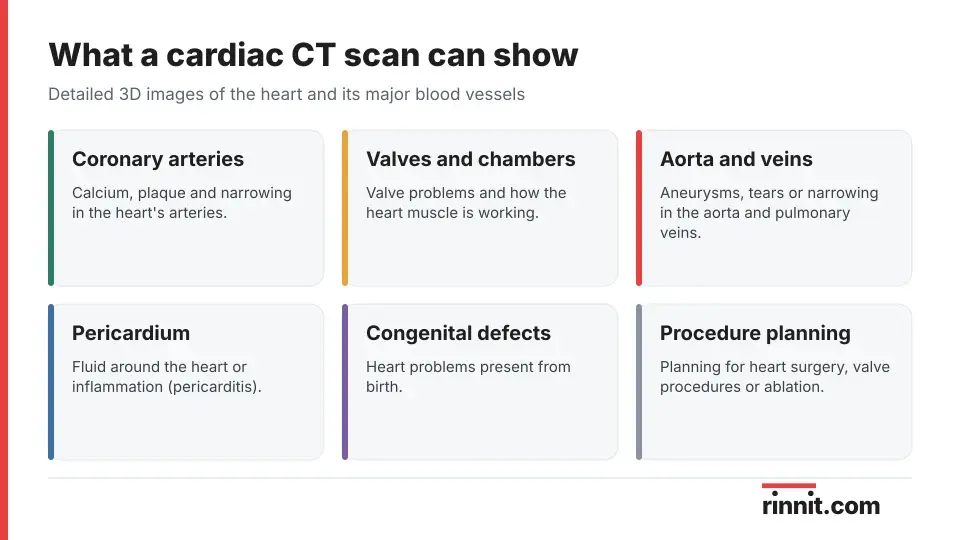
A cardiac CT scan uses multiple X-ray beams from different angles to create detailed images of your heart and its major blood vessels. A computer combines them into 3D views. The test may be done with or without iodine-based contrast dye. [1]
It can show your: [1]
Coronary arteries
Heart chambers and heart muscle
Heart valves
Pulmonary veins
Thoracic aorta, and sometimes the abdominal aorta
Pericardium, the sac around the heart
Why is a cardiac CT scan done?
A cardiologist usually orders a cardiac CT to: [1]
Evaluate chest pain or shortness of breath
Check for calcium or plaque in the coronary arteries
Assess the heart valves and the aorta
Plan heart surgery or valve procedures
Plan ablation treatment for an irregular heartbeat
Check for heart problems present from birth
Look at masses or fluid around the heart
Cardiac CT vs cardiac MRI
Feature | Cardiac CT | Cardiac MRI |
How it makes images | X-ray radiation | Magnets and radio waves |
Scanner | More open and quieter | More enclosed and louder |
Speed | Faster | Slower |
Usual contrast | Iodine-based | Gadolinium-based |
Sources: [1]
How do you prepare for a cardiac CT scan?
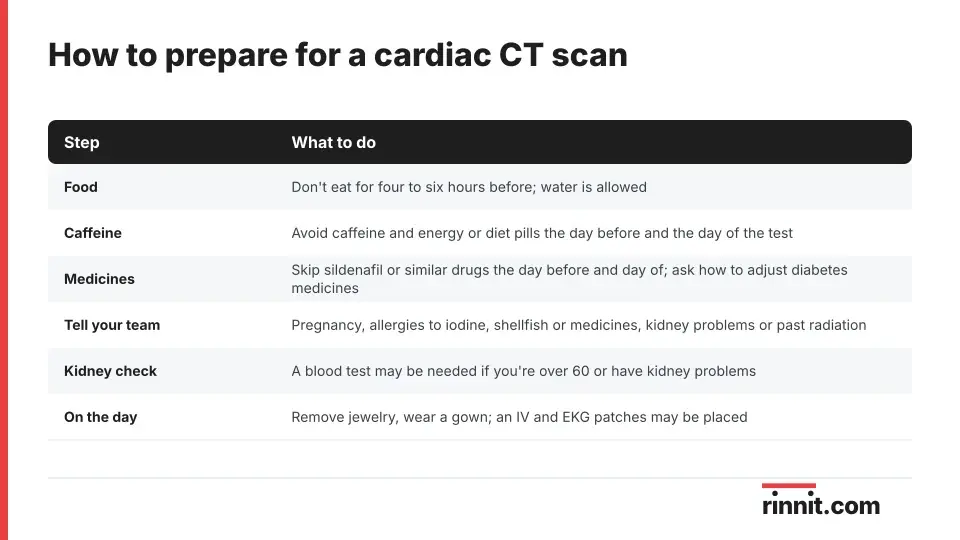
Follow your care team's instructions. In general: [1]
Don't eat for four to six hours before your appointment; water is allowed.
Avoid caffeine and energy or diet pills the day before and the day of the test.
Don't take sildenafil (Viagra or Revatio) or similar drugs the day before or the day of the test.
If you have diabetes, ask how to adjust your medicines on test day.
Tell your provider if you're pregnant, have allergies (iodine, shellfish or medicines), have had radiation therapy or have kidney problems.
If you're over 60 or have kidney problems, you may need a blood test of kidney function before receiving contrast. On the day, you'll remove jewelry and change into a gown. You may get a medicine to slow your heart rate, an IV for contrast and small electrode patches on your chest for an EKG. [1]
What happens during a cardiac CT scan?
You lie on a table that slides into the scanner, with your arms raised over your head. The scanner rotates around you without touching you. You'll need to stay still and may be asked to hold your breath briefly. Contrast can cause a warm feeling or a brief metallic taste. [1]
Step | Time |
Whole appointment | 30 to 60 minutes |
Actual scanning | About 10 minutes or less |
Results | Usually the same day or within a few days |
Sources: [1]
What happens after the scan?
The IV is removed, and you can go back to normal activities and eating. If you were given a sedative, you'll need someone to drive you home. [1]
What are the risks of a cardiac CT scan?
Contrast reactions: usually mild, such as itching, nausea, sneezing or a rash, and treated with antihistamines or steroids. Rarely, a severe allergic reaction (anaphylaxis) causes trouble breathing and needs emergency treatment.
Kidneys: people with diabetes or kidney disease may need extra fluids afterward to help clear the contrast.
Breastfeeding: contrast can pass into breast milk, so you may want to store milk beforehand for a day or two.
Radiation: the X-rays carry a small long-term cancer risk, kept as low as possible. The test is generally not recommended during pregnancy.
Heart-rate medicine: people with asthma, heart failure or COPD may have trouble breathing with it, so tell your provider.
Sources: [1]
What do cardiac CT results mean?
A normal result shows healthy-looking heart structures and arteries. An abnormal result may show plaque or narrowed coronary arteries, a high calcium score, valve or heart function problems, fluid around the heart or pericarditis, tumors or masses, congenital heart defects, or aneurysms, tears or narrowing in blood vessels. [1]
What does the coronary calcium score mean?
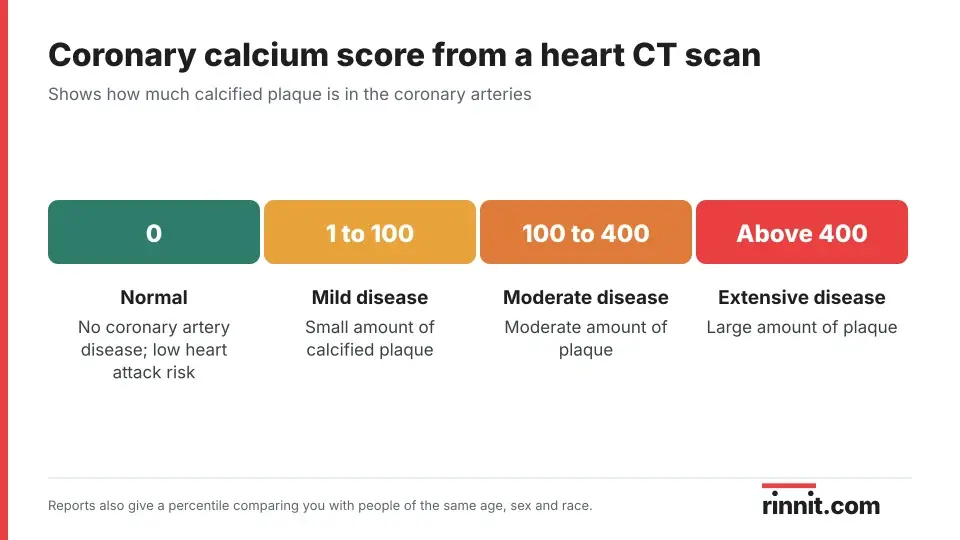
Calcium score | What it means |
0 | Normal: no calcium seen in the coronary arteries and low heart attack risk |
1 to 100 | Mild disease |
100 to 400 | Moderate disease |
Above 400 | Extensive disease |
Sources: [1]
Your report also gives a percentile that compares you with people of the same age, sex and race. [1]
When should you call your doctor?
Contact your provider if you have a reaction to the contrast or any medicine given during the test, or if you haven't received your results after a few days. [1]
Questions to ask your provider
Why do I need a cardiac CT, and will it use contrast?
Do I need a kidney test first?
Should I stop any of my medicines before the scan?
What does my calcium score mean for my heart attack risk?
What are the next steps if plaque or narrowing is found?
Conclusion
A cardiac CT scan gives detailed 3D pictures of your heart and its arteries in about 10 minutes of scanning. It helps explain chest pain, measure coronary calcium and plan procedures, and a calcium score of 0 points to a low heart attack risk. [1]
Large trials suggest that using CT in people with stable chest pain can guide care safely, with fewer complications than an invasive angiogram. [2] [3]
Keep learning: Read our guides to coronary artery disease, angina and atherosclerosis. For more, see MedlinePlus: Heart CT scan.
FAQ
What is a cardiac CT scan?
A cardiac CT scan uses X-rays and a computer to create detailed 3D images of your heart and its major blood vessels. [1]
Why is a cardiac CT scan done?
It is used to check chest pain or shortness of breath, look for coronary calcium or plaque, assess valves and the aorta, and plan heart procedures. [1]
How long does a cardiac CT scan take?
The appointment takes 30 to 60 minutes, but the scanning itself takes about 10 minutes or less. [1]
Can I eat before a cardiac CT scan?
No. Avoid eating for four to six hours before the scan, though you can drink water. [1]
Why should I avoid caffeine before a heart CT?
You should avoid caffeine and energy or diet pills the day before and the day of the scan, as instructed. [1]
What is a normal calcium score?
A calcium score of 0 is normal and means no calcium was seen in the coronary arteries and a low heart attack risk. [1]
What does a calcium score over 400 mean?
A calcium score above 400 indicates extensive coronary artery disease. [1]
Is a cardiac CT scan safe?
It is generally safe. Risks include contrast reactions and a small long-term cancer risk from radiation. [1]
Can I have a cardiac CT while pregnant?
A cardiac CT is generally not recommended during pregnancy, though precautions can be taken if it is necessary. [1]
What is the difference between cardiac CT and cardiac MRI?
Cardiac CT uses X-rays and is faster, quieter and more open; cardiac MRI uses magnets and gadolinium contrast. [1]
Related Reading
Cardiac Imaging: Types of Heart Scans and What Each One Shows compares the main heart imaging tests and what each one shows.
Learn more in our guide to Coronary Artery Disease: Symptoms, Causes, Diagnosis, Treatment and Prevention — What You Need to Know.
Learn more in our guide to Angina: Symptoms, Causes, Treatment & Complete Guide.
Learn more in our guide to Arteriosclerosis & Atherosclerosis: Symptoms, Causes, Diagnosis & Treatment — Complete Guide.
Learn more in our guide to Congenital Heart Disease (CHD): Types, Symptoms, Treatment & Survival — Complete Guide.
References
Cleveland Clinic. Heart CT Scan: Purpose, Procedure & Risks. Cleveland Clinic. Last updated February 28, 2022. https://my.clevelandclinic.org/health/diagnostics/16834-cardiac-computed-tomography
SCOT-HEART Investigators. Coronary CT Angiography and 5-Year Risk of Myocardial Infarction. N Engl J Med. 2018;379(10):924-933. PMID 30145934. https://doi.org/10.1056/NEJMoa1805971
DISCHARGE Trial Group. CT or Invasive Coronary Angiography in Stable Chest Pain. N Engl J Med. 2022;386(17):1591-1602. PMID 35240010. https://doi.org/10.1056/NEJMoa2200963
Medical disclaimer
This article is for general education only and does not replace advice from a qualified healthcare professional. Talk to your doctor about your own diagnosis and treatment, and seek emergency care right away for severe or sudden symptoms.



Comments