Heart Screening: Which Tests Check Your Heart Health and What Results Mean

Updated: 2 days ago
Written and medically reviewed by Dr. Baraa Alnahhal, MD · Last reviewed: November 2026 · How we review
Quick Answer: What is a heart screening?
A heart screening is a group of tests that look for heart disease before you have symptoms. It can include blood tests for cholesterol and blood sugar, an electrocardiogram (EKG), an echocardiogram and a calcium score test. The results show your risk of heart attack and stroke so your provider can plan ways to lower it. [1]
What the research says
Inviting older men to broad screening did not clearly lower deaths at 5 years. In 46,611 Danish men aged 65 to 74, 12.6% of those invited to CT-based heart screening died over a median 5.6 years versus 13.1% of those not invited, a difference that was not statistically significant; stroke risk was slightly lower in the invited group. (Lindholt et al., The New England Journal of Medicine, 2022) [2]
In younger men, screening raised bleeding without cutting deaths so far. In 31,268 men aged 60 to 64, 9.3% of the invited group and 9.9% of controls died over 7 years, a non-significant difference, while severe bleeding was more common with screening (6.0% vs 5.1%), likely tied to preventive aspirin. (Lindholt et al., European Heart Journal, 2026) [3]
Key takeaways
A heart screening is a set of tests chosen for your risk, not one single test. [1]
Common parts are a physical exam, blood pressure, cholesterol and blood sugar blood tests and an EKG. [1]
Imaging such as a calcium score, echocardiogram, CT angiogram or cardiac MRI may be added if your risk is higher. [1]
Some screenings, such as blood tests, can start at age 20. [1]
Normal results still call for heart-healthy habits, including 150 minutes of moderate activity each week. [1]
What is a heart screening?
A heart (cardiac) health screening includes tests that can find heart disease before symptoms appear. The results show whether you are at risk of cardiovascular problems such as stroke or heart attack. Your provider can then build a plan to lower that risk, which may include lifestyle changes, medicines or procedures. [1]
Finding a problem early gives you a chance to improve your health. If you already have heart disease, screening allows treatment to start sooner. [1]
Who should get a heart screening?
Your provider may recommend screening if: [1]

A biological family member has heart disease
You have diabetes
You have high blood pressure
You have high cholesterol
Some screenings, such as blood tests, may start at age 20. Your provider decides how often each test should be repeated. [1]
What tests are part of a heart screening?

Test | What it checks |
Physical exam | Waist size, body mass index (BMI) and blood pressure, which often has no symptoms when high |
Blood tests | Cholesterol and blood sugar levels |
Electrocardiogram (EKG) | The heart's electrical activity, to find an abnormal heart rate or rhythm |
Exercise stress test | Blood pressure and heart rhythm while you walk or pedal, to see blood flow during activity |
Echocardiogram | Ultrasound pictures of the heart's structure and how well it works |
Calcium score test | Calcium from hardened plaque in the coronary arteries |
Coronary CT angiogram | Plaque, narrowing and blockages in the coronary arteries |
Cardiac MRI | Damaged heart tissue or blood flow problems, without radiation |
Carotid ultrasound | Narrowed or blocked arteries that carry blood to the brain |
Sources: [1]
If you cannot walk for a stress test, medicine can be used instead to show blood flow problems. Imaging may also be added to a stress test. [1]
How does a heart screening work?
Many of these tests need no needles. Others need contrast dye given through an IV in your arm. Nuclear stress tests (SPECT or PET) use a small amount of radioactive tracer instead of dye. [1]
How do you prepare for a heart screening?
Your provider will give instructions for each test. You may need to: [1]
Avoid eating and drinking for several hours beforehand
Stop certain medicines or vitamins for a time
Avoid tobacco or caffeine
Change into a hospital gown and remove jewelry or other metal
What happens during a heart screening?
Most tests ask you to lie still while imaging equipment moves around you, and you may need to hold your breath for a short time. For an exercise stress test, you walk on a treadmill or pedal a bike. Tests that track your heart rhythm use small electrode patches on your chest. [1]
Some people feel closed in inside an MRI machine. Placing an IV or catheter may cause brief discomfort. [1]
What are the risks of a heart screening?
Most screening tests are low risk, but some carry possible risks: [1]
Harm to a fetus if you are pregnant, or to a nursing baby
A small amount of radiation exposure
Kidney damage or an allergic reaction to contrast dye
Injury from a catheter
An abnormal heart rhythm or chest pain during stress testing
Tell your provider if you are pregnant or breastfeeding before any imaging test. [1]
What happens after a heart screening?
You can usually go back to normal activities. If you had a sedative, someone needs to drive you home. If you received contrast dye, drink plenty of water to help flush it out. Some imaging tests need a few hours of observation in the hospital, and your provider may limit your activity depending on the test and your results. [1]
What do heart screening results mean?
Test type | What the result shows |
Blood tests | Numbers for your cholesterol and blood sugar levels |
Calcium score | How much calcium is in your coronary arteries |
EKG | Rhythm problems and sometimes signs of past heart damage |
Imaging tests | Blockages and blood flow problems |
Sources: [1]
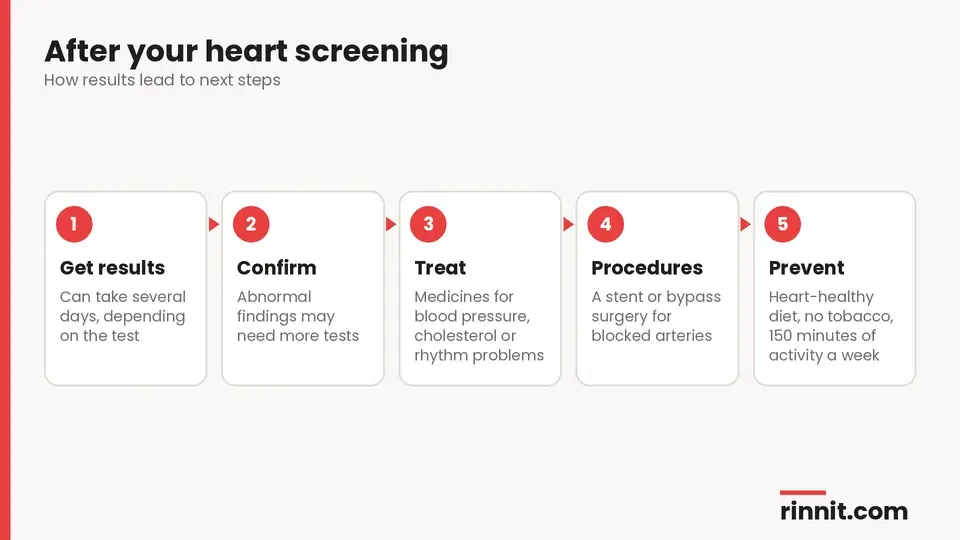
Results can take several days, depending on the test. [1]
What happens if your results are abnormal?
You may need more tests to confirm the finding. Treatment may include medicine for high blood pressure, high cholesterol, or heart rhythm or pumping problems. Narrowed or blocked arteries may need a procedure such as a stent, and coronary artery bypass graft (CABG) surgery is a more invasive option. [1]
What if your results are normal?
Keep up heart-healthy habits: eat a heart-healthy diet such as the Mediterranean diet, stop using tobacco and aim for 150 minutes of moderate physical activity each week. [1]
When should you call your provider?
Call your provider if you have bleeding, swelling or signs of infection after a screening test, or if you have questions about a test or your results. [1]
Conclusion
A heart screening is a set of tests matched to your risk that can catch heart disease before it causes symptoms. It usually starts with a physical exam, blood tests and an EKG, and can add imaging when your risk is higher.
Ask your provider which tests make sense for you and how often to repeat them, then use your results to guide changes that protect your heart.
Keep learning: Read our guides to the calcium score test, the lipid panel and the exercise stress test, or see what your numbers mean in normal blood pressure by age.
FAQ
What is a heart screening?
A group of tests that look for heart disease before symptoms appear and show your risk of heart attack or stroke. [1]
What tests are included in a heart screening?
It can include a physical exam, cholesterol and blood sugar tests, an EKG, a stress test, an echocardiogram, a calcium score, a CT angiogram, a cardiac MRI or a carotid ultrasound. [1]
Who should get a heart screening?
People with a family history of heart disease or risk factors such as diabetes, high blood pressure or high cholesterol. [1]
At what age should heart screening start?
Some screenings, such as blood tests, may start at age 20; your provider decides how often to repeat them. [1]
How do I prepare for a heart screening?
You may need to fast for several hours, stop certain medicines or vitamins, and avoid tobacco and caffeine. [1]
Does a heart screening hurt?
Most tests need no needles; an IV or catheter may cause brief discomfort. [1]
What are the risks of heart screening?
Possible risks include radiation, reactions to contrast dye, catheter injury, abnormal heart rhythm and chest pain. [1]
How long do heart screening results take?
Results can take several days, depending on the test. [1]
What happens if my heart screening is abnormal?
You may need confirming tests, and treatment may include medicines, a stent or bypass surgery. [1]
When should I call my doctor after a heart screening?
Call for bleeding, swelling or signs of infection, or if you have questions about your results. [1]
Related Reading
Coronary Artery Disease: Symptoms, Causes, Diagnosis, Treatment and Prevention — What You Need to Know explains the plaque buildup that heart screening looks for.
High Blood Pressure: Silent Symptoms, Serious Risks, and Proven Ways to Lower It covers one of the main risk factors screening checks.
Understanding Hyperlipidemia: Managing High Cholesterol for Heart Health explains what a high cholesterol result means.
Heart Disease: What It Is, How It Is Diagnosed, and How It Is Treated gives an overview of the conditions screening can find.
Heart Arrhythmia: Symptoms, Types, Causes, Diagnosis & Treatment — Complete Guide explains the rhythm problems an EKG can show.
Carotid Artery Disease: The Silent Stroke Risk in Your Neck, Explained covers what a carotid ultrasound looks for.
References
Cleveland Clinic. What's a Heart (Cardiac) Health Screening? Cleveland Clinic. Last updated October 15, 2025. https://my.clevelandclinic.org/health/diagnostics/heart-screening
Lindholt JS, Søgaard R, Rasmussen LM, et al. Five-Year Outcomes of the Danish Cardiovascular Screening (DANCAVAS) Trial. N Engl J Med. 2022;387(15):1385-1394. PMID 36027560. https://doi.org/10.1056/NEJMoa2208681
Lindholt JS, Mejldal A, Rasmussen LM, et al. Outcomes of cardiovascular screening in men aged 60-64 years: the DANCAVAS II trial. Eur Heart J. 2026;47(15):1814-1825. PMID 40884758. https://doi.org/10.1093/eurheartj/ehaf704
Medical disclaimer
This article is for general education only and does not replace advice from a qualified healthcare professional. Talk to your doctor about your own diagnosis and treatment, and seek emergency care right away for severe or sudden symptoms.



Comments