Revised Cardiac Risk Index (RCRI): What It Measures, How It's Scored and What Your Result Means

Updated: 2 days ago
Written and medically reviewed by Dr. Baraa Alnahhal, MD · Last reviewed: November 2026 · How we review
Quick Answer: What is the Revised Cardiac Risk Index?
The Revised Cardiac Risk Index (RCRI) is a scoring tool used before non-heart surgery to estimate the chance of heart complications, such as a heart attack or cardiac arrest. You get one point for each of six risk factors. A score of 0 or 1 means a risk below 1%, while 3 or more points means about 11%.
What the research says
The RCRI was built and tested in a large surgical cohort. In 4,315 patients aged 50 and older having major noncardiac surgery, rates of major cardiac complications in the validation group were 0.4%, 0.9%, 7% and 11% for 0, 1, 2 and 3 or more risk factors, respectively. (Lee et al., Circulation, 1999) [2]
It predicts heart events moderately well, but less well after vascular surgery. A systematic review of 24 studies with 792,740 patients found the RCRI separated low- and high-risk patients after mixed noncardiac surgery with an area under the curve of 0.75, but only 0.64 after vascular surgery, and it did not predict death well. (Ford et al., Annals of Internal Medicine, 2010) [3]
Key takeaways
The RCRI estimates the risk of heart complications after surgery that is not on the heart [1].
It counts six risk factors, with one point for each [1].
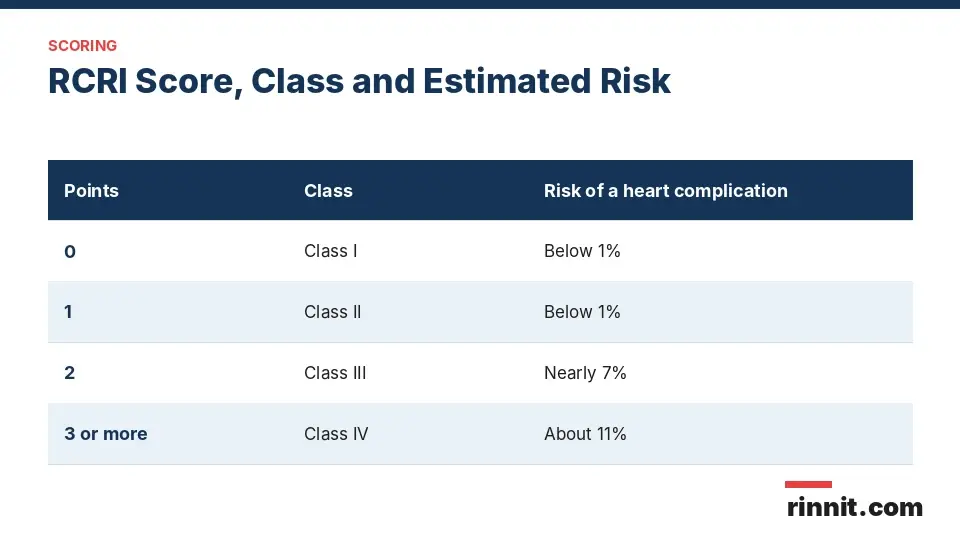
A score of 0 or 1 means a risk below 1%; 2 points means nearly 7%; 3 or more means about 11% [1].
It needs no physical test, only answers about your health, so it can be used almost anywhere [1].
Low-risk people can usually go ahead with surgery; higher-risk people may need heart tests first [1].
It may be less accurate for major blood vessel surgery [1].
What is the Revised Cardiac Risk Index?
The Revised Cardiac Risk Index (RCRI) helps providers estimate how likely you are to have a heart attack, cardiac arrest or death from heart causes after surgery [1]. It is used before operations on areas other than the heart, called noncardiac surgery [1].
Knowing this risk helps your care team decide whether you need certain heart tests before surgery and whether you will need extra care afterward [1].
The six RCRI risk factors
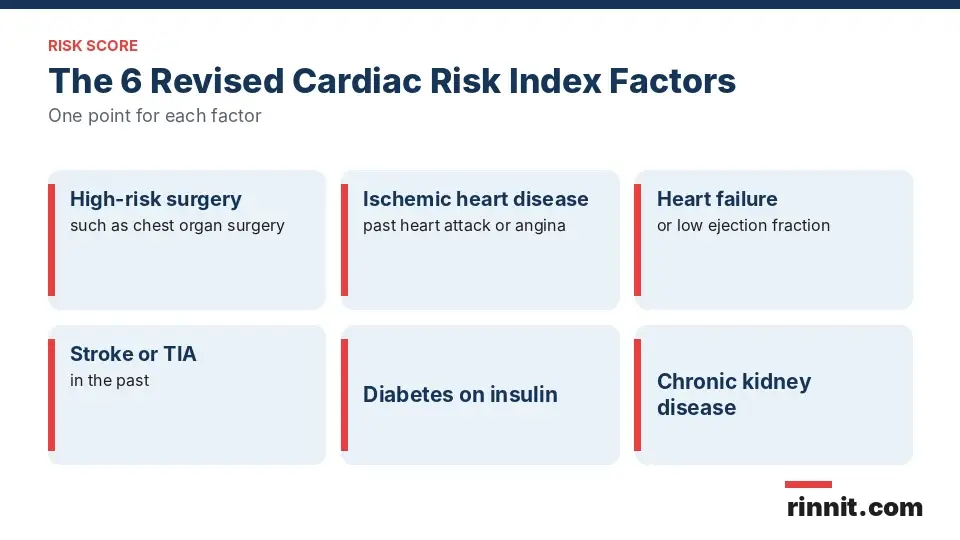
Each of the following adds one point to your score [1]:
High-risk surgery, such as an operation on an organ in the chest [1]
Ischemic heart disease, meaning a past heart attack or angina [1]
Heart failure or a low ejection fraction, the share of blood the left ventricle pumps out with each beat [1]
Stroke or transient ischemic attack (TIA) in the past [1]
Diabetes treated with insulin [1]
Chronic kidney disease with a creatinine level above 2.0 mg/dL [1]
Why the RCRI is used
Providers use the RCRI to find people who are at higher risk of major heart complications after surgery [1]. It is most useful when a decision is not straightforward [1]. For example, a young person with no risk factors having a simple operation is usually an easy call, while a person who is clearly high risk and whose surgery can wait will likely have their heart problems treated first [1].
For people with some risk factors, the score helps decide whether heart testing is needed, because surgery puts real stress on the body [1]. It predicts death after surgery less reliably than heart complications, but it can help guide the choice of a less invasive approach and flag who may need intensive care or a longer hospital stay [1].
How the RCRI is scored
Each risk factor counts as one point [1]. No blood test or scan is needed: the score comes from answers to health questions, so it can be used in hospital rooms and emergency departments [1].
Sources: [1]
In general, a score of 0 or 1 means testing before surgery may not be needed, while 2 or more points means testing may be needed [1].
Limitations of the RCRI
The RCRI may be less accurate for people having major vascular, or blood vessel, surgery [1]. Online surgical risk databases can give better estimates because they draw on results from similar operations at hundreds of hospitals [1].
What happens after your RCRI score
If you are low risk, you can usually go ahead with surgery [1]. If you are high risk, your care team will likely want more information first [1].

If you are in Class III or IV
You may need testing and extra steps to lower your chance of complications, and surgery may be postponed or canceled until underlying heart problems are addressed [1]. Possible tests include [1]:
When to contact your provider
Contact your provider if you have questions about any test recommended before surgery, including how to prepare and what to expect [1]. Ask what your score means if you are not sure [1].
Conclusion
The Revised Cardiac Risk Index is a quick, question-based way to estimate your chance of heart complications after noncardiac surgery. It adds one point for each of six risk factors and sorts you into Class I to IV.
A low score usually means surgery can go ahead, while a higher score may lead to heart tests or extra precautions first. Knowing your score helps you and your team plan safer surgery.
Keep learning: Read our guide to the electrocardiogram (EKG), our guide to the echocardiogram or our guide to the exercise stress test. For more background, see the MedlinePlus guide to surgery.
FAQ
What is the Revised Cardiac Risk Index?
It is a scoring tool that estimates the risk of heart complications after surgery that is not on the heart.
What does the RCRI predict?
It estimates the risk of a heart attack, cardiac arrest or death from heart causes after noncardiac surgery.
What are the six RCRI risk factors?
High-risk surgery, ischemic heart disease, heart failure, past stroke or TIA, insulin-treated diabetes and chronic kidney disease.
How is the RCRI scored?
Each risk factor adds one point. The total sorts you into Class I (0 points) to Class IV (3 or more points).
What does an RCRI score of 0 or 1 mean?
It means an estimated risk of a heart complication below 1%. Testing before surgery may not be needed.
What does an RCRI score of 3 or more mean?
It means an estimated risk of about 11%. You will likely need more testing before surgery.
Does the RCRI need a blood test or scan?
No. It is based on answers to health questions, so it can be used almost anywhere.
What tests might I need if my RCRI score is high?
Possible tests include an EKG, echocardiogram, chest X-ray, stress test, heart blood tests or a coronary angiogram.
Can a high RCRI score delay my surgery?
Yes. Surgery may be postponed or canceled until heart problems are addressed, if it can safely wait.
Is the RCRI accurate for all surgeries?
It may be less accurate for major blood vessel surgery, where surgical risk databases can give better estimates.
Related Reading
Coronary Artery Disease: Symptoms, Causes, Diagnosis, Treatment and Prevention — What You Need to Know explains the blocked heart arteries behind ischemic heart disease, one of the six RCRI risk factors.
Congestive Heart Failure: Symptoms, Stages, and How It's Treated covers heart failure, which adds a point to the RCRI score.
Transient Ischemic Attack (TIA): The Mini-Stroke That Is Actually a Warning explains TIA, a past event that counts as an RCRI risk factor.
Chronic Kidney Disease: What It Is, Its 5 Stages, Causes, and How It's Treated covers chronic kidney disease, another RCRI risk factor.
Angina: Symptoms, Causes, Treatment & Complete Guide explains angina, a sign of ischemic heart disease that raises surgical heart risk.
References
Cleveland Clinic. Revised Cardiac Risk Index. Cleveland Clinic. Last updated February 10, 2026. https://my.clevelandclinic.org/health/diagnostics/cardiac-risk-index
Lee TH, Marcantonio ER, Mangione CM, et al. Derivation and prospective validation of a simple index for prediction of cardiac risk of major noncardiac surgery. Circulation. 1999;100(10):1043-1049. PMID 10477528. https://doi.org/10.1161/01.cir.100.10.1043
Ford MK, Beattie WS, Wijeysundera DN. Systematic review: prediction of perioperative cardiac complications and mortality by the revised cardiac risk index. Ann Intern Med. 2010;152(1):26-35. PMID 20048269. https://doi.org/10.7326/0003-4819-152-1-201001050-00007
Medical disclaimer
This article is for general education only and does not replace advice from a qualified healthcare professional. Talk to your doctor about your own diagnosis and treatment, and seek emergency care right away for severe or sudden symptoms.



Comments