Angiogram: What It Shows, How It's Done, Risks and Recovery

Updated: 2 days ago
Written and medically reviewed by Dr. Baraa Alnahhal, MD · Last reviewed: November 2026 · How we review
Quick Answer: What is an angiogram?
An angiogram (angiography) is a minimally invasive test that uses X-ray images and an injected contrast dye to show how blood flows through the arteries or veins and where they are blocked or narrowed. A blockage can often be treated during the same procedure. Complications happen in less than 1% of cases. [1]
What the research says
Going through the wrist lowers bleeding and death risk. Pooled data on 21,600 patients from 7 randomized trials found that radial (wrist) access, compared with femoral (groin) access, lowered 30-day all-cause death (1.6% vs 2.1%) and major bleeding (1.5% vs 2.7%) in people having coronary angiography with or without a stent procedure. (Gargiulo et al., Circulation, 2022) [2]
Wrist access also means fewer access-site problems. A Cochrane review of 31 trials with 27,071 participants found the radial approach reduced bleeding (risk ratio 0.54) and access-site complications (risk ratio 0.36), though procedural success was slightly lower (risk ratio 0.97). (Kolkailah et al., Cochrane Database of Systematic Reviews, 2018) [3]
Key takeaways
An angiogram shows blockages or narrow spots in blood vessels of the heart, neck, kidneys, legs and other areas. [1]
It is not major surgery; it works through a tiny incision. [1]
Blockages can sometimes be treated during the test with angioplasty and a stent. [1]
Most people go home the same day or the next day, and someone must drive them. [1]
Complications occur in less than 1% of cases, mostly at the puncture site. [1]
What is an angiogram?
An angiogram is a diagnostic procedure that uses X-ray images to look for blockages or narrowed areas in your arteries or veins. It shows how blood circulates in vessels at specific places in your body, such as your heart, neck, kidneys or legs, and helps your provider find the source and extent of a blood vessel problem. [1]
Why is an angiogram done?
Your provider may recommend an angiogram if you have signs of blocked, damaged or abnormal blood vessels. It helps diagnose and plan treatment for: [1]

Coronary artery disease: blockage or narrowing in the arteries that supply the heart
Peripheral artery disease: blockage or narrowing in the leg arteries
Blood clots: masses of blood cells that block blood flow
Aneurysm: a weak spot in an artery wall
Sources: [1]
How do you prepare for an angiogram?
Before the test, your provider may check your blood to see how well it clots and make sure your kidneys are working well. Always ask your provider before stopping any medicine, especially antiplatelets and blood thinners. With your provider's approval: [1]
Stop clopidogrel for 5 days before the procedure.
Do not take blood thinners such as dipyridamole or warfarin within 72 hours before the test or 24 hours after it.
Take all other medicines as usual.
If you have diabetes, ask when to take your insulin or diabetes medicine.
Do not eat after midnight the night before. If you are having general anesthesia, do not eat or drink anything after midnight.
On the day of the angiogram, drink only clear liquids for breakfast, leave jewelry at home, bring a list of your medicines and allergies, tell every provider if you have diabetes, and arrange for a responsible adult to drive you home. [1]
What happens during an angiogram?
You will get medicine to keep you relaxed and comfortable. Most people receive sedation, and some receive general anesthesia. Then your provider will: [1]

Numb the area where the catheter will go in.
Enter the blood vessel with a needle and thread a wire through it.
Slide a long, thin catheter into a large artery, usually in the groin or wrist.
Guide the catheter tip carefully to the vessel being examined.
Inject a small amount of contrast dye. For a few seconds you may feel flushed or like you need to pee.
Take X-rays and watch where the dye flows to see how well blood moves.
Sources: [1]
Treatment during the angiogram
If a blockage is found, your provider may treat it right away with an angioplasty, which uses a tiny balloon to press the blockage against the artery wall. Angioplasty may be enough if blood flows better and less than 30% of the blockage remains. If the opening is still too small, a stent (a tiny metal tube) can be placed to keep the vessel open. Bypass surgery on the heart or legs is done on a different day. [1]
Angiogram at a glance
Item | What to expect |
Access site | Usually the groin or wrist |
Anesthesia | Sedation for most people; general anesthesia for some |
How long it takes | From 15 minutes to a few hours |
Going home | Same day or the next day |
Complication rate | Less than 1% of cases |
Sources: [1]
What happens after an angiogram?
Your provider removes the catheter, bandages the site and presses on it for at least 15 minutes to prevent bleeding. If the catheter went in through your leg, you will rest in bed for 4 to 6 hours. Most people go home the same day or the next day, even after angioplasty and stenting, and a responsible adult should stay with you overnight. [1]
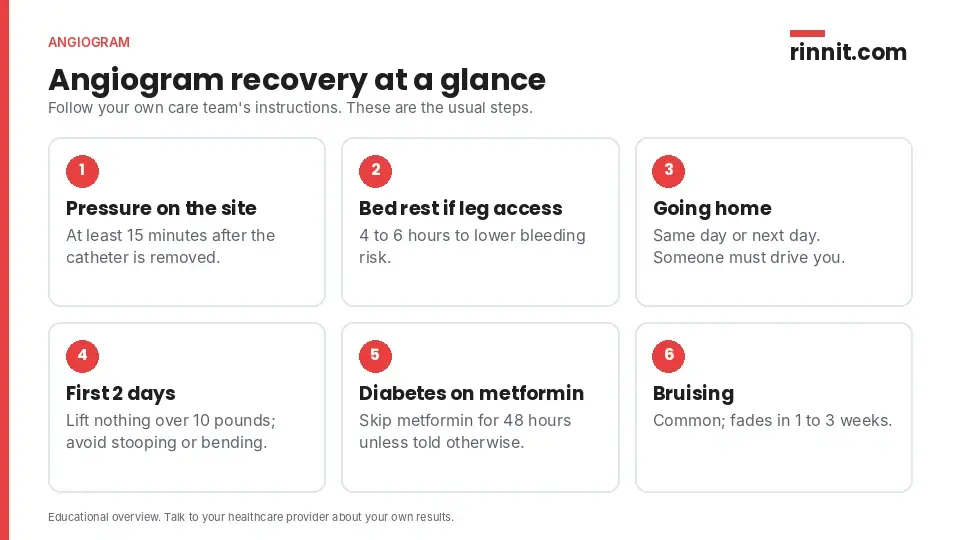
Do not lift anything heavier than 10 pounds or stoop or bend for 2 days.
If you take metformin, ask your provider whether to pause it after the test; this is usually needed only if you have kidney problems.
Drink water to help flush the contrast dye out of your body.
Sources: [1]
What are the risks of an angiogram?
Angiogram risks are low, and complications happen in less than 1% of cases. Most involve the puncture site. Possible risks include: [1]
Risk | Notes |
Bruising | Common; fades in 1 to 3 weeks |
Bleeding, pain or infection | At the puncture site |
Kidney problems | Linked to the contrast dye |
Allergic reaction | To the contrast dye |
Blood vessel injury or leak | A leak is rare |
Abnormal heart rhythm or cardiac arrest | May need resuscitation |
Clot causing heart attack or stroke | Rare |
Sources: [1]
What do angiogram results mean?
Your provider will usually talk with you right after the angiogram, though they may review the X-rays further before deciding on next steps. Small blockages may need only medicine and lifestyle changes such as more exercise and healthier eating. Larger blockages may need angioplasty and a stent, sometimes during the angiogram itself, or bypass surgery on another day. [1]
Who performs an angiogram?
An interventional cardiologist performs a heart (cardiac) angiogram. Interventional radiologists and vascular surgeons perform angiograms of the peripheral arteries, and interventional neurologists perform cerebral angiograms of the brain. [1]
When should you call your provider?
Contact your provider if you have: [1]
Pain or discomfort that does not improve with medicine
Trouble speaking or smiling (call 911 right away, since this can be a sign of stroke)
Numbness, weakness, warmth or swelling in the arm or leg used for the procedure
Fever
A lump near the wound
Bleeding where the catheter went in
Conclusion
An angiogram gives your care team a clear map of your blood vessels, showing exactly where blood flow is blocked and how serious it is. It is low-risk, usually means a same-day or next-day discharge and, in many cases, lets your provider treat the blockage on the spot. Follow your preparation and recovery instructions closely, and ask your provider about anything you are unsure of. [1]
Keep learning: Read our guides to coronary artery disease and peripheral artery disease. For more on heart tests, see the National Heart, Lung, and Blood Institute's guide to heart tests.
FAQ
What is an angiogram?
An angiogram is a test that uses X-ray images and an injected contrast dye to show how blood flows through your blood vessels and where they are blocked or narrowed [1].
Why would I need an angiogram?
It is done when you have signs of blocked, damaged or abnormal blood vessels, such as coronary artery disease, peripheral artery disease, blood clots or an aneurysm [1].
Is an angiogram major surgery?
No. It is a minimally invasive procedure done through a tiny incision just big enough for a catheter [1].
Is an angiogram painful?
Not very. You feel the numbing injection, then maybe some pressure as the catheter goes in, and soreness or bruising afterward [1].
How long does an angiogram take?
As little as 15 minutes, but some take a few hours if a blockage is treated during the procedure [1].
Will I be awake during an angiogram?
Most people get sedation to stay relaxed and comfortable. Some get general anesthesia, which puts them to sleep [1].
What are the risks of an angiogram?
Risks are low, with complications in less than 1% of cases. They include bruising, bleeding, infection, kidney problems and a reaction to the dye [1].
Are an angiogram and an angioplasty the same?
No. An angiogram finds a blockage. An angioplasty uses a tiny balloon to open it and can be done during the angiogram [1].
How long is recovery after an angiogram?
Most people go home the same or next day. Avoid lifting more than 10 pounds and stooping or bending for 2 days [1].
When should I call my provider after an angiogram?
Call for pain not helped by medicine, trouble speaking or smiling, numbness, weakness or swelling in the limb, fever, a lump near the wound, or bleeding at the catheter site [1].
Related Reading
Learn more in our guide to Coronary Artery Disease: Symptoms, Causes, Diagnosis, Treatment and Prevention — What You Need to Know.
Learn more in our guide to Peripheral Artery Disease (PAD): Symptoms, Causes, Diagnosis & Treatment Options.
Learn more in our guide to Deep Vein Thrombosis (DVT): Symptoms, Causes, Diagnosis & Treatment — Complete Guide.
Learn more in our guide to Ascending Aortic Aneurysm: A Plain-Language Guide to the Silent Weak Spot in Your Body's Main Artery.
References
Cleveland Clinic. Angiogram: What It Is and What It Shows. Cleveland Clinic. Last updated November 5, 2024. https://my.clevelandclinic.org/health/diagnostics/4977-angiography
Gargiulo G, Giacoppo D, Jolly SS, et al. Effects on Mortality and Major Bleeding of Radial Versus Femoral Artery Access for Coronary Angiography or Percutaneous Coronary Intervention: Meta-Analysis of Individual Patient Data From 7 Multicenter Randomized Clinical Trials. Circulation. 2022;146(18):1329-1343. PMID 36036610. https://doi.org/10.1161/CIRCULATIONAHA.122.061527
Kolkailah AA, Alreshq RS, Muhammed AM, et al. Transradial versus transfemoral approach for diagnostic coronary angiography and percutaneous coronary intervention in people with coronary artery disease. Cochrane Database Syst Rev. 2018;4(4):CD012318. PMID 29665617. https://doi.org/10.1002/14651858.CD012318.pub2
Medical disclaimer
This article is for general education only and does not replace advice from a qualified healthcare professional. Talk to your doctor about your own diagnosis and treatment, and seek emergency care right away for severe or sudden symptoms.



Comments