Ascending Aortic Aneurysm: A Plain-Language Guide to the Silent Weak Spot in Your Body's Main Artery

Updated: 2 days ago
Medically reviewed by Dr. Baraa Alnahhal, MD. Last reviewed October 13, 2026. This content is for educational purposes and is not medical advice.

Quick Answer
An ascending aortic aneurysm is a bulging weak spot in the first part of the aorta, in the chest. [1] Most people have no symptoms, though chest or high-back pain and shortness of breath can occur. [1] Aging, high blood pressure and Marfan syndrome raise risk. [1] Aneurysms under 5.5 cm are usually monitored; larger ones typically need surgery. [1] [4]
What the research says
The 5.5 cm surgery threshold comes from weighing risks, not from randomized trials. A clinical review explains that the risk of rupture and dissection depends on aortic diameter, and that above about 55 mm surgery improves outcomes because the risk of surgical complications is lower than the mortality from rupture or dissection. For people with Marfan syndrome or a bicuspid aortic valve, the timing of surgery is decided case by case, and the authors note that randomized treatment trials are lacking (Lavall et al., Deutsches Ärzteblatt International, 2012) [4].
With a bicuspid valve, the risk of a sudden aortic event is real but low in absolute terms. A systematic review of 32 studies (11,045 patients, 9,441 of them with a bicuspid valve) found an annualized acute aortic event rate of 0.29% (95% CI 0.23-0.35) in people with a bicuspid valve who had not had surgery, not significantly different from people with a normal three-flap valve (risk ratio 0.68, 95% CI 0.34-1.36). The authors conclude that the timing of surgery should balance this low risk against the morbidity and mortality of surgery (Hardikar and Marwick, JACC: Cardiovascular Imaging, 2013) [6].
In Turner syndrome, widening of the ascending aorta is common. A meta-analysis of 21 studies of adult women with Turner syndrome found ascending aortic dilatation in 23% (95% CI 19-26) at a mean age of 29 years, and an aortic dissection incidence of 164 per 100,000 patient-years (95% CI 95-284). Older age, bicuspid aortic valve, aortic coarctation, and high blood pressure were risk factors (Meccanici et al., Expert Review of Cardiovascular Therapy, 2023) [7].
What is an ascending aortic aneurysm, exactly?
An ascending aortic aneurysm is a bulging area in the first part of the aorta, the main artery in your body. [1] An aneurysm is a weak spot in a blood vessel wall. Aneurysms can tear or rupture (break open) and cause severe, life-threatening internal bleeding. [1]
These aneurysms are also called ascending thoracic aortic aneurysms (ATAAs) because they sit in your chest. [1] They are the most common location for chest aorta aneurysms: about 60% of all aneurysms in the thoracic aorta affect the ascending aorta. [1] Ascending aortic aneurysms affect about 10 out of 100,000 people each year. [1]
What does an ascending aortic aneurysm feel like?
An ascending aortic aneurysm usually feels like nothing at all, because most people with one don't experience any symptoms. [1] [4] That silence is exactly what makes this condition dangerous. [5] When symptoms do occur, they can include:
What causes an ascending aortic aneurysm?
Ascending aortic aneurysms develop when a blood vessel wall becomes weak or damaged. [1] Aging and heart disease can make the aorta less elastic. [1] The force of blood pushing against the weak area causes the blood vessel to bulge outward. [1]
Several conditions can lead to aneurysms:
Condition | What it is |
Aortitis [1] | Inflammation of the aorta |
Plaque buildup inside your arteries | |
Bicuspid aortic valve disease [1] | Two aortic valve flaps instead of the normal three |
A genetic disorder that can cause an enlarged aorta | |
A connective tissue disorder that can affect blood vessel walls | |
Trauma [1] | Injuries can cause tears in the artery wall |
A genetic disorder that can cause cardiovascular problems |
Who is most at risk?
The following factors make you more likely to develop an ascending aortic aneurysm:
Risk factor | Why it matters |
Age and sex | Men over 60 or women over 70 are more likely to develop one [1] |
Family history | A family history of aortic aneurysms raises your risk [1] |
Heart valve or connective tissue issues | Having a bicuspid aortic valve or a connective tissue disorder raises risk [1] |
Heart disease [1] | Heart disease damages the aorta and reduces its elasticity |
High blood pressure [1] | The extra force strains the weakened vessel wall |
Smoking [1] | Smoking damages blood vessel walls |
How is it diagnosed?
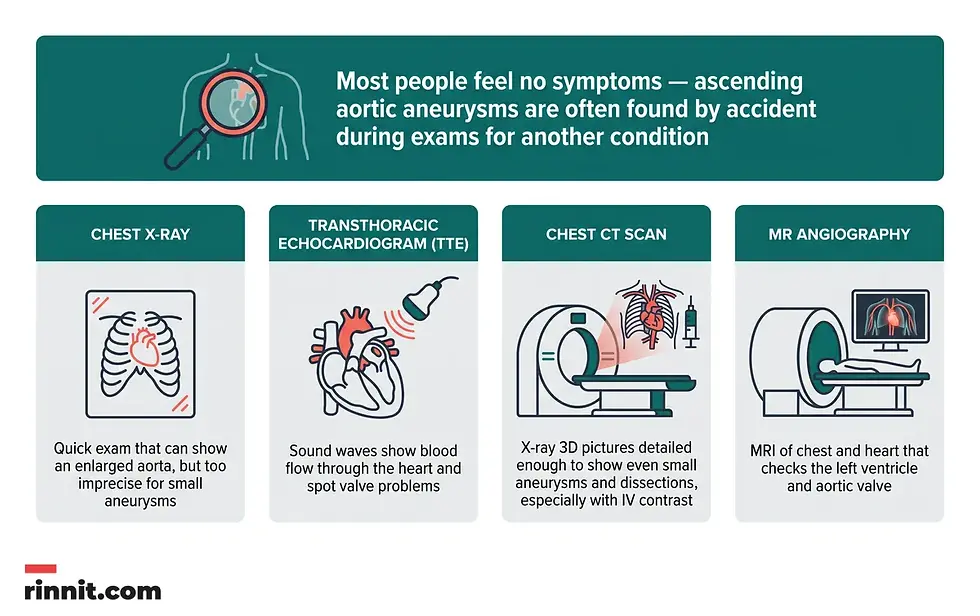
An ascending aortic aneurysm is often found by chance during an exam for another condition [1] [3], and providers then use imaging tests to learn more. They're often detected by chance during an exam for another health condition. Once a provider discovers a possible aneurysm, they use imaging tests to learn more about it:
Imaging test | What it shows |
Chest X-ray | A quick exam that can show an enlarged aorta, but it isn't detailed enough to show smaller aneurysms [1] |
Transthoracic echocardiogram (TTE) | Uses sound waves to show how blood flows through your heart [1] and can identify problems with your heart valves |
Chest CT scan | Uses X-rays to create 3D pictures of your chest; detailed enough to show even small aneurysms and dissections [1], particularly with IV contrast |
MR angiography | An MRI of the chest and heart that assesses how well your left ventricle and aortic valve are working [1] |
When is surgery needed?
Treatment depends on the aneurysm's size, rate of growth, and underlying cause.
Smaller than 5.5 centimeters: These aneurysms don't usually need surgery right away [1], unless you have additional risk factors such as a family history, a connective tissue disorder, or a bicuspid aortic valve [1]. Your provider may recommend:
Watchful-management step | What it involves |
Medications | |
Regular imaging | Exams about every six months to monitor the size, then every few years if the aneurysm isn't growing quickly [1] |
Lifestyle adjustments | Diet, exercise, and not smoking [1]. Ask your provider about safe, low-impact activities that won't put too much pressure on your arteries |
Larger than 5.5 centimeters: These aneurysms typically need surgery, but there are exceptions. [1] People with Marfan syndrome, a bicuspid aortic valve, or a family history of aneurysms may need surgery sooner. [1] Studies suggest these conditions make it more likely an aneurysm will rupture at a smaller size. [1] Your provider will make recommendations based on your individual needs. Also tell every prescriber that you have an aneurysm: the FDA warns that fluoroquinolone antibiotics, such as ciprofloxacin and levofloxacin, can raise the risk of an aortic aneurysm tearing or rupturing.
What does surgery involve?
During aneurysm repair surgery, the surgeon makes an incision (cut) in your chest to access the aorta. They remove the aneurysm bulge by cutting it out and, in its place, sew a graft, a tube made of a strong, synthetic material. [1] Depending on the location of the aneurysm, the surgeon may need to detach and reattach your two coronary arteries. [1] This type of open procedure requires cardiopulmonary bypass, a procedure where a machine takes over your heart and lung function during surgery. [1]
People with a bicuspid aortic valve or aortic valve disease may also have aortic valve surgery along with the aneurysm repair. [1] The surgeon uses a graft with an attached artificial aortic valve or can sometimes repair the bicuspid valve. Both open and minimally invasive surgeries require general anesthesia. [1]

What is the outlook?
Studies show that 79% of people who have elective (non-emergency) surgery for ascending aortic aneurysms survive for at least 10 years after treatment. [1] But the outlook is much worse if an aneurysm dissects or ruptures: about half of these people don't survive if they don't have emergency surgery within 48 hours. [1]
How can I prevent an ascending aortic aneurysm?
You can reduce your risk by:
When should I get emergency help?
Seek emergency help for an ascending aortic aneurysm if you cough up blood, have trouble breathing, feel sudden severe chest or upper back pain, or lose consciousness. [1]
What questions should I ask my doctor?
If you have an ascending aortic aneurysm, ask your doctor about its size, how fast it is growing, its chance of rupture and whether you need surgery.
How big is the aneurysm?
How can I reduce my risk of an aneurysm rupture?
Is the aneurysm getting larger? If so, how quickly is it growing?
What are the chances that the aneurysm will rupture?
Will I need surgery for the aneurysm?
What are the risks of aneurysm repair surgery?
What is the bottom line on ascending aortic aneurysms?
An ascending aortic aneurysm is a silent but serious condition: a bulging weak spot in the first part of the aorta, your body's main artery. Most people never feel it coming, which is why it's often found by accident. The risk profile is clear: older age, high blood pressure, smoking, heart disease, family history, and genetic or valve conditions such as Marfan syndrome or a bicuspid aortic valve.
The good news is that the decision point is well defined. Aneurysms under 5.5 centimeters are typically managed with blood pressure medication, imaging every six months, and lifestyle changes, while larger ones (or smaller ones in high-risk people) typically need surgery that removes the bulge and replaces it with a graft. Planned surgery has a strong track record, with 79% of elective surgery patients surviving at least 10 years. The message is simple: control your blood pressure, don't smoke, know your family history, and treat sudden severe chest or back pain, breathing trouble, or coughing up blood as an emergency.
Take the next step: If you're over 60, have high blood pressure, smoke, or know aortic aneurysms run in your family, talk to your healthcare provider about your risk, especially if you have a bicuspid aortic valve or a connective tissue disorder, since these raise the chance that a smaller aneurysm could rupture. If you've been diagnosed, stick to the imaging schedule, take your blood pressure medication exactly as prescribed, and know the emergency signs: coughing up blood, trouble breathing, and sudden severe chest or upper back pain mean call for help immediately. Early, planned treatment is the difference between a 10-year survival outlook and a race against a 48-hour clock.
Frequently Asked Questions
What is an ascending aortic aneurysm? An ascending aortic aneurysm is a bulging weak spot in the first part of the aorta, the main artery in your body. Because it sits in the chest, it's also called an ascending thoracic aortic aneurysm (ATAA). The bulge can tear or rupture and cause life-threatening internal bleeding.
Is it common? Ascending aortic aneurysms affect about 10 out of 100,000 people each year, and about 60% of all aneurysms in the thoracic (chest) aorta affect the ascending portion, making it the most common chest location.
What are the symptoms? Most people have no symptoms at all. When they do appear, watch for chest pain or pain high in the back, coughing or wheezing, difficulty swallowing, hoarseness, and shortness of breath.
What causes it? The aorta's wall becomes weak or damaged, often from aging and heart disease, which make the aorta less elastic, and blood pressure forces the weak spot to bulge outward. Aortitis, atherosclerosis, bicuspid aortic valve disease, Marfan syndrome, Loeys-Dietz syndrome, Turner syndrome, and trauma can also lead to aneurysms.
Who is at highest risk? Men over 60, women over 70, people with high blood pressure, smokers, people with heart disease, those with a family history of aortic aneurysms, and people with a bicuspid aortic valve or connective tissue disorders.
How is it diagnosed? Because it rarely causes symptoms, it's often found by chance. When suspected, doctors use a chest X-ray (can show a large aneurysm), a transthoracic echocardiogram (sound waves imaging blood flow and valves), a chest CT scan (3D images that catch even small aneurysms), and MR angiography (MRI assessing the left ventricle and aortic valve).
When do I need surgery? Aneurysms larger than 5.5 centimeters typically need surgery. Those with Marfan syndrome, a bicuspid aortic valve, or a family history may need surgery sooner, because their aneurysms are more likely to rupture at a smaller size.
What happens if my aneurysm is smaller than 5.5 centimeters? You'll usually be monitored with imaging about every six months (then every few years if it isn't growing quickly), take medications to manage blood pressure, and make lifestyle adjustments such as diet, exercise, and not smoking.
What does surgery involve? The surgeon cuts out the bulge through an incision in the chest and sews in a graft, a tube of strong synthetic material. Depending on location, the coronary arteries may need to be detached and reattached, and the procedure requires cardiopulmonary bypass, where a machine takes over heart and lung function. People with valve disease may also receive an artificial aortic valve or valve repair.
What is the outlook after surgery? Studies show 79% of people who have elective (non-emergency) surgery survive at least 10 years after treatment. But if an aneurysm dissects or ruptures, about half of those people don't survive without emergency surgery within 48 hours.
Can I prevent it? You can lower your risk by exercising, eating a healthy diet, managing your weight, blood pressure, and cholesterol, not smoking, and avoiding too much alcohol.
When should I call for emergency help? Call immediately for coughing up blood, difficulty breathing, sudden severe chest or upper back pain, or loss of consciousness, dizziness, or stroke symptoms.
Related Reading
Aortic Aneurysm: Types, Causes, Dissection Risk & Complete Guide - The broader family of aneurysms in the body's main artery, and how the ascending type fits in.
High Blood Pressure: Silent Symptoms, Serious Risks, and Proven Ways to Lower It - Why controlling blood pressure is the single most important step in aneurysm management.
Marfan Syndrome: Symptoms, Causes, and Management Strategies - The connective tissue disorder that raises aneurysm risk and may prompt earlier surgery.
Learn more in our guide to Angiogram: What It Shows, How It's Done, Risks and Recovery.
References
Cleveland Clinic. Ascending Aortic Aneurysm. Cleveland Clinic. Last updated October 14, 2021. https://my.clevelandclinic.org/health/diseases/21949-ascending-aortic-aneurysm
Isselbacher EM. Thoracic and abdominal aortic aneurysms. Circulation. 2005;111(6):816-28. PMID 15710776. https://doi.org/10.1161/01.CIR.0000154569.08857.7A
Farber MA, Parodi FE. Thoracic Aortic Aneurysms. Merck Manual Consumer Version. Last updated December 2024. https://www.merckmanuals.com/home/heart-and-blood-vessel-disorders/aneurysms-and-aortic-dissection/thoracic-aortic-aneurysms
Lavall D, et al. Aneurysms of the ascending aorta. Dtsch Arztebl Int. 2012;109(13):227-33. PMID 22532815. https://doi.org/10.3238/arztebl.2012.0227
Saliba E, et al. The ascending aortic aneurysm: When to intervene? Int J Cardiol Heart Vasc. 2015;6:91-100. PMID 38598654. https://doi.org/10.1016/j.ijcha.2015.01.009
Hardikar AA, et al. Surgical thresholds for bicuspid aortic valve associated aortopathy. JACC Cardiovasc Imaging. 2013;6(12):1311-20. PMID 24332283. https://doi.org/10.1016/j.jcmg.2013.10.005
Meccanici F, et al. Prevalence and development of aortic dilation and dissection in women with Turner syndrome: a systematic review and meta-analysis. Expert Rev Cardiovasc Ther. 2023;21(2):133-144. PMID 36688313. https://doi.org/10.1080/14779072.2023.2172403
Disclaimer
This guide is for general information only and is not a substitute for professional medical advice, diagnosis, or treatment. Seek emergency medical attention immediately for sudden, severe chest or back pain, difficulty breathing, coughing up blood, or loss of consciousness. Always seek the advice of a physician or other qualified health provider with any questions about a medical condition. Never disregard professional medical advice or delay seeking it because of something you have read here.



Comments