Transcatheter Pulmonary Valve Replacement (TPVR): Procedure, Recovery and Risks

Updated: 6 days ago
Written and medically reviewed by Dr. Baraa Alnahhal, MD · Last reviewed: October 2026 · How we review
Quick Answer: What is transcatheter pulmonary valve replacement?
Transcatheter pulmonary valve replacement (TPVR) is a minimally invasive procedure that replaces a narrowed or leaky pulmonary valve using a catheter passed through a vein in the groin or neck, without opening the chest. It mostly helps people born with congenital heart disease, takes two to three hours, and usually needs only one night in hospital. [1]
What the research says
TPVR matches surgery on early survival and shortens hospital stays. A meta-analysis comparing TPVR with surgical pulmonary valve replacement found no significant difference in early deaths (0.2% vs. 1.2%), while TPVR led to fewer procedure-related complications and shorter hospital stays. (Ribeiro et al., Annals of Thoracic Surgery, 2020) [2]
Lower long-term mortality, but a higher risk of valve infection. A review of 28 studies with 16,150 patients found TPVR lowered the risk of death by 36% over follow-up compared with surgery, but carried about three times the odds of infective endocarditis. (Chongmelaxme et al., PLoS One, 2025) [3]
Ten-year results are durable for most patients. In a US multicenter trial of 150 people (median age 19) who received a transcatheter pulmonary valve, 90% were alive, 79% had avoided reoperation and 60% had avoided any repeat procedure at 10 years. (Jones et al., Circulation: Cardiovascular Interventions, 2022) [4]
Key takeaways
TPVR places a new pulmonary valve inside the old, failing one through a vein, so the chest bone is not cut and no heart-lung machine is needed. [1]
The most common reason for TPVR is failure of a donor (homograft) pulmonary valve placed during childhood heart surgery. [1]
Most procedures take two to three hours, most people go home the next morning, and most return to their routine in about seven days. [1]
Compared with open-heart surgery, TPVR means less recovery time, a shorter hospital stay, smaller scars and a lower risk of wound infection. [1]
The new valve can wear out over time, and a repeat TPVR is possible if needed. [1]
Studies link TPVR to a higher risk of valve infection (endocarditis) than surgery, so dental precautions and follow-up visits matter. [2][3]
What is transcatheter pulmonary valve replacement?
Transcatheter pulmonary valve replacement is a procedure that replaces a failing pulmonary valve through tiny skin openings in the groin instead of through an open chest. [1]
The pulmonary valve controls blood flow from the heart's right side to the lungs. When it narrows or leaks, the right side of the heart has to work harder. [1]
During TPVR, the new valve travels from a leg vein up to the heart under X-ray guidance and is set in place inside the old valve. This restores blood flow to the lungs, eases strain on the heart and delivers more oxygen to the body. [1]
An interventional cardiologist who specializes in congenital heart disease performs the procedure in a pediatric or adult congenital cardiac catheterization lab, usually inside a hospital. [1]
Why does the pulmonary valve stop working properly?
The pulmonary valve stops working properly when it becomes too narrow (stenosis) or does not close fully (regurgitation). Both problems strain the right ventricle and can lead to right-sided heart failure. [1]
Problem | What happens | Effect on the heart |
Pulmonary stenosis | The valve is narrow and limits blood flow from the heart to the lungs | Puts strain on the right side of the heart; may cause right ventricle failure |
Pulmonary regurgitation | The valve does not close properly, so blood leaks backward into the heart | Reduces forward blood flow; may cause right ventricle failure |
Both conditions can cause:
Shortness of breath (dyspnea)
Swelling in the abdomen and legs (edema)
Chest pain
Palpitations
These symptoms come from heart failure or abnormal heart rhythms (arrhythmias), and they can improve after TPVR. [1]
Who is a good candidate for TPVR?
People born with congenital heart disease that affects the pulmonary valve are the main candidates for TPVR. [1]
Many of these patients had surgery in childhood to repair or replace the pulmonary valve. Surgeons often used a homograft (also called an allograft), which is a pulmonary valve from a donated human heart. [1]
Homografts can fail over time, causing stenosis or regurgitation in early adulthood. Homograft failure is the most common reason a heart team considers TPVR. [1]
People who had the Ross procedure for aortic stenosis can also develop pulmonary valve failure later and may benefit from TPVR. [1]
TPVR is offered instead of open-heart surgery to some, not all, people with a failing pulmonary valve. Your heart team will weigh the pros and cons of each option with you. [1]
Which heart conditions can TPVR help treat?
TPVR can improve blood flow through the heart in people with a history of these conditions: [1]
Condition | What it means |
Pulmonary atresia | A baby is born without a normal pulmonary valve, so blood cannot flow from the right ventricle into the pulmonary artery |
Regurgitant pulmonary valve | A valve disease in which blood flows backward into the right ventricle |
Tetralogy of Fallot | A combination of four heart defects that causes blood entering and leaving the heart to mix |
Truncus arteriosus | The aorta and pulmonary artery stay joined after birth, so one vessel leaves the heart instead of two |
Transposition of the great arteries | The aorta and pulmonary artery are reversed, attached to opposite sides of the heart |
For more on how these defects are found and treated early in life, see our guide to congenital heart defects in children.
How is TPVR different from open-heart pulmonary valve surgery?
TPVR replaces the pulmonary valve through a vein, while open-heart surgery reaches the valve by cutting through the chest bone and placing the patient on a heart-lung bypass machine. [1]
In surgery, the surgeon removes the failing valve and sews in a new one. Recovery takes longer, and for some people surgery is too risky. [1]

Feature | TPVR | Open-heart surgery |
How the valve is reached | Tiny incisions in the groin (or neck) vein | Chest bone is cut open |
Heart-lung bypass machine | Not needed | Needed |
Old valve | New valve placed inside it | Removed and replaced |
Hospital stay | Usually one night | Longer |
Return to routine | About 7 days in most cases | Longer |
Valve can wear out | Yes; repeat TPVR is possible | Yes; may need repeat surgery |
Overall, people with congenital heart disease who have TPVR may recover faster and need fewer surgeries over their lifetime. [1] The procedure follows the same catheter-based approach used for other heart valve replacements and for closing holes in the heart.
How do you prepare for TPVR?
Preparing for TPVR starts with a physical examination and an exercise stress test to check your overall health and heart function. [1]
Your heart team may also order:
Angiogram
Cardiac CT scan
Heart MRI
Echocardiogram
Electrocardiogram (EKG)
Based on these results, your provider may recommend TPVR or suggest monitoring your heart over time (watchful waiting). [1]
Before the procedure, you will get instructions on:
When to stop eating and drinking
What to wear on the day
Which medicines to stop or adjust
Tell your provider about any allergies and every medicine or supplement you take, especially blood thinners (anticoagulants) and nonsteroidal anti-inflammatory drugs (NSAIDs). [1]
What happens during a TPVR procedure?
A TPVR procedure places a new valve inside the old pulmonary valve through a catheter while you are under anesthesia, so you do not feel pain. [1]
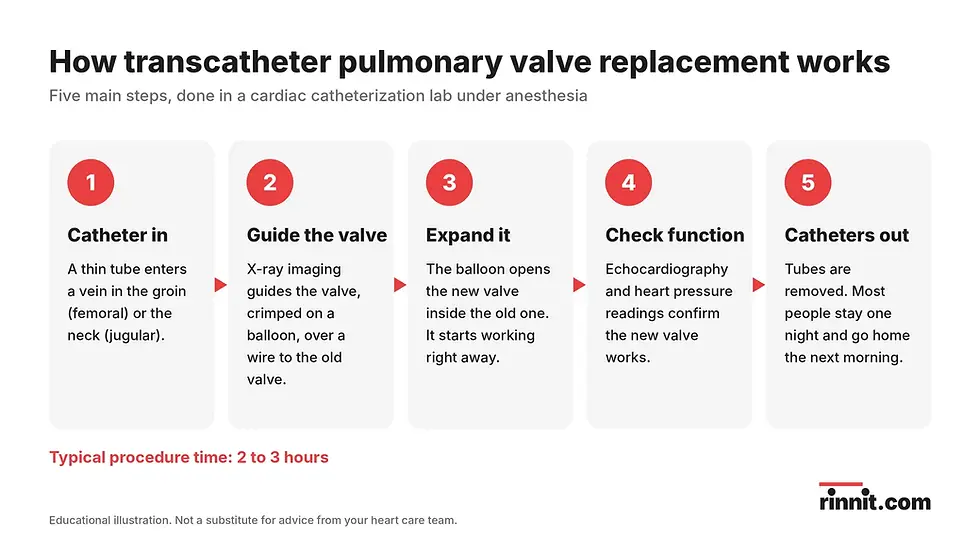
Your cardiologist:
Inserts a catheter. A thin, hollow tube goes in through the femoral vein in the groin or the jugular vein in the neck.
Guides the valve into place. Using fluoroscopy and angiography, the team moves the valve over a wire to its position inside the existing valve. The valve is crimped onto a balloon so it can travel easily through the veins.
Expands the valve. The balloon opens the new valve, which starts controlling blood flow right away.
Checks how well it works. Intracardiac or transesophageal echocardiography assesses the valve, and pressures inside the heart are measured before and after to confirm the heart is under less strain.
Removes the catheters. [1]
Most transcatheter pulmonary valve replacements take two to three hours. [1]
What is recovery like after TPVR?
Recovery after TPVR is short: you stay overnight for observation, go home the next morning and, in most cases, return to your routine within seven days. [1]

Stage | What to expect |
Before | Physical exam, stress test and imaging tests |
Procedure day | Anesthesia; procedure lasts 2–3 hours |
First night | Overnight observation in hospital |
Next morning | Discharge home with care instructions |
About 7 days | Back to your usual routine in most cases |
Pain, bruising or swelling at the catheter insertion site is common. Follow your discharge instructions closely and ask your heart team about anything you are unsure of. [1] Some people may also benefit from a structured cardiac rehab program; ask your care team whether it fits your situation.
What are the benefits of TPVR?
The main benefits of TPVR compared with open-heart surgery are: [1]
Less recovery time
Lower risk of wound infection (but a higher risk of valve infection)
Shorter hospital stay
Smaller incisions and scars
Replacing a failing pulmonary valve can have a major impact on lifespan and quality of life, and TPVR may delay or avoid repeat open-heart surgeries. [1]
What are the risks of TPVR?
The risks of TPVR include blood clots, blood vessel damage, bleeding, fever, valve infection and irregular heartbeat. [1]
Possible complication | Plain-language meaning |
Blood clot | A clump of blood that can block a vessel |
Blood vessel damage | Injury to the vein used for the catheter |
Fever | Raised body temperature after the procedure |
Pulmonary hypertension | High blood pressure in the lung arteries |
Endocarditis | Infection of the heart lining or valve |
Arrhythmia | Irregular heartbeat |
Unexpected bleeding | Bleeding at the access site or inside the body |
Rarely, TPVR can lead to a heart attack, stroke or death. [1]
Research adds one important point: across large reviews, infective endocarditis was more common after TPVR than after surgery (5.8% vs. 2.7% in one analysis). [2][3] This is why dental precautions and regular follow-up are part of life with a transcatheter valve. Learn more about pulmonary hypertension and how it affects the right side of the heart.
How long does a transcatheter pulmonary valve last?
How long a transcatheter pulmonary valve lasts depends on many factors, including your heart and overall health. [1]
Like surgically placed valves, a transcatheter valve can wear out, and some people need another procedure later. A repeat TPVR is possible if needed. [1]
In a US trial that followed patients for a median of 8.4 years, 53% still had a fully working valve at 10 years, and valves lasted longer in adults than in children. [4]
How common is TPVR?
Transcatheter heart valve procedures, which include TPVR, are common: more than 91,000 were performed in the United States in 2020. [1]
The first successful TPVR in a person was performed in 2000 by a French cardiologist, in a 12-year-old boy whose prosthetic heart conduit had narrowed and leaked. [1][5] Since then, thousands of these procedures have been performed, and as of 2022, three types of transcatheter pulmonary valves were approved by the US Food and Drug Administration (FDA). [1]
When should you call your doctor after TPVR?
You should contact your doctor after TPVR if you develop an unexplained fever, pain or any other new symptoms. [1]
Keep all follow-up appointments, because close monitoring helps catch valve wear or infection early. [1]
Can you fly, have an MRI or see a dentist after TPVR?
People who have had TPVR can safely go through airport security and have X-rays. [1]
Conclusion
Transcatheter pulmonary valve replacement gives many people born with congenital heart disease a way to fix a failing pulmonary valve without opening the chest. It takes a few hours, usually means just one night in hospital and allows most people to get back to normal life within a week. [1]
TPVR is not right for everyone, and the new valve may eventually need replacing. Research shows it performs as well as surgery for survival, with shorter hospital stays, but it carries a higher risk of valve infection. [2][3] A heart team experienced in congenital heart disease is the best guide to which option fits you.
Want to understand your heart better? Explore our congenital heart disease guide and our full library of evidence-based heart health articles, and bring your questions to your next cardiology visit.
FAQ
Is TPVR considered open-heart surgery?
TPVR is not open-heart surgery. The new valve is placed through a catheter inserted into a vein in the groin or neck, so the chest bone is not cut and no heart-lung bypass machine is used. [1]
How long does a TPVR procedure take?
Most TPVR procedures take two to three hours. You receive anesthesia before the procedure begins, so you do not feel pain. [1]
How long is the hospital stay after TPVR?
Most people stay one night in hospital after TPVR and go home the following morning. In most cases, people return to their routine within seven days. [1]
Who needs transcatheter pulmonary valve replacement?
TPVR is mainly for people born with congenital heart disease whose pulmonary valve has become narrow or leaky, often after childhood heart surgery. Failure of a donor (homograft) pulmonary valve is the most common reason. [1]
What are the main risks of TPVR?
The main risks of TPVR are blood clots, blood vessel damage, bleeding, fever, irregular heartbeat, pulmonary hypertension and valve infection (endocarditis). Heart attack, stroke and death are rare. [1]
Can a transcatheter pulmonary valve be replaced again?
A transcatheter pulmonary valve can be replaced again if it wears out. A repeat TPVR is possible, and your heart team will monitor the valve over time. [1]
Is it safe to go through airport security after TPVR?
Airport security and X-rays are safe after TPVR. Talk to your healthcare provider before having an MRI. [1]
Do I need antibiotics before dental work after TPVR?
Tell your dentist about your pulmonary valve before any dental procedure, because dental work can release bacteria into the blood and cause infection. You may need to take medicine before the appointment. [1]
How long does a transcatheter pulmonary valve last?
It depends on your heart and overall health, and valves tend to last longer in adults than in children. In one long-term U.S. study, 53% of patients still had a fully working valve at 10 years.
Can I have an MRI after TPVR?
Talk to your healthcare provider before any MRI scan, and tell the MRI team that you have a heart valve. Carry your valve implant card if you were given one.
Related Reading
Tetralogy of Fallot: A Parent's Guide to the Heart Condition Babies Are Born With — Symptoms, Diagnosis, and Surgery explains a congenital heart defect that often leads to TPVR later in life.
Pulmonary Valve Disease: Complete Guide to Symptoms, Causes, and Treatment covers the pulmonary valve problems that TPVR is used to treat.
Pulmonary Valve Stenosis: Complete Guide to Symptoms, Causes, Diagnosis, and Treatment explains a narrowed pulmonary valve and its treatment options.
Adult Congenital Heart Disease: What It Is, How It's Diagnosed, and Why Lifelong Follow-Up Matters describes lifelong care for adults born with heart defects.
References
Cleveland Clinic. Transcatheter Pulmonary Valve Replacement (TPVR). Cleveland Clinic. Last updated September 6, 2022. https://my.clevelandclinic.org/health/treatments/17571-transcatheter-pulmonary-valve-replacement-tpvr
Ribeiro JM, Teixeira R, Lopes J, et al. Transcatheter Versus Surgical Pulmonary Valve Replacement: A Systemic Review and Meta-Analysis. Ann Thorac Surg. 2020;110(5):1751-1761. PMID 32268142. https://doi.org/10.1016/j.athoracsur.2020.03.007
Chongmelaxme B, Kua KP, Amornvetchayakul C, et al. Comparative effects of transcatheter versus surgical pulmonary valve replacement: A systematic review and meta-analysis. PLoS One. 2025;20(5):e0322041. PMID 40392782. https://doi.org/10.1371/journal.pone.0322041
Jones TK, McElhinney DB, Vincent JA, et al. Long-Term Outcomes After Melody Transcatheter Pulmonary Valve Replacement in the US Investigational Device Exemption Trial. Circ Cardiovasc Interv. 2022;15(1):e010852. PMID 34930015. https://doi.org/10.1161/CIRCINTERVENTIONS.121.010852
Bonhoeffer P, Boudjemline Y, Saliba Z, et al. Percutaneous replacement of pulmonary valve in a right-ventricle to pulmonary-artery prosthetic conduit with valve dysfunction. Lancet. 2000;356(9239):1403-1405. PMID 11052583. https://doi.org/10.1016/S0140-6736(00)02844-0
Medical disclaimer
This article is for educational purposes only and does not replace professional medical advice, diagnosis or treatment. Always talk to a qualified healthcare provider about your own heart condition and treatment options. If you have chest pain, severe shortness of breath or fainting, seek emergency care right away.



Comments