Pulmonary Arteries: Anatomy, Function, Conditions and Care

Updated: 2 days ago
Medically reviewed by Dr. Baraa Alnahhal, MD · Last reviewed: October 2026
Quick Answer: What are the pulmonary arteries?
The pulmonary arteries are blood vessels that carry oxygen-poor blood from the right ventricle of the heart to the lungs. The main pulmonary artery splits into right and left branches, which lead to the lungs so blood can receive oxygen and release carbon dioxide. [1]
Core idea | Plain-language meaning |
Blood carried | Oxygen-poor, or deoxygenated, blood. |
Starting point | The right ventricle, through the pulmonary valve. |
Main vessel | One pulmonary trunk, or main pulmonary artery. |
Main branches | Right and left pulmonary arteries. |
Destination | The right and left lungs. |
Key purpose | Bring blood to the lungs for gas exchange. |
Special feature | They are the only arteries that carry oxygen-poor blood. |

What the research says
Normal main pulmonary artery size has been mapped with large CT studies. In 3,171 adults from the Framingham Heart Study (mean age 51), the mean main pulmonary artery diameter was 25.1 mm. The authors set 29 mm in men and 27 mm in women as upper normal reference values, and a diameter above the sex-specific 90th percentile (28.9 mm in men, 26.9 mm in women) was associated with more self-reported shortness of breath (adjusted odds ratio 1.31). The reference value for the pulmonary artery-to-aorta ratio was 0.9 (Truong et al., Circ Cardiovasc Imaging, 2012). [2]
An enlarged pulmonary artery on CT is linked to flare-ups of COPD. In a multicenter study of current and former smokers with COPD, a pulmonary artery-to-aorta ratio above 1 was associated with a history of severe exacerbations (odds ratio 4.78, 95% CI 3.43–6.65). It also independently predicted future severe exacerbations in the trial cohort (OR 3.44, 95% CI 2.78–4.25) and in an external validation cohort (OR 2.80, 95% CI 2.11–3.71) (Wells et al., N Engl J Med, 2012). [3]
Pulmonary hypertension is a substantial global health issue. A review estimates a prevalence of about 1% of the global population, rising to up to 10% in people older than 65. Left-sided heart and lung diseases are now the most frequent causes in almost all parts of the world, and about 80% of affected people live in developing countries (Hoeper et al., Lancet Respir Med, 2016). [4]
What are the pulmonary arteries?
Pulmonary arteries are blood vessels that carry oxygen-poor blood from the right side of the heart to the lungs. In medical language, “pulmonary” refers to something affecting the lungs. [1]
One main pulmonary artery, also called the pulmonary trunk, connects to the right ventricle at the pulmonary valve. After leaving the heart, it divides into right and left pulmonary arteries that lead to the corresponding lungs. If the valve itself is affected, see our guide to pulmonary valve disease. [1]
The main pulmonary artery is one of the heart’s great vessels. The main pulmonary artery and the aorta both carry blood out of the heart, but the pulmonary artery carries oxygen-poor blood while the aorta carries oxygen-rich blood. [1]
What do the pulmonary arteries do?
The pulmonary arteries deliver oxygen-poor blood to the lungs. Blood needs to reach the lungs to gain oxygen and remove waste products such as carbon dioxide. [1]
After gas exchange, oxygen-rich blood returns to the heart and is pumped to the rest of the body. [1]
Pulmonary-artery role | Why it matters |
Carries oxygen-poor blood | Brings blood to the lungs for oxygen uptake. |
Supports gas exchange | Helps blood gain oxygen and release carbon dioxide. |
Connects heart and lungs | Forms a central part of the pulmonary circuit. |
Starts the next circulation step | Oxygen-rich blood returns to the left heart and then enters the systemic circuit. |
How does the pulmonary circuit work?
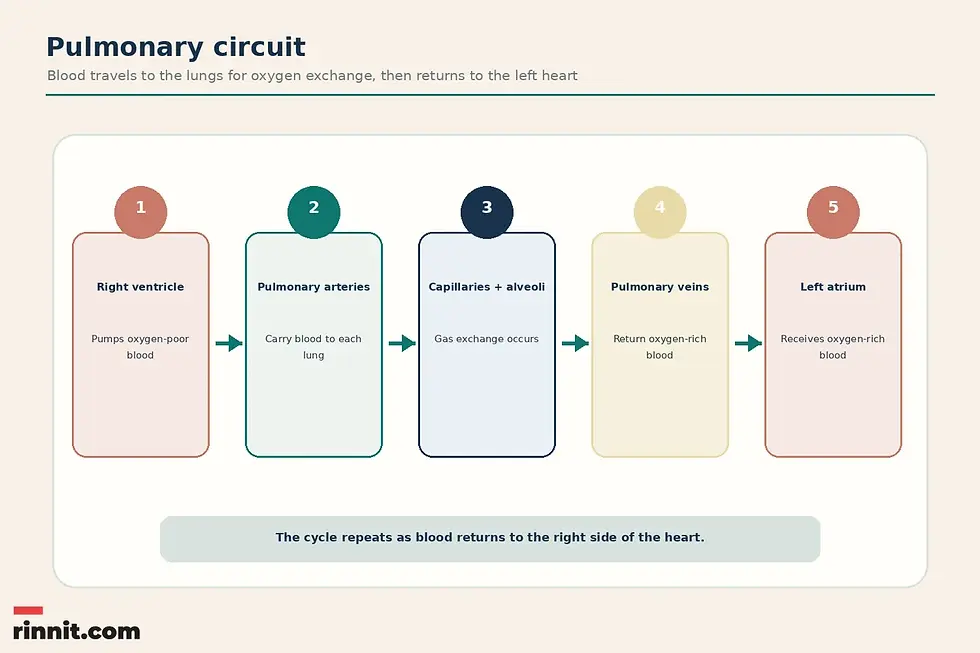
The pulmonary circuit is the network of blood vessels that moves blood between the heart and lungs. Its parts work together to supply oxygen to blood and remove waste products. It is one half of the wider circulatory system. [1]
1. Right ventricle: The bottom-right heart chamber pumps oxygen-poor blood through the pulmonary valve into the main pulmonary artery. [1]
2. Pulmonary trunk: The main pulmonary artery exits the heart and divides into right and left branches. [1]
3. Right and left pulmonary arteries: Each branch travels to its corresponding lung and divides into smaller vessels. [1]
4. Capillaries and alveoli: Smaller vessels lead to capillaries around the alveoli, or air sacs, where gas exchange occurs. [1]
5. Pulmonary veins: These vessels carry oxygen-rich blood from the lungs to the left atrium. [1]
6. Left heart: The left atrium sends blood to the left ventricle, which pumps it through the aortic valve and into the aorta. [1]
7. Systemic circuit: After oxygen is delivered to tissues, blood returns to the right atrium and then the right ventricle, beginning the pulmonary circuit again. [1]
Where are the pulmonary arteries located?
The pulmonary arteries are in the chest cavity. The pulmonary trunk connects to the right ventricle at the pulmonary valve near the front of the heart. [1]
It travels upward along the left side of the ascending aorta. Beneath the aortic arch, it divides into the right and left pulmonary arteries, which then travel to the lungs. [1]
How large are the pulmonary arteries?
The main pulmonary artery is usually around 5 centimeters long. Reported diameters depend on the population and how they are measured. A large CT study of 3,171 adults found a mean diameter of 25.1 millimeters (about 2.5 centimeters) and proposed upper normal values of 27 millimeters in women and 29 millimeters in men. [2] [1]
These figures describe populations. They are not a personal measurement or a diagnostic cutoff.
What are the pulmonary-artery walls made of?
Like other large and medium-sized arteries, pulmonary-artery walls have three layers. [1]
Layer | Role |
Tunica intima | Smooth inner layer. |
Tunica media | Middle layer that pushes blood through. |
Tunica adventitia | Protective outer layer. |
What conditions can affect the pulmonary arteries?
Congenital heart defects are the most common problems affecting the pulmonary arteries. These conditions are present at birth. [1]
Congenital heart conditions
Named congenital conditions include double outlet right ventricle, patent ductus arteriosus, pulmonary atresia, pulmonary artery stenosis, pulmonary valve stenosis, tetralogy of Fallot, transposition of the great arteries and truncus arteriosus. [1]
Adult-related conditions
Conditions that can affect adults’ pulmonary arteries include pulmonary embolism, pulmonary hypertension, pulmonary valve regurgitation and heart failure. Other listed conditions include cirrhosis, sickle cell anemia, scleroderma, obstructive sleep apnea, obesity, sarcoidosis, chronic obstructive pulmonary disease, interstitial lung disease and lupus. [1]
Category | Examples |
Present at birth | Double outlet right ventricle, patent ductus arteriosus, pulmonary atresia, pulmonary artery stenosis, pulmonary valve stenosis, tetralogy of Fallot, transposition of the great arteries and truncus arteriosus. |
Circulatory or heart-related | Pulmonary embolism, pulmonary hypertension, pulmonary-valve regurgitation and heart failure. |
Lung-related | Chronic obstructive pulmonary disease, obstructive sleep apnea and interstitial lung disease. |
Systemic or inflammatory | Cirrhosis, sickle cell anemia, scleroderma, sarcoidosis and lupus. |
Other listed factor | Obesity. |
What is pulmonary hypertension?
Pulmonary hypertension is one of the conditions that can affect the pulmonary arteries. Managing certain diseases well can help prevent it from developing, including chronic obstructive pulmonary disease, obstructive sleep apnea and heart failure. [1]
This article does not define a person’s cause, severity or treatment. A healthcare professional should interpret symptoms, examination findings and any test results together. For a full overview, read our pulmonary hypertension guide and our guide to pulmonary arterial hypertension.
What symptoms should you discuss with a healthcare professional?
Symptoms to discuss about the pulmonary arteries include bluish lips or skin, chest pain, coughing up blood, fainting, irregular heartbeat, shortness of breath and swelling. [1]
Bluish lips or skin
Chest pain, tightness or discomfort
Coughing up blood
Dizziness or fainting
Irregular heartbeat
Nausea and vomiting
Rapid pulse
Shortness of breath
Swollen ankles, feet or abdomen
Symptoms can have many causes. An online guide cannot identify whether a symptom involves the pulmonary arteries, heart, lungs or another system.
How can you support heart and pulmonary-artery health?
Many pulmonary-artery conditions are present at birth and cannot be prevented. Managing certain diseases well and following general heart-healthy habits can support the cardiovascular system. [1]
These general actions include avoiding smoking, vaping and tobacco products; eating a heart-healthy diet with fresh fruits and vegetables; getting at least 150 minutes, or 2.5 hours, of cardiovascular physical activity each week; keeping a weight that is healthy for you; and managing diabetes, high blood pressure and high cholesterol. [1]
General action | Context |
Avoid smoking, vaping and tobacco | A healthcare provider can offer quitting resources. |
Eat a heart-healthy diet | Include plenty of fresh fruits and vegetables. |
Be physically active | At least 150 minutes of cardiovascular activity each week. |
Maintain a personally healthy weight | Weight goals should be individualized. |
Manage related conditions | Diabetes, high blood pressure and high cholesterol. |
Manage COPD, sleep apnea and heart failure | These are conditions to manage well in relation to pulmonary hypertension risk. |
These are general educational points, not a personalized prevention or exercise prescription. Ask a healthcare professional what is appropriate for your health and abilities.

When should pulmonary-artery symptoms be assessed?
Contact a healthcare professional for bluish lips or skin, chest discomfort, coughing up blood, dizziness or fainting, an irregular heartbeat, nausea or vomiting, a rapid pulse, shortness of breath or swelling in the ankles, feet or abdomen.
Call emergency services (911 in the US) right away for sudden chest pain, sudden or severe shortness of breath, coughing up blood, fainting or bluish lips or skin, which can be signs of a pulmonary embolism. Chest pain, significant breathing difficulty, fainting or coughing up blood should not be evaluated by an online article alone.
Conclusion: pulmonary arteries connect the heart and lungs
Pulmonary arteries have a distinctive role: they carry oxygen-poor blood from the right ventricle to the lungs. The pulmonary trunk divides into right and left branches, which lead to smaller vessels around the alveoli for gas exchange. [1]
The pulmonary circuit then returns oxygen-rich blood through the pulmonary veins to the left side of the heart. From there, blood enters the systemic circulation and eventually returns to the right side of the heart. [1]
Congenital heart defects, pulmonary embolism, pulmonary hypertension, heart failure, lung disease and systemic conditions can affect this circulation. Warning symptoms deserve professional attention, while general heart-health habits may support the cardiovascular system. [1]
Use this guide to prepare questions for a qualified healthcare professional. Understanding pulmonary-artery anatomy is a starting point for informed care, not a diagnosis. [1]
Frequently Asked Questions
What do the pulmonary arteries carry?
They carry oxygen-poor blood from the right side of the heart to the lungs.
Are pulmonary arteries really arteries if they carry oxygen-poor blood?
Yes. They are arteries because they carry blood away from the heart. They are unusual because they are the only arteries in the body that carry oxygen-poor blood.
Where do the pulmonary arteries start?
The main pulmonary artery starts at the right ventricle, where it exits through the pulmonary valve.
What is the pulmonary trunk?
The pulmonary trunk is another name for the main pulmonary artery. It divides into right and left pulmonary arteries.
Which artery goes to the right lung?
The right pulmonary artery travels to the right lung. The left pulmonary artery travels to the left lung.
What is the role of the pulmonary arteries in gas exchange?
They bring oxygen-poor blood to smaller vessels and capillaries around the alveoli, where blood gains oxygen and releases carbon dioxide.
What do the pulmonary veins do?
Pulmonary veins carry oxygen-rich blood from the lungs to the left atrium. They move blood in the opposite direction from the pulmonary arteries.
What is the pulmonary circuit?
It is the network of vessels that moves blood between the heart and lungs for oxygen uptake and carbon-dioxide removal.
How long is the main pulmonary artery?
It is usually around 5 centimeters long.
What is the average diameter of the main pulmonary artery?
Reported values vary by population and method. A large CT study found a mean of 25.1 millimeters (about 2.5 centimeters), with upper reference values of 27 millimeters in women and 29 millimeters in men. These are population figures, not personal diagnostic cutoffs.
What are the three layers of a pulmonary artery?
The tunica intima is the smooth inner layer, the tunica media is the middle layer that pushes blood through and the tunica adventitia is the protective outer layer.
What conditions affect pulmonary arteries?
Congenital heart defects, pulmonary embolism, pulmonary hypertension, pulmonary-valve regurgitation, heart failure and several lung and systemic diseases.
Can pulmonary arteries be affected by conditions present at birth?
Yes. Congenital heart defects are the most common pulmonary-artery problems, and several examples are listed above.
What are symptoms of a pulmonary-artery problem?
Symptoms can include bluish lips or skin, chest pain or tightness, coughing up blood, dizziness or fainting, irregular heartbeat, nausea and vomiting, rapid pulse, shortness of breath and swelling.
How can I support pulmonary-artery health?
Avoid tobacco, eat a heart-healthy diet, get at least 150 minutes of cardiovascular activity weekly, keep a personally healthy weight and manage conditions such as diabetes, high blood pressure and high cholesterol.
Can lifestyle habits prevent congenital pulmonary-artery conditions?
No. Conditions present at birth cannot be prevented by lifestyle habits. They differ from other diseases that can be managed to help reduce pulmonary-hypertension risk.
When should I contact a healthcare professional?
Contact a healthcare professional for bluish lips or skin, chest pain, coughing up blood, dizziness or fainting, irregular heartbeat, rapid pulse, shortness of breath, nausea and vomiting or swelling.
Related reading
The Circulatory System: Your Body’s Life-Sustaining Transport Network
Pulmonary Valve Disease: Complete Guide to Symptoms, Causes, and Treatment
Pulmonary Hypertension: Complete Guide to Symptoms, Causes, Diagnosis, and Treatment
Pulmonary Embolism Guide: Symptoms, Causes, Diagnosis, and Treatment
Congestive Heart Failure: Symptoms, Stages, and How It’s Treated
What Is Chronic Obstructive Pulmonary Disease (COPD)? Symptoms, Causes, Stages, and Treatment
Sickle Cell Anemia: Symptoms, Causes, Treatment & Complete Guide
References
Cleveland Clinic. Pulmonary Arteries: What They Are & What They Do. Cleveland Clinic. Updated October 29, 2022. https://my.clevelandclinic.org/health/body/21486-pulmonary-arteries
Truong QA, Massaro JM, Rogers IS, et al. Reference values for normal pulmonary artery dimensions by noncontrast cardiac computed tomography: the Framingham Heart Study. Circ Cardiovasc Imaging. 2012;5(1):147-154. PMID 22178898. https://doi.org/10.1161/CIRCIMAGING.111.968610
Wells JM, Washko GR, Han MK, et al. Pulmonary arterial enlargement and acute exacerbations of COPD. N Engl J Med. 2012;367(10):913-921. PMID 22938715. https://doi.org/10.1056/NEJMoa1203830
Hoeper MM, Humbert M, Souza R, et al. A global view of pulmonary hypertension. Lancet Respir Med. 2016;4(4):306-322. PMID 26975810. https://doi.org/10.1016/S2213-2600(15)00543-3
Medical disclaimer
This article is for general educational purposes and is not a substitute for professional medical advice, diagnosis or treatment. Always seek the advice of a qualified healthcare professional with any questions about a medical condition or treatment.



Comments