Congenital Heart Defects in Children: Symptoms, Causes, and Treatment

Updated: 4 hours ago
Medically reviewed by Dr. Baraa Alnahhal, MD · Last reviewed: October 2026
TL;DR
A congenital heart defect is a heart structure problem present at birth, caused by changes that occur while the heart forms during the first six weeks of pregnancy. Most babies show no warning signs at all. Serious cases cause bluish skin, rapid breathing, and poor feeding in the first weeks of life, while milder cases may not appear until childhood as easy fatigue or fainting during exercise. The exact cause is usually unknown, but several pregnancy risk factors are known. Treatment ranges from watchful waiting to medicines, catheter procedures, surgery, and, in rare cases, transplant — and most children can participate in sports and live full lives with proper follow-up care.
Quick answer
What is a congenital heart defect? A problem with the structure of the heart that a child is born with. It affects at least 8 in every 1,000 babies born in the US each year. [1]
How does it happen? The defect begins in the first six weeks of pregnancy, when the baby's heart is forming and starting to beat. The exact cause of most defects is unknown, but gene changes, certain medicines, and factors like smoking during pregnancy may play a role. [1]
What are the signs? Serious defects show up soon after birth as bluish lips, tongue, or nails, rapid breathing, and shortness of breath during feedings that leads to poor weight gain. Milder defects may not appear until later, as easy fatigue or fainting during exercise. [1]
Can it be treated? Yes. Many defects need no treatment or close on their own as a child grows. Serious defects are treated with medicines, heart procedures done through a small tube (cardiac catheterization), open-heart or minimally invasive surgery, and, rarely, a heart transplant. [2]
What the research says
According to PubMed:
Congenital heart defects are common worldwide, and more are being found. A systematic review and meta-analysis of 260 studies covering 130,758,851 live births found that the birth prevalence of congenital heart defects rose to 9.410 per 1,000 (95% CI 8.602 to 10.253) in 2010 to 2017. Milder defects (ventricular septal defect, atrial septal defect, and patent ductus arteriosus) explained 93.4% of the rise, consistent with better detection of less severe defects. (Liu et al., DOI).
Pulse oximetry screening helps catch critical defects in newborns. A Cochrane review of 21 studies with 457,202 participants found that pulse oximetry detected critical congenital heart defects with a sensitivity of 76.3% (95% CI 69.5 to 82.0) and a specificity of 99.9% (95% CI 99.7 to 99.9), with a false-positive rate of 0.14%. Out of 10,000 apparently healthy newborns, about six have a critical defect, and screening detects five of them. (Plana et al., DOI).
Physical activity programs appear safe for people with congenital heart disease. A Cochrane review of 15 randomized trials with 924 participants (5 trials in children and adolescents) found no serious adverse events related to the physical activity interventions and no deaths (moderate-certainty evidence), although the authors noted that more high-quality trials are needed. (Williams et al., DOI).
Study details are from PubMed abstracts.
What does "congenital heart defect" actually mean?
A congenital heart defect (CHD) is a problem with the structure of the heart that a child is born with. The word "congenital" simply means the problem was present at birth. It is one of the most common birth defects: at least 8 out of every 1,000 infants born in the United States each year have a heart defect. That is roughly 40,000 babies annually. [1] [2]
Hearing the word "heart defect" in connection with your child is frightening. The good news is that the majority of these defects can be fixed, often with one procedure alone, and most children go on to live productive, normal, or near-normal lives. [3] Some defects are simple and need no treatment at all. Others are more complex and may require several surgeries over a period of years.
A congenital heart defect affects the heart's structure. It can involve the arteries, the valves, the chambers, or the wall that separates the chambers. Depending on the type and severity, the defect can change how blood and oxygen flow to the lungs and body, cause heart rhythm problems, or force the heart to work harder than it should. [1]
Some defects are very simple. A small hole in the heart may cause few or no problems with a child's development and health, and it may even resolve on its own. [2] At the other end of the spectrum, some babies are born with parts of their hearts missing or not fully formed. Those conditions require immediate medical care. [1]
Key fact | What to know |
What it is | A problem with the heart's structure present at birth |
How common | At least 8 in every 1,000 US births (about 40,000 babies a year) |
When it starts | During the first six weeks of pregnancy, as the heart forms |
Who it affects | Babies, children, teens — and sometimes not found until adulthood |
How it is found | Fetal ultrasound, newborn screening, murmurs at checkups, or symptoms |
Treatment range | No treatment needed → medicines → catheter procedures → surgery → transplant |
Outlook | The majority of defects can be fixed; most children live normal or near-normal lives |
Defects can also be identified before birth, and some do not show signs until children are older — or even into adulthood. In some cases, symptoms return years after the defect has been treated. [1] That is why lifelong follow-up matters, even for children whose hearts were fully repaired.
What are the symptoms of congenital heart defects in children?
Serious congenital heart defects are usually found soon after birth or during the first few months of life. The signs are often connected to feeding, because eating takes a lot of calories and effort from a baby — so heart problems often show up at feeding time. [3]
Signs of a serious defect in a baby include a pale gray or bluish color of the lips, tongue, or fingernails (called cyanosis), rapid breathing, swelling in the legs, belly, or areas around the eyes, and shortness of breath during feedings that leads to poor weight gain. [1] Note that depending on the child's skin color, color changes may be harder or easier to see. [1]
Less-serious defects may not be found until later in childhood. In older children, signs include getting short of breath easily during exercise, tiring very easily during activity, fainting during exercise or activity, and swelling in the hands, ankles, or feet. [1] A pediatrician may also hear an abnormal heartbeat or a sound called a murmur during a checkup. Most of these murmurs are actually innocent — but every one should be checked. [1]
Child's age | Symptoms that may signal a heart defect |
Infant | Shortness of breath, difficult breathing, or sweating while feeding; rapid breathing; bluish lips, tongue, or nails; poor weight gain |
Younger child | Nausea and vomiting with eating; symptoms that appear with activity |
Older child / teen | Easily getting short of breath during exercise; tiring very easily; fainting (especially during exercise); chest pain or palpitations with activity |
Any age | Swelling in hands, ankles, feet, legs, belly, or around the eyes; a murmur heard by a doctor |
When to see a doctor
Serious congenital heart defects are often diagnosed before or soon after birth. If you think your baby has symptoms of a heart condition, call your child's healthcare professional. For teenagers, chest pain or fainting with exercise or activity is a particular red flag that deserves a prompt medical workup. [3]
What causes congenital heart defects in children?
To understand the causes, it helps to know how a normal heart works. The typical heart has four chambers: two upper chambers called the atria, which receive incoming blood, and two lower, more muscular chambers called the ventricles, which pump blood out. Valves at the chamber openings keep blood flowing in the right direction. The right side of the heart sends blood to the lungs to pick up oxygen, and the left side pumps that oxygen-rich blood through the body's main artery, the aorta, to the rest of the body. [1]
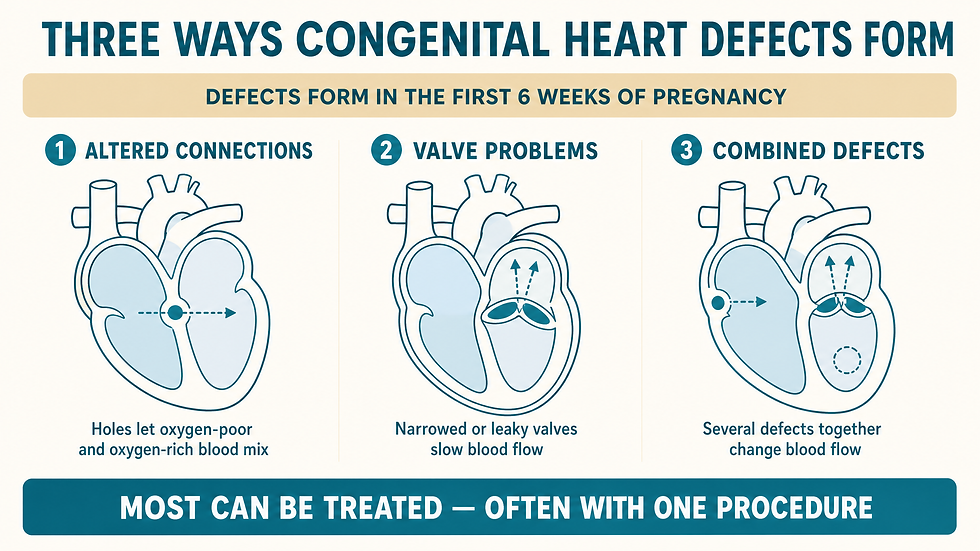
During the first six weeks of pregnancy, the baby's heart begins to form and starts to beat, and the major blood vessels that go to and from the heart also begin to form. It is at this critical point that congenital heart defects may begin to develop. [1] Researchers are not sure what causes most types of congenital heart defects. They think that gene changes, certain medicines or health conditions, and environmental or lifestyle factors — such as smoking — may play a role. [1]
The many types of congenital heart defects fall into three general categories.
Changes in the connections in the heart or blood vessels
Altered connections let blood flow where it usually would not, which allows oxygen-poor blood to mix with oxygen-rich blood. That lowers the amount of oxygen sent through the body and forces the heart and lungs to work harder. [1]
Defect | What it is |
Atrial septal defect (ASD) | A hole between the upper heart chambers (the atria) |
Ventricular septal defect (VSD) | A hole in the wall between the right and left lower chambers (the ventricles) |
Patent ductus arteriosus (PDA) | A connection between the lung artery and the body's main artery (the aorta) that stays open after birth, causing incorrect blood flow |
Anomalous pulmonary venous connection | Blood vessels from the lungs attach to a wrong area of the heart, totally or partially |
Heart valve problems
Heart valves are like doorways between the chambers and blood vessels, opening and closing to keep blood moving in the proper direction. When valves cannot open and close correctly, blood cannot flow smoothly. Problems include valves that are narrowed and do not open completely, and valves that do not close completely. [1]
Examples include aortic stenosis, where a baby is born with an aortic valve that has one or two flaps instead of three, creating a narrow opening that makes the heart work harder and the muscle thicker over time; pulmonary stenosis, where the pulmonary valve opening is narrowed and blood flow slows; and Ebstein anomaly, where the tricuspid valve is an unusual shape and often leaks. [1]
Combinations of defects
Some infants are born with several defects at once. The most complex ones cause significant changes in blood flow or underdeveloped heart chambers. [1]
Combined defect | What it is |
Tetralogy of Fallot | Four changes: a hole between the lower chambers, thickened muscle in the lower right chamber, a narrowed path to the lung artery, and a shifted connection of the aorta |
Pulmonary atresia | The valve to the lungs is not formed correctly, so blood cannot travel its usual path to get oxygen |
Tricuspid atresia | The tricuspid valve is not formed; solid tissue blocks the path, leaving the right lower chamber underdeveloped |
Transposition of the great arteries | The two main arteries leaving the heart are reversed; the complete form (D-TGA) is usually noticed in pregnancy or soon after birth |
Hypoplastic left heart syndrome | A major part of the heart fails to develop; the left side cannot pump enough blood to the body |
What are the risk factors for congenital heart defects?
Most congenital heart defects result from changes that occur early as the baby's heart develops before birth. The exact cause of most is unknown, but several risk factors have been identified. [1]
Risk factor | What the evidence shows |
Rubella (German measles) during pregnancy | Can change the baby's heart development; immunity can be checked with a blood test before pregnancy, and a vaccine is available |
Diabetes | Poor blood sugar control before and during pregnancy increases risk; gestational diabetes (which develops during pregnancy) generally does not increase a baby's risk |
Certain medicines | Lithium (for bipolar disorder) and isotretinoin (for acne) are linked to heart defects; always tell your healthcare team about every medicine you take |
Alcohol during pregnancy | Increases the risk of congenital heart defects in the baby |
Smoking during pregnancy | Increases risk; quitting helps, and avoiding secondhand smoke matters too |
Genetics | Defects run in families and can be inherited; gene changes are linked to heart problems present at birth; people with Down syndrome are often born with heart conditions |
What are the complications?
Possible complications of a congenital heart defect include congestive heart failure in babies with severe defects, which shows up as rapid breathing — often with gasping breaths — and poor weight gain. Another risk is endocarditis, an infection of the lining of the heart and heart valves; untreated, it can damage or destroy the valves or cause a stroke. [1]
Heart rhythm problems called arrhythmias are another complication. Scar tissue from surgeries can change how the heart signals, making it beat too fast, too slow, or irregularly. Some irregular heartbeats may cause stroke or sudden cardiac death if left untreated. [1]
Children with more-serious defects also often grow and develop more slowly than other children. They may be smaller than children their age, and if the nervous system has been affected, they may learn to walk and talk later than other children. [1] Although uncommon, a defect can let a blood clot pass through the heart and travel to the brain, causing a stroke. And some children may develop anxiety or stress because of developmental delays, activity restrictions, or learning difficulties — a concern worth raising with your child's healthcare professional. [1]
Important: these complications may occur years after the heart condition has been treated. [1] That is the reason follow-up care never ends at the operating room door.
How are congenital heart defects diagnosed?
A congenital heart defect may be diagnosed during pregnancy or after birth. Signs of certain defects can be seen on a routine pregnancy ultrasound, called a fetal ultrasound. [2] After birth, a healthcare professional might suspect a defect if the baby has growth delays, color changes in the lips, tongue, or nails, or a murmur heard with a stethoscope — keeping in mind that most heart murmurs are innocent. [2]
Diagnostic test | What it does |
Pulse oximetry | A sensor on the fingertip measures oxygen in the blood; too little may signal a heart or lung problem |
Electrocardiogram (ECG/EKG) | A quick, painless test that records the heart's electrical activity with sticky patches on the chest and sometimes the arms or legs |
Echocardiogram | Sound waves create images of the heart in motion, showing how blood moves through the heart and valves; this test diagnoses most forms of CHD. Done before birth, it is called a fetal echocardiogram |
Chest X-ray | Shows whether the heart is enlarged or the lungs hold extra fluid — possible signs of heart failure |
Cardiac catheterization | A thin, flexible tube is guided through a blood vessel (usually in the groin) to the heart to measure blood flow and pressure; some repairs can be done during this test |
Heart (cardiac) MRI | Magnetic fields and radio waves create detailed 3D pictures of the heart for accurate measurement of the chambers; often used in adolescents and adults |
Doctors may use pulse oximetry, an ECG, an echocardiogram, a chest X-ray, cardiac catheterization, or a cardiac MRI depending on the child's situation. Cardiac catheterization is notable because it is both diagnostic and therapeutic — doctors can use it to close certain holes in the heart or place expandable valves. [1]
How are congenital heart defects in children treated?
Treatment depends on the specific heart problem and how severe it is. Some defects have no long-term effect on a child's health and may safely go untreated. Others, such as a small hole in the heart, may close as a child ages. Serious defects need treatment soon after they are found. [2]
Treatment path | What it involves |
Watchful waiting | Some defects need no treatment or close on their own as the child grows |
Medications | Treat symptoms or complications — blood pressure drugs (ACE inhibitors, ARBs, beta blockers), water pills (diuretics) that remove fluid and lower strain on the heart, and heart rhythm drugs (anti-arrhythmics) |
Cardiac catheterization | Thin, flexible tubes repair the heart without open-heart surgery: a catheter enters through a blood vessel, usually in the groin, and tiny tools thread through to fix holes or narrowed areas; some catheter treatments happen in steps over years |
Heart surgery | Open-heart or minimally invasive surgery; the type depends on the specific change in the heart |
Heart transplant | Needed if a serious defect cannot be fixed |
Fetal cardiac intervention | Treatment before birth in very specific, rare situations to fix a serious defect or prevent complications as the baby grows |
Some children born with a congenital heart defect need many procedures and surgeries throughout life. Lifelong follow-up care is essential: the child needs regular checkups with a cardiologist, a doctor trained in heart diseases, and follow-up may include blood and imaging tests to check for complications. [2] As patients get older, continuing care with an adult-focused cardiologist trained in congenital heart disease is crucial. [1]
Can my child play sports?
In most forms of congenital heart disease, care teams work to find a way for the child to keep participating in the sports they love — athletics matter enormously for friendships, communities, and identity. [3] Some children do need reduced exercise or specific sports restrictions, and the child's care professional can say which activities are safe. [2] There are exceptions: children with certain genetic syndromes that make artery walls weak are advised against weightlifting or heavy pushing, which could cause those arteries to stretch and potentially rupture. [3] In most cases, though, teams find a way for children to play. [3]
Everyday care and prevention at home
Two home habits come up again and again for children with CHD. First, follow the activity guidance your cardiologist sets rather than guessing. Second, ask whether your child needs preventive antibiotics before dental procedures. Some defects raise the risk of infective endocarditis — an infection of the heart and valve lining — and antibiotics before dental care are recommended for some children, especially those with a mechanical heart valve. [2] Healthy gums and teeth also reduce this risk, making regular dental checkups genuinely important. [1]

Conclusion: a condition with real hope
A congenital heart defect is a heart structure problem present at birth, and it touches about 8 of every 1,000 babies. Serious cases announce themselves early with bluish coloring, rapid breathing, and feeding difficulties, while milder cases may hide until childhood or beyond. The causes usually cannot be pinned down — but several known pregnancy risk factors, from rubella to smoking, give expecting parents concrete ways to lower risk. Modern care offers a full ladder of treatment, from simple observation to catheter procedures, surgery, and transplant, and most children with CHD go on to live full, productive lives with regular heart care.
Next steps: If your baby shows any bluish coloring, rapid breathing, or trouble gaining weight, or if your older child faints, tires unusually easily, or has chest pain during activity, contact your child's healthcare professional promptly. Ask your doctor which tests your child needs, whether treatment is needed and when, what the best treatment is, what long-term complications to watch for, and how likely future children would be to have a defect. And if your child has been diagnosed, find a support group and a counselor if the stress builds — this is a marathon, and no family should run it alone.
Frequently asked questions
Is a congenital heart defect the same as heart disease?
Yes, in everyday language the two terms are used interchangeably. A congenital heart defect — also called congenital heart disease or CHD — refers to one or more problems with the heart's structure that are present at birth. It is different from the acquired heart disease that develops in adults, such as coronary artery disease. [1]
Can a heart defect be seen before birth?
Yes. Some congenital heart defects can be seen on an ultrasound while the baby is still in the womb. In certain extreme cases, treatment may even be advised before birth to correct the problem or reduce complications as the child develops. [1]
Do all heart murmurs mean something is wrong?
No. Most heart murmurs are innocent — meaning there is no heart defect and the murmur is not dangerous to the child's health. [1] [2] However, some murmurs are caused by blood flow changes to and from the heart, so every murmur a doctor hears should be properly checked out. [1]
Will my child need surgery forever?
Not necessarily. Some defects need no treatment, and small holes may close on their own as a child ages. [2] Other children need several procedures and surgeries over the years, and some catheter-based treatments must be done in steps. [2] What every child needs is lifelong follow-up with a cardiologist trained in congenital heart disease, even after repairs. [1] [2]
Can my child with a heart defect play sports?
In most forms of congenital heart disease, care teams find a way for children to keep playing the sports they love. [3] Some children need specific activity limits, and those with certain genetic conditions should avoid heavy weightlifting or pushing. [3] The child's own heart doctor is the only one who can say which sports and exercises are safe for your child. [2]
This article is for general education and is not a substitute for professional medical advice, diagnosis, or treatment. Always consult a qualified healthcare professional about your individual situation.
References
Mayo Clinic Staff. Congenital heart defects in children - Symptoms and causes. Mayo Clinic. December 7, 2024. https://www.mayoclinic.org/diseases-conditions/congenital-heart-defects-children/symptoms-causes/syc-20350074
Mayo Clinic Staff. Congenital heart defects in children - Diagnosis and treatment. Mayo Clinic. December 7, 2024. https://www.mayoclinic.org/diseases-conditions/congenital-heart-defects-children/diagnosis-treatment/drc-20350080
Mayo Clinic Staff. Congenital heart defects FAQs (expert answers video with pediatric cardiologist Jonathan Johnson, M.D.). Mayo Clinic. December 24, 2025. https://www.mayoclinic.org/diseases-conditions/congenital-heart-defects-children/multimedia/vid-20522479
Centers for Disease Control and Prevention. About congenital heart defects. CDC. February 6, 2026. https://www.cdc.gov/heart-defects/about/index.html
National Heart, Lung, and Blood Institute. What are congenital heart defects? NHLBI, NIH. March 24, 2022. https://www.nhlbi.nih.gov/health/congenital-heart-defects
American Heart Association. The impact of congenital heart disease. American Heart Association. August 25, 2026. https://www.heart.org/en/health-topics/congenital-heart-defects/the-impact-of-congenital-heart-defects
Beerman LB. Overview of congenital cardiovascular anomalies. Merck Manual Professional Version. January 2025. https://www.merckmanuals.com/professional/pediatrics/congenital-cardiovascular-anomalies/overview-of-congenital-cardiovascular-anomalies
Liu Y, Chen S, Zühlke L, et al. Global birth prevalence of congenital heart defects 1970-2017: updated systematic review and meta-analysis of 260 studies. Int J Epidemiol. 2019;48(2):455-463. PMID 30783674. https://doi.org/10.1093/ije/dyz009
Plana MN, Zamora J, Suresh G, et al. Pulse oximetry screening for critical congenital heart defects. Cochrane Database Syst Rev. 2018;3(3):CD011912. PMID 29494750. https://doi.org/10.1002/14651858.CD011912.pub2
Williams CA, Wadey C, Pieles G, et al. Physical activity interventions for people with congenital heart disease. Cochrane Database Syst Rev. 2020;10(10):CD013400. PMID 33112424. https://doi.org/10.1002/14651858.CD013400.pub2


Comments