What Is a Vascular Ring? A Plain-Language Guide to the Heart Condition That Wraps a Blood Vessel Around the Windpipe

Medically reviewed by Dr. Baraa Alnahhal, MD · Last reviewed: October 2026
TL;DR
A vascular ring is a heart condition a baby is born with. Part of the body's main artery, or its branches, forms a complete ring around the windpipe and the food swallowing tube. The ring can squeeze these tubes and cause noisy breathing, a long-lasting cough, and trouble swallowing or feeding. Surgery is usually needed when the ring presses on the windpipe or food tube, and people born with a vascular ring need regular checkups for life.
Quick Answer
What it is: A birth defect where part of the body's main artery (the aorta) or its branches forms a complete ring around the windpipe (trachea) and the food swallowing tube (esophagus).
When it shows up: Some people have no symptoms at all, and sometimes symptoms aren't noticed until later in life. Congenital heart conditions like vascular rings are often diagnosed before or soon after birth.
Main symptoms: Noisy breathing, wheezing, a cough that doesn't go away after a cold, trouble swallowing, choking, and difficulty eating.
Why it happens: The exact cause is unknown. It forms while the baby grows in the womb, and gene changes, some medicines, some health conditions, smoking, and things in the environment may play a role in congenital heart conditions.
How it's treated: Surgery is usually needed when the ring presses on the windpipe or food tube. The surgeon splits the ring so the blood vessel stops squeezing the tubes, and regular checkups continue for life.
What the research says
Surgery for a true vascular ring is relatively safe and effective. A clinical review of the literature on a right aortic arch forming a complete vascular ring found that affected patients present with breathing and/or swallowing difficulties from compression of the windpipe and esophagus. Surgery was reported to be relatively safe, with low complications and death rates that were more related to other heart or body abnormalities than to the operation itself. In most patients, symptoms fully resolved within months to years, but a subset kept some narrowing of the airway or esophagus, and some needed another procedure for persisting or recurring symptoms. This is why long-term follow-up matters. (Biermann et al., Eur J Cardiothorac Surg, 2021)
Some arch variants form a ring; others are linked to other conditions. A radiology review of congenital aortic arch variants explains that variants that form a vascular ring, such as a double aortic arch, can cause breathing distress from windpipe compression, and that certain arch anomalies are strongly associated with congenital heart disease. It also notes that CT angiography and MR angiography allow a complete evaluation of the aortic arch and its branch vessels in relation to surrounding structures. (Hanneman et al., Radiographics, 2017)
What is a vascular ring, exactly?
The body's main artery is called the aorta. It carries blood out of the heart and up into the chest, where it bends over in a curve known as the aortic arch. Branches come off this arch to feed the head, neck, and arms.
In a vascular ring, part of the aortic arch or one of its branches develops in an unusual way during pregnancy. Instead of arching over normally, these vessels form a complete ring that circles two important tubes:
The windpipe (trachea), which carries air to and from the lungs.
The food swallowing tube (esophagus), which leads from the mouth to the stomach.
Because the ring surrounds these tubes, it can squeeze them. That is why a vascular ring often shows up as breathing and swallowing problems rather than as a classic heart problem.
A vascular ring is a type of congenital heart defect, which means a heart condition present at birth. Some people with a vascular ring may be born with other heart conditions too.
A related condition: vascular sling. In a vascular sling, a blood vessel off the aorta goes behind the esophagus. Unlike a full ring, a sling rarely needs treatment.

What are the symptoms of a vascular ring?
Some people with a vascular ring never have symptoms. In others, the signs do not show up until later in life. When symptoms do appear, they mostly involve breathing and eating.
Symptom | What parents may notice |
Wheezing | A whistling sound when the child breathes |
Chronic cough | A cough that is long-term or doesn't go away after a cold |
Noisy breathing | Breathing that sounds loud, strained, or unusual |
Shortness of breath with exercise | Getting winded faster during activity |
Heartburn | Burning discomfort in the chest or throat area |
Frequent respiratory infections | Repeated chest colds or breathing infections |
Trouble swallowing | Food feels stuck or slow going down |
Spitting up | Frequent spitting up |
Choking | Choking episodes |
Difficulty eating | May prefer soft foods, eat slowly, and chew thoroughly |
If a child is born with other heart conditions as well, the specific symptoms depend on which conditions are present.
When should you call the doctor?
Congenital heart conditions like vascular rings are often diagnosed before or soon after a child is born. Still, parents should know the signs to watch for. Call your baby's healthcare professional if your child has any of these:
Coughing
Wheezing
Noisy breathing
Difficulty feeding and swallowing
Get help right away if your baby has trouble breathing. If your baby has symptoms of a heart condition, you may be sent to a doctor trained in heart diseases, called a cardiologist.
What causes a vascular ring?
The exact cause of vascular rings is not known. What is known is the timing: congenital heart conditions happen while a baby, also called a fetus, is growing in the womb during pregnancy.
Some things that may play a role in the development of congenital heart conditions are:
Gene changes
Some medicines
Some health conditions
Lifestyle choices, including smoking
Things in your environment
What increases the risk?
What increases the risk of a vascular ring specifically is not well known. Possible risk factors for vascular rings and other congenital heart conditions include the following.
Risk factor | How it may raise risk |
Genetics | Changes in some genes have been linked to congenital heart conditions. For example, people with Down syndrome often are born with heart conditions. |
Diabetes before pregnancy | Having type 1 or type 2 diabetes during pregnancy may change how the unborn baby's heart forms. Diabetes that develops during pregnancy doesn't typically increase the risk. |
Rubella (German measles) during pregnancy | Rubella can cause harmful changes in an unborn baby's heart. A blood test before pregnancy can check whether you are immune, and a vaccine is available for people who aren't immune. |
Some medicines | Taking some medicines during pregnancy may increase the risk. Examples include lithium (Lithobid) for bipolar disorder and isotretinoin (Claravis, Myorisan, others) for acne. Talk with a healthcare professional about the medicines you take. |
Smoking | Smoking during pregnancy, or being around tobacco smoke, increases the risk of some congenital heart conditions. |
Alcohol use | Drinking alcohol during pregnancy may increase the risk of heart conditions in the baby. |
How do doctors diagnose a vascular ring?
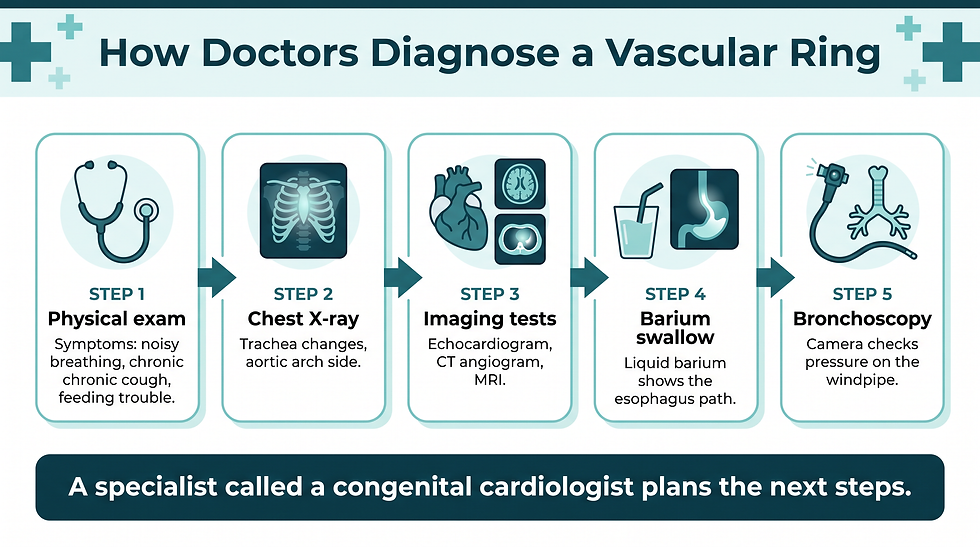
Diagnosis starts with a physical exam and questions about symptoms. Because vascular rings can hide behind ordinary-sounding symptoms like cough and wheezing, a set of tests helps doctors see what is happening around the windpipe and food tube.
Test | What it does |
Chest X-ray | A picture of the heart and lungs. It can show changes in the windpipe that might suggest a vascular ring, and it can tell which side of the body the aortic arch is on. |
Echocardiogram, CT angiogram, or MRI scan | Imaging tests that healthcare professionals can use to plan treatment. |
Barium swallow | The child swallows a liquid called barium while X-rays show how it moves from the mouth to the stomach. It can show changes in the structure of the esophagus that may be caused by a vascular ring. |
Upper endoscopy | A long, flexible tube with a camera (an endoscope) is passed through the mouth into the throat. A tiny camera at the tip sends pictures to a video screen so the doctor can look at the esophagus. |
Bronchoscopy | A small, flexible tube with a light and camera is inserted through the mouth or nose into the lungs. It shows the inside of the windpipe and the lungs' airways, and can tell if a vascular ring is pushing against the trachea. |
How is a vascular ring treated?
Surgery usually is done to treat a vascular ring that presses against the windpipe or food tube. Surgery also helps prevent complications.
Here is what happens during the operation:
The surgeon finds the ring formed by the blood vessels.
The surgeon splits the vascular ring so the blood vessel stops pressing against the windpipe and the food pipe.
Depending on the type of vascular ring, one of the branches off the aorta may need to be moved to a new position.
The specific type of surgery depends on the type of heart conditions present.
A vascular sling, by contrast, rarely needs treatment.
What does life look like after treatment?
People born with vascular rings need regular health checkups for life to prevent complications. It is best to be cared for by a healthcare professional trained in congenital heart conditions, called a congenital cardiologist. Your child's cardiology team can explain what follow-up plan fits your child.

The Bottom Line
A vascular ring is a birth defect in which part of the aorta or its branches loops around a child's windpipe and food tube. It often shows up as noisy breathing, a stubborn cough, and feeding trouble rather than as a typical heart complaint. Surgery usually relieves the squeeze, and regular checkups with a doctor trained in congenital heart conditions continue for life.
Take the Next Step
If your baby has persistent noisy breathing, a cough that outlives every cold, or trouble feeding, do not wait for it to clear up. Call your child's healthcare professional. Get emergency help right away if your baby has trouble breathing. Only a doctor who examines your child can confirm whether a vascular ring is the cause. This guide is for information, not diagnosis.
Frequently Asked Questions
Is a vascular ring a heart problem or a breathing problem?
Both, in a way. It is a congenital heart defect because the ring is made of abnormal blood vessels from the aorta. But it usually causes breathing and swallowing symptoms because the ring squeezes the windpipe and food tube.
Do all children with a vascular ring have symptoms?
No. Some people with a vascular ring don't have symptoms, and sometimes symptoms aren't noticed until later in life.
What is the most common symptom parents notice?
A cough that is long-term or doesn't go away after a cold, along with noisy breathing, wheezing, and trouble feeding or swallowing, are among the signs to watch for.
Can a vascular ring be seen before birth?
Sometimes. Mayo Clinic's pediatric heart team notes that vascular rings are increasingly diagnosed on imaging done during pregnancy. Congenital heart conditions are also often diagnosed soon after a child is born.
What is the difference between a vascular ring and a vascular sling?
A vascular ring forms a complete ring around the windpipe and esophagus. In a vascular sling, a blood vessel off the aorta goes behind the esophagus. A sling rarely needs treatment.
What does vascular ring surgery involve?
The surgeon splits the ring so the blood vessel stops pressing on the windpipe and food pipe. Depending on the type of ring, one of the branches off the aorta may need to be moved. The specific type of surgery depends on the type of heart condition present.
Does my child need follow-up care after surgery?
Yes. People born with vascular rings need regular health checkups for life to prevent complications, ideally with a congenital cardiologist.
Could a vascular ring run in families?
The exact cause of vascular rings is not known. Gene changes are listed among the things that may play a role in congenital heart conditions in general, but Mayo Clinic's surgical team states that no genetic link is known for vascular rings.
Related Reading
Double Aortic Arch: The Most Symptomatic Vascular Ring - Symptoms, Surgery, Recovery and Outlook
Congenital Heart Defects in Children: Symptoms, Causes, and Treatment
Heart Murmurs: What They Mean, When They're Harmless, and How They're Treated
What Is Infant Acid Reflux? A Plain-Language Guide for Parents
References
Mayo Clinic Staff. Vascular rings: Overview. Mayo Clinic. Last updated December 7, 2024. Accessed October 14, 2026. https://www.mayoclinic.org/diseases-conditions/vascular-rings/cdc-20389579
Mayo Clinic. Expertise in the nuances of diagnosis, management and surgery for vascular rings. Mayo Clinic Medical Professionals. March 31, 2022. https://mayoclinic.org/medical-professionals/news/expertise-in-the-nuances-of-diagnosis-management-and-surgery-for-vascular-rings/mac-20530282
Biermann D, Holst T, Hüners I, et al. Right aortic arch forming a true vascular ring: a clinical review. Eur J Cardiothorac Surg. 2021;60(5):1014-1021. PMID: 33970211. https://doi.org/10.1093/ejcts/ezab225
Hanneman K, Newman B, Chan F. Congenital variants and anomalies of the aortic arch. Radiographics. 2017;37(1):32-51. PMID: 27860551. https://doi.org/10.1148/rg.2017160033
Disclaimer: This guide is for general information only and is not a substitute for professional medical advice, diagnosis, or treatment. Always seek the advice of a physician or other qualified health provider with any questions about a medical condition. Trouble breathing in a baby is a medical emergency. Never disregard professional medical advice or delay seeking it because of something you have read here.


Comments