Double Aortic Arch: The Most Symptomatic Vascular Ring - Symptoms, Surgery, Recovery and Outlook

Updated: 4 days ago
Medically reviewed by Dr. Baraa Alnahhal, MD · Last reviewed: October 2026
TL;DR: A double aortic arch is a rare birth defect in which two aortic arches form a circle around a baby's windpipe and food pipe. It is one type of vascular ring (about 1 in 10,000 babies) and the type most likely to cause symptoms, such as noisy breathing, a seal-bark cough, and choking during feeds. Surgery divides the smaller arch, needs no heart-lung machine, and has excellent outcomes. Call 911 if the baby looks blue or struggles to breathe.
Call 911 right away if your baby's skin looks blue (cyanosis) or your baby is visibly struggling to breathe. A double aortic arch can put life-threatening pressure on a baby's windpipe.
Quick Answer
A double aortic arch is a rare congenital heart defect in which two aortic arches form a circle of blood vessels around a baby's windpipe (trachea) and food pipe (esophagus). If the circle is too tight, it compresses these tubes and causes breathing problems, noisy breathing, and swallowing difficulties. Surgery divides the smaller extra arch, is safe, has excellent outcomes, and lets children live a normal, unrestricted life.
What the research says
Repair of vascular rings works well in children. In 58 children who had surgery (22 with a double aortic arch), symptoms improved in 93% of those who had them. There was one perioperative death (1.7%), unrelated to the ring, and recurrent laryngeal nerve injury in 3 children (5.2%) and transient chylothorax in 2 (3.4%) (Said et al., Semin Thorac Cardiovasc Surg, 2021).
A double aortic arch can also come with a Kommerell diverticulum. Among 66 patients operated on for a double aortic arch, 10 also had the diverticulum removed. None had major complications or readmissions, and the average hospital stay after surgery was 3.1 days (Backer et al., Ann Thorac Surg, 2019).
Key takeaways
A double aortic arch is one type of vascular ring, a group of heart defects affecting about 1 in 10,000 babies.
It is the vascular ring most likely to cause symptoms, so it is usually diagnosed sooner than other types.
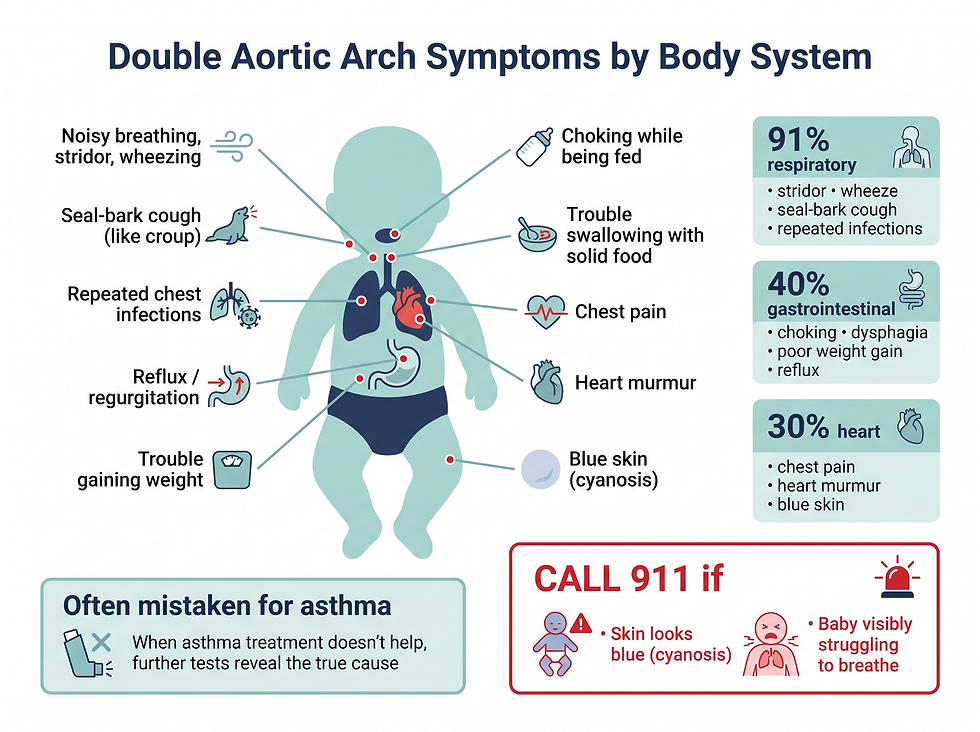
Respiratory symptoms affect about 91% of affected children, gastrointestinal symptoms about 40%, and heart symptoms about 30%.
Surgery is needed. Babies without symptoms should have it at 6 to 9 months, and babies with symptoms may need it sooner.
After repair, children have an excellent outlook and normal activities. Noisy breathing may last up to a year.
What Is a Double Aortic Arch?
The aorta is the large artery that supplies blood to the whole body. Normally it forms as one large vessel that leaves the heart and runs down into the belly. Its curved top, above the heart, is the aortic arch. In a double aortic arch, extra blood vessels form a second arch connected to the main one. Together the arches make a circle that wraps around the trachea and esophagus.
The aortic arch forms between weeks 2 and 7 of pregnancy. A double aortic arch is made of blood vessels that should have gone away during the fifth week but, for unknown reasons, stayed.

Is a Double Aortic Arch the Same as a Vascular Ring?
No. A double aortic arch is one type of vascular ring. About 1 in 100 babies are born with some type of congenital heart disease, and about 1 in 10,000 are born with a vascular ring.
Vascular ring type | What happens |
Double aortic arch | Two aortic arches (left and right) surround the trachea and esophagus. |
Right aortic arch with aberrant left subclavian artery and left ligamentum | One arch descends to the right of the trachea. The left subclavian artery runs behind the trachea and esophagus, and the left ligamentum arteriosum (a fetal vessel remnant) completes the ring. |
Left aortic arch with aberrant right subclavian artery | The right subclavian artery travels behind the trachea and esophagus and can compress them. |
Innominate artery compression | The innominate artery arises to the left of the trachea and crosses in front of it, putting pressure on it. |
Pulmonary artery sling | The left pulmonary artery extends from the right one and passes between the trachea and esophagus. |
What Are the 3 Types of Double Aortic Arch?
The three types depend on which arch is bigger and where it sits relative to the trachea.
Type | Share of cases |
Dominant right arch with a small left arch | 80% |
Dominant left arch with a small right arch | About 10% |
Balanced arches (both similar in size) | About 10% |
Which Vascular Ring Is Most Common?
Researchers once thought the double aortic arch was the most common vascular ring. Newer research shows the right aortic arch is. Babies with a right aortic arch are more likely to have other congenital heart disease but are less likely to be diagnosed right after birth, and may not have surgery until 6 to 18 months of age. The double aortic arch is the type most likely to cause symptoms, so it is diagnosed sooner and surgery may be needed sooner.
What Are the Symptoms of a Double Aortic Arch?
Symptoms come from compression of the trachea, the esophagus, or both, and can affect breathing, eating, or heart function. They usually appear early in infancy, especially in severe cases, but can appear by age three or even in the teenage years. Some children are first diagnosed with asthma because the symptoms look similar. When asthma treatment does not help, further tests can reveal the cause.
Symptom group | How common | Examples |
Respiratory | 91% | Noisy breathing with stridor or wheezing; a seal-bark cough similar to croup; repeated lower respiratory infections |
Gastrointestinal | 40% | Choking during feeds; trouble swallowing (dysphagia), usually when solids begin; trouble gaining weight; regurgitation or reflux |
Heart | 30% | Chest pain; heart murmur; blue skin (cyanosis) |
The seal-bark cough is much like the cough of croup, and a heart murmur can be found on examination.
What Causes a Double Aortic Arch?
The exact cause is unknown. It is more common in babies conceived by in-vitro fertilization, though no one knows why. It is also linked with other conditions:
Cause or risk factor | What is known |
Exact cause | Unknown. Vessels that should disappear in week 5 of pregnancy persist. |
In-vitro fertilization (IVF) | More common in babies conceived by IVF; the reason is unknown. |
Another congenital heart defect | Up to 12% of babies, such as a ventricular septal defect or tetralogy of Fallot. |
Genetic disorder | Up to 20% of babies, such as chromosome 22q11 deletion or trisomy 21. |
Read more about related defects in our guides to ventricular septal defect and tetralogy of Fallot.
How Is a Double Aortic Arch Diagnosed?
It is diagnosed by chance or when symptoms begin. Sometimes it is spotted on imaging done for other reasons, during pregnancy or soon after birth. Diagnoses through prenatal imaging have been rising since 2004, which helps because treatment can be planned for soon after birth.
Test | Role |
Chest X-ray | Often done first. |
CT scan | Detailed imaging of the arches and nearby structures. |
Echocardiogram | Most helpful for finding other heart defects. |
MRI | Detailed imaging of the arches. |
Bronchoscopy | Checks the airway, either before diagnosis or before surgery to show details that help the surgeon. |
Genetic testing | Useful for diagnosing genetic disorders. |
How Do You Fix a Double Aortic Arch?
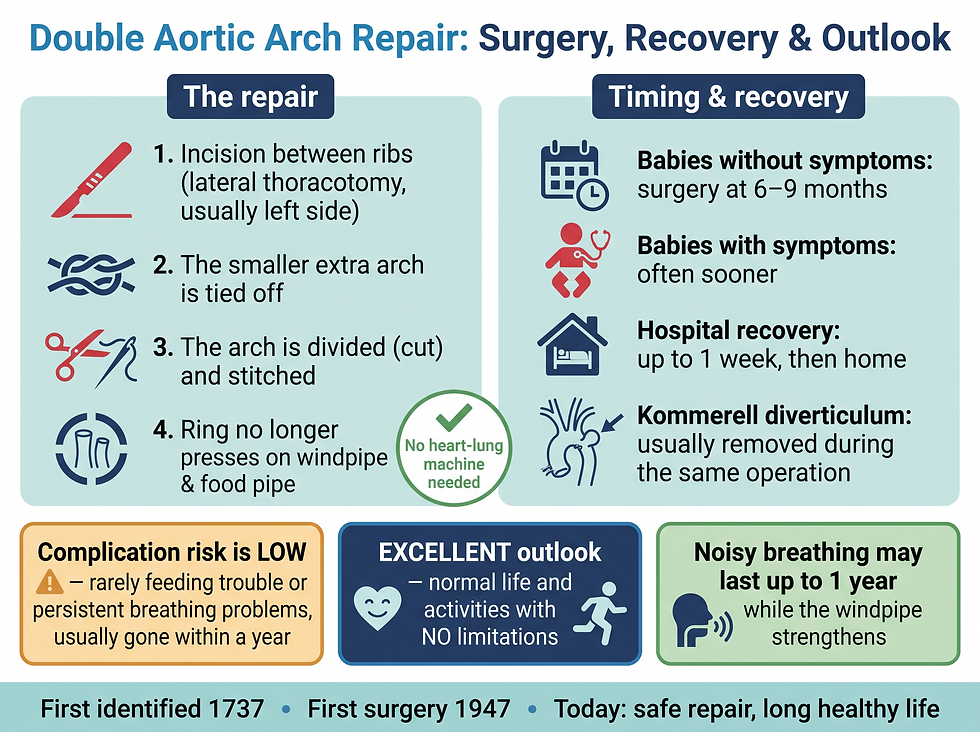
Surgery is needed. Babies without symptoms should have it at 6 to 9 months of age. Babies with symptoms may need it sooner, especially if symptoms are severe. The condition was first identified in 1737 and first repaired in 1947, and today babies can live long, healthy lives after repair.
Repair is safe, with excellent outcomes, and the baby does not need a heart-lung machine. The surgeon makes a cut between two ribs, usually on the left, where most babies have the smaller extra arch. The smaller arch is tied off, divided, and stitched, and these steps are repeated until the arch no longer presses on the trachea and esophagus. The baby recovers in the hospital for up to a week and then goes home.
What if There Is a Kommerell Diverticulum or Another Heart Defect?
A small number of babies also have a Kommerell diverticulum, an aneurysm in the descending aorta near the arch that can press on the trachea and esophagus. Surgeons prefer to remove it during the same operation to prevent problems later. If the baby has other heart defects that need surgery, the arch can be fixed at the same time, which may need a vertical incision in the middle of the chest (median sternotomy).
What Are the Complications of Surgery?
The risk of complications is low. Rarely, a baby has trouble feeding or persistent breathing problems, and these usually go away within a year. Risks are different when other heart defects are repaired in the same operation, so ask the surgeon to explain them.
What Is the Outlook After Surgery?
Babies and children who have repair have an excellent outlook and enjoy a normal life and activities with no limitations. Noisy breathing may persist for up to a year, because a double aortic arch prevents the trachea from developing properly and it takes time to strengthen. Rarely, respiratory symptoms last longer than a year. Regular check-ups matter, and parents should report any lingering symptoms.
Can a Double Aortic Arch Be Prevented?
No. It forms early in pregnancy and is present at birth.
When to Call Your Baby's Doctor
Call the doctor for any new or worsening symptoms. If your baby has the typical seal-bark cough or noisy breathing, tell the doctor right away. It may be a normal childhood illness, but in rare cases it signals a heart problem that affects breathing. Call 911 if the skin looks blue or your baby is visibly struggling to breathe.
Questions to Ask Your Baby's Doctor
Question | Why it matters |
When will my baby need surgery? | Timing depends on whether symptoms are present. |
Where will the surgery take place, and who will do it? | Helps you plan the care team and location. |
What symptoms should I look for at home? | Early warning signs between appointments. |
How can I make my baby comfortable at home? | Day-to-day comfort before and after surgery. |
Does my baby have other heart defects? | Up to 12% do. |
Should my baby or family have genetic testing? | Up to 20% have a genetic disorder. |
What is the outlook for my baby? | Confirms the excellent outlook after repair. |
What Is Aortic Arch Syndrome?
Aortic arch syndrome is a very rare form of vasculitis (inflammation of blood vessel walls) more commonly called Takayasu's arteritis. It affects medium and large vessels, often the aortic arch and its main branches, and develops in teenagers and young adults. It is a different problem from the congenital double aortic arch and needs different treatment.
Conclusion
Finding out that your baby has a congenital heart defect is frightening. A double aortic arch causes some of the most visible symptoms, such as noisy breathing, a seal-bark cough, and feeding difficulty, but it is also one of the most reliably fixable. Repair needs no heart-lung machine, the risk of complications is low, and most children go on to live a normal life. If your baby shows these symptoms, contact your pediatrician promptly, and call 911 for blue skin or visible struggling to breathe.
Related reading
Tetralogy of Fallot: A Parent's Guide to the Heart Condition Babies Are Born With
Ventricular Septal Defect (VSD): Complete Guide to Symptoms, Causes, Diagnosis & Treatment
Croup: The Barking Cough, Symptoms, Causes, Home Care and When to Go to the ER
The Ascending Aorta: Anatomy, Function, and Vital Health Considerations
Esophageal Atresia: Symptoms, Types, Causes, Diagnosis, Surgery and Survival Rates
Frequently Asked Questions
What is a double aortic arch?
A rare congenital heart defect in which two aortic arches form a circle around the baby's windpipe and food pipe, which can cause breathing and swallowing problems.
What causes a double aortic arch?
The cause is unknown. Vessels that should disappear in the fifth week of pregnancy stay behind. It is more common after in-vitro fertilization, for unknown reasons.
Is a double aortic arch genetic?
Up to 20% of affected babies have a genetic disorder such as chromosome 22q11 deletion or trisomy 21. Ask your provider about genetic testing.
Can a double aortic arch be prevented?
No. It forms early in pregnancy and is present at birth.
How common is a double aortic arch?
Vascular rings affect about 1 in 10,000 babies. The double aortic arch is one type.
Is a double aortic arch dangerous?
It can be. It can put life-threatening pressure on the windpipe. Call 911 if the baby looks blue or struggles to breathe.
What is a vascular ring?
An abnormal aortic arch formation that can compress the windpipe, the food pipe, or both.
Is it the most common vascular ring?
No. The right aortic arch is the most common, but the double aortic arch is the most likely to cause symptoms.
What does it sound like?
Noisy breathing with stridor (a high-pitched sound) or wheezing, and a cough like a seal bark, similar to croup.
Can it cause feeding problems?
Yes. About 40% of affected children have choking during feeds, trouble swallowing, poor weight gain, or reflux.
Why might my baby look blue?
Blue skin (cyanosis) is a heart symptom seen in about 30% of children. Call 911 right away.
Can it be found before birth?
Yes. Prenatal imaging diagnoses have been rising since 2004, which lets treatment be planned for soon after birth.
How is it diagnosed?
With a chest X-ray, CT scan, echocardiogram, or MRI. Bronchoscopy may check the airway.
Does it need surgery?
Yes. Babies without symptoms should have surgery at 6 to 9 months. Babies with symptoms may need it sooner.
Is the surgery safe?
Yes. Repair is safe with excellent outcomes and does not need a heart-lung machine.
How is it repaired?
Through a cut between two ribs, usually on the left. The surgeon ties off, divides, and stitches the smaller arch.
How long is the hospital stay?
Up to a week, then the baby goes home.
What are the surgery risks?
The risk is low. Rarely, feeding trouble or breathing problems occur, and these usually go away within a year.
What is a Kommerell diverticulum?
An aneurysm in the descending aorta near the arch. Surgeons prefer to remove it during the same operation.
What is the outlook?
Excellent. Children enjoy a normal life with no limitations, though noisy breathing may last up to a year.
Can my child play sports after repair?
Children who have had repair enjoy normal activities with no limitations. Confirm guidance with the care team.
What is aortic arch syndrome?
Another name for Takayasu's arteritis, a rare inflammation of large blood vessels in teens and young adults. It is a different condition.
When do I call the doctor, and when 911?
Call the doctor for any new or worsening symptoms. Call 911 if the baby looks blue or visibly struggles to breathe.
Sources
Cleveland Clinic. Double Aortic Arch. Cleveland Clinic. Last updated July 1, 2022. https://my.clevelandclinic.org/health/diseases/23432-double-aortic-arch
Said SM, Marey G, Knutson S, et al. Outcomes of surgical repair of vascular rings and slings in children: a word for the asymptomatic. Semin Thorac Cardiovasc Surg. 2021;33(2):492-500. PMID 32977012. https://doi.org/10.1053/j.semtcvs.2020.09.013
Backer CL, Bharadwaj SN, Eltayeb OM, et al. Double aortic arch with Kommerell diverticulum. Ann Thorac Surg. 2019;108(1):161-166. PMID 30849335. https://doi.org/10.1016/j.athoracsur.2019.01.062
Worhunsky DJ, Levy BE, Stephens EH, et al. Vascular rings. Semin Pediatr Surg. 2021;30(6):151128. PMID 34930596. https://doi.org/10.1016/j.sempedsurg.2021.151128
Medical disclaimer
The information in this article is for educational purposes only and is not a substitute for professional medical advice, diagnosis, or treatment. Always seek the advice of your physician or another qualified health provider with any questions you may have about a medical condition. Never disregard professional medical advice or delay seeking it because of something you have read here. If you think you may have a medical emergency, call your doctor or your local emergency number immediately.


Comments