What Is Infant Acid Reflux? A Plain-Language Guide for Parents

Medically reviewed by Dr. Baraa Alnahhal, MD · Last reviewed: October 2026
TL;DR
Infant acid reflux, often simply called infant reflux or gastroesophageal reflux (GER), is when a baby spits up liquid or food because stomach contents move back up into the esophagus, the tube connecting the mouth to the stomach. It happens because the valve muscle at the top of the stomach, the lower esophageal sphincter, is not yet fully developed. Reflux is very common, happening many times a day, and usually is not a cause for concern as long as the baby is content and growing well. It typically improves as the valve matures and is unusual after 18 months of age. Simple changes such as feeding upright, burping often and keeping the baby upright after meals ease most cases, while warning signs such as forceful vomiting, poor weight gain, or green or bloody spit-up mean it is time to see a doctor. [1] [2]
Quick Answer
What it is: A baby spitting up liquid or food because stomach contents flow back up into the esophagus, usually from an immature valve muscle (the lower esophageal sphincter). [1]
How common: Very common. It happens many times a day, and about half of babies have normal spitting up. [1] [3]
When it gets better: As the valve matures. It is unusual for infant reflux to continue after age 18 months. [1]
What helps at home: Feeding upright, holding the baby upright for 30 minutes after feeding, smaller and more frequent feedings, and frequent burping. [2]
When to call a doctor: Forceful or projectile vomiting, green or yellow fluid, blood or coffee-ground-looking spit-up, poor weight gain, breathing trouble, refusing to feed, or first spit-ups starting at 6 months or older. [1]
What the research says
Spit-up is common, peaks around 4 months and usually resolves by age 1. A clinical review reports that regurgitation occurs daily in about 40% of infants, usually begins before 8 weeks of age, peaks at about 4 months and typically resolves by 1 year. It advises reassuring parents that reflux is self-limited and does not warrant routine testing or medicine. (Antono & Dotson, Am Fam Physician, 2025)
Acid-reducing medicines have not been shown to help infants with typical reflux. A Cochrane review of 36 randomized trials (2,251 infants and children) found very low-certainty evidence and no clear symptom benefit in infants from omeprazole, esomeprazole, H2 blockers or alginates. (Tighe et al., Cochrane Database Syst Rev, 2023)
Proton pump inhibitors did no better than placebo for infant symptoms. A systematic review of 13 randomized trials found that these medicines were equal to placebo for reducing reflux symptoms in infants, although they were effective in older children. (Fernández-González et al., Children, 2024)
Almost every baby spits up at some point, and for most parents the first worry is whether it is normal. The good news is that infant reflux is one of the most common experiences of the first year of life, and it is rarely a cause for concern when a baby is content, feeding well and gaining weight. This guide explains what reflux is, why it happens, how to tell normal spit-up from something that needs a doctor's attention, and which home steps and treatments actually help.
What Is Infant Acid Reflux?
Infant reflux is when a baby spits up liquid or food. It happens when stomach contents move back up from a baby's stomach into the esophagus, the muscular tube that connects the mouth to the stomach. If the muscle between the esophagus and the stomach relaxes when the stomach is full, food might flow up the baby's esophagus. This muscle is called the lower esophageal sphincter. Reflux happens in infants many times a day. [1]
The condition is sometimes called gastroesophageal reflux, or GER. It becomes less common as a baby gets older, and it is unusual for infant reflux to continue after age 18 months. Most of the time, infant reflux is not a cause for concern, because stomach contents usually do not have enough acid to irritate the throat or esophagus and cause symptoms. [1]
Rarely, reflux leads to weight loss or growth that lags behind that of other children of the same age and sex. These symptoms may mean that a baby has a medical issue, such as an allergy, a blockage in the digestive system, or gastroesophageal reflux disease, also called GERD. [1]
What Is the Difference Between GER and GERD?
GER is the everyday spitting up that happens because a baby's valve muscle is immature. It is common, harmless in most cases, and usually resolves on its own as the baby grows. GERD is a more serious form of GER in which reflux causes serious health issues, such as irritation and damage to the lining of the esophagus. GERD may need medical treatment. [1]
How Does Reflux Happen?
In infants, the ring of muscle between the esophagus and the stomach is not yet fully developed. When this muscle, the lower esophageal sphincter (LES), is not fully developed, it allows stomach contents to flow back up into the esophagus. Over time, the LES typically matures. It opens when a baby swallows and remains tightly closed at other times, keeping stomach contents where they belong. [1]
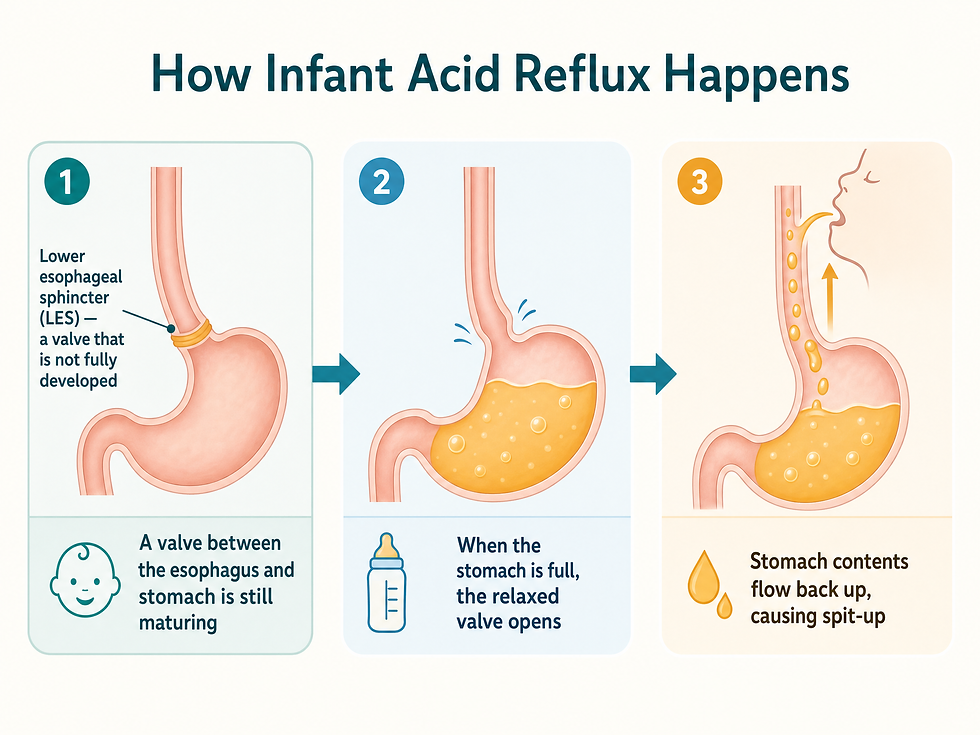
Two factors that contribute to infant reflux are common in babies and often cannot be avoided: babies lie flat most of the time, and they are fed an almost completely liquid diet. Both make it easier for stomach contents to travel back up the esophagus. [1]
What Causes Reflux Beyond Normal Immaturity?
Sometimes infant reflux can be caused by more-serious conditions. [1]
Condition | What happens |
GERD | The reflux has enough acid to irritate and damage the lining of the esophagus. |
Pyloric stenosis | The valve that lets food leave the stomach and enter the small intestine thickens and enlarges, trapping food in the stomach and blocking it from moving on. |
Food intolerance | A protein in cow's milk is the most common trigger. |
Eosinophilic esophagitis | A white blood cell called an eosinophil builds up and injures the lining of the esophagus. |
Sandifer syndrome | Causes unusual tilting and rotation of the head and movements that look like seizures. It is a rare complication of GERD. |
What Are the Risk Factors?
Infant reflux is common, but some things make it more likely that a baby will have it. [1]
Risk factor | How it relates to reflux |
Premature birth | Preterm babies have a less mature valve muscle and digestive system. |
Lung conditions, such as cystic fibrosis | Chronic lung conditions make reflux more likely. |
Nervous system conditions, such as cerebral palsy | Conditions that affect the nervous system increase reflux risk. |
Previous surgery on the esophagus | Prior esophageal surgery raises the likelihood of reflux. |
Can Reflux Cause Complications?
Infant reflux usually gets better on its own and rarely causes problems for babies. If a baby has a more serious condition such as GERD, the baby's growth may lag behind that of other children. Some research also suggests that babies who have frequent episodes of spitting up might be more likely to develop GERD later in childhood. [1]
When Should You See a Doctor?
If a baby is content and growing well, reflux is not a cause for concern. However, some signs mean it is time to see a healthcare professional. Some of these symptoms may point to serious but treatable conditions, such as GERD or a blockage in the digestive tract. [1]
Warning sign | What it looks like |
Not gaining weight | Growth slows or falls behind expected levels. |
Forceful spitting up (projectile vomiting) | Stomach contents consistently shoot out of the mouth. |
Green or yellow fluid | Spit-up is green or yellow instead of milk. |
Blood or coffee-grounds spit-up | Spit-up contains blood or looks like coffee grounds. |
Refusing to feed or eat | Baby turns away from feeding. |
Blood in the stool | Visible blood in the diaper. |
Breathing trouble or persistent cough | Difficulty breathing or a cough that will not go away. |
New spit-up at 6 months or older | Spitting up begins for the first time at age 6 months or later. |
Irritability after eating | Baby is very irritable after feeds. |
Low energy | Baby does not have much energy. |

How Is Infant Reflux Diagnosed?
To diagnose infant reflux, a healthcare professional typically starts with a physical exam and asks questions about a baby's symptoms. If a baby is growing as expected and seems content, testing usually is not needed. In some cases, however, a healthcare professional might recommend testing. [2]
Diagnostic test | What it involves |
Ultrasound | An imaging test that can detect pyloric stenosis. |
Lab tests | Blood and urine tests that help find or rule out causes of poor weight gain and frequent vomiting. |
Esophageal pH monitoring | A thin tube is placed through the nose or mouth into the esophagus and attached to a device that monitors acidity. The baby may need to stay in the hospital while being monitored. |
X-rays | Images that detect digestive tract problems, such as a blockage. A baby may be given a contrast liquid, usually barium, with a bottle before the test. |
Upper endoscopy | A tiny camera on the end of a flexible tube examines the upper digestive system, and tissue samples may be taken. It is usually done under general anesthesia, a sleep-like state. |
How Is Infant Reflux Treated?
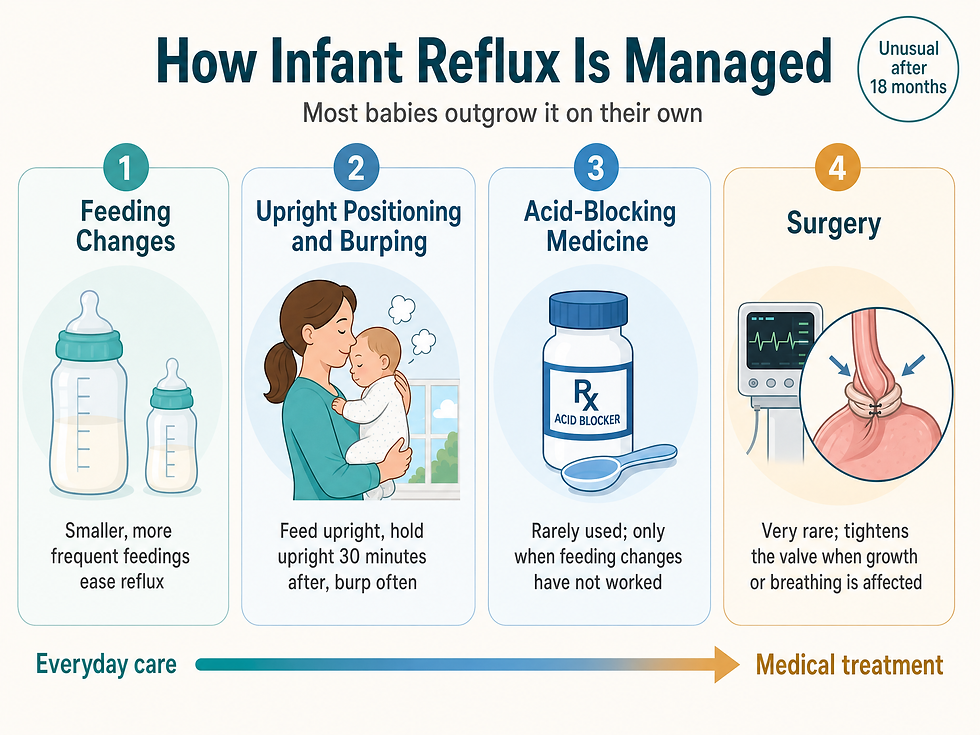
For most babies, making some changes to feeding eases infant reflux until it gets better on its own. Treatment only becomes necessary when reflux causes weight problems or other symptoms. [2]
Lifestyle and Home Remedies
Several simple steps can minimize reflux at home: [2]
Feed your baby in an upright position, then hold your baby in a sitting position for 30 minutes after feeding. Gravity can help stomach contents stay where they belong. Be careful not to jostle or jiggle your baby while the food is settling.
Try smaller, more frequent feedings. Feed a little less than usual if you are bottle-feeding, or cut back a little on nursing time.
Take time to burp your baby. Frequent burps during and after feeding keep air from building up in the stomach.
Put your baby to sleep on the back. Most babies should be placed on their backs to sleep, even if they have reflux.
Infant reflux is usually little cause for concern. Keep plenty of burp cloths handy as you wait for your baby's reflux to stop. [2]
Medicines
Reflux medicines are not typically used in children to treat reflux that is not complicated. A healthcare professional may recommend an acid-blocking medicine for several weeks or months. Acid-blocking medicines include cimetidine, famotidine and omeprazole. Medicine may be recommended if a baby has poor weight gain and changes in feeding have not worked, refuses to feed, has a swollen and irritated esophagus, or has chronic asthma. [2]
Surgery
Rarely, a baby may need surgery. This is only done if a baby is not gaining enough weight or has trouble breathing because of reflux. During the surgery, the LES between the esophagus and the stomach is tightened, which prevents acid from flowing back up into the esophagus. [2]
How Do You Prepare for a Doctor's Appointment?
You may start by seeing your baby's primary healthcare team, or you may be referred to a pediatric gastroenterologist, a specialist in children's digestive diseases. [2]
Before the visit, make a list of your baby's symptoms, including any that do not seem related to the reason for the appointment. Note key personal information, including major stresses, recent life changes and family medical history. Write down all medicines, vitamins or other supplements your baby takes, including doses. List your questions for the healthcare team, and note the baby's caregivers and how they feed the baby. Take a family member or friend along if possible, to help remember the information you are given. [2]
During the visit, you will likely be asked when the symptoms began, whether they are continuous or occasional, how bad they are, and what seems to improve or worsen the baby's condition. Useful questions to ask include: [2]
What is likely causing my baby's symptoms, and what are other possible causes?
What tests does my baby need?
Is my baby's condition likely temporary or chronic?
What is the best course of action, and what alternatives are there?
How can I manage the reflux alongside my baby's other health conditions?
Are there restrictions I need to follow, and should my baby see a specialist?
Conclusion and Next Steps
Infant acid reflux is a normal part of many babies' first year. It happens because the valve between the esophagus and stomach is still maturing, and it usually improves on its own, rarely continuing past 18 months. The best approach for most families is simple: feed upright, burp often, offer smaller and more frequent feeds, and keep plenty of burp cloths nearby. The warning signs are easy to remember, and if your baby has any of them, a healthcare professional can quickly sort out whether it is simple reflux or something that needs treatment. You are not doing anything wrong. This is just a stage, and it passes. [1] [2]
Ready to handle spit-up season with confidence? Try the four home steps in this guide for a few days, keep the warning-sign checklist handy, and bring your questions to your baby's next appointment.
Learn more. For more evidence-based health guides, visit Rinnit.com.
Frequently Asked Questions
What is infant acid reflux?
Infant acid reflux is when a baby spits up liquid or food because stomach contents move back up into the esophagus, the tube connecting the mouth to the stomach. It happens because the lower esophageal sphincter, the valve muscle at the top of the stomach, is not yet fully developed.
Is spitting up normal in babies?
Yes. Normal spitting up happens in about half of babies. As long as a baby is content and growing well, reflux is rarely a problem and usually gets better on its own as the valve muscle matures.
When does infant reflux stop?
Reflux becomes less common as a baby gets older, and it is unusual for infant reflux to continue after age 18 months. Many babies improve well before then.
When should I call the doctor about my baby's spit-up?
Call a healthcare professional if your baby is not gaining weight, spits up forcefully or shoots out stomach contents, spits up green or yellow fluid, spits up blood or coffee-ground-looking contents, refuses to feed, has blood in the stool, has trouble breathing or a cough that won't go away, begins spitting up at 6 months or older, is very irritable after eating, or has low energy.
What can I do at home to reduce reflux?
Feed your baby in an upright position and hold them upright for 30 minutes afterward, try smaller and more frequent feedings, burp your baby often during and after feeds, and always put your baby to sleep on their back, even with reflux.
Can infant reflux be treated with medicine?
Medicines are not typically used for uncomplicated reflux. A healthcare professional may recommend an acid-blocking medicine for several weeks or months if a baby has poor weight gain that feeding changes have not fixed, refuses to feed, has an irritated esophagus, or has chronic asthma. Surgery is only considered rarely, when a baby is not gaining weight or has trouble breathing because of reflux.
References
Mayo Clinic. Infant reflux: Symptoms and causes. Reviewed December 10, 2024. Accessed October 14, 2026.
Mayo Clinic. Infant reflux: Diagnosis and treatment. Reviewed December 10, 2024. Accessed October 14, 2026.
Seattle Children's Hospital. Spitting Up - Reflux. Last reviewed May 1, 2025. Accessed October 14, 2026.
Antono B, Dotson A. Gastroesophageal reflux in infants and children: diagnosis and treatment. Am Fam Physician. 2025;111(1):62-72. PMID: 39823617.
Tighe MP, Andrews E, Liddicoat I, et al. Pharmacological treatment of gastro-oesophageal reflux in children. Cochrane Database Syst Rev. 2023;8(8):CD008550. PMID: 37635269. DOI.
Fernández-González SM, Moreno-Álvarez A, Solar-Boga A. Proton pump inhibitors in pediatric gastroesophageal reflux disease: a systematic review of randomized controlled trials. Children (Basel). 2024;11(3):296. PMID: 38539331. DOI.
This guide is for informational purposes only and is not medical advice. Individual diagnosis and treatment decisions should always be made with a qualified healthcare professional.


Comments