Prosthesis: Types, Uses and Living With a Prosthetic

Updated: 2 days ago
Written and medically reviewed by Dr. Baraa Alnahhal, MD · Last reviewed: November 2026 · How we review
Quick Answer
A prosthesis is an artificial body part that replaces one that's missing or no longer works. Some are external and removable, such as a prosthetic arm or leg, an artificial eye or dentures. Others are implanted, such as a hip or knee replacement or an artificial heart valve. Getting used to one takes time, rehabilitation and lifelong care.
What the research says
Most hip replacements last decades: pooling national registry data on 215,676 hip replacements, about 58% were still in place after 25 years (Evans JT et al., Lancet, 2019) [2]
Knee replacements last even longer: in registry data on 299,291 total knee replacements, about 82% lasted 25 years, compared with about 70% of partial knee replacements (Evans JT et al., Lancet, 2019) [3]
Key takeaways
A prosthesis is an artificial body part.
External prostheses, like artificial limbs, can be removed; internal ones are implanted.
People need them after injury, amputation, cancer, birth differences or wear and tear.
Rehabilitation helps you learn to use a prosthesis.
Most need regular maintenance and eventual replacement.
What is a prosthesis?
The word "prosthetic" describes something artificial that replaces a body part, and prosthetics is the medical specialty that designs and fits them. Some prostheses mainly restore appearance, while others restore movement or function. In some cases, an internal prosthesis can replace a failing body part as well as, or better than, a transplant. Sources: [1]
Why you might need one

A prosthesis can restore movement, function and confidence.
A serious injury that needs reconstructive surgery.
Amputation due to injury or disease.
Removal of a body part to treat or prevent cancer.
Being born without a body part.
Long-term wear and tear, such as arthritis or cataracts.
Chronic disease, such as heart valve disease or inflammatory bowel disease. Sources: [1]
Types of prostheses
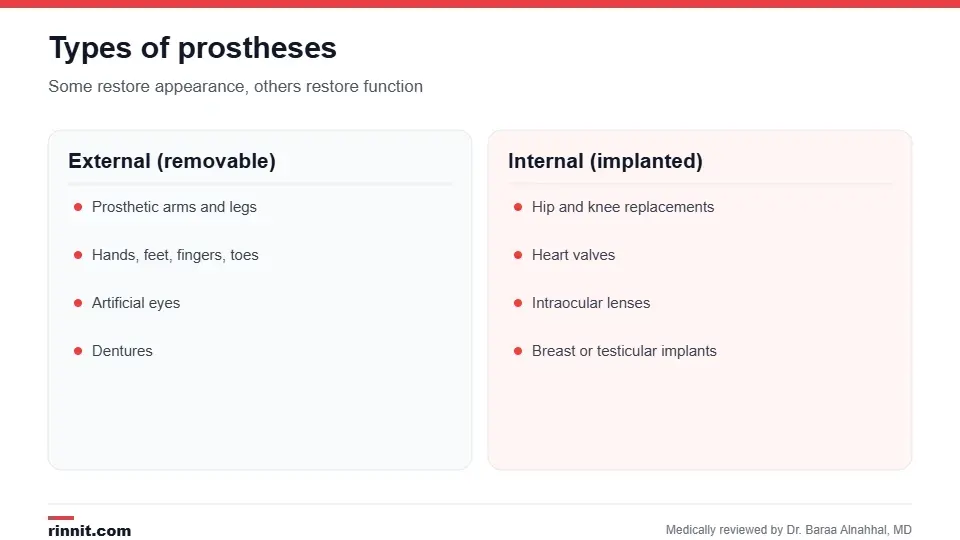
Some restore appearance, others restore function.
Type | Examples |
External (removable) | Prosthetic legs, arms, hands, feet, fingers and toes; artificial eyes; breast prostheses worn in a bra; dentures; ostomy bags |
Internal (implanted) | Joint replacements such as hip and knee; artificial cervical disk; mechanical heart valves or a total artificial heart; electronic voice box; breast, testicular or penile implants; dental bridges; intraocular lenses |
Sources: [1]
Getting and using a prosthesis
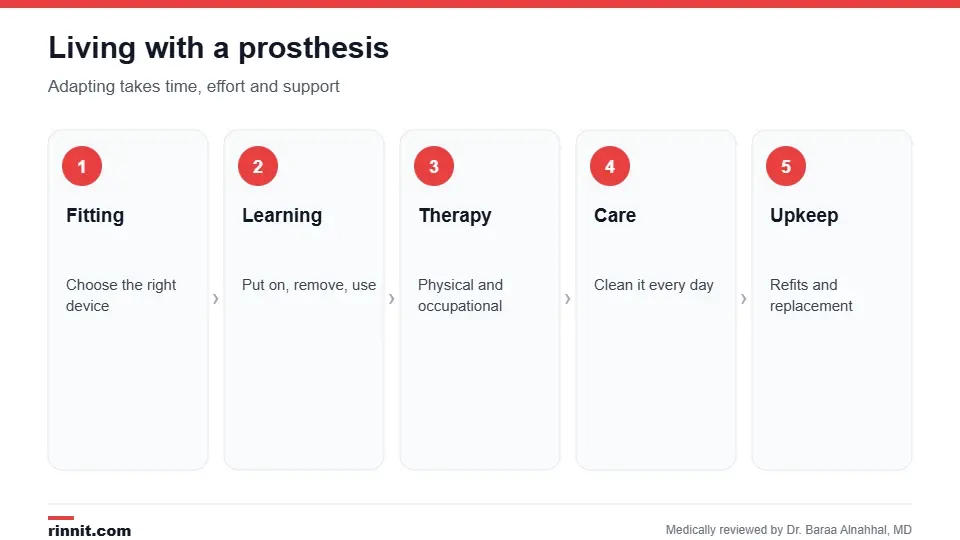
Adapting takes time, effort and support.
Your care team helps choose and fit the right prosthesis for your needs and goals.
Internal prostheses are placed during surgery, followed by surgical recovery.
For an external prosthesis, you learn to put it on, take it off and use it.
Physical therapy and occupational therapy help you build strength and skills.
You learn to clean and care for it every day. Sources: [1]
Risks and challenges
Challenge | Details |
Surgery risks | For internal prostheses, the usual risks of surgery |
Rehabilitation | Can be long and demanding |
Skin problems | Sores and discomfort where an external prosthesis touches the skin |
Implant problems | Loosening, shifting or infection of an internal prosthesis |
Limited lifespan | Most prostheses eventually need repair or replacement |
Ongoing care | Refittings, adjustments for growing children and sometimes long-term medicines |
Some people also deal with phantom limb pain after an amputation. Sources: [1]
Outlook
A prosthesis can make daily life easier, boost independence and improve confidence. How much it helps depends on your health, the type of prosthesis and your goals. Joint replacements, for example, often last for decades. Sources: [1, 2, 3]
When to call your provider
Your prosthesis doesn't fit well or causes pain.
You have skin sores or redness where it touches your body.
An implanted joint becomes painful, loose or unstable.
You have signs of infection, such as fever, warmth or swelling.
Conclusion
Prostheses replace body parts lost to injury, disease or birth differences, helping people move, work and live more independently. With good fitting, rehabilitation and ongoing care, many people do very well.
Keep learning: read about hip replacement and knee replacement.
Frequently asked questions
What is a prosthesis?
An artificial body part that replaces a missing or failing one.
What are the types of prostheses?
External ones you can remove, like limbs, and internal ones that are implanted.
What are examples of internal prostheses?
Hip and knee replacements, heart valves and intraocular lenses.
Why would someone need a prosthesis?
After injury, amputation, cancer, a birth difference or wear and tear.
How long does it take to adjust?
It varies; rehabilitation and practice take time.
Do prostheses last forever?
No. Most need repair, adjustment or replacement over time.
How long do hip and knee replacements last?
Many last 25 years or more.
What are the risks?
Surgery risks, skin sores, loosening and infection.
Who helps me learn to use a prosthesis?
Physical and occupational therapists.
Can a prosthesis work better than a transplant?
In some cases, it can work as well or better.
Related Reading
Prosthetic Foot: Types, Fitting and Living With One explains prosthetic foot types and fitting.
Prosthetic Arm: Types, Fitting and How It Works explains prosthetic arm types and fitting.
Amputation Surgery: Understanding Procedures, Causes, and Long-Term Recovery a common reason for a prosthetic limb.
Understanding Prosthetic Feet: A Guide to Types and Mobility types of prosthetic feet.
Hip Replacement Surgery: Procedure, Recovery Time and Risks a common internal prosthesis.
Knee Replacement: Restoring Mobility and Quality of Life another common joint prosthesis.
Understanding Phantom Limb Pain: Causes, Symptoms, and Management pain after limb loss.
References
Cleveland Clinic. Prosthesis: Definition, Types & Living With Prosthetics. Cleveland Clinic. Last updated May 15, 2024. https://my.clevelandclinic.org/health/treatments/prosthesis
Evans JT, Evans JP, Walker RW, et al. How long does a hip replacement last? A systematic review and meta-analysis of case series and national registry reports with more than 15 years of follow-up. Lancet. 2019;393(10172):647-654. PMID 30782340. https://doi.org/10.1016/S0140-6736(18)31665-9
Evans JT, Walker RW, Evans JP, et al. How long does a knee replacement last? A systematic review and meta-analysis of case series and national registry reports with more than 15 years of follow-up. Lancet. 2019;393(10172):655-663. PMID 30782341. https://doi.org/10.1016/S0140-6736(18)32531-5
Medical disclaimer
This article is for general education only and does not replace advice from a qualified healthcare professional. Talk to your doctor about your own diagnosis and treatment, and seek emergency care right away for severe or sudden symptoms.



Comments