Prosthetic Arm: Types, Fitting and How It Works

Updated: 2 days ago
Written and medically reviewed by Dr. Baraa Alnahhal, MD · Last reviewed: November 2026 · How we review
Quick Answer
A prosthetic arm (upper limb prosthesis) is an artificial replacement for part or all of an arm. It's used after an amputation or for a limb difference present at birth. Types include passive, body-powered and myoelectric arms. Fitting usually starts three to six weeks after amputation surgery, and adapting can take up to a year.
What the research says
Many people stop using their prosthetic arm: a review of about 200 articles found adults rejected body-powered arms in 26% and electric arms in 23% of cases on average, compared with 45% and 35% in children (Biddiss EA et al., Prosthetics and Orthotics International, 2007) [2]
Nerve rerouting surgery eased phantom pain: in a trial of 28 amputees with chronic pain, phantom limb pain scores fell 3.2 points with targeted muscle reinnervation versus a slight increase with standard nerve surgery at 1 year (Dumanian GA et al., Annals of Surgery, 2019) [3]
Key takeaways
A prosthetic arm replaces part or all of a missing arm.
Types include passive, body-powered, myoelectric and hybrid arms.
Fitting usually starts three to six weeks after amputation.
Therapy helps you learn to use it, often over a year.
Using a prosthesis helps prevent overuse of your other arm.
What is a prosthetic arm?
A prosthetic arm can replace the hand, wrist, elbow or shoulder. It may be mainly cosmetic or mainly functional, and some are made for specific activities. Learn more about prostheses and prosthetic hands. Sources: [1]
Who needs one
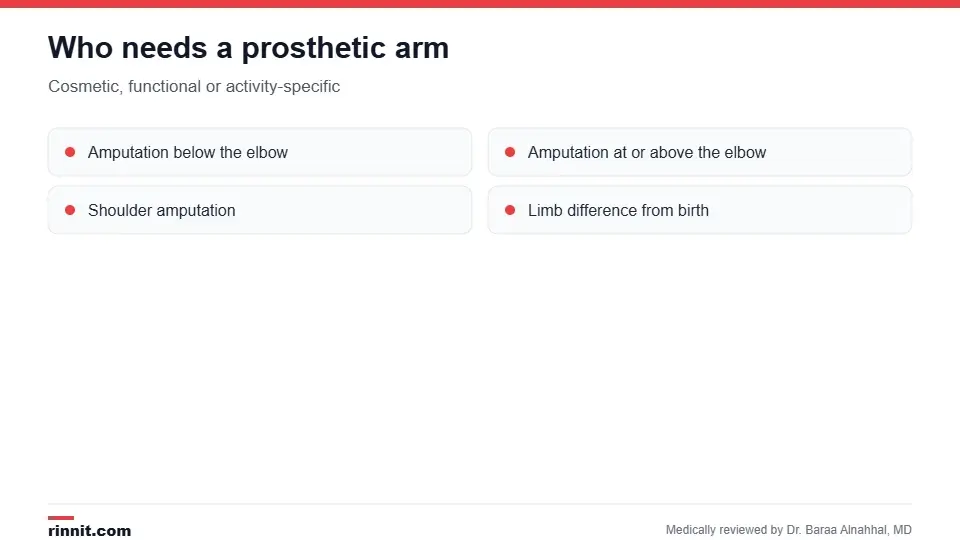
A prosthesis can be cosmetic, functional or activity-specific.
People with an amputation below or at the elbow, above the elbow or at the shoulder.
People born with a limb difference, such as congenital limb deficiency. Sources: [1]
Using a prosthesis helps your body spread the workload. Without one, you may overuse your other side, leading to neck or back pain and repetitive strain injuries. Sources: [1]
Types of prosthetic arms
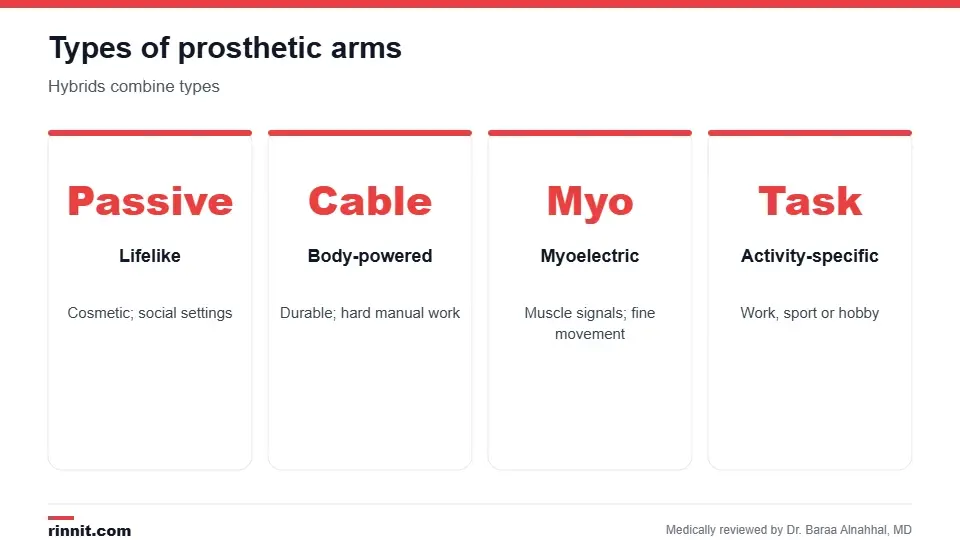
Many myoelectric arms use a bionic hand.
Type | How it works | Best for |
Passive | Lifelike silicone; can be positioned | Social settings |
Body-powered | Cables and a harness moved by other muscles | Hard, repetitive manual work; durable and weatherproof |
Activity-specific | Custom-made for a job, sport or hobby | Specific tasks |
Myoelectric | Skin electrodes read muscle signals | Fine movements; often a bionic hand |
Hybrid | Combines types, such as a body-powered elbow and myoelectric hand | Mixed needs |
Sources: [1, 2]
Getting fitted
Mental health support and peer groups can help.
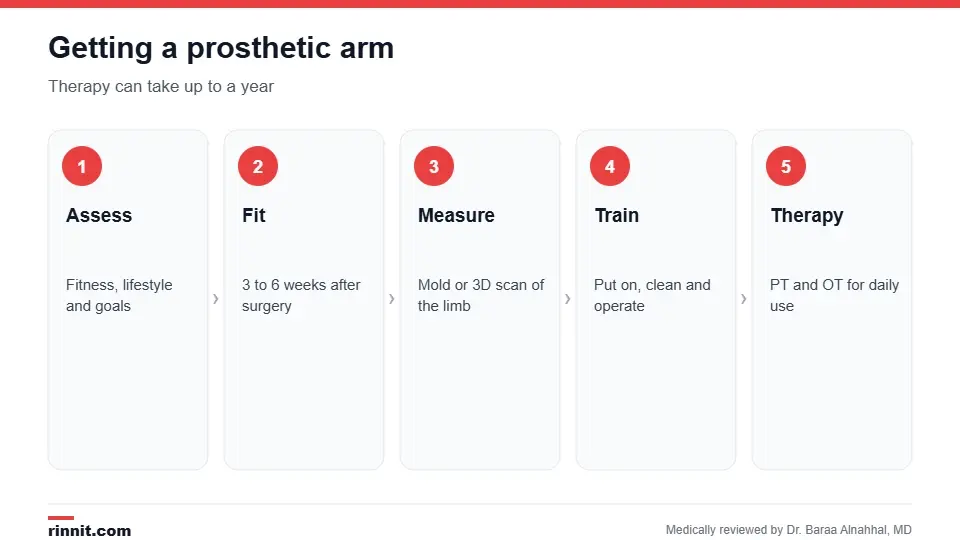
You're assessed for physical fitness, and you discuss your lifestyle and goals.
Fitting usually starts three to six weeks after amputation surgery.
A prosthetist measures your limb and may make a mold or 3D scan.
You learn to put on, remove, clean and operate the arm.
Physical therapy and occupational therapy help with daily use. Sources: [1]
Targeted muscle reinnervation
Targeted muscle reinnervation (TMR) is a newer surgery during amputation that reroutes cut nerves to other muscles. It can help prevent painful neuromas and phantom limb pain and improve control of a myoelectric arm. Sources: [1, 3]
Risks and challenges
Muscle strains with body-powered arms.
Mechanical failures or charging problems.
Pressure sores or chafing from a poor fit.
Sweat buildup. Sources: [1]
Most problems can be avoided with a good fit, training and maintenance. Sources: [1]
Adapting to your prosthesis
Therapy can take up to a year, and learning to program a bionic arm may take longer. Emotional adjustment takes time too, so mental health care and peer support are recommended. Prostheses need adjustments and repairs and eventually need replacing. Sources: [1]
When to call your prosthetist
Contact your care team if you have discomfort or problems with your prosthesis. Sources: [1]
Conclusion
Today's prosthetic arms are more functional and versatile than ever, though not the same as a natural limb. The right type, a good fit and dedicated training help you get the most from yours.
Keep learning: read about prosthetic hands and phantom limb pain.
Frequently asked questions
What is a prosthetic arm?
An artificial replacement for part or all of an arm.
Who needs a prosthetic arm?
People with an arm amputation or a limb difference from birth.
What types are there?
Passive, body-powered, activity-specific, myoelectric and hybrid.
What is a myoelectric arm?
An arm controlled by muscle signals picked up through the skin.
What is a body-powered arm?
An arm moved by cables and a harness connected to other muscles.
When can I get fitted?
Usually three to six weeks after amputation surgery.
How long does it take to learn?
Therapy can take up to a year.
What is targeted muscle reinnervation?
Surgery that reroutes nerves to help control a prosthesis and ease pain.
Why use a prosthetic arm?
To improve function and avoid overusing your other arm.
Do prosthetic arms need replacing?
Yes. They need repairs and eventually replacement.
Related Reading
Prosthetic Foot: Types, Fitting and Living With One explains prosthetic foot types and fitting.
Understanding Prosthetic Hands: A Guide to Types, Technology, and Benefits types of prosthetic hands.
Amputation Surgery: Understanding Procedures, Causes, and Long-Term Recovery amputation and recovery.
Understanding Phantom Limb Pain: Causes, Symptoms, and Management pain after amputation.
Prosthesis: Types, Uses and Living With a Prosthetic an overview of prostheses.
Occupational Therapy: What It Is, Who Needs It, and What to Expect learning daily tasks.
References
Cleveland Clinic. Prosthetic Arm: What It Is, Who Needs It & How It's Used. Cleveland Clinic. Last updated August 7, 2024. https://my.clevelandclinic.org/health/treatments/prosthetic-arm
Biddiss EA, Chau TT. Upper limb prosthesis use and abandonment: a survey of the last 25 years. Prosthet Orthot Int. 2007;31(3):236-257. PMID 17979010. https://doi.org/10.1080/03093640600994581
Dumanian GA, Potter BK, Mioton LM, et al. Targeted muscle reinnervation treats neuroma and phantom pain in major limb amputees: a randomized clinical trial. Ann Surg. 2019;270(2):238-246. PMID 30371518. https://doi.org/10.1097/SLA.0000000000003088
Medical disclaimer
This article is for general education only and does not replace advice from a qualified healthcare professional. Talk to your doctor about your own diagnosis and treatment, and seek emergency care right away for severe or sudden symptoms.



Comments