Prosthetic Foot: Types, Fitting and Living With One

Updated: 2 days ago
Written and medically reviewed by Dr. Baraa Alnahhal, MD · Last reviewed: November 2026 · How we review
Quick Answer
A prosthetic foot replaces part or all of a natural foot after amputation, helping you walk and stay active. The most common reason for foot amputation is diabetes-related foot problems. A prosthetist custom-makes it over several weeks, and getting used to it can take months. Most prosthetic feet last three to five years.
What the research says
Powered feet lowered the energy cost of walking: across 15 studies of 141 people with below-knee amputation, feet with powered ankle motion reduced the energy needed to walk compared with energy-return feet, which didn't beat simpler feet on level ground (Hafner BJ et al., PM&R, 2022) [2]
Energy-return and powered feet gave more push-off: a review of 28 studies found push-off power rose with walking speed for energy-return and powered feet, but not for basic SACH feet (Müller R et al., PLOS One, 2019) [3]
Key takeaways
A prosthetic foot replaces part or all of a missing foot.
Diabetes-related problems are the most common cause of foot amputation.
Types range from simple to computer-controlled.
A prosthetist custom-makes each foot.
Most prosthetic feet last three to five years.
What is a prosthetic foot?
A prosthetic foot is a type of prosthesis. It attaches to a custom socket on your residual limb using suspension systems such as vacuum suction or a pin lock. Learn more about prosthetic feet. Sources: [1]
Who needs one

It can restore mobility, independence and quality of life.
Diabetes-related foot problems, the most common reason.
Trauma.
Infection.
Tumors.
Peripheral artery disease. Sources: [1]
Types of prosthetic feet
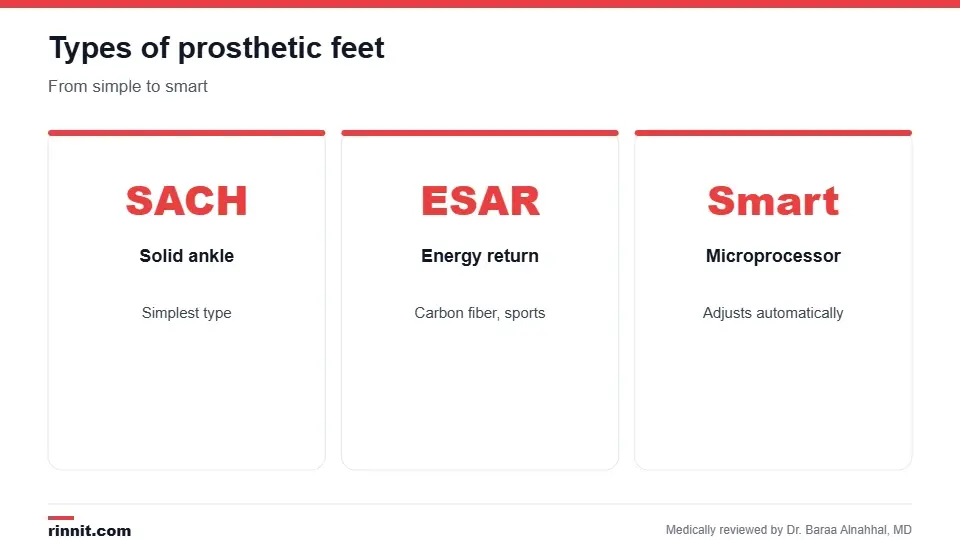
Partial-foot options are available too.
Type | Key feature |
SACH | Simplest; solid ankle, often temporary |
Flexible keel | Flexes a little for uneven ground |
Axial | Mechanical ankle; durable and stable |
Hydraulic | Fluid for smooth motion and shock absorption |
Energy-return (ESAR) | Carbon fiber returns energy; common for sports |
Microprocessor | Sensors adjust automatically; battery powered |
Specialty | Running, swimming, showering and other activities |
Partial-foot options include shoe inserts, ankle-foot orthoses, silicone prostheses and carbon fiber footplates. Sources: [1, 2, 3]
Getting a prosthetic foot
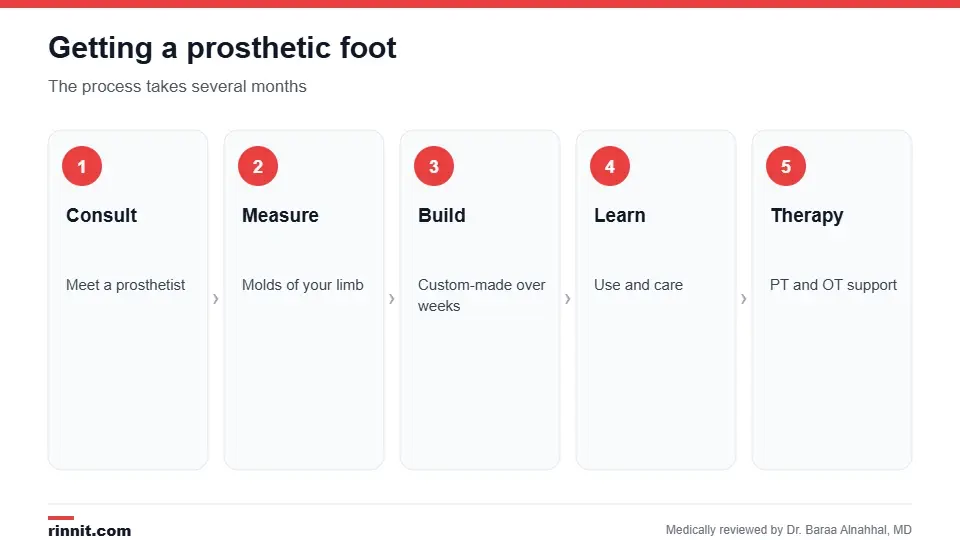
The whole process takes several months.
Meet with a prosthetist to discuss your needs and goals.
Your limb is measured and molded.
Your foot is custom-made over several weeks.
You learn how to use, clean and care for it.
Physical or occupational therapy helps with daily activities. Sources: [1]
Risks and challenges
Pressure sores.
Skin irritation from sweat.
Balance problems or muscle strains.
Mechanical failures.
Microprocessor feet need nightly charging and must stay dry. Sources: [1]
Living with a prosthetic foot
Don't sleep with your prosthesis on.
You can drive; hand controls can be added to a car.
A counselor or support group can help with the emotional adjustment.
Adjusting can take several months. Sources: [1]
Outlook
Most prosthetic feet last three to five years, depending on use. Your fit may need adjusting sooner as your residual limb changes shape. Your prosthetist can help solve any problems. Sources: [1]
Conclusion
A prosthetic foot can restore your mobility and independence after amputation. Choosing the right type with your prosthetist and working with therapists help you walk safely and confidently.
Keep learning: read about prosthetic arms and amputation recovery.
Frequently asked questions
What is a prosthetic foot?
An artificial foot that replaces part or all of a missing foot.
Why do people need prosthetic feet?
Most often after amputation from diabetes-related foot problems.
What is a SACH foot?
The simplest type, with a solid ankle and cushioned heel.
What is a bionic foot?
A microprocessor foot with sensors that adjust automatically.
What feet are best for sports?
Energy-return carbon fiber feet and specialty sports feet.
How long does it take to get one?
The whole process takes several months.
Can I sleep in my prosthesis?
No.
Can I drive with a prosthetic foot?
Yes; hand controls can be added if needed.
How long do prosthetic feet last?
Usually three to five years.
What problems can happen?
Pressure sores, skin irritation and balance problems.
Related Reading
Understanding Prosthetic Feet: A Guide to Types and Mobility more on prosthetic feet.
Prosthesis: Types, Uses and Living With a Prosthetic an overview of prostheses.
Prosthetic Arm: Types, Fitting and How It Works upper limb prostheses.
Amputation Surgery: Understanding Procedures, Causes, and Long-Term Recovery amputation and recovery.
Limb Salvage Surgery: An Alternative to Amputation an alternative to amputation.
References
Cleveland Clinic. Prosthetic Foot: What It Is, Who Needs It & How It's Used. Cleveland Clinic. Last updated August 7, 2024. https://my.clevelandclinic.org/health/treatments/prosthetic-foot
Hafner BJ, Halsne EG, Morgan SJ, et al. Effects of prosthetic feet on metabolic energy expenditure in people with transtibial amputation: a systematic review and meta-analysis. PM&R. 2022;14(9):1099-1115. PMID 34390623. https://doi.org/10.1002/pmrj.12693
Müller R, Tronicke L, Abel R, et al. Prosthetic push-off power in trans-tibial amputee level ground walking: a systematic review. PLOS One. 2019;14(11):e0225032. PMID 31743353. https://doi.org/10.1371/journal.pone.0225032
Medical disclaimer
This article is for general education only and does not replace advice from a qualified healthcare professional. Talk to your doctor about your own diagnosis and treatment, and seek emergency care right away for severe or sudden symptoms.



Comments