Omentectomy: Why It's Done, Types, Risks and Recovery

Updated: 6 days ago
Written and medically reviewed by Dr. Baraa Alnahhal, MD · Last reviewed: October 2026 · How we review
Quick Answer: What is an omentectomy?
An omentectomy is surgery to remove part or all of the omentum, a layer of fatty tissue and blood vessels covering the stomach and intestines. It is mainly done during cancer surgery to remove cancer that has spread there, help stage cancer, or ease abdominal fluid buildup. Recovery ranges from a few weeks to up to eight weeks. [1]
What the research says
Removing the omentum during stomach cancer surgery may not improve survival. A pooled analysis of 9 studies with 3,561 patients found no significant difference in 5-year overall survival between omentectomy and keeping the omentum (risk ratio 0.95); keeping it shortened surgery by about 26 minutes and cut blood loss by about 56 mL. (Lin et al., Surgery, 2022) [2]
Complication rates were similar with or without omentum removal. Across 7 studies with 1,879 patients with locally advanced stomach cancer, overall complications were 31.8% when the omentum was kept versus 30.3% when it was removed, and major complications were 9.2% versus 10.1%. (Chen et al., Int J Surg, 2021) [3]
In presumed early ovarian cancer, omentectomy finds hidden spread in a small share of patients. Hidden omental metastases were reported in 2%–4% of patients, moving 3%–11% up to stage IIIA, and guidelines recommend omentectomy as part of staging surgery. (Bolze et al., Gynecol Obstet Fertil Senol, 2019) [4]
Key takeaways
An omentectomy removes all (total) or part (partial) of the omentum. [1]
The surgery is mainly a cancer treatment and is usually one step in a larger operation. [1]
Cancer rarely starts in the omentum but often spreads there, especially from the ovaries and stomach. [1]
Surgeons may use small cuts (laparoscopic or robotic) or one long cut (open surgery). [1]
A specific risk is bowel obstruction caused by bands of scar tissue. [1]
Recovery takes a few weeks after smaller surgery and up to eight weeks after major surgery. [1]
What is an omentectomy?
An omentectomy (pronounced "oh-men-TEK-tuh-me") is a surgical procedure that removes all or part of the omentum. [1]
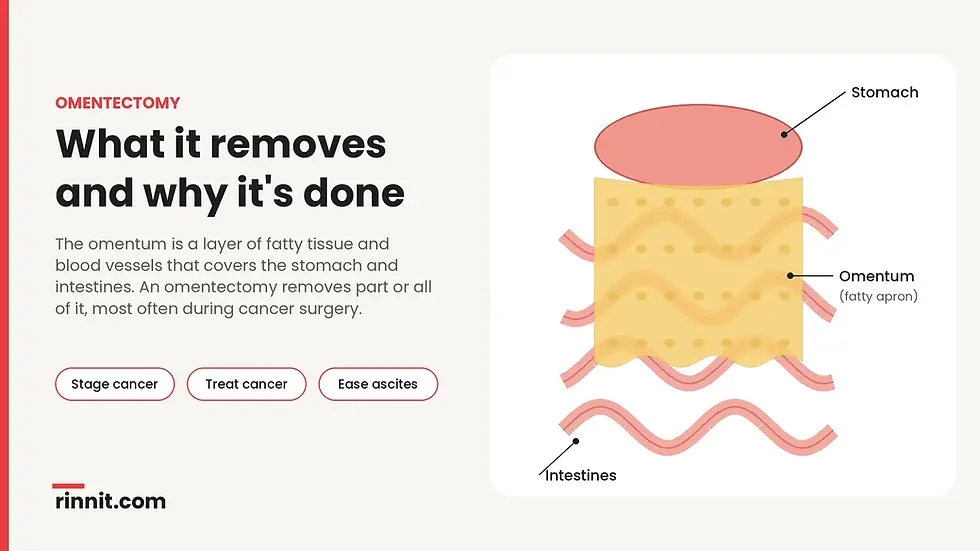
The omentum is a layer of fatty tissue and blood vessels. It covers some of the organs in your abdominal cavity, such as your stomach and intestines. [1]
Think of it as a fatty apron hanging over your abdominal organs. When cancer develops in the belly, this apron is a common place for it to spread. [1]
Why is an omentectomy done?
An omentectomy is done mainly to treat cancer, either cancer in the omentum itself or nearby cancer that is likely to spread there. [1]
It is rare for cancer to begin in the omentum. It is common, though, for cancer to spread to it from other places in the abdomen, especially the ovaries and the stomach. [1]
Sometimes surgeons remove the omentum to look for microscopic signs of cancer. This helps your care team find the cancer stage and plan the right treatment. [1]
What are the types of omentectomy?
The two types of omentectomy are total omentectomy, which removes the entire omentum, and partial omentectomy, which removes only a portion of it. [1]
Surgeons can also reach the omentum in two different ways. [1]
Feature | Option 1 | Option 2 |
Type | Total: the whole omentum is removed | Partial: a portion of the omentum is removed |
Surgical method | Open surgery: one long cut in the abdomen | Laparoscopic or robotic: several small cuts |
Hospital stay | May be longer, especially if several organs are removed | May be shorter |

Which surgeries are commonly combined with an omentectomy?
An omentectomy is usually performed as part of a larger cancer operation, not as a single procedure. If cancer is present in other places, your surgeon will aim to remove it all at once. [1]
Combined surgery | What it removes |
The uterus | |
Salpingectomy | One or both fallopian tubes |
Oophorectomy | One or both ovaries |
Prostatectomy | The prostate |
Part or all of the stomach | |
Part or all of the colon | |
Retroperitoneal lymph node dissection | One or several lymph nodes in the abdomen |
Cytoreductive (debulking) surgery | Cancer throughout the abdomen, such as peritoneal carcinomatosis |
Sources: [1]
How should you prepare for an omentectomy?
Preparing for an omentectomy starts with a meeting with a team of specialists who explain the procedure, its risks and its benefits. [1]
The team will also check your overall health. This makes sure you are fit for general anesthesia and the operation. [1]
Bring your questions to this meeting. It is normal to feel worried or scared before surgery, and your surgeon should answer every question you have. [1]
What happens during an omentectomy?
What happens during an omentectomy depends on three main factors: the surgical method, the type of omentectomy, and how far the cancer has spread. [1]
What are the risks of an omentectomy?
The risks of an omentectomy include the general risks of any surgery plus one specific risk: bowel obstruction. [1]
Risk | Details |
Anesthesia problems | A risk with any operation under general anesthesia [1] |
Bleeding | Can happen during or after surgery [1] |
Infection | A small risk with any surgery [1] |
Injury to nearby organs | Organs close to the omentum can be affected [1] |
Bands of scar tissue inside the abdomen can partly or fully block the bowel [1] |
All surgeries carry a small risk of complications. If your care team recommends an omentectomy, it is because they believe the benefits outweigh the risks. [1]
What happens after an omentectomy?
After an omentectomy, most people spend several days recovering in the hospital. The stay may be shorter if your surgeon used small cuts, and longer if several organs were removed. [1]
Your surgeon will go over the results of the surgery and any important lab findings. Together, you will review your condition and the next steps in your treatment plan. [1]
Cancer surgery is often followed by other treatments to make sure no cancer cells are left behind. This may include chemotherapy or radiation therapy. [1]
How long is omentectomy recovery?
Omentectomy recovery takes anywhere from a few weeks to up to eight weeks, depending on the type of surgery and how extensive it was. [1]
Situation | Typical recovery |
Hospital stay | Several days; shorter with small cuts, longer if several organs are removed |
Smaller operation | A few weeks |
Major operation removing multiple organs | Up to 8 weeks |
Sources: [1]

Your surgical team will tell you what to expect for your own case. [1]
What is the outlook after an omentectomy?
The outlook after an omentectomy depends on how far the cancer has spread. If cancer in the omentum is limited, removing it may be a cure. If cancer has spread to many places, removing as much of it as possible may improve your outcome. [1]
An omentectomy can be a life-changing cancer treatment. How the surgery affects you depends on your own situation, so talk honestly with your surgeon about what to expect. [1]
Conclusion
An omentectomy removes part or all of the fatty apron that covers your abdominal organs. It is mainly part of cancer surgery, where it helps stage the disease, remove cancer that has spread, and sometimes cure it. Recovery ranges from a few weeks to up to eight weeks, and many people go on to further treatment such as chemotherapy or radiation.
If an omentectomy is part of your care plan, write down your questions before you meet your surgical team, and ask what recovery will look like for your specific operation.
Keep learning with Rinnit. Explore our clear, evidence-based guides on ovarian cancer, stomach cancer and chemotherapy, and follow us on YouTube and Instagram for new health explainers every week.
FAQ
What is an omentectomy?
An omentectomy is a surgical procedure to remove all or part of the omentum, a layer of fatty tissue and blood vessels that covers the stomach and intestines. Surgeons usually perform it as part of a larger cancer operation.
Why would someone need an omentectomy?
Doctors recommend an omentectomy mainly when cancer is in the omentum or nearby cancer is likely to spread there, especially from the ovaries or stomach. The surgery can also help stage cancer and treat fluid buildup in the belly.
What is the difference between a partial and a total omentectomy?
A total omentectomy removes the entire omentum, while a partial omentectomy removes only a portion of it. Your surgeon chooses the type based on your condition and the extent of the cancer.
Is an omentectomy done on its own?
An omentectomy is usually done as part of a larger cancer surgery, not as a single procedure. Common combined surgeries include hysterectomy, oophorectomy, gastrectomy, colectomy and debulking surgery.
What are the risks of an omentectomy?
The risks of an omentectomy include anesthesia problems, bleeding, infection and injury to nearby organs. A specific risk is bowel obstruction caused by bands of scar tissue inside the abdomen.
How long does it take to recover from an omentectomy?
Recovery from an omentectomy takes a few weeks after a smaller operation and up to eight weeks after major surgery that removes multiple organs. Most people first spend several days in the hospital.
Will I need more treatment after an omentectomy?
Many people need more treatment after an omentectomy, because cancer surgery is often followed by chemotherapy or radiation therapy to clear any remaining cancer cells. Your care team will plan next steps based on your surgery results.
Can you live without an omentum?
Yes. People live normal lives without an omentum, because other parts of the body take over its roles.
Is an omentectomy done with open or keyhole surgery?
It can be done through one larger cut (open surgery) or through small cuts with a camera (laparoscopic or robotic surgery). The choice depends on the cancer and which other organs need to be removed.
Why is the omentum removed in ovarian cancer surgery?
Ovarian cancer often spreads to the omentum. Removing it helps doctors stage the cancer and takes out cancer cells that may be hidden there.
Related Reading
What Is Omentum Cancer? Causes, Symptoms, and Treatment explains cancer that starts in or spreads to the omentum.
Ovarian Cancer: Symptoms, Causes, and Treatment — A Clear Guide to Understanding and Managing the Disease covers ovarian cancer symptoms, staging and treatment.
Peritoneal Carcinomatosis: Symptoms, Causes & Treatment — Cancer Spreading to the Abdominal Lining explains cancer that spreads across the lining of the abdomen.
HIPEC (Hyperthermic Intraperitoneal Chemotherapy): How It Works, Recovery, and Risks describes heated chemotherapy given inside the abdomen during surgery.
References
Cleveland Clinic. Omentectomy. Cleveland Clinic. Last updated February 2, 2026. https://my.clevelandclinic.org/health/treatments/24007-omentectomy
Lin HW, Loh EW, Shen SC, et al. Gastrectomy with or without omentectomy for gastric cancer: A systematic review and meta-analysis. Surgery. 2022;171(5):1281-1289. PMID 34857385. https://doi.org/10.1016/j.surg.2021.10.052
Chen M, He FQ, Liao MS, et al. Gastrectomy with omentum preservation versus gastrectomy with omentectomy for locally advanced gastric cancer: A systematic review and meta-analysis. Int J Surg. 2021;96:106176. PMID 34763112. https://doi.org/10.1016/j.ijsu.2021.106176
Bolze PA, Collinet P, Golfier F, et al. Surgery in early-stage ovarian cancer: Article drafted from the French Guidelines in oncology entitled "Initial management of patients with epithelial ovarian cancer" developed by FRANCOGYN, CNGOF, SFOG, GINECO-ARCAGY under the aegis of CNGOF and endorsed by INCa [in French]. Gynecol Obstet Fertil Senol. 2019;47(2):168-179. PMID 30686727. https://doi.org/10.1016/j.gofs.2018.12.007
Further reading:
National Cancer Institute. Omentectomy. NCI Dictionary of Cancer Terms. National Cancer Institute. Accessed October 31, 2026. https://www.cancer.gov/publications/dictionaries/cancer-terms/def/omentectomy
Medical disclaimer
This article is for general educational purposes only and does not replace professional medical advice, diagnosis or treatment. Always talk with your doctor or surgical team about your own condition and treatment options.



Comments