Peritoneal Carcinomatosis: Symptoms, Causes & Treatment — Cancer Spreading to the Abdominal Lining

Updated: 2 days ago
Medically reviewed by Dr. Baraa Alnahhal, MD · Last reviewed: September 2026
TL;DR
Peritoneal carcinomatosis is a serious condition that happens when cancer spreads to the peritoneum — the lining of the abdomen. It usually comes from cancers that start in other organs, such as the colon, stomach, or ovaries, and is usually a sign that the cancer is at a late stage. The most common symptom is abdominal swelling or bloating caused by fluid buildup called ascites, along with abdominal pain, loss of appetite, unexplained weight loss, fatigue, nausea, and bowel changes. Diagnosis combines imaging tests (CT, MRI, PET), fluid analysis (peritoneal washing cytology), and sometimes staging laparoscopy, because scans can miss early disease. Treatment usually requires a combination of systemic chemotherapy, cytoreductive surgery (CRS) to remove visible cancer, HIPEC (heated chemotherapy placed directly into the abdomen during surgery), and sometimes PIPAC (aerosolized chemotherapy). When cure is not possible, palliative care focuses on comfort and quality of life. Newer treatments can help some people feel better and live longer — and sometimes may even lead to a cure.
Quick Answer: What Is Peritoneal Carcinomatosis?
Peritoneal carcinomatosis is a condition in which cancer spreads to the peritoneum, the lining of the abdomen.
It usually comes from cancers that start in other organs — most commonly the ovaries, colon or rectum, stomach, pancreas, or appendix.
It is usually a sign that the cancer is at a late stage.
The most common symptom is abdominal swelling or bloating caused by fluid buildup called ascites; pain, appetite loss, weight loss, nausea, bowel changes, and bleeding also occur.
Scans alone often miss early disease, so diagnosis combines imaging with fluid tests (peritoneal washing cytology) and staging laparoscopy.
Treatment combines systemic chemotherapy, cytoreductive surgery (CRS), and HIPEC — heated chemotherapy placed directly into the abdomen — plus newer methods like PIPAC.
Newer treatments can help some people feel better and live longer, and sometimes may even lead to a cure; palliative care supports comfort and quality of life when cure is not possible.

What Is Peritoneal Carcinomatosis?
Peritoneal carcinomatosis is a serious condition that happens when cancer spreads to the lining of the abdomen, called the peritoneum. It usually comes from cancers that start in other organs, such as the colon, stomach, or ovaries. Peritoneal carcinomatosis is usually a sign that the cancer is at a late stage.
Peritoneum: the thin lining of the abdominal cavity that covers the organs in the belly.
Peritoneal carcinomatosis can cause belly pain and swelling, blockage in the bowels, and loss of appetite. Treatments for this condition include chemotherapy, surgery, or newer methods that place heated medicine directly into the abdomen. These newer treatments can help some people feel better and live longer. Sometimes they may even lead to a cure.
One distinction matters for understanding the condition: cancer that starts in the peritoneum is called primary peritoneal cancer, which is much rarer. Peritoneal carcinomatosis that has spread from other organs is considered a secondary or metastatic cancer. The most common primary peritoneal cancer is peritoneal mesothelioma.
What Are the Symptoms of Peritoneal Carcinomatosis?
Some people may notice symptoms early, while others may not feel anything until the disease has gotten worse. Symptoms often become more noticeable when cancer cells grow and start affecting nearby organs, such as the intestines, bladder, and stomach.
The most common symptoms include:
Symptom | What it looks like |
Abdominal swelling or bloating | The most common symptom; caused by fluid buildup called ascites in the belly — may feel like gaining weight in the belly despite exercise; women in menopause may appear as if they are pregnant |
Abdominal pain or discomfort | Often described as vague cramping or pressurelike pain |
Loss of appetite | Feeling full quickly, even after small meals |
Losing weight without trying | Weight loss not related to changes in diet or activity |
Fatigue | Feeling very tired, even after resting |
Nausea and vomiting | Often linked to bowel issues caused by tumor pressure |
Bowel changes | Constipation or diarrhea and, sometimes, a blockage that prevents food or gas from passing |
Bleeding | Rectal or vaginal bleeding may occur |
Other possible symptoms include:
Symptom | What it looks like |
Urinary symptoms | If cancer spreads near the bladder or ureters, it may cause changes in urination or block urine flow — the ureters are thin tubes that carry urine from each kidney to the bladder |
Shortness of breath | Usually due to pressure from fluid buildup pushing on the lungs |
What Causes Peritoneal Carcinomatosis?
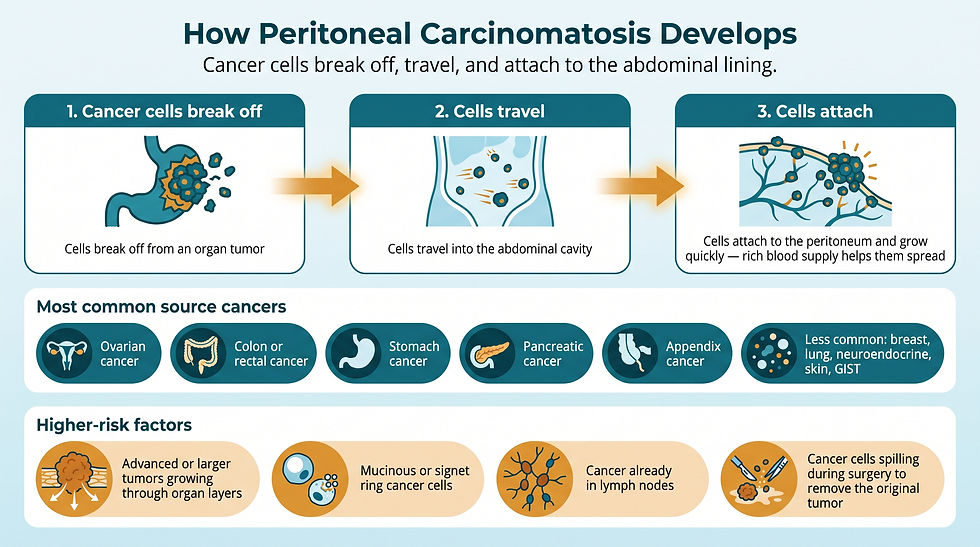
Peritoneal carcinomatosis develops in three steps: cancer cells break off from other organs, then travel into the abdominal cavity, and finally attach to the lining of the belly (the peritoneum). The peritoneum has a large surface area with a rich blood supply, which allows cancer cells to grow quickly.
The most common cancers that can lead to peritoneal carcinomatosis include:
Source cancer | Notes |
Ovarian cancer | One of the most common sources |
Colon or rectal cancer | A leading source; right-sided colon cancers are more likely to spread to the peritoneum |
Stomach cancer | A common source of peritoneal spread |
Pancreatic cancer | Can spread to the peritoneum |
Appendix cancer | Can spread to the peritoneum |
Less common sources | Breast, lung, neuroendocrine or skin cancer, or gastrointestinal stromal tumors |
Who Is Most at Risk?
Most of the time, peritoneal carcinomatosis happens when cancer spreads to the peritoneum from another part of the body. Some traits of the cancer or the person can make the cancer more likely to spread to the peritoneum:
Risk factor | Why it raises risk |
Advanced or larger cancers | Cancers that grow through the outermost layers of the organs or spread to lymph nodes are more likely to reach the peritoneum |
Certain types of cancer cells | Mucinous and signet ring cancer cells are strongly linked to peritoneal carcinomatosis; they can be fast growing and aggressive and are more likely to spread throughout the abdomen rather than stay in one spot |
Lymph node involvement | When cancer has already spread to nearby lymph nodes, the risk of peritoneal carcinomatosis is higher |
Surgery to remove primary cancer | If cancerous tissue is accidentally cut or leaks during surgery, cancer cells can spill into the abdominal cavity and implant on the peritoneum, growing into new cancers |
Cancer location | Cancers on the right side of the colon are more likely to spread to the peritoneum than cancers on the left side |
What Complications Can It Cause?
Peritoneal carcinomatosis can lead to several serious complications as the cancer spreads and affects organs within the abdominal cavity:
Complication | Effect |
Fluid buildup in the belly (ascites) | Causes bloating, discomfort, shortness of breath, and sometimes infection; fluid may need to be drained often, sometimes through catheters managed at home |
Bowel blockage (obstruction) | Cancer presses on or wraps around the intestines; causes severe pain and vomiting and makes it difficult to pass stool or eat; may require emergency surgeries |
Urinary blockage | Cancer presses on or grows around the ureters, blocking the flow of urine |
Trouble absorbing nutrients | When the intestines are not working well, the body cannot take in enough nutrients; over time this weakens the person and raises the risk of infections or poor nutrition |
How Is Peritoneal Carcinomatosis Diagnosed?
Peritoneal carcinomatosis often spreads across the abdominal lining without forming distinct masses. Because of this, doctors usually need to combine imaging, fluid tests, and sometimes surgery to confirm a diagnosis.
Test | What it involves | What it shows |
Imaging tests (CT, MRI, PET) | Scans are typically the first step in looking for suspected peritoneal carcinomatosis | Visible tumor spread, fluid buildup, or organ involvement; however, imaging is often not sensitive enough to detect smaller cancers or early peritoneal disease — a negative scan does not rule out peritoneal carcinomatosis |
Peritoneal washing cytology | Fluid from the abdominal cavity is collected during a minor procedure and examined under a microscope | Whether cancer cells are floating in the peritoneal fluid; a positive result is a strong sign of peritoneal spread even when no visible cancer is present |
Staging laparoscopy | A safe, minimally invasive surgical procedure using a small camera to look directly inside the abdominal cavity | Allows inspection of the peritoneum, finding hidden tumors, and taking tissue or fluid samples; especially valuable for metastases too small to be seen with imaging |
Tumor marker tests | A blood sample is used to look for chemicals made by cancer cells | Chemical markers consistent with cancer |
Circulating tumor DNA (ctDNA) | A newer blood test that looks for small pieces of DNA from cancer cells in the blood | Can help find peritoneal cancer that does not show up on scans; however, the role of ctDNA in diagnosis is still uncertain |
How Is Peritoneal Carcinomatosis Treated?
Treatment often requires a combination of therapies. The exact plan depends on where the cancer started, how far it has spread, and the person's overall health. The healthcare team also considers treatment goals, such as extending life, symptom relief, or both.
Systemic Chemotherapy
The most common treatment is systemic chemotherapy — medicine given through the blood to reach the whole body. Chemotherapy uses strong medicines to kill cancer cells, help shrink tumors, and relieve symptoms such as pain or bloating. It may also allow for surgery later.
One important limitation: systemic chemotherapy doesn't reach the peritoneum as well as it does other parts of the body, which can limit how well it works for peritoneal carcinomatosis.
Immunotherapy
Immunotherapy is another type of systemic treatment that may be offered for certain cancers.
Cytoreductive Surgery (CRS)
Cytoreductive surgery (CRS) removes all visible cancer from the peritoneum and other organs in the abdomen. Also known as debulking surgery, CRS is a major operation and should only be done in centers with experience. It is best for people who are healthy enough for surgery and whose cancer can be mostly or completely removed.
Hyperthermic Intraperitoneal Chemotherapy (HIPEC)
Hyperthermic intraperitoneal chemotherapy (HIPEC) is typically combined with CRS. After the cancer is removed during surgery, the abdominal cavity is bathed with heated chemotherapy to target any remaining microscopic cancer cells.
This combined approach — often referred to as CRS-HIPEC or HIPEC surgery — allows for higher medicine concentrations to reach cancer in the peritoneum. It can also lessen the typical side effects of systemic chemotherapy because less medicine is absorbed into the bloodstream. Research has shown that HIPEC can prevent cancer from returning for certain people, and HIPEC may prolong survival.
Pressurized Intraperitoneal Aerosolized Chemotherapy (PIPAC)
Pressurized intraperitoneal aerosolized chemotherapy (PIPAC) is a newer method. During PIPAC, a special aerosolized mist of chemotherapy is put directly into the belly during a minimally invasive procedure. The medicine is given as a fine aerosol under pressure, which helps it spread evenly throughout the abdomen. PIPAC is typically done when surgery isn't possible or when surgery would be too risky or not helpful.
Palliative Care
When peritoneal carcinomatosis cannot be cured or treated with chemotherapy or surgery, the focus may turn to comfort and quality of life. Palliative care is a special type of healthcare that focuses on relieving pain and other symptoms, such as digestive issues, malnutrition, and fluid buildup (ascites). Treatments may include fluid drainage, pain relief medicines, and nutritional support.
Palliative care involves a team of healthcare professionals — doctors, nurses, and other specially trained health professionals. The goal is to improve the quality of life for people with serious illnesses and their families.
What Is the Prognosis?
Peritoneal carcinomatosis is a serious and often late-stage condition. Depending on how aggressive the cancer is, people with peritoneal carcinomatosis from more advanced cancers may live only 4 to 6 months on average when treated with systemic chemotherapy alone.
However, some people may live longer if they are healthy enough to have CRS-HIPEC. In some studies, CRS-HIPEC extended survival by more than three years. For people who cannot have surgery, newer treatments such as PIPAC may also help them live longer.

How Can You Cope With This Diagnosis?
It can be hard to cope with a cancer diagnosis, especially if it is a cancer recurrence or metastasis. In time, people learn to cope in their own ways. Three approaches may help until you find what works for you:
Coping strategy | Why it helps |
Learn enough about your cancer to make treatment decisions | Ask your healthcare team about your treatment options and their side effects; the more you know, the more you will be able to take part in decisions about your care; ask the team to recommend trustworthy information sources |
Keep friends and family close | Keeping people you care about close helps you deal with cancer; they can help during hospital stays and offer support when there is too much to handle |
Find someone to talk with | A good listener — a friend, family member, counselor, medical social worker, clergy member, or cancer support group — can help you talk through hopes and fears; the healthcare team can recommend local support groups or cancer organizations |
Preparing for Your Appointment
If you have peritoneal carcinomatosis, you will likely be referred to specialists who treat advanced disease — an oncologist (a doctor who uses medicines to treat cancer) and a surgeon or surgical oncologist (a doctor who removes cancer using surgery).
What you can do: ask a family member or friend to go to your appointment with you — this person can help you remember the information you are told. Make a list of your symptoms and when they began, your key medical information (other conditions and family medical history), all medicines, vitamins, and supplements with doses, and questions to ask your healthcare team.
Some basic questions to ask include:
Question to ask | Why it matters |
How serious is my condition? | Frames the overall outlook |
Can you explain the lab report of my cancer to me? | Helps you understand your specific diagnosis |
Can I have a copy of my lab report? | Keeps you informed across appointments |
Will I need more tests? | Clarifies next diagnostic steps |
What are the treatment options for my cancer? | Reveals whether CRS-HIPEC, PIPAC, or other approaches apply |
What is the chance that my cancer can be cured? | Honest framing of goals |
What are the potential side effects of each treatment? | Supports informed consent |
How will each treatment affect my daily life? | Helps with practical planning |
How much time can I take to decide about treatment? | Sets expectations for decision timing |
Are clinical trials available for me? | May open access to newer options |
What to expect from your doctor: be prepared to answer basic questions about your symptoms; whether there is a family history of cancer — especially at a young age — and what types; whether you or any relatives have been tested for Lynch syndrome or other hereditary cancer conditions; and whether you have other health conditions, such as diabetes, heart disease, or kidney disease.
Conclusion
Peritoneal carcinomatosis is a serious, often late-stage condition in which cancer spreads to the peritoneum, the lining of the abdomen. It most often originates from ovarian, colon, stomach, pancreatic, or appendix cancer, and its hallmark symptom is abdominal swelling or bloating caused by fluid buildup (ascites), accompanied by pain, appetite loss, unexplained weight loss, and bowel changes.
Because the disease often spreads without forming distinct masses, diagnosis typically requires more than scans — peritoneal washing cytology and staging laparoscopy frequently uncover disease that imaging misses. Treatment usually combines systemic chemotherapy with cytoreductive surgery and HIPEC, with PIPAC as an option when surgery is not possible, and palliative care when comfort is the priority. Newer treatments can help some people live substantially longer — in some studies, more than three years — and in rare cases may even lead to a cure.
If you have persistent belly swelling, pain, appetite loss, or unexplained weight loss — especially with a history of ovarian, colon, or stomach cancer — see a healthcare provider promptly for evaluation.
Frequently Asked Questions
What is peritoneal carcinomatosis?
Peritoneal carcinomatosis is a serious condition that happens when cancer spreads to the peritoneum, the lining of the abdomen. It usually comes from cancers that start in other organs, such as the colon, stomach, or ovaries, and is usually a sign that the cancer is at a late stage.
What does peritoneal carcinomatosis feel like?
The most common symptom is abdominal swelling or bloating caused by fluid buildup called ascites — some people feel they are gaining weight in the belly despite exercise. It is often accompanied by vague cramping or pressurelike abdominal pain, feeling full quickly, unexplained weight loss, fatigue, nausea, and bowel changes such as constipation or diarrhea.
Is peritoneal carcinomatosis the same as peritoneal cancer?
No. Cancer that starts in the peritoneum is called primary peritoneal cancer, which is much rarer (the most common form is peritoneal mesothelioma). Peritoneal carcinomatosis is cancer that has spread to the peritoneum from another organ, making it a secondary or metastatic cancer.
What cancers cause peritoneal carcinomatosis?
The most common are ovarian cancer, colon or rectal cancer, stomach cancer, pancreatic cancer, and appendix cancer. Less commonly, breast, lung, neuroendocrine, or skin cancer, or gastrointestinal stromal tumors can spread to the peritoneum.
How is peritoneal carcinomatosis diagnosed?
Because it often spreads without forming distinct masses, diagnosis combines imaging tests (CT, MRI, PET), peritoneal washing cytology (microscopic examination of fluid collected from the abdominal cavity), staging laparoscopy (a minimally invasive camera procedure), tumor marker blood tests, and newer ctDNA blood tests. Notably, a negative scan does not rule out peritoneal carcinomatosis.
Can peritoneal carcinomatosis be cured?
Sometimes. Newer treatments — especially cytoreductive surgery (CRS) combined with HIPEC (heated chemotherapy placed directly into the abdomen) — can help some people feel better and live longer, and sometimes may even lead to a cure. When cure is not possible, palliative care focuses on comfort and quality of life.
What is HIPEC surgery?
HIPEC (hyperthermic intraperitoneal chemotherapy) is typically combined with cytoreductive surgery. After visible cancer is removed, the abdominal cavity is bathed with heated chemotherapy to target remaining microscopic cancer cells. This allows higher medicine concentrations to reach the peritoneum with fewer systemic side effects, and research shows it may prolong survival and prevent cancer from returning in certain people.
What is the life expectancy with peritoneal carcinomatosis?
Prognosis depends on the cancer's aggressiveness and treatment. With systemic chemotherapy alone, people with more advanced cancers may live 4 to 6 months on average. Some people live substantially longer if healthy enough for CRS-HIPEC — in some studies, survival was extended by more than three years. Newer treatments like PIPAC may also help people who cannot have surgery live longer.
Sources
Peritoneal carcinomatosis — Symptoms & Causes. Clinical reference page, dated February 3, 2026. https://www.mayoclinic.org/diseases-conditions/peritoneal-carcinomatosis/symptoms-causes/syc-20585171
Peritoneal carcinomatosis — Diagnosis & Treatment. Clinical reference page, dated February 3, 2026. https://www.mayoclinic.org/diseases-conditions/peritoneal-carcinomatosis/diagnosis-treatment/drc-20585172
This article is for general informational purposes and is not a substitute for professional medical advice, diagnosis, or treatment. Always consult a qualified healthcare professional about any medical condition.
Comments