Hysterectomy (Surgical Removal of the Uterus)

Updated: 3 days ago
Medically reviewed by Dr. Baraa Alnahhal, MD · Last reviewed: October 2026
A hysterectomy is a surgical procedure that removes your uterus. After surgery, you can't become pregnant and won't get a menstrual period. Reasons for the surgery include abnormal bleeding, uterine prolapse, fibroids, and cancer, and recovery usually takes four to six weeks, depending on the type of surgery [1].
Quick Answer: What is a hysterectomy?
A hysterectomy is the surgical removal of the uterus and, most likely, the cervix, sometimes with the fallopian tubes and ovaries. It ends pregnancy and periods and treats conditions such as heavy bleeding, fibroids, endometriosis and cancer. Most people recover in about four to six weeks, and if the ovaries are removed, menopause starts immediately. [1]
What the research says
Vaginal and laparoscopic approaches got women back to normal activities sooner than abdominal surgery. A Cochrane review of 47 randomized trials (5,102 women) found return to normal activities was 9.5 days shorter after vaginal than abdominal hysterectomy and 13.6 days shorter after laparoscopic than abdominal hysterectomy. Laparoscopic surgery had more urinary tract injuries (odds ratio 2.4), and robotic-assisted surgery showed no advantage over laparoscopic in two trials (152 women). The evidence was mostly low to moderate quality, and the authors concluded that vaginal hysterectomy should be preferred when feasible (Aarts et al., Cochrane Database of Systematic Reviews, 2015 [2]).
Removing the ovaries at hysterectomy was linked to higher death rates in younger women. Among 200,549 women aged 30 to 70 in Ontario who had a hysterectomy for non-cancer reasons (median follow-up 12 years), removing both ovaries and fallopian tubes was associated with higher all-cause mortality in women under 45 (hazard ratio 1.31) and aged 45 to 49 (1.16), but not in women aged 50 to 54 or 55 and older. This is observational data, so it shows association rather than proof (Cusimano et al., BMJ, 2021 [3]).
Single-incision keyhole surgery was not clearly better. A systematic review of 13 randomized trials (1,088 women, including 620 hysterectomies) comparing single-port with conventional multiport laparoscopy found a longer operating time and a higher conversion rate with single-port hysterectomy, and no significant differences in the other outcomes measured (Bonollo et al., Minerva Obstetrics and Gynecology, 2021 [4]).
What Does a Hysterectomy Treat?
A hysterectomy treats conditions such as heavy vaginal bleeding, severe pelvic pain, uterine fibroids, severe endometriosis and uterine prolapse, though providers often suggest alternative treatments first. Sometimes those treatments don't help, or surgery is the only option. Surgeons perform hysterectomies to treat [1]:
Abnormal or heavy vaginal bleeding: persistent bleeding that does not respond to other treatments.
Severe pelvic pain.
Uterine fibroids and other noncancerous tumors.
Severe endometriosis: tissue similar to the uterine lining growing outside the uterus.
Uterine prolapse: the uterus sliding from its normal position, which can lead to urinary or fecal incontinence.
Cancer: cervical, ovarian, or uterine cancer.
Conditions of the uterine lining, such as hyperplasia or adenomyosis.
Serious complications of childbirth, such as uterine rupture.
Many people also have a hysterectomy to prevent cancer. For people at high risk for certain types of cancer, removing the uterus (and/or surrounding reproductive organs) can reduce the chances of developing cancer. Approximately 600,000 people in the United States have a hysterectomy each year [1].
What are the types of hysterectomy?
The types of hysterectomy differ in which organs are removed, and your healthcare provider will discuss which type you need depending on your condition. This determines whether your fallopian tubes and/or ovaries are removed too [1]:
Total hysterectomy: removal of your uterus and cervix, leaving your ovaries. Because you still have your ovaries, you won't enter menopause immediately after surgery.
Supracervical hysterectomy: removal of just the upper part of your uterus, leaving your cervix. You may also have your fallopian tubes and ovaries removed at the same time. Because you still have your cervix, you'll still need Pap smears.
Total hysterectomy with bilateral salpingo-oophorectomy: removal of your uterus, cervix, fallopian tubes, and ovaries. Removing your ovaries starts menopause immediately (if you haven't already completed it).
Radical hysterectomy with bilateral salpingo-oophorectomy: removal of your uterus, cervix, fallopian tubes, ovaries, the upper portion of your vagina, and some surrounding tissue and lymph nodes. Providers use this type most commonly when cancer is involved. You'll enter menopause after this type because you won't have ovaries anymore.

Types of hysterectomy: which organs are removed in partial, total, and radical procedures.
What are the alternatives to a hysterectomy?
When a hysterectomy isn't medically necessary, some alternatives to try could be [1]:
Watching and waiting to see if the condition improves.
Taking medicines such as birth control pills to manage painful periods or abnormal bleeding.
Surgery to remove the lining of your uterus.
Procedures to shrink or remove uterine fibroids.
Exercises for uterine prolapse that help improve the muscles in the pelvic area.
Using a pessary to "prop up" your uterus if you have a uterine prolapse.
Surgery to treat endometriosis or vaginal bleeding that doesn't involve removing your uterus.
How do you prepare for a hysterectomy?
A healthcare provider will explain the procedure in detail, including possible complications and side effects. Talk to them about any concerns you have about the surgery and the recovery process. You may need to provide blood and urine samples to make sure you're healthy enough for surgery. A hysterectomy may not involve a hospital stay, depending on the type you have and the surgical approach your surgeon uses, so be sure to discuss what support you'll need in the early days of recovery and plan for help [1].
Which surgical methods are used for a hysterectomy?
Your healthcare provider will choose the type of hysterectomy you need and the best surgical method, such as a vaginal hysterectomy. You'll get either general anesthesia, which puts you to sleep for the procedure, or, less commonly, regional anesthesia (epidural or spinal), which blocks pain while you stay awake [1]. The surgical approaches are [1]:
Vaginal hysterectomy: a surgeon removes your uterus through an incision at the top of your vagina, with no abdominal incisions and dissolvable stitches inside the vagina. It has the fewest complications and fastest recovery (up to four weeks), and people often go home the same day.
Vaginal laparoscopic hysterectomy: a surgeon inserts a laparoscope (a thin tube with a video camera) into your lower abdomen through the vaginal incision for better visualization, and removes your uterus through your vagina. There are no abdominal incisions, people often go home the same day, and full recovery is shorter and less painful than after an abdominal laparoscopic hysterectomy.
Abdominal laparoscopic hysterectomy: the laparoscope goes in through a small incision near your belly button, and surgical tools go in through several other small abdominal incisions. Your uterus is removed in small pieces through the incisions (or possibly through your vagina). If a power morcellator is used to cut the uterus into pieces, the FDA warns it can spread an undetected uterine cancer, so ask whether one will be used and whether the tissue will be contained in a bag. Some people go home the same day or after one night; full recovery is shorter and less painful than after an abdominal hysterectomy.
Robotic-assisted laparoscopic hysterectomy: similar to an abdominal laparoscopy, but your surgeon controls robotic arms and instruments through three to five small incisions around your belly button. Recovery is like a laparoscopic hysterectomy.
Abdominal hysterectomy: your uterus is removed through a 6- to 8-inch incision in your abdomen, made either from your belly button to your pubic bone or across the top of your pubic hairline, and closed with stitches or staples. Surgeons may use it when cancer is involved, when the uterus is very enlarged, or when disease spreads to other pelvic areas. It generally requires a longer hospital stay (two or three days) and a longer recovery.
How long does a hysterectomy take?
The procedure lasts one to three hours. The time varies with the size of your uterus, whether you have scar tissue from past surgeries, and whether your surgeon needs to remove endometriosis or other organs such as your fallopian tubes or ovaries [1].
How painful is a hysterectomy?
Anesthesia keeps you from feeling pain during the surgery, but you can expect soreness and discomfort for a few weeks. Your surgeon will discuss options for pain relief during recovery, which could involve prescription pain medication or over-the-counter medicines such as NSAIDs or acetaminophen [1].
What side effects happen after a hysterectomy?
Some of the most common side effects of a hysterectomy are [1]:
Vaginal bleeding and drainage (can last up to six weeks).
Soreness or irritation at the incision sites.
Difficulty peeing or pooping in the days following surgery.
Fatigue and tiredness from surgery.
If your provider removes your ovaries and you haven't already gone through menopause, you may have symptoms of menopause such as hot flashes, vaginal dryness, loss of libido, and difficulty sleeping. Your surgeon will discuss treatment options, which could include hormone replacement therapy [1].
How long you stay in the hospital varies by the type of surgery. You'll walk around as soon as possible to prevent blood clots in your legs. If you had an abdominal hysterectomy, you might stay for a few days; vaginal and laparoscopic hysterectomies typically don't require an overnight stay. You typically don't need bed rest — your provider will want you to walk around as soon as you're able [1].
If your provider removes your ovaries, you can expect to enter menopause right away. If your provider keeps your ovaries, you won't enter menopause: you'll still lose the ability to get pregnant, but your ovaries will continue to make hormones, and you'll enter menopause at a more typical age (around 51) [1].
What are the benefits and risks of a hysterectomy?
Advantages: a hysterectomy can help you live a more enjoyable life, especially if you have constant pelvic pain or heavy and irregular bleeding. If you're at a higher risk of uterine cancer, it can lower this risk. Having your cervix removed means you may not need Pap smears any longer, and having your fallopian tubes removed reduces the risk of ovarian cancer even if your ovaries aren't removed [1].
Disadvantages: a hysterectomy is a major surgery with a long recovery. It comes with risks and side effects and is permanent. Depending on the type of surgery, you can go into menopause or have menopause symptoms immediately afterward, and you won't be able to become pregnant after any type of hysterectomy [1].
As with any surgery, there's a slight chance that problems may occur, including [1]:
Blood clots.
Severe infection.
Bleeding.
Injury to your urinary tract, bowel, or other nearby organs.
Complications from anesthesia.
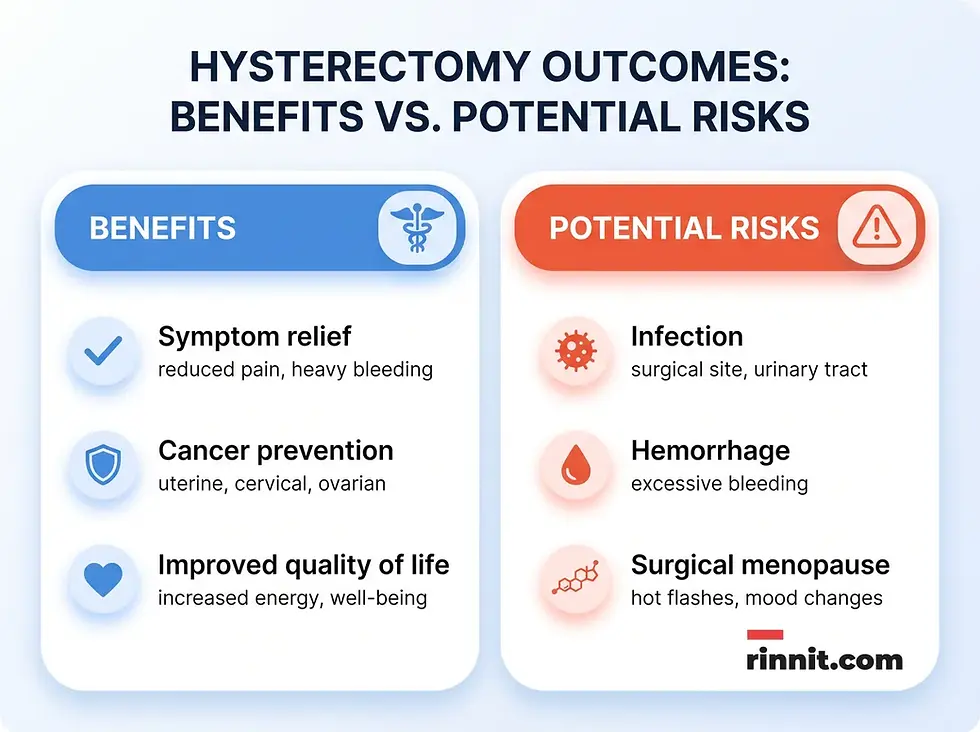
Hysterectomy outcomes: benefits versus potential risks. Individual outcomes vary.
What are recovery and outlook like after a hysterectomy?
Most people recover from a hysterectomy in about four to six weeks. Your recovery depends on the type of hysterectomy you had and the method your surgeon used. Vaginal and laparoscopic recoveries take about two to four weeks, while it may take up to six weeks to recover from an abdominal hysterectomy. You should increase your activity gradually and pay attention to how you feel — if anything causes you pain, stop [1].
Common instructions after a hysterectomy
You can have light vaginal bleeding or dark brown discharge for up to six weeks. Use only a light panty liner or sanitary pad (no tampons).
Don't lift heavy objects (over 10 pounds) for at least four to six weeks.
Don't put anything into your vagina for four to six weeks, or as directed by your healthcare provider.
Don't have sex for six weeks after surgery.
Don't take a bath or swim in a pool for at least six weeks.
If surgical strips were used on abdominal incisions, they should fall off on their own within two weeks. Internal stitches should dissolve on their own in a few weeks. If staples were used, they'll be removed at your follow-up appointment.
You can drive about two weeks after abdominal surgery or when you're no longer taking narcotics for pain. After a vaginal or laparoscopic hysterectomy, you might begin driving within a few days.
Resume your exercise routine in four to six weeks, depending on how you feel, building up gradually.
You can usually go back to work in two to six weeks, depending on what kind of work you do.
How you may feel
It's normal to feel slightly different physically and emotionally after a hysterectomy. Physically, your periods will stop, and you may occasionally feel bloated. You may feel discomfort at abdominal incision sites for about four weeks, and any redness, bruising, or swelling will disappear in four to six weeks. Burning or itching around the incisions is normal, as is a numb feeling around the incisions or down your leg, which usually lasts about two months. People who have a supracervical hysterectomy may continue to have light periods for a year [1].
Emotional reactions vary. You may feel a sense of loss, but these reactions are usually temporary. Others find that a hysterectomy improves their health and well-being. Discuss any emotional concerns with your healthcare provider, who may recommend counseling or a support group [1].
Pap tests and your sex life
Whether you still need a Pap test depends on whether your surgeon removed your cervix and why you had the hysterectomy. If you still have a cervix, you should continue to get Pap smears to screen for cervical cancer. If you don't have a cervix, you may not need a Pap test. A hysterectomy shouldn't affect your sexual function; if you enter menopause as a result, symptoms such as low sex drive and vaginal dryness can be treated, so let your provider know [1].
When should you call a healthcare provider after a hysterectomy?
Call your healthcare provider if you have [1]:
Bright red vaginal bleeding.
A fever over 100 degrees Fahrenheit (37.77 degrees Celsius).
Severe nausea or vomiting.
Difficulty peeing, a burning feeling when you pee, or frequent urination.
Increasing redness, swelling, or drainage from your incision.
Increasing amounts of pain (pain that gets worse instead of better).
What is the bottom line on hysterectomy?
A hysterectomy is a major, permanent surgery that can bring significant relief from chronic or serious pelvic conditions, from heavy bleeding and fibroids to prolapse and cancer. Understanding the different types — and the surgical methods available — helps you work with your healthcare provider to choose the best path for your recovery and long-term well-being. Whether your ovaries are removed is one of the most important decisions, because it determines whether menopause begins right away. Following activity restrictions and attending follow-up appointments are key to a successful recovery.
Your next step: if a hysterectomy has been recommended, ask your surgeon which type and surgical approach are planned and why, whether your ovaries will be kept, what alternatives exist, and what recovery to expect, so you can plan time off and help at home.
Frequently Asked Questions
Will I still have periods after a hysterectomy?
No. Because the uterus is removed, you will no longer have menstrual periods. (People who have a supracervical hysterectomy may continue to have light periods for up to a year because small amounts of uterine lining can remain in the cervix.)
Can I get pregnant after a hysterectomy?
No. A hysterectomy is permanent, and you can't become pregnant after any type of hysterectomy.
Will I enter menopause immediately?
Only if your ovaries are removed during the surgery and you haven't already gone through menopause. If the ovaries are left in place, you won't enter menopause immediately; they keep making hormones and you'll enter menopause at a more typical age.
How long does the surgery take?
The procedure lasts one to three hours. The time varies with the size of your uterus, scar tissue from past surgeries, and whether your surgeon needs to remove endometriosis or other organs such as your fallopian tubes or ovaries.
When can I return to work?
You can usually go back to work in two to six weeks, depending on what kind of work you do.
Is a hysterectomy painful?
Anesthesia keeps you from feeling pain during the surgery. Afterward, expect soreness and discomfort for a few weeks, which your surgeon will help you manage with prescription or over-the-counter pain medicine.
Can I still have sex after a hysterectomy?
A hysterectomy shouldn't affect your sexual function. You shouldn't have sex for six weeks after surgery, and you shouldn't put anything into your vagina for four to six weeks or as directed by your healthcare provider. If you enter menopause as a result of surgery, symptoms such as low sex drive and vaginal dryness can occur, and treatment is available.
What is the fastest recovery method?
A vaginal hysterectomy generally has the fewest complications and the fastest recovery (up to four weeks), and people often go home the same day. Laparoscopic and robotic-assisted approaches have a similarly shorter recovery than abdominal surgery.
Do I still need Pap smears?
It depends on whether your cervix was removed and why you had the hysterectomy. If you still have your cervix, you should continue to get Pap smears to screen for cervical cancer. If you don't have a cervix, you may not need a Pap test.
What are the main risks of the surgery?
As with any surgery, there is a slight chance of problems, including blood clots, severe infection, bleeding, injury to the urinary tract, bowel or other nearby organs, and complications from anesthesia.
How do I prepare for a hysterectomy?
Your healthcare provider explains the procedure in detail, including possible complications and side effects, so you can raise any concerns about surgery and recovery. [1] You may need to give blood and urine samples to make sure you're healthy enough for surgery. [1] Ask whether you'll stay in the hospital, and plan for the help you'll need in the early days of recovery. [1]
When should I call my doctor after a hysterectomy?
Call your provider if you have bright red vaginal bleeding, a fever over 100°F (37.77°C), severe nausea or vomiting, or difficulty peeing, burning when you pee or frequent urination. [1] Also call for increasing redness, swelling or drainage from your incision, or pain that gets worse instead of better. [1]
Related Reading
References
Cleveland Clinic. Hysterectomy. Cleveland Clinic. May 31, 2024. https://my.clevelandclinic.org/health/procedures/hysterectomy
Aarts JWM, Nieboer TE, Johnson N, et al. Surgical approach to hysterectomy for benign gynaecological disease. Cochrane Database of Systematic Reviews. 2015;(8):CD003677. PMID 26264829. https://doi.org/10.1002/14651858.CD003677.pub5
Cusimano MC, Chiu M, Ferguson SE, et al. Association of bilateral salpingo-oophorectomy with all cause and cause specific mortality: population based cohort study. BMJ. 2021;375:e067528. PMID 34880044. https://doi.org/10.1136/bmj-2021-067528
Bonollo M, Bellaminutti S, Gasparri ML, et al. Is it time to leave multi- for single-port laparoscopy in benign gynecologic surgery? A systematic review of randomized clinical trials. Minerva Obstetrics and Gynecology. 2021;74(5):434-443. PMID 34792320. https://doi.org/10.23736/S2724-606X.21.04957-5
Medical disclaimer
This article is for informational purposes only and is not a substitute for professional medical advice, diagnosis, or treatment. The clinical information in this guide reflects source material last reviewed in May 2024.


Comments