Lip Fillers: What to Expect, Benefits, Risks, and Recovery

Updated: 2 days ago
Medically reviewed by Dr. Baraa Alnahhal, MD · Last reviewed: October 2026
Quick Answer
Lip fillers are injections of synthetic hyaluronic acid that add volume to the lips, typically lasting about 6 to 12 months, sometimes longer. Pain usually improves within 12 to 24 hours and swelling within 24 to 48 hours. They should be given by an experienced provider such as a plastic surgeon or dermatologist, not a salon. [1]
What the research says
Most side effects are minor: According to PubMed, a retrospective review of 253 adult women treated with a hyaluronic acid filler (about 1.06 mL on average) at five centers in Brazil found swelling in 15.8% and bruising in 11.1%. There were no major complications and no vascular occlusion, and average satisfaction was 3.92 out of 4. (Menezes et al., J Cosmet Dermatol, 2025)
Knowing the lip's blood vessels helps placement: In 50 patients, ultrasound showed the upper and lower lip arteries run from the side of the lip toward the middle, close to the surface near the midline. Using that map to guide injections, none of the 50 had adverse effects or vascular complications over 3 months. (Kim, Aesthet Surg J, 2024)
Serious problems are rare but real: A systematic review of 243 published cases of filler-related skin ischemia (loss of blood flow) on the face, not only the lips, found vision loss in 39% of cases when the skin area supplied by the ophthalmic artery was affected, versus 0.8% when it was not. Stroke occurred in 8% versus 0.8%. (Soares et al., Plast Reconstr Surg, 2023)
What are lip fillers?
Lip fillers are injections that add volume to your lips. They are a type of dermal filler and consist of synthetic hyaluronic acid, a substance naturally found in your body. [1]
Lip fillers are temporary, not permanent. They typically last about 6 to 12 months, sometimes longer, depending on the product, your age and how fast your body breaks the filler down. Keeping the same volume may require touch-up treatments. [1]
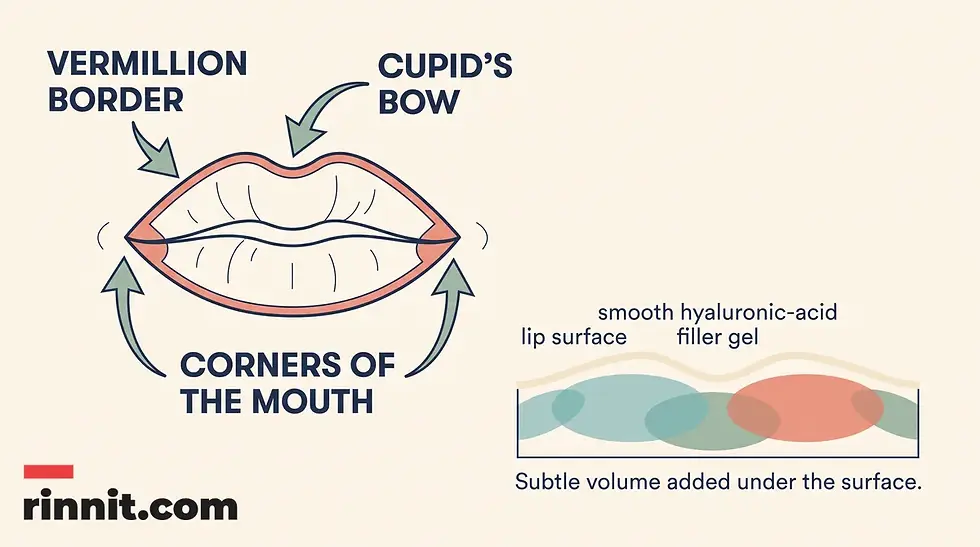
Lip fillers add temporary volume with injections placed in selected areas of the lips, such as the vermillion border, Cupid's bow, and the corners of the mouth. To learn more about the parts of the lip, see our guide to [lip anatomy](https://www.rinnit.com/post/lip-anatomy-a-complete-guide-to-structure-and-function).
Why do people choose lip fillers?
Getting lip fillers is a personal decision. Reasons include restoring volume that has changed over time, correcting differences in lip shape or size, smoothing wrinkles at the sides of the mouth, and supporting self-esteem or body image. [1] Lip volume can change with genetics, smoking, and sun damage. Fillers do not stop aging, but they may delay the need for a more invasive surgical option such as lip implants or a lip lift. [1]
Possible goal | What it means |
Restore volume | Lips can become smaller or thinner with age. |
Address asymmetry | Lips naturally differ in size or shape. |
Smooth wrinkles | Lines can form at the sides of the mouth when you smile or laugh. See our guide to lip lines. |
Desired appearance | Treatment may help you pursue a preferred look and may support confidence. |
These goals do not guarantee a particular result. Every face is different, and a reference photo may not be exactly achievable. A good consultation focuses on describing what you want and understanding what is realistic. [1]
Who may be considered?
A person considered for lip fillers should be in good physical health, have realistic expectations, and not have an active mouth infection, including a canker sore or cold sore. The provider should also review your physical health, facial shape, mental health, social circumstances, and your reasons for wanting treatment. [1]
A consultation is not only about lip size. The provider may ask about your expectations, whether someone else is encouraging treatment, and whether you spend a lot of time thinking about imagined or very small flaws in your body. These questions help place the procedure in the context of your overall well-being. [1]
In the United States, the FDA has not approved lip fillers for anyone under 21 or for use during pregnancy, and studies have not established whether treatment during pregnancy is safe. [1]
What should you discuss before lip filler treatment?
Your provider will review allergies, preexisting conditions, prescription and over-the-counter medicines, and herbal supplements. They will examine and measure your face and lips and may take photos for your medical record. Tell them about any history of cold sores or canker sores before your appointment. [1]
Describe the shape and volume you want in plain language. A photograph can help start the conversation, but the result may not look identical because each person's facial structure and lip shape are different. [1]
Consultation topic | Question or information to bring |
Health history | Which health conditions or risk factors should affect the plan? |
Allergies | Do I have an allergy to any numbing medicine or filler ingredient? |
Medicines | Which prescription medicines, over-the-counter medicines, and supplements do I take? |
Oral health | Do I have an active cold sore, canker sore, or other mouth infection? |
Expectations | What shape, volume, and degree of change are realistic for my face? |
Timing | How long should I allow for swelling and bruising before an important event? |
Follow-up | When will my lips be checked after treatment? |
Reversal | If needed, can hyaluronidase be used to dissolve the filler? |
What happens during a lip filler procedure?
The provider first numbs your lips. A numbing cream may be applied (often a combination of benzocaine, lidocaine, and tetracaine), and numbing generally takes 15 to 30 minutes. If you are allergic to that combination, a nerve-block injection may be used instead. [1]
The provider then uses a thin needle to inject filler into some or all parts of the lips, such as the edge of the lips (vermillion border), the curve in the center of the upper lip (Cupid's bow), and the corners of the mouth. The needle goes no deeper than 2.5 millimeters, and the average amount used is about 1 milliliter, roughly one-fifth of a teaspoon. You may feel pinching, and your eyes may water. [1]
An ice pack may be used during the procedure to reduce swelling and bruising. The whole appointment can take anywhere from about 30 minutes to two hours. [1]

A lip filler visit includes assessment, numbing, carefully placed injections, short observation, and follow-up after healing begins.
What happens immediately afterward?
After the injections, the provider may gently massage your lips so the filler settles, and may keep icing the area. You may be monitored for up to 15 minutes for dizziness, nausea, or substantial bleeding, and then you can usually go home. [1]
A local anesthetic does not usually make you tired or groggy, but having a friend or family member drive you home may be more comfortable. Swelling, sensitivity, and bruising are common afterward. Swelling usually decreases within 24 to 48 hours but may take up to a week, and mild pain should improve within 12 to 24 hours. For tips on bruising, see our guide to bruises. [1]
What does lip filler aftercare involve?
Apply an ice pack for up to 10 minutes at a time to reduce inflammation, pain, and swelling, and avoid lipstick, lip balm, and other products on your lips for at least 24 hours. Avoid touching or puckering your lips, including kissing and using a straw. Brush your teeth carefully, drink plenty of water, and avoid exercise for at least 24 hours. [1]
Wait to eat until the numbing has worn off. For at least 24 hours, avoid messy foods that make you wipe your lips, smoking, and alcohol. Puckering can disturb the filler, and alcohol thins the blood and can worsen bruising. [1]
First-day care | Guidance |
Swelling | Use an ice pack for up to 10 minutes at a time. |
Lip products | Avoid lipstick, lip balm, and other lip products for at least 24 hours. |
Mouth movement | Avoid touching, puckering, kissing, and straws. |
Eating | Wait until numbness wears off; avoid messy foods for at least 24 hours. |
Oral care | Brush your teeth carefully. |
Hydration | Drink plenty of water. |
Exercise | Avoid exercise for at least 24 hours. |
Smoking and alcohol | Avoid both for at least 24 hours. |
How long do lip filler results last, and what follow-up is needed?
Your provider will usually schedule a follow-up about two weeks after treatment to examine your lips and discuss the final result, including whether you want more volume. Another photo may be taken for your record. If you have a big event coming up, schedule treatment at least two weeks beforehand. Results are temporary, and future treatments may be needed to keep the volume. [1]
What are the benefits and limitations of lip fillers, and are they reversible?
Potential benefits include adding or restoring lip volume, evening out asymmetry, smoothing some wrinkles near the mouth, and supporting confidence. Lip fillers are also described as reversible: a qualified provider can inject hyaluronidase to dissolve the filler if appropriate. [1]
Reversibility does not remove all risk, and it does not mean every outcome can be corrected right away. Plan treatment with an experienced provider who can explain what can and cannot be changed. [1] If you are comparing options, you may also want to read about the lip flip, a different way to change how the upper lip looks, and about other fillers such as jawline filler and collagen-stimulating fillers.
What are the risks and side effects of lip fillers?
Possible effects include bleeding and pain at the injection sites, cold sore reactivation, discoloration, tenderness, infection, uneven lips (asymmetry), and filler moving toward the nose (migration). A serious complication called vascular compromise can occur if filler is injected into or around an artery and can lead to tissue death. Rarely it can cause blindness or stroke, so seek emergency care for severe pain, skin that turns white, gray or dusky, or any vision change during or after treatment. Read more in our guide to vascular occlusion after dermal fillers. [1]
Experience and setting matter. Lip fillers are very safe when performed by an experienced provider, but if they are not, you risk problems such as permanently stretched lips, tissue death, hardened filler, or infection. Learn more about the provider's training in our guide to the role of a plastic surgeon. [1]
Possible risk | What it can involve |
Injection-site bleeding or pain | Bruising, bleeding, or mild pain where the needle enters |
Cold sore reactivation | A past cold sore pattern may become active again |
Discoloration or tenderness | The treated area may change color or feel sensitive |
Infection | Infection can occur at injection sites |
Vascular compromise | Filler in or near an artery can reduce blood flow and cause tissue death |
Asymmetry | Lips may differ in size or shape after treatment |
Migration | Filler may move into nearby areas, often toward the nose |

Recovery is usually brief, but unexpected changes should be discussed with your treating healthcare professional right away.
When should you contact a healthcare professional after lip fillers?
Go to your follow-up visit about two weeks after treatment. Contact your treating provider sooner if symptoms are concerning, getting worse, or do not match your aftercare instructions, especially if you notice possible infection, substantial bleeding, marked discoloration, significant tenderness, or any other unexpected change. [1]
Dizziness, nausea, and heavy bleeding are the effects monitored right after treatment. Because vascular compromise and tissue death are serious risks, an unusual color change, severe or escalating pain, or a rapidly changing appearance warrants prompt contact with your provider. [1]
What questions should you ask before choosing lip fillers?
A consultation should cover the provider's experience, the proposed filler, realistic outcomes, recovery time, risks, pain relief, follow-up, and what happens if you are not happy with the result. [1]
Topic | Question to ask |
Experience | How many lip filler procedures have you performed? |
Technique | Which areas of my lips would you treat, and why? |
Expectations | What result is realistic for my facial shape and features? |
Safety | What are the complete risks and complications? |
Recovery | How long should swelling, bruising, and tenderness last? |
Medicines | Which pain relievers are safe during recovery? |
Alternatives | Would a different approach, such as a lip flip, be more appropriate for me? |
Follow-up | When should I return, and how often would maintenance be discussed? |
Reversal | If needed, when would hyaluronidase be considered? |
Conclusion
Lip fillers can temporarily add or restore lip volume, but the decision involves more than the look you want. A qualified provider should review your health, allergies, mouth health, medicines, expectations, and the possible risks before treatment. Use the questions in this guide to prepare, plan for temporary swelling or bruising, follow your aftercare instructions, attend follow-up, and ask for advice about any unexpected or worsening change. [1] For more on cosmetic treatments in general, see our overview of cosmetic surgery.
Learn more. Clear visual guides help people understand cosmetic procedures before they decide. Explore the infographic templates in the Rinnit.com marketplace to create professional visuals that explain treatment steps, recovery, and safety.
Frequently Asked Questions
Are lip fillers permanent?
No. Lip fillers typically last about 6 to 12 months, sometimes longer, although the duration varies. You may need routine touch-up treatments to maintain volume.
How long will my lips be swollen?
Swelling usually improves after 24 to 48 hours but can last up to a week. If you have an important event, schedule treatment at least two weeks ahead so recovery is more likely to be complete.
Do lip fillers hurt?
Your lips are numbed before the injections. You may feel pinching, and mild pain at the injection sites usually improves within 12 to 24 hours.
Can I eat right after lip fillers?
Wait until the numbing has worn off so you do not accidentally bite your lips. Avoid messy foods, straws, smoking, and alcohol for at least 24 hours.
Can I exercise after lip fillers?
Avoid exercise for at least 24 hours, or longer if your provider tells you to.
Can lip fillers be dissolved?
Yes, in most cases. A qualified provider can inject an enzyme called hyaluronidase to dissolve hyaluronic acid filler when appropriate.
Can I get lip fillers if I have a history of cold sores?
Tell your provider about any history of cold sores. An active cold sore or canker sore means you should wait, and cold sore reactivation is a possible risk of treatment.
Can I get lip fillers during pregnancy?
Safety during pregnancy has not been studied, and in the United States lip fillers are not FDA-approved for use during pregnancy. Talk with a qualified provider if you are pregnant or planning a pregnancy.
Where should lip fillers be done?
By an experienced healthcare provider who specializes in lip fillers, such as a plastic surgeon, dermatologist, or cosmetic surgeon. They should not be done at a beauty salon or spa.
What should I avoid right after lip fillers?
For at least 24 hours, avoid lipstick, lip balm and other lip products. Try not to touch or pucker your lips, including kissing and using a straw, and follow your provider's aftercare steps.
Related Reading
Vascular Occlusion: Symptoms, Causes, and Treatment After Dermal Fillers — the most serious filler complication, explained.
Lip Anatomy: A Complete Guide to Structure and Function — the parts of the lip that fillers work on.
Understanding the Lip Lift: A Permanent Solution for Lip Enhancement — a surgical alternative.
Cold Sore: Stages, Causes, Triggers, and the Treatments That Shorten an Outbreak — why timing matters before lip treatments.
References
Cleveland Clinic. Lip Fillers: What to Expect, Types, Benefits & Side Effects. Cleveland Clinic. Last updated December 1, 2021. Accessed October 18, 2026. https://my.clevelandclinic.org/health/treatments/22133-lip-fillers
Menezes MVA, Dezanetti CBG, Penna FWP, et al. Aesthetic treatment of the lips with hyaluronic acid filler: the Multi Vector Lip technique. J Cosmet Dermatol. 2025;24(9):e70445. PMID 40931930. https://doi.org/10.1111/jocd.70445
Kim JS. 9-point injection technique for lip augmentation and lip corner lifting using sonographic imaging of the labial artery pathway. Aesthet Surg J. 2024;44(10):1080-1090. PMID 38649792. https://doi.org/10.1093/asj/sjae086
Soares DJ, Bowhay A, Blevins LW, et al. Patterns of filler-induced facial skin ischemia: a systematic review of 243 cases and introduction of the FOEM scoring system and grading scale. Plast Reconstr Surg. 2023;151(4):592e-608e. PMID 36477154. https://doi.org/10.1097/PRS.0000000000009991
Medical disclaimer
This article is for informational purposes only and is not medical advice. Always consult a qualified healthcare professional for diagnosis and treatment decisions.



Lip filler results are often judged from photos, but images cannot reveal the full consultation or recovery process. The same caution applies to Dr. Rival’s rhinoplasty before and after photos. Before-and-after examples may help clarify aesthetic goals, yet individual anatomy and surgical limitations mean results will vary.