Canker Sore (Aphthous Ulcer): Types, Triggers, Treatment & Complete Guide

Updated: 2 days ago
Medically reviewed by Dr. Baraa Alnahhal, MD · Last reviewed: October 2026
Quick Answer: What Is a Canker Sore?
A canker sore, also called an aphthous ulcer, is a small, shallow lesion on the soft tissues inside the mouth. Most have a white or yellow center with a red border and can be extremely painful, making eating and talking difficult. Unlike cold sores, they are not contagious, and most go away on their own in a week or two. [1]
What the research says
A routine multivitamin did not prevent canker sores. In a double-masked trial of 160 adults with a history of recurrent minor sores, people taking a daily multivitamin averaged 4.19 new episodes versus 4.60 on placebo over up to a year (P = .69), and episodes lasted about the same (8.66 vs 8.99 days). (Lalla et al., J Am Dent Assoc, 2012) [3]
Recurrent sores are common, and stronger drugs carry trade-offs. Recurrent aphthous stomatitis affects up to 25% of people worldwide. In a meta-analysis of 21 trials (1,668 patients), thalidomide improved response rates and lengthened the time between recurrences but significantly increased adverse events, so the reviewers suggest reserving it for major sores or cases that do not respond to topical agents. (Jian et al., BMC Oral Health, 2024) [4]
Probiotics may ease the pain, not shrink the ulcer. In a systematic review of 7 randomized trials, a pooled analysis of three trials found probiotics significantly reduced oral pain compared with placebo (−1.72, P = 0.0001), but probiotics alone did not reduce ulcer severity; combined with steroids or an anesthetic antiseptic gel they worked better than the gel or steroid alone. (Cheng et al., Sci Rep, 2020) [5]
Canker Sores at a Glance
Definition: A small, shallow, painful lesion on the soft tissues inside the mouth or at the base of the gums
Typical appearance: Round or oval, white or yellow center, red border; tingling or burning 1–2 days before appearing
Contagious? No — unlike cold sores, it's not caused by the herpes virus
The 3 types: Minor (most common), major (up to 6 weeks, can scar), herpetiform (clusters of 10–100)
Typical healing time: 1 to 2 weeks for most minor sores — without scarring
Common triggers: Mouth injury, sodium lauryl sulfate, food sensitivities, vitamin deficiencies, bacteria, H. pylori, hormonal shifts, stress
Underlying conditions: Celiac disease, Crohn's disease, ulcerative colitis, Behcet's disease, faulty immune system, HIV/AIDS
Who gets them: Anyone — more often teens and young adults, more common in females; family history common in recurrent cases
Diagnosis: Visual exam — no tests needed
Treatment: Minor sores need none; options for painful or persistent ones include rinses, topicals, cautery, oral meds, supplements
Home remedies: Salt water or baking soda rinse, milk of magnesia, ice chips, gentle brushing, avoiding irritants
What Is a Canker Sore?
Canker sores, also called aphthous ulcers, are small, shallow lesions that develop on the soft tissues in your mouth or at the base of your gums. They occur singly or in clusters on the inside surfaces of your cheeks or lips, on or under your tongue, at the base of your gums, or on your soft palate. They usually have a white or yellow center and a red border and can be extremely painful — so painful that they make eating and talking difficult.
Three facts set canker sores apart from their better-known cousin, the cold sore:
Canker sores don't occur on the surface of your lips.
They aren't contagious.
They are not associated with herpes virus infections.
And the most reassuring fact of all: most canker sores go away on their own in a week or two.

Canker sores appear inside the mouth — inside cheeks, under the tongue, or on the soft palate — and come in three types: minor, major, and herpetiform.
What are the symptoms and three types of canker sores?
Most canker sores are round or oval with a white or yellow center and a red border. You might notice a tingling or burning sensation a day or two before the sores actually appear. The condition has three types, and each behaves differently: [1]
Minor canker sores (most common): Usually small; oval shaped with a red edge. Heals without scarring in 1 to 2 weeks.
Major canker sores (less common): Larger and deeper; usually round with defined borders (irregular edges when very large); can be extremely painful. May take up to six weeks to heal and can leave extensive scarring.
Herpetiform canker sores (uncommon; usually develop later in life): Pinpoint size; often occur in clusters of 10 to 100 sores, but may merge into one large ulcer; irregular edges. Heals without scarring in 1 to 2 weeks.
One important clarification about the herpetiform type: despite the name, it is not caused by the herpes virus infection.
When to See a Doctor
Most canker sores need nothing more than time. But consult your doctor if you experience:
Unusually large canker sores
Recurring sores — with new ones developing before old ones heal, or frequent outbreaks
Persistent sores, lasting two weeks or more
Sores that extend into the lips themselves (the vermilion border)
Pain you can't control with self-care measures
Extreme difficulty eating or drinking
High fever along with canker sores
Also, see your dentist if you have sharp tooth surfaces or dental appliances that seem to trigger the sores.
What triggers and underlying conditions cause canker sores?
The precise cause of canker sores remains unclear. Researchers suspect that a combination of factors contributes to outbreaks — even in the same person. [1]
Eight Common Triggers
Minor mouth injury: Dental work, overzealous brushing, sports mishaps, or an accidental cheek bite.
Sodium lauryl sulfate: Found in some toothpastes and mouth rinses.
Food sensitivities: Particularly chocolate, coffee, strawberries, eggs, nuts, cheese, and spicy or acidic foods.
Nutritional gaps: A diet lacking vitamin B-12, zinc, folate (folic acid), or iron.
Bacterial allergy: An allergic response to certain bacteria in your mouth.
H. pylori: The same bacteria that cause peptic ulcers.
Hormonal shifts: During menstruation.
Emotional stress: A well-known outbreak trigger.
Conditions That Can Cause Canker Sores
Canker sores may also occur because of certain conditions and diseases:
Celiac disease — a serious intestinal disorder caused by a sensitivity to gluten, a protein found in most grains.
Inflammatory bowel diseases — such as Crohn's disease and ulcerative colitis.
Behcet's disease — a rare disorder that causes inflammation throughout the body, including the mouth.
A faulty immune system — one that attacks healthy cells in your mouth instead of pathogens such as viruses and bacteria.
HIV/AIDS — which suppresses the immune system.
Risk Factors
Anyone can develop canker sores. But they occur more often in teens and young adults, and they're more common in females. People with recurrent canker sores often have a family history of the disorder. This may be due to heredity or to a shared factor in the environment, such as certain foods or allergens.
How are canker sores diagnosed?
The diagnosis is refreshingly simple: tests aren't needed to diagnose canker sores. Your doctor or dentist can identify them with a visual exam. In some cases — especially if your canker sores are severe and ongoing — you may have tests to check for other health problems behind the outbreaks. [2]
What are the treatment options for canker sores?
Treatment usually isn't necessary for minor canker sores, which tend to clear on their own in a week or two. But large, persistent, or unusually painful sores often need medical care. A number of treatment options exist: [2]
Mouth rinses: If you have several canker sores, your doctor may prescribe a rinse containing the steroid dexamethasone to reduce pain and inflammation, or lidocaine to reduce pain.
Topical products: Over-the-counter and prescription pastes, creams, gels, or liquids applied to individual sores as soon as they appear. Active ingredients include benzocaine (Anbesol, Kank-A, Orabase, Zilactin-B), fluocinonide (Lidex, Vanos), and hydrogen peroxide (Orajel Antiseptic Mouth Sore Rinse, Peroxyl).
Oral medications: For severe sores or those that don't respond to topicals: sucralfate (Carafate) used as a coating agent, colchicine (normally for gout), and oral steroids as a last resort due to serious side effects.
Cautery: Tissue is burned away to get rid of the sore — chemical cautery places a substance on the sore, and low-level laser therapy is another option. Cautery is used for more-painful or more-severe sores, especially to lessen pain.
Nutritional supplements: Prescribed if you consume low amounts of folate (folic acid), vitamin B-6, vitamin B-12, or zinc.
Treat the underlying problem: If canker sores relate to a more serious health problem, your doctor will treat that underlying condition.
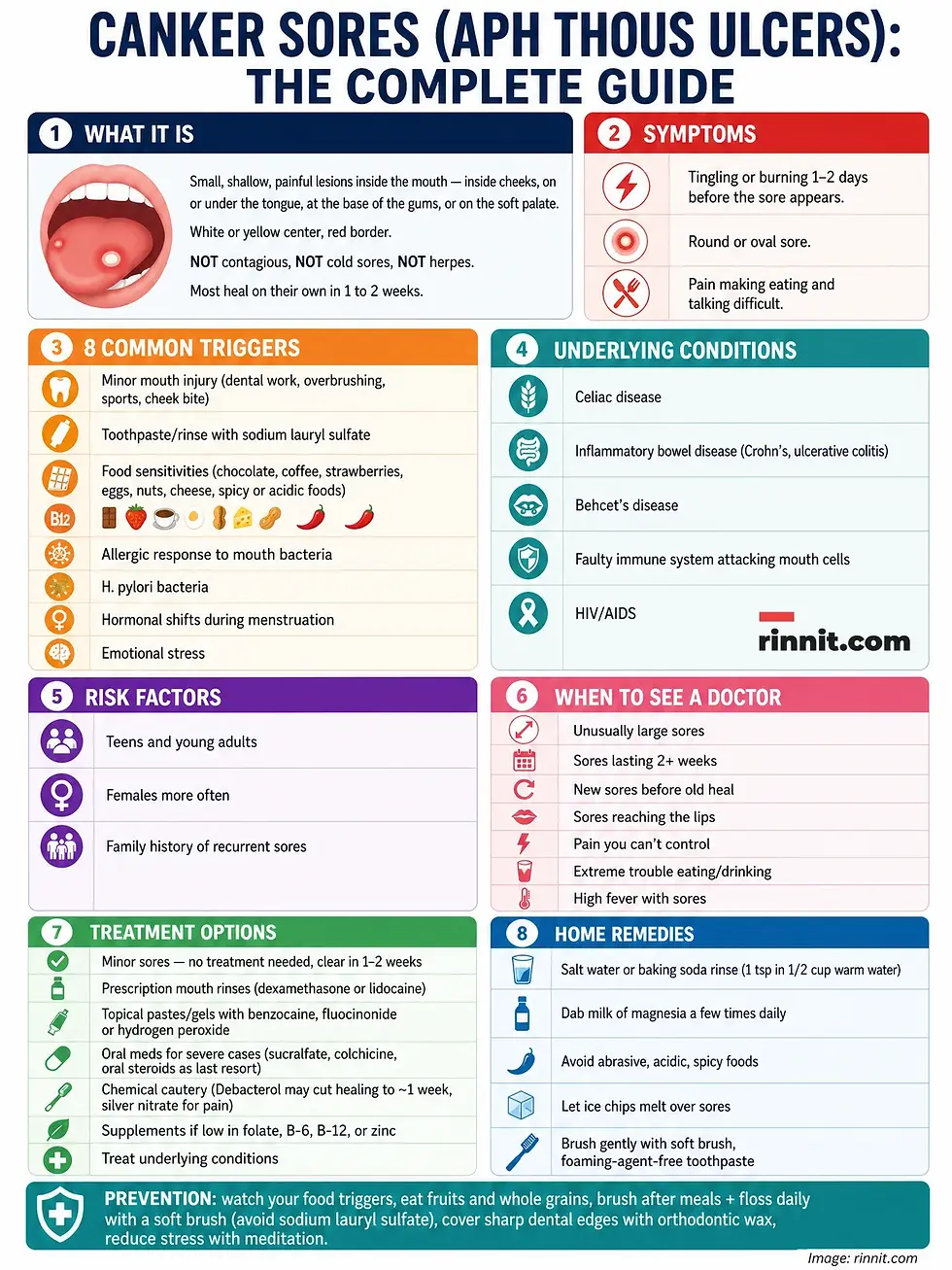
The complete canker sore guide: the 8 triggers, the 3 types, warning signs, treatment options, and five home remedies.
What home remedies and lifestyle steps help canker sores?
Canker sore pain relief and faster healing may come from salt water or baking soda rinses, milk of magnesia, ice chips, gentle brushing and avoiding irritating foods.
Rinse your mouth. Use a salt water rinse or a baking soda rinse — dissolve 1 teaspoon of baking soda in 1/2 cup warm water.
Dab a small amount of milk of magnesia on your canker sore a few times a day.
Avoid abrasive, acidic, or spicy foods that can cause further irritation and pain.
Apply ice to your canker sores by allowing ice chips to slowly dissolve over the sores.
Brush your teeth gently, using a soft brush and a foaming-agent-free toothpaste such as Biotene or Sensodyne ProNamel.
How can you reduce how often canker sores come back?
Canker sores often recur, but you may be able to reduce their frequency by following these tips:
Watch what you eat. Avoid foods that seem to irritate your mouth — nuts, chips, pretzels, certain spices, salty foods, and acidic fruits such as pineapple, grapefruit, and oranges. Avoid any foods you're sensitive or allergic to.
Choose healthy foods. To help prevent nutritional deficiencies, eat plenty of fruits, vegetables, and whole grains.
Follow good oral hygiene habits. Brush after meals and floss once a day with a soft brush to prevent irritation, and avoid toothpastes and mouth rinses containing sodium lauryl sulfate.
Protect your mouth. If you have braces or other dental appliances, ask your dentist about orthodontic waxes to cover sharp edges.
Reduce your stress. If your sores seem related to stress, use stress-reduction techniques such as meditation and guided imagery.
How should you prepare for a canker sore appointment?
Your doctor or dentist can diagnose a canker sore based on its appearance. Here's how to get ready.
Information to Gather
Before your appointment, make a list of:
Your symptoms, including when they first started and how they may have changed or worsened over time
All your medications, including over-the-counter medications, vitamins or other supplements, and their doses
Any other medical conditions, to see if any relate to your symptoms
Key personal information, including any recent changes or emotional stressors in your life
Questions to ask your doctor or dentist to make your visit more efficient
Eight Questions to Ask
Do I have a canker sore?
If so, what factors may have contributed to its development? If not, what else could it be?
Do I need any tests?
What treatment approach do you recommend, if any?
What self-care steps can I take to ease my symptoms?
Is there anything I can do to speed up healing?
How soon do you expect my symptoms will improve?
Is there anything I can do to help prevent a recurrence?
Don't hesitate to ask any other questions during your appointment.
Eleven Questions Your Doctor or Dentist Will Ask
What are your symptoms?
When did you first notice these symptoms?
How severe is your pain?
Have you had similar sores in the past? If so, have you noticed if anything in particular seemed to trigger them?
Have you been treated for similar sores in the past? If so, what treatment was most effective?
Have you had any recent dental work?
Have you recently experienced significant stress or major life changes?
What is your typical daily diet?
Have you been diagnosed with any other medical conditions?
What medications are you taking, including prescription and over-the-counter medications, vitamins, herbs, and other supplements?
Do you have a family history of canker sores?
Frequently Asked Questions
What is a canker sore?
A canker sore (aphthous ulcer) is a small, shallow, painful lesion that forms on the soft tissues inside your mouth — inside cheeks or lips, on or under the tongue, at the base of the gums, or on the soft palate. It usually has a white or yellow center with a red border.
Is a canker sore the same as a cold sore?
No. Canker sores form inside the mouth, are not contagious, and are not caused by the herpes virus. Cold sores form on the surface of the lips and are caused by a herpes virus.
How long does a canker sore last?
Most minor canker sores heal on their own without scarring in one to two weeks. Major canker sores may take up to six weeks to heal and can leave scarring; herpetiform clusters also heal in one to two weeks.
What causes canker sores?
The precise cause is unclear, but outbreaks are linked to a combination of triggers — minor mouth injuries, sodium lauryl sulfate in toothpaste, food sensitivities, vitamin B-12/zinc/folate/iron deficiencies, bacterial allergies, H. pylori, hormonal shifts, and stress — as well as conditions such as celiac disease, inflammatory bowel disease, Behcet's disease, immune dysfunction, and HIV/AIDS.
How do you get rid of a canker sore fast?
For minor sores, home care is usually enough: salt water or baking soda rinses, milk of magnesia, ice chips, gentle brushing with a foaming-agent-free toothpaste, and avoiding abrasive, acidic, or spicy foods. For severe or persistent sores, prescription rinses, topical treatments, or cautery (used mainly to lessen pain from more severe sores) can help. [2]
When should I see a doctor for a canker sore?
See a doctor for unusually large sores, sores lasting two weeks or more, recurring outbreaks, sores that reach the lips themselves, pain you can't control, extreme difficulty eating or drinking, or a high fever with the sores.
Are canker sores contagious?
No. Canker sores are not contagious — you can't catch them from or pass them to others. This is a key difference from cold sores, which are caused by the herpes virus and can spread.
Conclusion: Small Sore, Manageable Problem
The main lessons from this guide are:
Canker sores are common, painful, and usually self-limiting — most heal on their own in one to two weeks without scarring and need no treatment at all.
Know the difference from cold sores: canker sores live inside the mouth, aren't contagious, and have nothing to do with the herpes virus — a distinction that matters for treatment and reassurance.
You have real control: identifying your personal triggers (foods, toothpaste, stress), practicing gentle oral hygiene, and using simple home remedies can reduce both the pain and the frequency of outbreaks — and medical options exist for the stubborn cases.
We hope this complete guide has helped you identify what you're dealing with, ease the pain, and know exactly when to call the doctor.
This article is for general educational and informational purposes only and does not constitute medical advice. Please consult a qualified healthcare professional for diagnosis and treatment of any health condition.
References
Mayo Clinic Staff. Canker sore — Symptoms and causes. Mayo Clinic. August 26, 2026. https://www.mayoclinic.org/diseases-conditions/canker-sore/symptoms-causes/syc-20370615
Mayo Clinic Staff. Canker sore — Diagnosis and treatment. Mayo Clinic. August 26, 2026. https://www.mayoclinic.org/diseases-conditions/canker-sore/diagnosis-treatment/drc-20370620
Lalla RV, Choquette LE, Feinn RS, et al. Multivitamin therapy for recurrent aphthous stomatitis: a randomized, double-masked, placebo-controlled trial. J Am Dent Assoc. 2012;143(4):370-376. PMID 22467697. https://doi.org/10.14219/jada.archive.2012.0179
Jian Y, Wang F, Zhao M, et al. Efficacy and safety of thalidomide for recurrent aphthous stomatitis: a systematic review and meta-analysis of randomized controlled trials. BMC Oral Health. 2024;24(1):1149. PMID 39342210. https://doi.org/10.1186/s12903-024-04923-1
Cheng B, Zeng X, Liu S, et al. The efficacy of probiotics in management of recurrent aphthous stomatitis: a systematic review and meta-analysis. Sci Rep. 2020;10(1):21181. PMID 33273680. https://doi.org/10.1038/s41598-020-78281-7



Comments