Vascular Occlusion: Symptoms, Causes, and Treatment After Dermal Fillers

Updated: 2 days ago
Medically reviewed by Dr. Baraa Alnahhal, MD · Last reviewed: October 2026
Editorial note: This article is provided for educational purposes only. It is not medical advice. Always consult a qualified healthcare professional about your individual health situation.
Quick Answer
Vascular occlusion is a blockage of blood flow in an artery or vein, often after a dermal filler presses on or is injected into a vessel. [1] Symptoms such as intense pain, swelling, white skin spots or blue-purple discoloration often appear right away or within hours. [1] Emergency treatment, including enzyme injections to dissolve filler, helps prevent tissue death. [1]
What the research says
Hyaluronidase worked in most hyaluronic acid cases, and delay was costly. A systematic review and meta-analysis of 14 studies found that hyaluronidase gave partial or total recovery in 84.2% of hyaluronic acid-related vascular occlusions. Delays beyond five days were linked to permanent deficits, and the glabella, nose and nasolabial folds were the sites most often involved. (Chakhachiro & Waseem, Cureus, 2025) [2]
Skin recovered fully in about three of four treated patients. Across 15 studies of 223 patients given hyaluronidase for skin necrosis after hyaluronic acid fillers, 77.8% had complete scar resolution (low-certainty evidence). Low doses (500 IU or less) had a higher resolution rate (88.1%) than high doses (about 70%), but the difference was not statistically significant. (Boey et al., Aesthetic Plast Surg, 2024) [3]
Eye complications are the most serious, and not all improve. In a systematic review of 34 reports of ocular complications after facial hyaluronic acid injections, vision loss was the most common complication (17 reports, 50%), and 15 reports (45.45%) showed no improvement even after treatment. (Mortada et al., Aesthetic Plast Surg, 2022) [4]
When to Call Your Care Team
Emergency warning: Seek immediate care at the nearest emergency room if you experience any of the following at the site of a recent dermal filler injection. Delayed treatment can lead to irreversible tissue death, heart attack, or stroke. Any vision change, eye pain, drooping eyelid or loss of vision after a facial filler is an emergency that can cause permanent blindness: call 911 or go to the emergency room immediately. [1]
What Is Vascular Occlusion?
Vascular occlusion is a general term for any blockage that prevents blood from moving through your arteries or veins. [1] While often caused by blood clots (thrombosis) or fatty plaque buildup, it has become a noted concern as a rare side effect of cosmetic procedures like lip and dermal fillers. [1]
When a filler substance is injected, it can accidentally press against a nearby blood vessel or be injected directly into an artery. [1] This physical obstruction cuts off the supply of oxygen and nutrients to the surrounding tissue, creating a medical emergency that requires rapid intervention to restore circulation.
Symptoms and Warning Signs
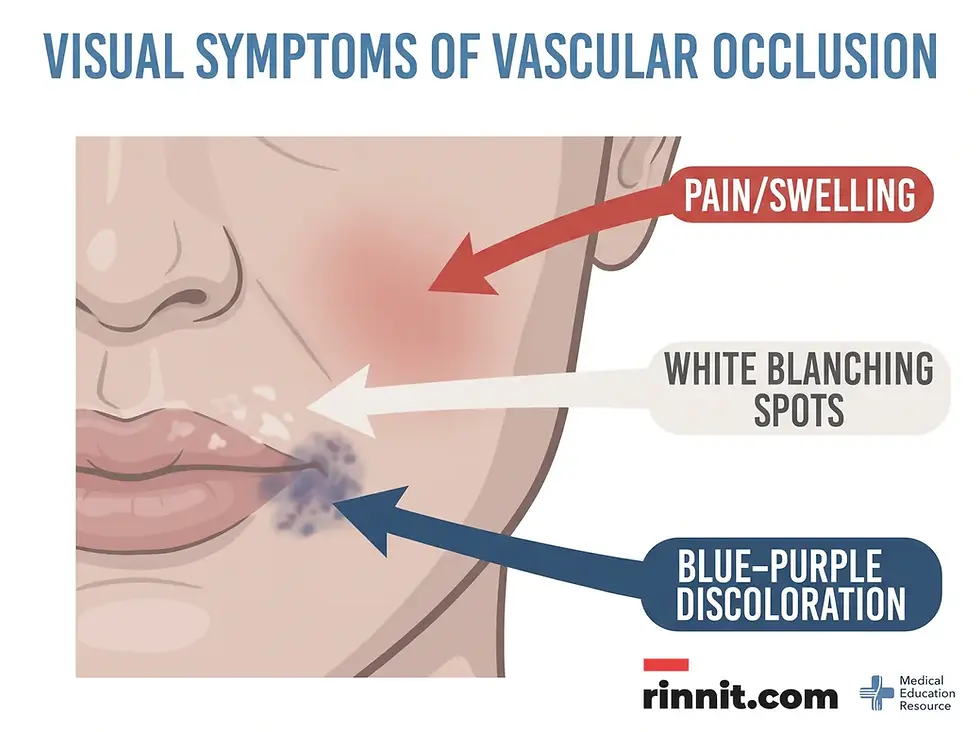
Symptoms of vascular occlusion often start immediately or within minutes to hours of a filler injection, though some appear later. [1] Recognizing these signs early is the most critical factor in achieving a successful recovery.
Skin Color and Temperature Changes
The most visible indicators of a blockage are changes in the skin’s appearance at the injection site. These changes occur because the tissue is no longer receiving adequate blood flow.
Symptom | Description and Appearance |
Pain or discomfort | Significant pain at the site of the blockage, often more intense than typical post-procedure soreness. |
Swelling | Noticeable inflammation around the injection area. [1] |
Blanching | The appearance of white spots or pale patches where blood flow has stopped. [1] |
Erythema to discoloration | Skin may turn red initially, then progress to a blueish-purple hue. [1] |
Cool temperature | The affected area feels noticeably cooler to the touch than the surrounding skin. [1] |
Causes and Mechanisms
Vascular occlusion is primarily caused by a physical blockage in the vascular pathway. In the context of cosmetic fillers, this happens through two main mechanisms:
Beyond cosmetic procedures, vascular occlusions can also be caused by traditional medical factors such as blood clots (thrombosis) or the gradual buildup of fatty plaque in the vessel walls. [1]

Diagnosis and Emergency Treatment
Vascular occlusion is a serious condition typically diagnosed in an emergency setting. [1] Healthcare providers use physical exams, medical history, and imaging tests like X-rays to locate the blockage and assess the extent of the damage. [1]
Treatment Roadmap
Early treatment is designed to remove the obstruction and improve blood flow before permanent damage occurs.
Treatment Type | Purpose and Action |
Manual manipulation | Massaging or tapping the skin to help release pressure on the blood vessel. [1] |
Heat application | Applying heat to the area to encourage vessels to dilate and improve circulation. [1] |
Enzyme injections | |
Blood thinners | Using aspirin to thin the blood and facilitate easier movement through narrowed pathways. [1] |
Antibiotics | Administered to prevent or treat infections if tissue death (necrosis) has begun. [1] |

Potential Complications
If left untreated, the lack of oxygen and blood supply leads to dangerous consequences. The most immediate risk is tissue necrosis, where cells and tissue die, potentially requiring cosmetic surgery to repair the skin. [1] In severe cases, a blockage can lead to organ damage, heart attack, or stroke. [1]
Prevention and Safety
While not all cases can be prevented, you can significantly reduce your risk by:
Conclusion
Vascular occlusion is a rare but high-stakes complication of dermal fillers. By recognizing the early warning signs of pain and skin discoloration, you can seek the emergency care needed to restore blood flow and ensure a full recovery.
Ready to prioritize your safety? If you are considering dermal fillers, consult with a board-certified dermatologist and ensure you have a clear plan for contacting your provider if any unusual symptoms appear after your procedure.
Frequently Asked Questions
1. Is vascular occlusion the same as a blood clot?
Not exactly. Vascular occlusion is a general term for any blockage. A blood clot (thrombosis) is just one possible cause of an occlusion.
2. How soon do symptoms appear after fillers?
Symptoms often start right away or within hours of the injection, though some appear later.
3. Can vascular occlusion be reversed?
Yes, if diagnosed and treated early, blood flow can be restored, leading to a full recovery.
4. What does “blanching” look like?
Blanching appears as white or pale spots on the skin where blood is no longer circulating.
5. What is hyaluronidase?
Hyaluronidase is an enzyme injected by doctors to dissolve hyaluronic acid fillers that are causing a blockage.
6. Can I get fillers again if I’ve had an occlusion?
Whether to get fillers again is a question you must discuss with your doctor, as it depends on the cause and your individual recovery.
7. Is vascular occlusion painful?
Yes, it typically causes significant pain or discomfort at the site of the blockage.
8. What is tissue necrosis?
Necrosis is the death of cells and tissue caused by a lack of oxygen and blood supply.
9. Can a lip filler cause a stroke?
While rare, untreated vascular occlusion can lead to serious complications, including stroke.
10. Does heat help vascular occlusion?
Yes, applying heat to the skin can help improve blood flow as part of a professional treatment plan.
11. Why is aspirin used for this condition?
Aspirin helps thin the blood, making it easier for blood to move past a partial blockage.
12. Is swelling normal after fillers?
Some swelling is normal, but excessive swelling combined with pain or color changes is a red flag for occlusion.
13. Are all fillers at risk for this?
Any substance injected underneath the skin, including hyaluronic acid and calcium hydroxylapatite, carries a rare risk.
14. What imaging tests are used for diagnosis?
Doctors may use X-rays or other imaging to get a better look at the blockage.
15. Can I treat this at home?
No. Vascular occlusion is a medical emergency that requires immediate professional treatment.
Related Reading
Nonsurgical Rhinoplasty (Liquid Nose Job): Uses, Results and Risks explains nonsurgical rhinoplasty with fillers.
References
Cleveland Clinic. Vascular occlusion. Cleveland Clinic. February 7, 2023. https://my.clevelandclinic.org/health/diseases/24682-vascular-occlusion
Chakhachiro A, Waseem M. Risk factor analysis for vascular occlusions after dermal filler injections: a systematic review and meta-analysis. Cureus. 2025;17(4):e82800. PMID 40406769. https://doi.org/10.7759/cureus.82800
Boey JJJ, Boey JJE, Cao T, et al. Conventional high-dose vs low-dose hyaluronidase for skin necrosis after hyaluronic acid fillers: a systematic review and pilot meta-analysis. Aesthetic Plast Surg. 2024;48(19):3971-3978. PMID 39214904. https://doi.org/10.1007/s00266-024-04334-1
Mortada H, Seraj H, Barasain O, et al. Ocular complications post-cosmetic periocular hyaluronic acid injections: a systematic review. Aesthetic Plast Surg. 2022;46(2):760-773. PMID 35091771. https://doi.org/10.1007/s00266-021-02730-5



Comments