Nonsurgical Rhinoplasty (Liquid Nose Job): Uses, Results and Risks

Updated: 2 days ago
Written and medically reviewed by Dr. Baraa Alnahhal, MD · Last reviewed: November 2026 · How we review
Quick Answer
Nonsurgical rhinoplasty, also called a liquid nose job, uses dermal fillers to temporarily reshape the nose without surgery. It takes 45 minutes or less, and results last about six months. It can't make the nose smaller or fix breathing problems. Choose an experienced licensed professional, since rare complications include tissue death and vision loss.
What the research says
Satisfaction was high, and serious problems were rare: a review of 30 studies with 9,657 people found 99.08% were satisfied; complications occurred in 39.11%, mostly redness and swelling, while severe artery blockage occurred in 0.27% (Song D et al., Aesthetic Plastic Surgery, 2024) [2]
Serious complications were about 3 in 1,000: a review of 37 papers covering 7,339 people given hyaluronic acid nose injections found serious complications such as blindness and skin necrosis in about 3 per 1,000, while mild ones like bruising and swelling occurred in 13.34% (Ma Y et al., Aesthetic Plastic Surgery, 2025) [3]
Key takeaways
Nonsurgical rhinoplasty reshapes the nose with fillers.
It takes 45 minutes or less with no downtime.
Results last about six months and are reversible.
It can't make the nose smaller.
Choose an experienced, licensed provider.
What is nonsurgical rhinoplasty?
It's a cosmetic alternative to surgical rhinoplasty. Dermal fillers add volume under the skin to change how the nose looks. In some cases, botulinum toxin injections are used instead. It can also let you preview changes before surgery. Sources: [1]
What it can and can't do

Surgery is better for dramatic or lasting changes.
Can do | Can't do |
Add volume | Make the nose smaller |
Lift the tip | Make the nose narrower |
Smooth bumps or a bridge bump | Improve breathing |
Straighten a slightly crooked nose | Make major structural changes |
Sources: [1]
How to prepare
Your provider talks with you about your goals and what you want to change and may take photos of your nose to plan. Not everyone is a good candidate. Sources: [1]
What happens during the procedure

The procedure takes 45 minutes or less.
A numbing cream may be applied to your skin.
Filler is injected into specific areas of your nose.
You may feel slight pressure or pinching.
You see results right away. Sources: [1]
The procedure usually takes 45 minutes or less. Sources: [1]
Risks and side effects
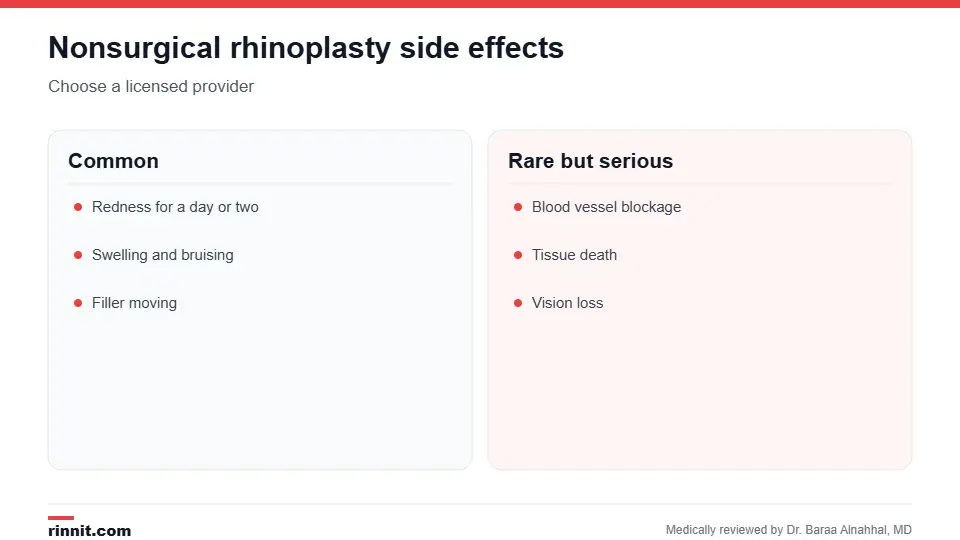
The nose is close to the eyes and has many blood vessels.
Type | Examples |
Common, short-lived | Redness and sensitivity for a day or two, swelling, bruising, nausea, filler moving |
Rare but serious | Blood vessel blockage, tissue death, vision loss |
Because it's more technical than other filler treatments, it should be done by a licensed professional such as a plastic surgeon. Get emergency care right away for sudden vision changes, severe pain, or skin that turns pale, white or dusky after the injection, which can mean filler has blocked a blood vessel. Sources: [1, 2, 3]
Recovery and results
There's no downtime; you can return to normal activities right away.
Results are immediate.
There are no incisions or scars.
Results last about six months, sometimes longer.
Hyaluronic acid filler can be reversed. Sources: [1]
When to call your provider
Blurred vision.
Fever.
An allergic reaction, such as hives.
Redness or swelling that gets worse after three days. Sources: [1]
Conclusion
Nonsurgical rhinoplasty is a quick, reversible way to make subtle changes to your nose. Choosing a skilled, licensed provider is the best way to lower the risk of rare but serious complications.
Keep learning: read about rhinoplasty and dermal fillers.
Frequently asked questions
What is nonsurgical rhinoplasty?
Reshaping the nose with injectable fillers instead of surgery.
What filler is used?
Usually hyaluronic acid.
Can it make my nose smaller?
No. That requires surgery.
How long does it take?
45 minutes or less.
Does it hurt?
You may feel slight pressure or pinching.
How long do results last?
About six months.
Is there downtime?
No. You can return to normal activities right away.
Is it reversible?
Yes.
What are the risks?
Redness and swelling, and rarely blood vessel blockage or vision loss.
Who should do it?
A licensed professional such as a plastic surgeon.
Related Reading
Rhinoplasty: Reshaping and Restoring Nasal Function surgical nose reshaping.
Dermal Fillers: Types, Procedure, Results, and Side Effects how fillers work.
Vascular Occlusion: Symptoms, Causes, and Treatment After Dermal Fillers a rare filler complication.
Sculptra: A Guide to Collagen-Stimulating Dermal Fillers another type of filler.
Understanding the Nose: More Than Just Your Sense of Smell how the nose works.
References
Cleveland Clinic. Nonsurgical Rhinoplasty (Nose Job): What It Is, Uses & Procedure. Cleveland Clinic. Last updated April 26, 2022. https://my.clevelandclinic.org/health/treatments/22880-nonsurgical-rhinoplasty-nose-job
Song D, Wang X, Yu Z. Nonsurgical rhinoplasty: an updated systematic review of technique, outcomes, complications, and its treatments. Aesthetic Plastic Surgery. 2024;48(23):4902-4915. PMID 38862661. https://doi.org/10.1007/s00266-024-04161-4
Ma Y, Jin M, Zhen Y, et al. Advances of hyaluronic acid nasal injection techniques and complications: a systematic review. Aesthetic Plastic Surgery. 2025;49(23):6675-6686. PMID 40897966. https://doi.org/10.1007/s00266-025-05194-z
Medical disclaimer
This article is for general education only and does not replace advice from a qualified healthcare professional. Talk to your doctor about your own diagnosis and treatment, and seek emergency care right away for severe or sudden symptoms.



Comments