Cold Sore: Stages, Causes, Triggers, and the Treatments That Shorten an Outbreak

Updated: 3 days ago
Medically reviewed by Dr. Baraa Alnahhal, MD · Last reviewed: October 2026
Quick Answer
A cold sore, also called a fever blister, is a common viral infection causing tiny, fluid-filled blisters on and around the lips [1]. It is usually caused by HSV-1 and spreads through close contact, even without a visible sore [1]. Most heal on their own in 2 to 3 weeks [1]. There is no cure, but antiviral medicines speed healing [1] [2].
What the research says
Cold sores are common and usually mild. A BMJ Clinical Evidence systematic review of 27 studies describes HSV-1 infection as a mild, self-limiting, painful blistering around the mouth that affects 20% to 40% of adults at some time, with recurrences triggered by factors such as bright light, stress, and fatigue. The review covered oral and topical antivirals, sunscreen, topical anesthetics, and zinc oxide cream, but its abstract does not report effect sizes (PubMed: Worrall, BMJ Clin Evid, 2009) [3].
Docosanol 10% cream shortened healing by about 18 hours. In two identical double-blind trials across 21 sites, median time to healing was 4.1 days in 370 docosanol patients, 18 hours shorter than in 367 placebo patients (P = .008) when started in the prodrome or erythema stage and applied 5 times daily. The share of episodes stopped before blistering was 40% versus 34%, which was not statistically significant (P = .109) (PubMed: Sacks et al., J Am Acad Dermatol, 2001) [4].
Starting early appears to matter. In a smaller randomized trial of 63 patients (98 episodes), applying docosanol 10% cream early, in the prodromal or erythema stage, shortened mean healing time by about 3 days compared with late docosanol or placebo. The sample was small, and the study dates from 1996 (PubMed: Habbema et al., Acta Derm Venereol, 1996) [5].
What Is a Cold Sore?
A cold sore is a common viral infection. It takes the form of tiny, fluid-filled blisters on and around the lips. These blisters are often grouped together in patches. After the blisters break, a scab forms that can last several days. Cold sores usually heal in 2 to 3 weeks without leaving a scar [1]. They are sometimes called fever blisters.
Cold sores spread from person to person by close contact, such as kissing. They're usually caused by herpes simplex virus type 1 (HSV-1), and less commonly herpes simplex virus type 2 (HSV-2) [1]. Both of these viruses can affect the mouth or genitals and can be spread by oral sex. The virus can spread even if you don't see the sores [1].
There's no cure for cold sores, but treatment can help manage outbreaks. Prescription antiviral medicine or creams can help sores heal more quickly, and they may make future outbreaks happen less often and be shorter and less serious [1].

What Are the Stages of a Cold Sore?
A cold sore usually passes through several stages [1], starting with tingling and itching, which is the best time to start treatment.
Stage | What Happens |
1. Tingling and itching | Many people feel itching, burning, or tingling around the lips for a day or so before a small, hard, painful spot appears and blisters form |
2. Blisters | Small fluid-filled blisters often form along the border of the lips; sometimes they appear around the nose or cheeks or inside the mouth |
3. Oozing and crusting | The small blisters may merge and then burst, leaving shallow open sores that ooze and crust over |
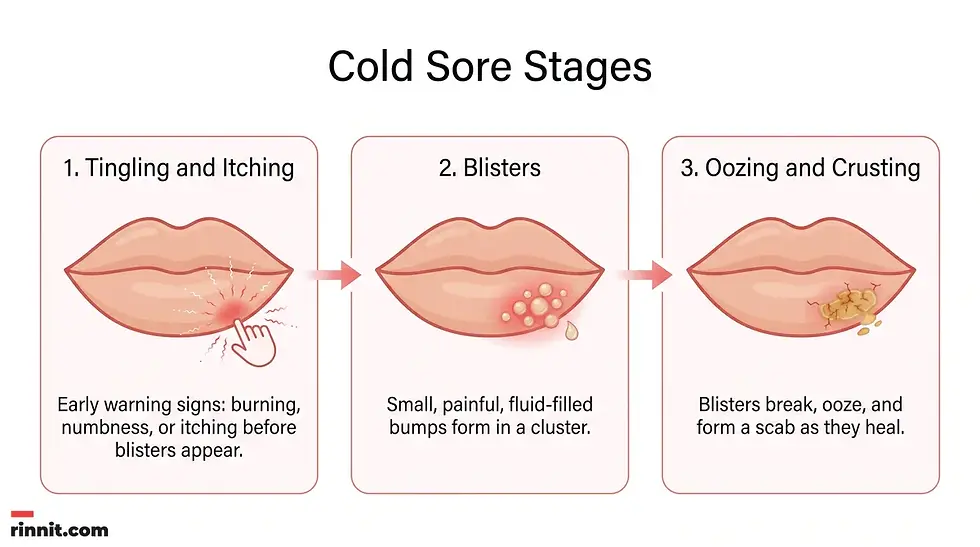
The tingling and itching stage matters because it is your early warning window — the best time to start treatment.
First Outbreak vs. Recurrence
Symptoms vary, depending on whether this is your first outbreak or a recurrence. The first time you have a cold sore, symptoms may not start for up to 20 days after you were first exposed to the virus [1]. The sores can last several days, and the blisters can take 2 to 3 weeks to heal completely [1].
If blisters return, they'll often appear at the same spot each time and tend to be less severe than the first outbreak [1]. In a first-time outbreak, you also might experience:
First-Outbreak Symptom | Detail |
Fever | Fever accompanying the first outbreak |
Painful gums | Gums may become painful |
Sore throat | Throat soreness can occur |
Headache | Headaches may accompany the outbreak |
Muscle aches | Aching muscles may occur |
Swollen lymph nodes | Lymph nodes may swell |
Children Under 5: A Common Mix-Up
Children under 5 years old may have cold sores inside their mouths. These sores are often mistaken for canker sores [1]. The distinction matters: canker sores involve only the mucous membrane and aren't caused by the herpes simplex virus [1].
Feature | Cold Sore | Canker Sore |
Location | On and around the lips (border, nose, cheeks); inside the mouth mainly in young children | Inside the mouth, on the mucous membrane |
Cause | Herpes simplex virus (HSV-1 or HSV-2) | Not caused by herpes simplex virus |
What Causes Cold Sores?
Cold sores are caused by certain strains of the herpes simplex virus (HSV). HSV-1 usually causes cold sores. HSV-2 is often the cause of genital herpes. But either type can spread to the face or genitals through close contact, such as kissing or oral sex. Shared eating utensils, razors, and towels can also spread HSV-1 [1].
How Contagious Is It — and When?
Cold sores are most likely to spread when you have oozing blisters. But you can spread the virus even if you don't have blisters. Many people who are infected with the virus that causes cold sores never develop symptoms [1].
Once you've had a herpes infection, the virus can hide in nerve cells in the skin and may cause another cold sore at the same place as before [1].
What Triggers a Cold Sore to Come Back?
A return of cold sores may be triggered by [1]:
Trigger | Example |
Viral infection or fever | Another illness reactivating the dormant virus |
Hormonal changes | Those related to a menstrual period |
Stress | Emotional stress periods |
Fatigue | Tiredness and exhaustion |
Sun or wind | Being outdoors in the sun or wind |
Changes in the immune system | Anything that weakens immune defenses |
Injury to the skin | Local skin damage |
Who Is at Risk?
Almost everyone is at risk of cold sores, because the virus that causes them is so widespread. Most adults carry the virus that causes cold sores, even if they've never had symptoms [1]. You're most at risk of complications from the virus if you have a weak immune system from conditions and treatments such as:
Immune-Weakening Factor | Why It Raises Risk |
HIV / AIDS | Weakened immune defense |
Atopic dermatitis (eczema) | Skin barrier and immune vulnerability |
Cancer chemotherapy | Suppressed immune system |
Anti-rejection medicine for organ transplants | Immunosuppressive treatment |
What Are the Possible Complications?
In some people, the virus that causes cold sores can cause problems in other areas of the body [1].
Area | Complication | Why It Matters |
Fingertips | Both HSV-1 and HSV-2 can be spread to the fingers — an infection called herpes whitlow; children who suck their thumbs may transfer the infection from their mouths to their thumbs | Finger infection that needs proper care |
Eyes | The virus can sometimes cause eye infection; repeated infections can cause scarring and injury, which may lead to vision problems or loss of vision | Gritty or painful eyes need prompt medical attention |
Widespread skin | People with atopic dermatitis (eczema) are at higher risk of cold sores spreading all across their bodies — this can become a medical emergency | Urgent care needed for widespread spread |
When to See a Doctor
Cold sores generally clear up without treatment [1]. See your healthcare provider if:
Sign | Action |
You have a weak immune system | See your provider — you're at higher complication risk |
The cold sores don't heal within two weeks | See your provider |
Symptoms are severe | See your provider |
The cold sores often return | See your provider — suppressive treatment may help |
You have gritty or painful eyes | See your provider — eye involvement needs prompt care |
How Is a Cold Sore Diagnosed?
Diagnosis is usually straightforward: your healthcare provider can usually diagnose cold sores just by looking at them. To confirm the diagnosis, your healthcare provider might take a sample from the blister for testing in a laboratory [2].
What Treatments Are Available?
Cold sores often clear up without treatment in 2 to 4 weeks [2]. Your doctor might prescribe antiviral medicine that may speed the healing process [2].
Antiviral | Notes |
Acyclovir | A well-established prescription antiviral |
Valacyclovir | A well-established prescription antiviral |
Famciclovir | A well-established prescription antiviral |
Penciclovir | Available as a cream applied to the sore |
Some of these products are pills. Others are creams you put on the sores several times a day. In general, the pills work better than the creams. For very severe infections, some antiviral medicines can be injected [2].
For frequent outbreaks, your provider may prescribe an antiviral medicine to take on a regular basis if you develop cold sores more than nine times a year or if you're at high risk of serious complications [1].
Lifestyle and Home Remedies
The over-the-counter cold sore ointment docosanol may shorten the healing time of a cold sore [2]. At the first sign of symptoms, apply it to the affected skin as directed on the package. Use a cotton-tipped swab to put medicine on a cold sore — this helps prevent the spread of the sores to other parts of the body [2].

To ease the discomfort of a cold sore [2]:
Home Care Step | What It Does |
Try other cold sore remedies | Some nonprescription products contain a drying agent, such as alcohol, that may speed healing |
Use lip balms and cream | Protect your lips from the sun with a zinc oxide cream or lip balm with sunblock; apply a moisturizing cream if your lips become dry |
Apply a compress | A cold, damp cloth may ease symptoms and help remove crusting; or try a warm cloth on the blisters to ease pain |
Rest and pain relievers | Take nonprescription pain medicine if you have a fever or the sore is painful; creams with lidocaine or benzocaine may offer some pain relief |
Alternative Medicine — What the Evidence Says
Studies about whether alternative medicine helps with cold sores have had mixed results [2]. Some approaches people use include:
Approach | What the Evidence Suggests |
Lysine | An amino acid, available as an oral supplement and as a cream |
Rhubarb and sage | A cream combining rhubarb and sage may be about as effective as acyclovir cream |
Stress reduction | If cold sores are brought on by stress, relaxation techniques such as deep-breathing exercises and meditation may help |
Propolis | Available as a 3% ointment; when applied early and often, it might shorten the duration of the breakout |
How Can You Prevent Cold Sores and Stop Spreading Them?
If sunlight seems to trigger your condition, apply sunblock to the spot where the cold sore tends to form. Or talk with your healthcare provider about using an oral antiviral medicine before an activity that tends to cause a cold sore to return [1]. Take these steps to help avoid spreading cold sores to other people [1]:
Prevention Step | Why It Helps |
Avoid kissing and skin contact with people while blisters are present | The virus spreads most easily when the blisters leak fluid |
Avoid sharing items | Utensils, towels, lip balm, and other personal items can spread the virus when blisters are present |
Keep your hands clean | When you have a cold sore, wash your hands carefully before touching yourself and other people, especially babies |
How should you prepare for an appointment about cold sores?
Make an appointment with your primary care provider if your cold sores are lasting or severe, return often, or are accompanied by eye pain or gritty eyes [2]. Before your appointment, consider your answers to the following: Have you ever had these symptoms before? Do you have a history of skin problems? What medicines and supplements do you take regularly?
Questions to ask your healthcare provider:
Do I have a cold sore?
What treatment do you recommend, if any?
What self-care steps might ease my symptoms?
Can I spread this condition to others? For how long?
How do I reduce the risk of spreading this condition to others?
How soon do you expect my symptoms will improve?
Am I at risk of complications from this condition?
Can I do anything to help prevent another blister?
Your healthcare provider is likely to ask whether you could sense a cold sore coming before you could see it, whether your symptoms include eye pain or gritty eyes, whether anything seems to bring on your symptoms, whether you've been treated for cold sores in the past (and what treatment helped most), whether you've been under stress lately or had major life changes, whether you're pregnant, and whether your work or home life brings you into contact with infants or people with major illness [2].
Conclusion
Cold sores are very common — a virus that most adults carry, a sore that follows a predictable tingling-to-crusting path, and an outbreak that typically resolves on its own in two to four weeks. The two facts that matter most are the transmission reality (the virus can spread even without visible sores) and the treatment window (antiviral pills generally outperform creams, and starting at the first tingle makes the biggest difference). If your sores are severe, keep returning, won't heal within two weeks, or affect your eyes, see a healthcare provider — suppressive antiviral therapy exists for frequent outbreaks, and eye involvement deserves prompt attention.
Frequently Asked Questions
1. What is a cold sore?
A cold sore, also called a fever blister, is a common viral infection appearing as tiny, fluid-filled blisters on and around the lips, often grouped in patches. It is usually caused by herpes simplex virus type 1 (HSV-1) and typically heals in 2 to 3 weeks without scarring.
2. What causes cold sores?
Cold sores are caused by the herpes simplex virus — usually HSV-1, less commonly HSV-2. The virus spreads through close contact like kissing, and can also spread via shared eating utensils, razors, and towels. Either virus type can affect the mouth or genitals and can be spread by oral sex.
3. What are the stages of a cold sore?
A cold sore usually passes through three stages: tingling and itching (a day or so of burning or tingling before a spot appears), blisters (small fluid-filled blisters along the lip border, sometimes around the nose, cheeks, or inside the mouth), and oozing and crusting (blisters merge, burst, and form shallow sores that ooze and crust over).
4. How long does a cold sore take to heal?
Blisters can take 2 to 3 weeks to heal completely, and cold sores often clear up without treatment in 2 to 4 weeks. Recurrent outbreaks are often less severe than the first one.
5. Is a cold sore contagious?
Yes. Cold sores spread person to person by close contact such as kissing. They are most contagious when the blisters are oozing, but the virus can spread even if you don't have blisters, and many infected people never develop symptoms.
6. What triggers a cold sore to come back?
Once infected, the virus hides in nerve cells in the skin and can reactivate at the same spot. Common triggers include viral infection or fever, hormonal changes such as a menstrual period, stress, fatigue, sun or wind exposure, immune system changes, and skin injury.
7. Cold sore vs. canker sore — what's the difference?
Cold sores are fluid-filled blisters around the lips caused by the herpes simplex virus. Canker sores appear only inside the mouth on the mucous membrane and are not caused by the herpes simplex virus.
8. What treatments speed up a cold sore?
Prescription antivirals (acyclovir, valacyclovir, famciclovir, penciclovir) speed healing — pills generally work better than creams. Over the counter, docosanol ointment applied at the first sign may shorten healing time. Pain can be eased with a cold compress, pain relievers, or lidocaine/benzocaine creams.
9. When should I see a doctor for a cold sore?
See your provider if you have a weak immune system, the sores don't heal within two weeks, symptoms are severe, the sores return often, or you have gritty or painful eyes. Eye involvement needs prompt medical attention.
10. Can I prevent cold sores from spreading?
Yes — avoid kissing and skin contact while blisters are present, don't share utensils, towels, lip balm, or other personal items while blisters are present, and wash your hands carefully before touching yourself and others, especially babies. If sun triggers your sores, apply sunblock to the spot where they tend to form.
Related Reading
Managing Herpes Simplex: A Comprehensive Guide to Outbreaks and Care explains the virus behind cold sores and how outbreaks are managed.
Antivirals: What They Treat, How They Work and Side Effects explains how antiviral medicines work, including those used for herpes.
Canker Sore (Aphthous Ulcer): Types, Triggers, Treatment & Complete Guide covers mouth ulcers that are often confused with cold sores.
Angular Cheilitis: Cracked Mouth Corners Explained — Causes, Treatment, and How Long It Lasts explains cracked, sore mouth corners and how they heal.
References
Mayo Clinic Staff. Cold sore — Symptoms and causes. Mayo Clinic. Jan. 5, 2024. https://www.mayoclinic.org/diseases-conditions/cold-sore/symptoms-causes/syc-20371017
Mayo Clinic Staff. Cold sore — Diagnosis and treatment. Mayo Clinic. Jan. 5, 2024. https://www.mayoclinic.org/diseases-conditions/cold-sore/diagnosis-treatment/drc-20371023
Worrall G. Herpes labialis. BMJ Clin Evid. 2009;2009:1704. PMID 21726482. https://pubmed.ncbi.nlm.nih.gov/21726482/
Sacks SL, Thisted RA, Jones TM, et al. Clinical efficacy of topical docosanol 10% cream for herpes simplex labialis: a multicenter, randomized, placebo-controlled trial. J Am Acad Dermatol. 2001;45(2):222-230. PMID 11464183. https://doi.org/10.1067/mjd.2001.116215
Habbema L, De Boulle K, Roders GA, Katz DH. n-Docosanol 10% cream in the treatment of recurrent herpes labialis: a randomised, double-blind, placebo-controlled study. Acta Derm Venereol. 1996;76(6):479-481. PMID 8982417. https://doi.org/10.2340/0001555576479481
Medical Disclaimer
This article is for informational purposes only and does not constitute medical advice. Always seek the advice of your physician or other qualified health provider with any questions you may have regarding a medical condition. Never disregard professional medical advice or delay in seeking it because of something you have read here.



Comments