Lip Lift: A Permanent Solution for Lip Enhancement

Updated: 2 days ago
Medically reviewed by Dr. Baraa Alnahhal, MD · Last reviewed: October 2026
Quick Answer
A lip lift is a cosmetic surgery that reduces the space between the bottom of the nose and the top of the lip [1]. By removing a small strip of skin [1], a surgeon lifts the upper lip to make it more visible. This permanent procedure is typically performed under local anesthesia in less than an hour [1], offering an alternative to fillers.
What the research says
Lip lifts measurably restore upper-lip proportions with high satisfaction. In a systematic review of 7 studies (1,754 patients), bullhorn-type lifts shortened philtral length from 14.0–14.5 mm to 10.8–12.0 mm and increased upper-incisor show from 1.5–2.0 mm to 3.5–5.0 mm; mean patient satisfaction was 4.4 out of 5, complications were mostly mild and transient, and revision rates were 0.6%–6.7%. (Komisarek et al., J Cosmet Dermatol, 2026) [2]
Head-to-head evidence between surgical techniques is limited. A systematic review of non-filling lip augmentation (18 papers assessed) found only one study that directly compared the efficacy of two surgical techniques and none that compared their complications, so technique choice relies largely on your anatomy and your surgeon's experience. (Moragas et al., J Craniomaxillofac Surg, 2014) [3]
The classic bullhorn lift has been refined. A review drawing on an 823-patient series describes a modified bullhorn lift with deep-plane release and secure suspension, presented as reproducible for patients of all ages, ethnicities and skin types. (Talei, Facial Plast Surg Clin North Am, 2019) [4]
A lip lift is a permanent surgical option for people who want a more defined upper lip without repeated filler injections. Below is how it works, the main techniques, what recovery looks like, and the risks to discuss with your surgeon.
Overview of the Lip Lift Procedure
A lip lift is a specialized surgical technique designed to enhance the aesthetics of the mouth by reducing the length of the philtrum, the area between the nose and the upper lip. This procedure is increasingly favored by those seeking a more pronounced and youthful appearance without the need for recurring filler injections or implants. By shortening this space, the lip lift can add the appearance of volume and improve the overall balance of facial features.
The procedure is highly customizable, allowing plastic surgeons to address specific concerns such as down-turned lip corners or the loss of definition caused by natural aging [1]. Because it involves the physical removal of excess skin and the repositioning of the lip, the results are permanent and look natural.
Common Types of Lip Lift Techniques
There are several variations of the lip lift, each tailored to meet different aesthetic goals and anatomical requirements. The choice of technique depends on the patient's existing lip shape and the desired outcome.
Technique | Description | Primary goal |
|---|---|---|
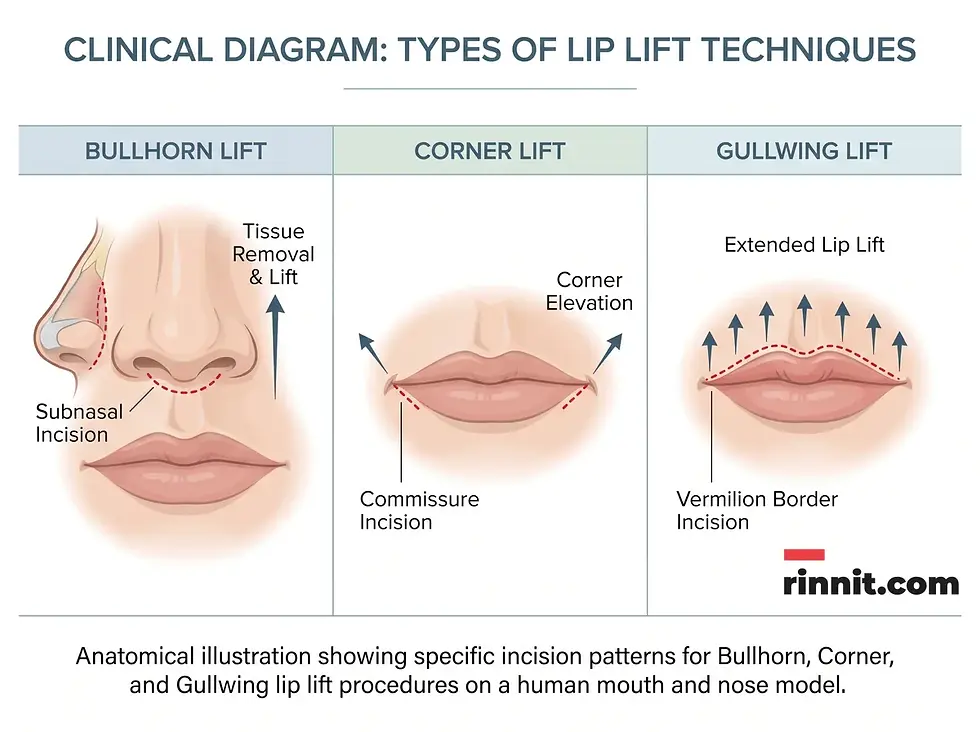
Bullhorn lift | A subnasal incision shaped like a bullhorn below the nose [1]. | Lifts the center and sides of the upper lip [1]. |
Central lift | A single incision at the base of the nose [1]. | Enhances the Cupid's bow and lifts the center. |
Corner lift | Incisions at the corners of the mouth [1]. | Elevates downturned corners into a slight smile [1]. |
Gullwing lift | An incision along the border of the upper lip [1]. | Creates a more defined and pronounced top lip [1]. |
Italian lift | Two small incisions located at each nostril [1]. | Provides a subtle lift without affecting the center [1]. |
V to Y advancement | A V-shaped incision closed in a Y-shape [1]. | Increases the visible surface area of the lip. |
What to Expect During the Procedure
Preparing for a lip lift involves a consultation with a plastic surgeon to discuss health history and goals. Patients are typically advised to stop smoking and avoid blood-thinning medications or herbal supplements [1] for several weeks before the surgery.
On the day of the procedure, local anesthesia is usually administered to numb the area, allowing the patient to remain awake and comfortable. If the lip lift is combined with other surgeries, such as a facelift, general anesthesia may be used [1]. The surgeon carefully removes a precise amount of excess skin and lifts the lip into its new position before closing the incisions with small, fine stitches [1]. The entire process generally takes less than one hour [1].

Recovery and Long-Term Results
Most patients are cleared to return home the same day [1]. Following surgery, it is common to experience some swelling, soreness, and a feeling of tightness in the lips [1]. Surgeons provide specific aftercare instructions, such as sleeping with the head elevated and sticking to soft foods for the first few days [1] to minimize strain on the incision site.
The recovery timeline is generally straightforward, though patience is required to see the final transformation.
Recovery phase | Expected timeline | Typical experience |
|---|---|---|
Initial healing | 1–7 days | Swelling and bruising begin to subside; stitches removed or dissolving. |
Surgical site healing | 6–8 weeks | Most visible signs of surgery disappear [1]. |
Tightness sensation | 2–3 months | Lips begin to feel more flexible and natural. |
Optimal results | Up to 4 months | Final shape and volume appearance are fully visible [1]. |
Full normalization | Up to 6 months | Lips feel completely normal in terms of sensation and movement [1]. |

Risks and Considerations
While a lip lift is considered a safe and minor surgical procedure, it does carry potential risks that patients should discuss with their provider. Common side effects include temporary bruising and swelling, which typically resolve within a few weeks. More rare complications can include infection, nerve damage, or uneven results [1].
One significant consideration is the potential for scarring. Plastic surgeons are trained to place incisions in the natural creases beneath the nose to make any resulting scars as inconspicuous as possible. Over time, these fine lines usually fade and blend with the surrounding skin tone [1].
Conclusion
The lip lift offers a durable and effective solution for those looking to enhance their smile and achieve a more youthful facial profile. By providing permanent results and a natural appearance, it serves as a powerful alternative to temporary cosmetic enhancements. With a variety of techniques available, patients can work with their surgeons to find the approach that best suits their unique anatomy and aesthetic desires.
Next Steps
If you are considering a lip lift, the first step is to schedule a consultation with a board-certified plastic surgeon. During this meeting, you can discuss your goals, review the different techniques, and determine if you are a suitable candidate for the procedure. Be sure to ask about the recovery process and any specific preparations you may need to make based on your health history.
Frequently Asked Questions
1. Is a lip lift more effective than lip fillers?
A lip lift provides permanent results and changes the position of the lip, whereas fillers are temporary and primarily add volume.
2. How long does the surgery take?
The procedure typically takes less than one hour to complete.
3. Will I be awake during the procedure?
Yes. Most lip lifts are performed under local anesthesia, meaning you are awake but the area is completely numb.
4. Is the scarring noticeable?
Surgeons place incisions in natural creases to minimize visibility; scars usually fade into fine, inconspicuous lines over time.
5. How soon can I return to work?
Many patients return to work the next day or within several days, depending on their comfort level and the nature of their job.
6. When are the stitches removed?
Stitches are removed by your surgeon a few days after the procedure, or they dissolve on their own.
7. Are the results of a lip lift permanent?
Yes. Unlike fillers, a lip lift is a permanent surgical enhancement.
8. Can a lip lift improve a "gummy" smile?
While it primarily lifts the lip, its effect on a gummy smile depends on the individual's anatomy and the technique used.
9. What should I eat after surgery?
Eat soft foods that require minimal chewing for the first few days.
10. Does a lip lift affect how I speak?
You may be advised to avoid talking a lot at first, but your speech should return to normal as swelling subsides.
11. Can I exercise after the procedure?
Strenuous activities such as strength training and heavy lifting should be avoided for about two weeks.
12. Is the procedure painful?
You will not feel pain during the surgery because of anesthesia; discomfort afterward can be managed with medication.
13. What is the most common type of lip lift?
The bullhorn (subnasal) lip lift is the most frequently performed technique.
14. When will I see the final results?
While healing occurs sooner, optimal results are typically seen about four months after the procedure.
15. Can a lip lift be reversed?
Because it involves removing skin, it is considered a permanent change and is not easily reversible.
16. How do I prepare for a lip lift?
Your consultation includes a physical exam and a review of your general health and goals, and the surgeon chooses the type of lip lift for you [1]. Before surgery, stop alcohol and blood thinners, including aspirin and herbal supplements, but do not change your regular medications unless a healthcare provider approves [1]. Quit smoking several weeks before and after surgery, and arrange for someone to drive you home because the anesthetic can leave you tired and dazed [1].
17. When should I call my doctor after a lip lift?
Call your plastic surgeon for signs of an allergic reaction or infection, excessive bleeding, swelling that worsens or does not go away, or a fever [1]. Stitches are removed a few days after surgery or dissolve on their own, and the incisions take about six to eight weeks to heal [1].
Related Reading
Lip Fillers: What to Expect, Benefits, Risks, and Recovery explains temporary injectable lip enhancement and its side effects.
Lip Flip: What It Is, Results, Risks, and Recovery describes a nonsurgical toxin treatment that turns the upper lip outward.
Lip Augmentation: Types, Results, Recovery and Risks compares surgical and injectable ways to add lip volume.
Lip Anatomy: A Complete Guide to Structure and Function describes the structure of the lips and the area above them.
References
Cleveland Clinic. Lip Lift. Cleveland Clinic. Last updated November 17, 2023. https://my.clevelandclinic.org/health/procedures/lip-lift
Komisarek O, et al. The Bullhorn and Beyond: Evidence-Based Review and Clinical Recommendations for Lip Lift Techniques. Journal of Cosmetic Dermatology. 2026;25(3):e70703. PMID 41731334. https://doi.org/10.1111/jocd.70703
Moragas JS, Vercruysse HJ, Mommaerts MY. "Non-filling" procedures for lip augmentation: a systematic review of contemporary techniques and their outcomes. Journal of Cranio-Maxillofacial Surgery. 2014;42(6):943-952. PMID 24534683. https://doi.org/10.1016/j.jcms.2014.01.015
Talei B. The Modified Upper Lip Lift: Advanced Approach with Deep-Plane Release and Secure Suspension: 823-Patient Series. Facial Plastic Surgery Clinics of North America. 2019;27(3):385-398. PMID 31280853. https://doi.org/10.1016/j.fsc.2019.04.004
Medical disclaimer
This article is for informational purposes only and does not constitute medical advice. Always seek the advice of your physician or other qualified health provider with any questions you may have regarding a medical condition or surgical procedure.



Comments