Lip Flip: What It Is, Results, Risks, and Recovery

Updated: 3 days ago
Medically reviewed by Dr. Baraa Alnahhal, MD · Last reviewed: October 2026
Quick Answer
A lip flip is a nonsurgical treatment that uses botulinum toxin to relax the muscles around the upper lip so it turns slightly upward and looks fuller without added volume, unlike lip filler. Results appear in about one week and typically last two to five months. Get urgent advice for difficulty breathing, swallowing or talking, vision problems or muscle weakness. [1]
What the research says
Consistent eversion with minor side effects: According to PubMed, a systematic review identified 48 articles on the lip flip, and 7 met the inclusion criteria. The review reports consistent upper lip eversion, high patient satisfaction, and minimal downtime, with mild, short-lived side effects such as difficulty whistling or drinking through a straw that resolved within weeks. (Pitchford et al., Arch Dermatol Res, 2025)
It changes lip height, not volume: In a prospective study of 17 women, objective 3D measurement showed a modest but significant increase in upper lip height at 15 days (p = 0.011) with no change in lip volume. All side effects were mild and temporary, including numbness and some functional limitation, and resolved within 30 days. (Germani et al., Aesthetic Plast Surg, 2026)
Temporary muscle weakness is possible: In a very small study of 3 patients, 3D imaging two weeks after injection showed a taller upper lip border (vermilion height, P = .038) and a shorter skin portion of the upper lip (P = .024). Slight perioral muscle weakness and difficulty keeping the mouth closed lasted about one month. (Li et al., J Cosmet Dermatol, 2021)
What is a lip flip?
A lip flip is a nonsurgical procedure that makes the lips look fuller without increasing their volume. The provider injects botulinum toxin into the corners of the mouth (oral commissures) and the edges of the lips (vermillion border). [1]
The toxin relaxes the muscles around the upper lip. As they relax, the upper lip can turn upward slightly (eversion) and look larger than before. The change is in appearance and position, not added material or volume. [1]

A lip flip changes the appearance of the upper lip by relaxing selected surrounding muscles so the lip turns upward slightly.
Lip flip versus lip fillers
Both treatments can make lips look fuller, but they work differently. Lip fillers use hyaluronic acid to add volume. A lip flip uses botulinum toxin in parts of the upper lip to relax muscle and create a subtle upward turn without adding volume. [1] See our full guide to lip fillers for details on that option.
Feature | Lip flip | Lip fillers |
Main mechanism | Relaxes muscles around the upper lip so it turns upward slightly | Adds volume with hyaluronic acid |
Adds lip volume? | No | Yes |
Visible change | About one week | Lips look fuller right after the procedure |
Typical duration | About two to five months | About 6 to 12 months, sometimes longer |
Recovery | Pain and swelling generally improve within 12 to 24 hours | Swelling may improve in 24 to 48 hours but can last up to a week |
Main limitations | Too much muscle relaxation may affect drinking, speaking, or saliva control | Possible infection, asymmetry, filler migration, and vascular compromise |
The right option depends on your goals, health history, anatomy, and comfort with the possible risks. A qualified provider should explain which approach, if any, is appropriate for you. [1]
Why do people choose a lip flip?
A lip flip is a personal decision. Possible goals include a fuller-looking lip, a less visible expression-related wrinkle, less gum showing when you smile, and more confidence or a better body image. Some people prefer it because they do not want fillers or surgical lip augmentation, which change lip volume and shape and generally involve more bruising and swelling. [1]
Lip appearance changes with age, and genetics, smoking, and sun damage are linked with losing lip volume over time. A lip flip does not stop aging or change the structure of the lips. [1] For more on lines around the mouth, see our guides to lip lines and wrinkles.
Possible goal | What a lip flip may change |
Fuller-looking upper lip | Muscle relaxation can allow a slight upward turn |
Less visible expression wrinkles | Relaxed muscles may reduce the look of wrinkles made by facial expressions |
More gum coverage | The upper lip may cover more of the gums when you smile |
Alternative to added volume | The look changes without adding volume |
Confidence or body image | Some people choose it to feel more confident |
These goals do not guarantee a particular result. A consultation should address what is realistic for your features and expectations. [1]
Who may be considered?
A person considered for a lip flip should be in good physical health, have realistic expectations, and not have an active mouth infection, including a canker sore or cold sore. [1]
The provider should consider more than the look you want. The consultation may cover your motivation, expectations, mental health, social circumstances, and whether someone else is encouraging the procedure. [1]
There has not been much research on lip flip safety during pregnancy, and it is not recommended while pregnant. Talk with a qualified provider if you are pregnant or planning a pregnancy. [1]
Before treatment: what to discuss
Your provider will review your general health, preexisting conditions, and risk factors. Tell them about allergies, especially cow's milk allergy, because some botulinum toxin products contain albumin, a protein found in cow's milk. Also tell them about prescription medicines, over-the-counter medicines, and supplements. [1]
The provider may photograph your face and lips for your medical record. Describe the result you want clearly and ask what is realistic, since a lip flip changes appearance subtly and does not restructure the lips. [1]
Your provider may recommend avoiding alcohol, cigarettes, and aspirin for at least one week before the procedure. Alcohol and aspirin thin the blood, and cigarettes may increase bruising at injection sites. Follow your provider's instructions instead of changing a medicine on your own. [1]
Consultation topic | Question or information to bring |
Health history | Which conditions or risk factors affect whether treatment is appropriate? |
Allergies | Do I have an allergy relevant to the proposed botulinum toxin product or a numbing option? |
Medicines | Which prescription medicines, over-the-counter medicines, and supplements do I take? |
Oral health | Do I currently have a cold sore, canker sore, or other mouth infection? |
Expectations | How much change is realistic for my upper lip and facial features? |
Timing | How far ahead of an important event should the procedure be scheduled? |
Recovery | When can I eat normally, exercise, smoke, or drink alcohol? |
Alternatives | Would lip fillers or another lip enhancement better match my goals? |
Follow-up | What symptoms should prompt a call, and how often should results be reviewed? |
What happens during a lip flip?
A lip flip is minimally invasive, so your lips are unlikely to be numbed routinely. If pain or fear of needles is a concern, ask whether a numbing cream or nerve block is appropriate. [1]
The provider uses a thin needle to inject botulinum toxin into parts of the upper lip, including the corners and edges. You may feel a little pain, and your eyes may water. A cotton swab may be used to absorb small dots of blood. The procedure is quick and usually takes 10 to 20 minutes. The amount and placement are decided by the treating provider, and this article is not dosing guidance. [1]

A lip flip appointment includes a health review, careful placement of botulinum toxin, brief monitoring, and time for the visible effect to develop.
What happens immediately afterward?
The provider monitors you for up to 15 minutes for allergic reactions, dizziness, nausea, swelling, or substantial bleeding. Once monitoring is done, you can usually go home. Botulinum toxin does not make you tired, so driving home may be possible. [1]
Your lips may be slightly swollen, sensitive, or numb. Swelling and sensitivity usually resolve within 24 hours. The final look is not immediate: it takes about one week for the lips to look fuller as the muscle-relaxing effect develops. [1]
Lip flip aftercare
Apply an ice pack for up to 10 minutes to reduce inflammation, pain, and swelling, and avoid lipstick, lip balm, and other lip products for at least three to four days. Avoid pressure on your lips, including touching, puckering, kissing, and using a straw. Brush your teeth carefully and avoid sleeping facedown. These steps are meant to lower the chance of the toxin moving to other areas. [1]
You can eat and drink carefully soon after treatment, but avoid messy foods that could lead you to wipe your lips for at least three days. Avoid straws and smoking for at least three days and alcohol for at least 24 hours. [1]
Recovery period | Guidance |
Ice | Apply an ice pack for up to 10 minutes. |
Lip products | Avoid lipstick, lip balm, and other lip products for at least three to four days. |
Pressure and movement | Avoid touching, puckering, kissing, and straws. |
Position | Avoid sleeping facedown. |
Eating and drinking | Eat and drink carefully; avoid messy foods for at least three days. |
Smoking | Avoid smoking for at least three days. |
Alcohol | Avoid alcohol for at least 24 hours. |
Oral care | Brush your teeth carefully. |
Results and how long they last
A lip flip typically lasts two to five months. The effect fades gradually as the botulinum toxin wears off, so keeping the look means repeat treatments, which you would discuss with your provider. [1]
Your lips may start to look fuller after about one week. If you want the effect for a wedding or another big event, schedule the procedure at least two weeks ahead so the effect has time to develop and early recovery is complete. [1]
Benefits, limitations, and reversibility
Potential benefits include a fuller-looking upper lip without added volume, a possible reduction in expression-related wrinkles, more upper lip coverage of the gums when smiling, and generally less pain, bruising, and swelling than other lip enhancement procedures. [1]
A lip flip is temporary and does not change the structure of the lips. It also cannot be reversed right away if you dislike the result: you have to wait for the toxin to wear off. [1] If you want a more lasting change, you may want to read about the surgical lip lift.
Risks and side effects
Possible risks include headache, fever, chills, discoloration, and tenderness. The muscles may relax too much, which can cause drooling and difficulty drinking or speaking, and these effects may last until the toxin wears off. [1]
Botulism is an extremely uncommon possibility, and the toxin may spread to other parts of the body. An unwanted cosmetic result cannot be quickly reversed. [1] To learn more about this condition, see our guide to botulism.
Possible risk or limitation | What it can involve |
Temporary result | The effect usually lasts two to five months |
Excessive muscle relaxation | Drooling, difficulty drinking, or difficulty speaking |
Delayed correction | An unwanted result cannot be dissolved; you must wait for the toxin to wear off |
Headache, fever, or chills | Whole-body symptoms reported as possible risks |
Discoloration or tenderness | Changes or sensitivity around the treated areas |
Botulism | A very rare but serious complication |
Toxin spread | Symptoms in other facial or body muscles |
When to contact a healthcare professional
Contact your provider immediately if any of these happen shortly after treatment or even weeks later: difficulty breathing, difficulty swallowing or talking, impaired vision, or weakness in muscles elsewhere in your face or body. These can mean the toxin has spread beyond the treated area. [1]
Also contact your provider about worsening or unexpected swelling, substantial bleeding, marked discoloration, severe tenderness, fever, chills, or any concern that does not fit your recovery instructions. [1]
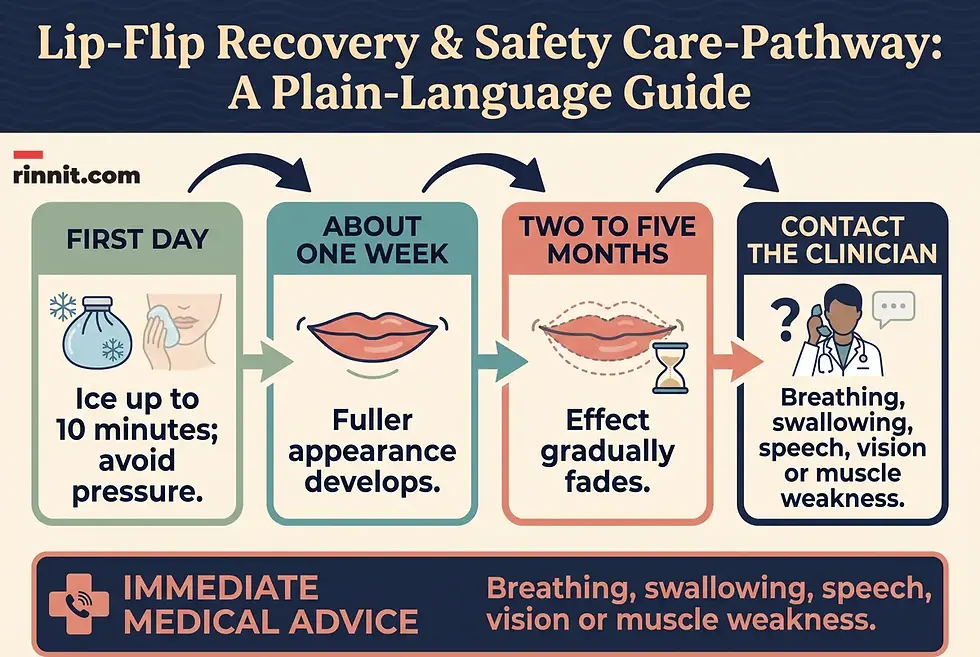
Recovery is usually brief, but breathing, swallowing, speech, vision, or muscle weakness symptoms need immediate medical advice.
Questions to ask before choosing a lip flip
A consultation should cover the provider's experience, the product, realistic outcomes, recovery, medicines, risks, alternatives, and follow-up. [1]
Topic | Question to ask |
Experience | How many lip flip procedures have you performed? |
Technique | Which muscles and lip areas would you treat, and why? |
Expectations | What degree of eversion and fullness is realistic for my features? |
Alternatives | Would lip fillers or another lip enhancement option better match my goal? |
Safety | What are the complete risks and complications? |
Recovery | How long should pain, swelling, numbness, or sensitivity last? |
Medicines | Which pain relievers or medicines should I discuss before treatment? |
Follow-up | When should I contact you, and how often should results be reviewed? |
Combination treatment | Is combining a lip flip with lip fillers appropriate for me? |
Conclusion
A lip flip can create a fuller-looking upper lip without adding volume. It works by relaxing selected muscles, usually shows a visible change after about one week, and typically lasts two to five months. The choice is personal, and the procedure has limitations and risks to weigh with an experienced provider. Use the questions in this guide to prepare, follow your provider's aftercare instructions, and seek immediate medical advice for breathing, swallowing, speech, vision, or muscle weakness symptoms. [1] For an overview of other cosmetic procedures, see our guide to cosmetic surgery.
Learn more. Clear visuals help people understand cosmetic procedures before they decide. Explore the infographic templates in the Rinnit.com marketplace to create professional guides that explain treatment steps, recovery, and warning signs.
Frequently Asked Questions
Does a lip flip add volume?
No. A lip flip changes the look of the upper lip by relaxing surrounding muscles so the lip turns upward slightly. It does not add volume.
Is a lip flip the same as lip filler?
No. Lip fillers add volume with hyaluronic acid, while a lip flip uses botulinum toxin to relax selected muscles around the upper lip.
How long does a lip flip last?
Typically two to five months.
How soon will I see lip flip results?
Your lips may take about one week to look fuller. For a major event, schedule the procedure at least two weeks ahead.
How long are swelling and sensitivity expected to last?
Swelling and sensitivity usually resolve within 24 hours. Pain and swelling should generally improve within 12 to 24 hours.
Can I eat after a lip flip?
You can eat and drink carefully soon afterward, but avoid messy foods for at least three days. Also avoid straws and smoking for at least three days.
Can I wear lipstick after a lip flip?
Avoid lipstick, lip balm, and other lip products for at least three to four days.
Can a lip flip be reversed?
Not right away. If you do not like the result, you have to wait for the botulinum toxin to wear off.
Can a lip flip affect speaking or drinking?
Yes. If the muscles relax too much, drooling and difficulty drinking or speaking can occur until the toxin wears off.
Can I have a lip flip during pregnancy?
There has not been much research on safety during pregnancy, so a lip flip is not recommended while pregnant. Talk with a qualified provider if you are pregnant or planning a pregnancy.
When should I seek urgent medical advice?
Contact your provider immediately for difficulty breathing, difficulty swallowing or talking, impaired vision, or weakness in muscles elsewhere in the face or body.
Related Reading
Lip Fillers: What to Expect, Benefits, Risks, and Recovery — the volume-adding alternative to a lip flip.
Understanding the Lip Lift: A Permanent Solution for Lip Enhancement — a surgical option for the upper lip.
Understanding Lip Lines: Causes, Treatments, and Prevention — lines around the mouth explained.
Botulism: Symptoms, Causes, and Treatment — the rare complication linked to botulinum toxin.
References
Cleveland Clinic. Lip Flip: What It Is, Botox®, Results & Precautions. Cleveland Clinic. Last updated February 4, 2022. Accessed October 18, 2026. https://my.clevelandclinic.org/health/treatments/22362-lip-flip
Pitchford CA, Desrosiers AS, Tolkachjov SN. The lip flip: a systematic review of botulinum toxin lip augmentation. Arch Dermatol Res. 2025;317(1):765. PMID 40377719. https://doi.org/10.1007/s00403-025-04265-0
Germani M, Munoz-Lora VRM, Roschel P, et al. Lip flip revisited: clinical outcomes and neuromodulatory basis of upper lip eversion. Aesthetic Plast Surg. 2026;50(11):4437-4440. PMID 41915065. https://doi.org/10.1007/s00266-026-05727-0
Li Y, Chong Y, Yu N, et al. The use of botulinum toxin A in upper lip augmentation. J Cosmet Dermatol. 2021;20(1):71-74. PMID 32969573. https://doi.org/10.1111/jocd.13731
Medical disclaimer
This article is for informational purposes only and is not medical advice. Always consult a qualified healthcare professional for diagnosis and treatment decisions.



Comments