Wrinkles: What Causes Them, How to Slow Them, and Your Realistic Treatment Options

Updated: 2 days ago
Medically reviewed by Dr. Baraa Alnahhal, MD · Last reviewed: September 2026
Editor's note: This article is for general education only and is not medical advice. It was prepared from clinical reference material updated December 12, 2023, and statistics cited below are dated with their sources so readers can assess freshness.
TL;DR
Wrinkles are a natural part of aging, most common on sun-exposed skin like the face, neck, hands, and forearms. Sun exposure is the biggest preventable driver — researchers estimate UV radiation accounts for about 80% of visible facial aging. Daily broad-spectrum SPF 30+ sunscreen and not smoking are the two best-evidenced prevention steps. When treatment is wanted, options range from prescription retinoid creams to Botox, fillers, lasers, and surgery — each with different timelines, costs, and side effects.
Quick Answer: Do wrinkles mean something is wrong with my skin?
No. Wrinkles are a natural part of aging, not a disease. They form as skin becomes thinner, drier, and less elastic, and they appear most on sun-exposed areas such as the face, neck, hands, and forearms. Sun exposure is the largest controllable factor — UV radiation breaks down the collagen and elastin that keep skin firm. Daily broad-spectrum sunscreen (SPF 30 or higher) and quitting smoking are the most reliable prevention steps, while prescription retinoids, injectables, resurfacing, and surgery are the main treatment routes if lines bother you.
What exactly are wrinkles?
Wrinkles are the lines and creases that form in your skin. They most commonly develop around the mouth, eyes, and neck, where the skin becomes thinner, drier, and less elastic with age [1].
They are a natural part of aging. The lines are most likely to form on skin that is often exposed to the sun — the face, neck, hands, and forearms. Pollutants and smoking also speed the aging process [1].
Some wrinkles stay fine; others become deep and coarse. With repeated sun exposure, wrinkles can become very pronounced and deep, especially on the back of the neck [1].
If your wrinkles bother you, several options exist to smooth them or make them less visible, including medicines, skin-resurfacing techniques, fillers, and surgery [1].
Why does my skin start wrinkling as I get older?
Wrinkles are caused by several factors — some you can control, others you can't [1].
Age is the baseline cause. With aging, the skin naturally becomes less elastic and drier, with less fat and collagen in the deeper layers. This process creates the lines and creases typical of wrinkling, and it also causes loose, saggy skin [1].
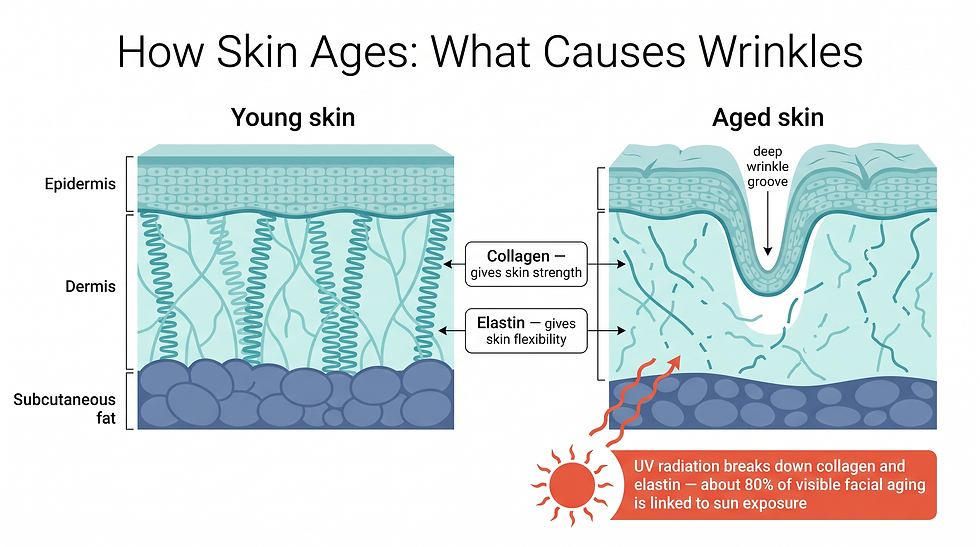
Ultraviolet (UV) radiation is the biggest controllable driver. UV radiation from sunlight and other sources speeds the skin's aging process, especially in people who tend to sunburn easily. It breaks down the elastin fibers and collagen in the skin. Without these supportive connective tissues, the skin loses strength and flexibility [1]. The scale of this effect is striking: a widely cited clinical study estimated that UV exposure is responsible for about 80% of visible facial aging signs [4].
Smoking and air pollution speed the aging process independently of sun exposure [1].
Repeated facial expressions also leave marks. Every time you squint, smile, or frown, tiny grooves form beneath the skin's surface. Young skin springs back; as skin ages and loses flexibility, these grooves become permanent features of the face [1].
Family history matters too — the genes you inherit play a big part in the look and feel of your skin [1].
Cause | Can you control it? | What it does to the skin |
Aging | No | Skin becomes thinner, drier, less elastic, with less fat and collagen |
UV radiation | Yes | Breaks down elastin fibers and collagen; roughly 80% of visible facial aging signs |
Smoking and pollution | Yes | Speeds the skin aging process |
Repeated facial expressions | Partially | Repeated squinting, smiling, and frowning etch permanent grooves as skin loses flexibility |
Family history | No | Inherited genes shape the look and feel of your skin |
What do wrinkles actually look and feel like?
Most people first notice fine lines — shallow creases that appear when the skin is dry or contracted, often around the eyes and mouth [1].
Over time, some wrinkles become deep and coarse. This deepening is strongly tied to repeated sun exposure and is especially noticeable around the eyes, mouth, and neck, and on the back of the neck [1].
Sun-exposed skin tends to show the worst changes. Because wrinkling tracks cumulative UV damage, the face, neck, hands, and forearms typically display more lines than covered areas of the body [1].
Wrinkle feature | What you may notice |
Fine lines | Shallow creases around the eyes ("crow's-feet"), mouth, and forehead |
Deep wrinkles | Pronounced grooves around the mouth, eyes, and neck |
Coarse wrinkles | Very deep, pronounced lines, especially on the back of the neck with repeated sun exposure |
Sagging skin | Loose skin alongside wrinkles, caused by loss of deeper fat and collagen |
What makes wrinkles worse — and what slows them down?
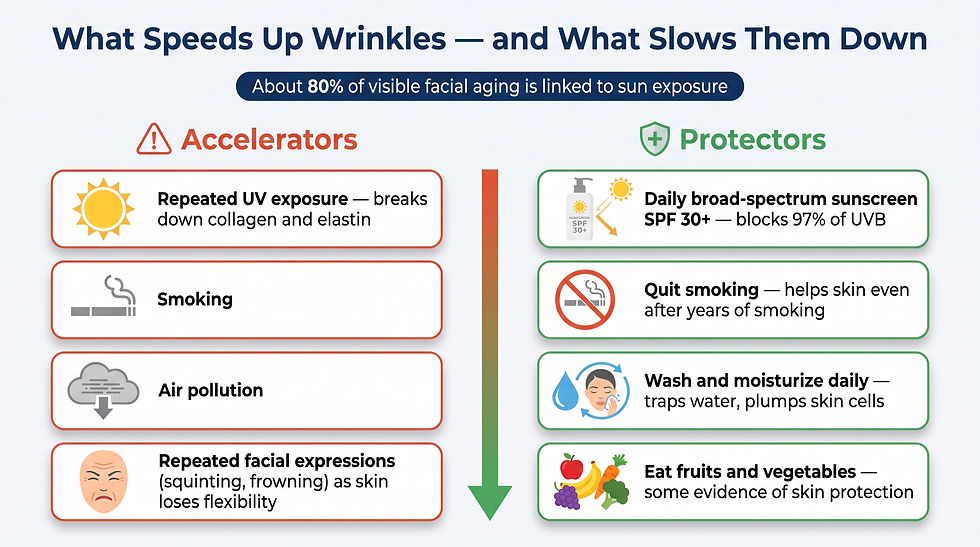
Your lifestyle choices shift how quickly and how deeply wrinkles form. The table below separates the evidence-based protection habits from the accelerators.
Factor | Effect on wrinkles | Evidence strength |
Daily sunscreen (SPF ≥30, year-round) | Slows and prevents some wrinkling | Strong — SPF 30 blocks 97% of UVB rays |
Quitting smoking | Improves skin and prevents further wrinkles | Strong |
Daily moisturizing | Traps water; dry skin shrivels plump skin cells into fine lines | Moderate |
Indoor tanning | Accelerates aging — avoid it | Strong |
Midday sun exposure | Accelerates aging — limit it, wear sun-protective clothing | Strong |
Air pollution | Speeds the aging process | Moderate |
Facial creams without proven ingredients | No proven benefit | Weak — OTC creams are not required to prove they work |
What can I actually do to prevent wrinkles?
Four habits form the prevention foundation [1].
Protect your skin from UV radiation. Avoid indoor tanning and limit time in the sun, especially midday. Wear sun-protective clothing such as wide-brimmed hats, long-sleeved shirts, and sunglasses. Use a broad-spectrum sunscreen with an SPF of at least 30 every day, year-round, even on cloudy days. Apply generously and reapply every two hours — or more often if you are swimming or sweating [1]. Note that most people apply only 20–50% of the recommended amount, which is why generous application matters [6].
Wash your face and moisturize. Dry skin shrivels plump skin cells, which can lead to fine lines and wrinkles. Make it a habit to gently wash your face and moisturize every day, since moisturizing traps water in the skin [1]. Many moisturizers contain active ingredients aimed at fine lines — look for retinol, niacinamide, and vitamin C, and note that many also include broad-spectrum sunscreen. Products with retinol or retinoids are not for use during pregnancy.
Don't smoke. Even after years of heavy smoking, quitting still improves your skin and prevents further wrinkling [1].
Eat a healthy diet. There is some evidence that certain vitamins in your diet help protect the skin. More study is needed on nutrition's role in preventing wrinkles, but eating plenty of fruits and vegetables is good general practice [1].
Are over-the-counter wrinkle creams worth it?
Be realistic about them. Over-the-counter moisturizers and wrinkle creams are not classified as medicine, which means they are not required to undergo scientific research to prove they work [1].
You have an OTC option with a stronger track record: adapalene (Differin), a vitamin A-derived product that can help prevent fine lines and wrinkles [1].
Whatever you choose, expect patience. It may take a few weeks or even months of regular use before you notice improvement — or you may see no change at all [1].
Product type | What to know |
Basic moisturizers | Trap water and plump dry skin; unproven for wrinkle reversal |
Creams with retinol, niacinamide, or vitamin C | May help prevent fine lines; effects take weeks to months |
Adapalene (Differin) | OTC vitamin A-derived option that can help prevent fine lines |
Prescription retinoids (tretinoin, tazarotene) | Strongest evidence for reducing fine wrinkles and splotches — requires a prescription |
What professional treatments are available for wrinkles?
Treatment depends on your goals, the depth of your wrinkles, your skin tone, and your willingness to accept downtime and costs. Your doctor may suggest two or more treatments combined for the best result [2].

Prescription creams and serums
Your doctor may prescribe an anti-wrinkle product with prescription-strength retinoids, derived from vitamin A. These creams and serums are intended to reduce fine wrinkles and splotches. You may need to use the product for a few weeks or months before you notice improvement [2].
Examples include tretinoin (Renova, Retin-A), tazarotene (Avage, Tazorac), and adapalene (Differin — now available without a prescription). Retinoids might cause a rash, burning, or dryness, and are not for use during pregnancy. Because retinoids make the skin sensitive to the sun, you may be advised to use them at bedtime — or to also apply SPF 30+ sunscreen and protective clothing during the day [2].
Botox injections
When injected in small doses into specific muscles, Botox prevents the muscles from moving, which helps skin look smoother. It works well on frown lines between the eyebrows, across the forehead, and on crow's-feet [2].
It may take up to seven days to see results, and the effect typically lasts a few months — so repeat injections are needed to maintain results. Possible side effects are headache, droopy eyelids, and pain, swelling, or bruising at the injection site [2].
Chemical peels
A chemical peel may be done as an outpatient procedure, often without numbing — though extensive resurfacing may involve medicine that puts you in a sleep-like state. A chemical solution removes the top layers of skin, and the skin that grows back is smoother. Depending on the peel's depth, you may need several treatments before seeing a difference [2].
Possible side effects include scarring, infection, and changes in skin color of the treated area. People with brown or Black skin have a higher risk of long-term skin color changes [2].
Facial fillers
Facial fillers are injected into the skin to plump and smooth lines and creases. Examples include calcium hydroxylapatite (Radiesse), poly-L-lactic acid (Sculptra), and hyaluronic acid (Restylane, Juvederm) [2].
It may take one to three sessions to achieve your desired result, and after about six months, repeat injections are needed to maintain results. Possible side effects — inflamed skin, bruising, and changes in skin color — tend to clear up within weeks [2].
Laser resurfacing
Laser resurfacing is a general term for energy-based facial rejuvenation procedures. They can smooth the skin, but they cannot fix sagging skin [2].
Method | How it works | Recovery | Best for |
Ablative laser | Destroys the outer skin layer and heats underlying skin, stimulating collagen; new collagen smooths and tightens as the wound heals | About 7–10 days on average | Deeper wrinkles |
Nonablative laser | Stimulates collagen growth with a less aggressive, subtler approach | Shorter recovery than ablative | Moderate wrinkles |
Fractional (either type) | Leaves microscopic columns of untreated tissue | Shorter recovery, lower side-effect risk; multiple sessions likely | Wider range of skin tones |
Laser resurfacing risks include scarring, infection, and skin color changes. People with brown or Black skin face a higher risk of long-term color changes; if that is a concern, seek an expert experienced with selecting lasers and settings for a range of skin colors, and discuss any history of hyperpigmentation or keloid formation [2].
Deoxycholic acid injections
Deoxycholic acid (Kybella) injections treat excess fat under the chin — the "double chin." The injected acid dissolves extra fat cells, reducing fullness. Repeat injections are usually needed. Possible side effects are swelling, pain, numbness, bruising, and hardness under the skin [2].
Face-lift and neck lift
Face-lift surgery lifts the skin and tightens the underlying muscle and tissues, aiming to improve the jawline, neck, and lower face. A neck lift is often done at the same time. Note what a face-lift will not correct: fine wrinkles, sun damage, uneven skin color, or creases around the nose and upper lip [2].
These surgeries may be done in a hospital or an outpatient surgical facility. Risks include bleeding, infection, and a hematoma (a collection of blood under the skin). Healing times can be lengthy, and bruising and swelling may not clear up for several weeks. Results are not permanent — you may choose another surgery several years later [2].
What do the main treatments cost and how long do results last?
One important practical note: products, procedures, and surgeries to enhance your appearance usually are not covered by insurance [2].
Treatment | First results | Typical maintenance | Key side effects |
Prescription retinoid creams | Weeks to months | Ongoing use | Rash, burning, dryness, sun sensitivity |
Botox injections | Up to 7 days | Every few months | Headache, droopy eyelids, injection-site pain |
Chemical peel | After top layer regrows (days to weeks) | May need several sessions, then repeats | Scarring, infection, skin color changes |
Facial fillers | Immediately to days | Repeat after ~6 months | Inflamed skin, bruising, color changes |
Laser resurfacing (ablative) | 7–10 days average recovery | One-time or repeated | Scarring, infection, color changes |
Deoxycholic acid injections | Weeks | Repeat injections usually needed | Swelling, pain, numbness, hardness |
Face-lift / neck lift | Weeks (bruising and swelling clear slowly) | Not permanent — may redo in several years | Bleeding, infection, hematoma |
Is there anything my skin tone should tell me about treatment choices?
Yes. Two of the resurfacing options carry a specific caution: people with brown or Black skin have a higher risk of long-term skin color changes after chemical peels and laser resurfacing [2].
If this concerns you, the guidance is to seek an expert with experience selecting lasers and settings for a range of skin colors, and to tell your doctor about any history of hyperpigmentation or keloid formation before treatment [2]. Your doctor should also be asked how many times they have performed the treatment you are considering and whether they have experience treating people with your skin color [2].
What should I expect when I see a dermatologist?
Diagnosis of wrinkles involves looking at the skin to assess the lines and creases and what may have caused them. Your doctor also discusses your medical history and what matters to you — this conversation informs which treatments best meet your needs regarding results, side effects, and recovery time [2].
Questions to prepare
When you make an appointment, prepare a list of questions [2]:
Your questions | Why they matter |
What is the best course of action? | Sets the overall plan |
What are my treatment options and the pros and cons of each? | Balances benefit against side effects |
What do the treatments cost? Does insurance cover them? | Most appearance treatments are not covered |
What results can I expect? | Sets realistic expectations |
How often will I need to repeat the treatment? | Many options require ongoing maintenance |
What kind of follow-up, if any, will I have? | Plans the long-term relationship |
What the doctor will ask you
Be ready to answer questions about your skin habits and history [2]:
The doctor may ask | What it reveals |
What products (cleansers, moisturizers) do you use? | Your current skin care routine |
Do you use sunscreen? | Your UV protection habits |
Did you expose your skin to sun when you were younger? | Cumulative past UV damage |
Have you used tanning beds in the past — or now? | Ongoing UV acceleration |
Do you smoke or have you ever smoked? | Smoking-related aging contribution |
How do I know if a wrinkle is worth seeing a doctor about?
Wrinkles are a cosmetic matter, not a medical emergency. However, if you are concerned about how your skin looks — whether from lines, uneven color, or how quickly your skin is changing — see a doctor who specializes in the skin (a dermatologist). A dermatologist can assess your skin, help you create a skin care plan, and discuss treatment options [1].
The same evaluation also matters for a different reason: sun-damaged skin carries an elevated risk of skin cancer, and a full skin assessment can catch early warning signs while you address wrinkles [3].
Conclusion: Protect first, treat second, expect honestly
Wrinkles are a natural part of aging, and no product stops the clock. But the evidence is clear about what moves the needle: daily broad-spectrum sunscreen (SPF 30 or higher, applied generously and reapplied every two hours) and not smoking are the two most reliable ways to slow wrinkling — UV radiation alone accounts for roughly 80% of visible facial aging, and quitting smoking helps skin even after years of exposure.
For the lines that bother you, a realistic ladder exists: moisturizers and OTC adapalene as daily basics, prescription retinoids for stronger evidence, and Botox, fillers, peels, lasers, or surgery for more significant change. Each has a timeline, a maintenance schedule, and side effects — most notably, people with brown or Black skin face a higher risk of long-term color changes after peels and lasers, so expertise with your skin tone matters.
Your next steps: apply SPF 30+ sunscreen every morning as a non-negotiable habit, stop smoking if you smoke, and wash and moisturize your face daily. If wrinkles concern you, book a dermatology appointment — bring your questions about options, costs, and realistic results, and ask about your provider's experience with your skin tone before committing to any procedure.
Frequently Asked Questions
Can wrinkles be reversed?
Wrinkles are a natural part of aging and cannot be fully erased, but they can be smoothed and made less visible. Prescription retinoid creams reduce fine wrinkles and splotches over weeks to months, and procedures such as Botox, fillers, laser resurfacing, and surgery provide stronger — though usually temporary — improvement.
Does sunscreen really prevent wrinkles?
Yes, and it is the single most effective step. UV radiation breaks down the collagen and elastin that keep skin firm, and research estimates UV exposure causes about 80% of visible facial aging signs. A broad-spectrum SPF 30+ sunscreen blocks 97% of UVB rays; dermatologists recommend it every day, year-round, even on cloudy days.
At what age do wrinkles start?
Wrinkles develop gradually as skin becomes thinner, drier, and less elastic. Fine lines often first appear around the eyes and mouth, while deep, coarse wrinkles — especially on sun-exposed areas like the back of the neck — reflect years of repeated sun exposure. The timing varies with genetics, sun habits, and smoking.
What is the best treatment for deep wrinkles?
Treatment depends on depth, skin tone, and goals, and doctors often combine options. For deep lines, the most effective options are typically prescription retinoids, laser resurfacing (ablative or fractional), facial fillers, and — for sagging rather than fine creases — face-lift surgery. A face-lift will not correct fine wrinkles, sun damage, or uneven color.
Does Botox get rid of wrinkles?
Botox smooths skin by preventing specific muscles from moving, and it works well on frown lines between the eyebrows, forehead lines, and crow's-feet. Results take up to seven days, last a few months, and require repeat injections. Possible side effects include headache, droopy eyelids, and injection-site pain or bruising.
Are wrinkle creams worth the money?
Over-the-counter wrinkle creams are not classified as medicine and are not required to prove they work, so results vary — some people see improvement after weeks or months, others see none. OTC adapalene (a vitamin A derivative) and moisturizers with retinol, niacinamide, or vitamin C offer the most credible OTC options, while prescription retinoids provide the strongest evidence for reducing fine wrinkles.
How much do wrinkle treatments cost, and does insurance cover them?
Products, procedures, and surgeries to enhance appearance are usually not covered by insurance, so costs fall to you. Expect ongoing expenses: Botox and fillers need repeat sessions every few months to about six months, retinoids and moisturizers require continuous use, and face-lift results are not permanent.
Can people with dark skin get wrinkle treatments safely?
Yes, but with extra care. People with brown or Black skin have a higher risk of long-term skin color changes after chemical peels and laser resurfacing. If you choose these treatments, work with an expert experienced in selecting lasers and settings for a range of skin tones, and mention any history of hyperpigmentation or keloid formation.
References
Mayo Clinic — Wrinkles: Symptoms and causes (updated Dec. 12, 2023)
Mayo Clinic — Wrinkles: Diagnosis and treatment (updated Dec. 12, 2023)
American Academy of Dermatology — How dermatologists treat sun-damaged skin
ISAPS — Global Survey 2024: botulinum toxin procedure statistics
American Society of Plastic Surgeons — 2024 Plastic Surgery Statistics
U.S. Food and Drug Administration — Dermal filler do's and don'ts for wrinkles, lips and more
U.S. Food and Drug Administration — Wrinkle treatments and other anti-aging products
Krutmann J, et al. — The skin aging exposome (J Dermatol Sci, 2016)
Comments