Vampire Facelift (PRP Facelift): How It Works, Benefits, Side Effects and Results

Updated: 3 days ago
Written and medically reviewed by Dr. Baraa Alnahhal, MD · Last reviewed: November 2026 · How we review
Quick Answer: What is a vampire facelift?
A vampire facelift, or PRP facelift, is a nonsurgical way to rejuvenate facial skin. A provider injects platelet-rich plasma (PRP), taken from your own blood, together with a hyaluronic acid filler to contour the face, reduce wrinkles and plump the skin. It takes one to two hours, side effects are usually mild, and results last 12 to 18 months. [1]
What the research says
People noticed smoother skin, but expert raters did not. In a masked trial analyzing 19 adults who received PRP in one cheek and saline in the other, six months later participants rated the PRP side as more improved for texture (2.00 vs 1.21) and wrinkles (1.74 vs 1.21), but dermatologists' photoaging scores showed no significant difference. (Alam et al., JAMA Dermatology, 2018) [2]
Skin imaging improved after a course of injections. Thirty women received three PRP injections 15 days apart. Skin analysis showed fewer wrinkles, smoother texture and smaller pores, and lab tests suggested PRP helped protect skin fibers from UV-B damage. (Du and Lei, Experimental and Therapeutic Medicine, 2020) [3]
The overall evidence is still weak. An overview of 13 systematic reviews, based on 28 primary studies (18 of them uncontrolled), rated confidence in the results as low or critically low in 12 of the 13 reviews and found the evidence insufficient for firm conclusions about PRP for facial rejuvenation. (Cruciani et al., Blood Transfusion, 2024) [4]
Key takeaways
A vampire facelift injects platelet-rich plasma from your own blood plus a hyaluronic acid filler to rejuvenate the face without surgery. [1]
It's an alternative to a surgical facelift, usually takes one to two hours and has a short recovery. [1]
Filler plumping is visible right away, PRP smoothing appears after about two weeks and results last about 12 to 18 months. [1]
Side effects are usually mild, such as swelling, bruising, tenderness, tingling and itching. [1]
Research is still limited, so choose a board-certified plastic surgeon or dermatologist. [1]
What is a vampire facelift?
A vampire facelift, or PRP facelift, is a procedure to rejuvenate your facial skin without surgery. It uses injections of platelet-rich plasma (PRP) and a temporary dermal filler (hyaluronic acid filler). It's called a vampire facelift because the main ingredient comes from your own blood, and you'll notice immediate results comparing your skin before and after. [1]
What is platelet-rich plasma (PRP)?
Platelet-rich plasma is part of your blood. Plasma is the liquid portion of blood, and platelets are cells in your blood that contain growth factors and help blood clot to prevent bleeding. PRP is blood that contains only growth factors, platelets and plasma. [1]
To collect PRP, a provider draws your blood and puts it through a centrifuge, a machine that spins blood at high speed. The centrifuge separates your blood into: [1]
Platelets and plasma
White blood cells
Red blood cells
Once your blood finishes spinning, your provider removes the platelet-rich plasma portion to inject into your face. [1]

Why is a vampire facelift done?
A vampire facelift is an alternative to a surgical facelift. Platelet-rich plasma is claimed to: [1]
Drive the production of new skin cells
Encourage the growth of collagen, a protein that gives skin its structure
Increase elastin, a protein that lets tissue stretch
A PRP facelift may help: [1]
Brighten your skin
Contour your face
Improve skin texture
Reduce the appearance of wrinkles
Make your skin look plumper
Reduce acne scars
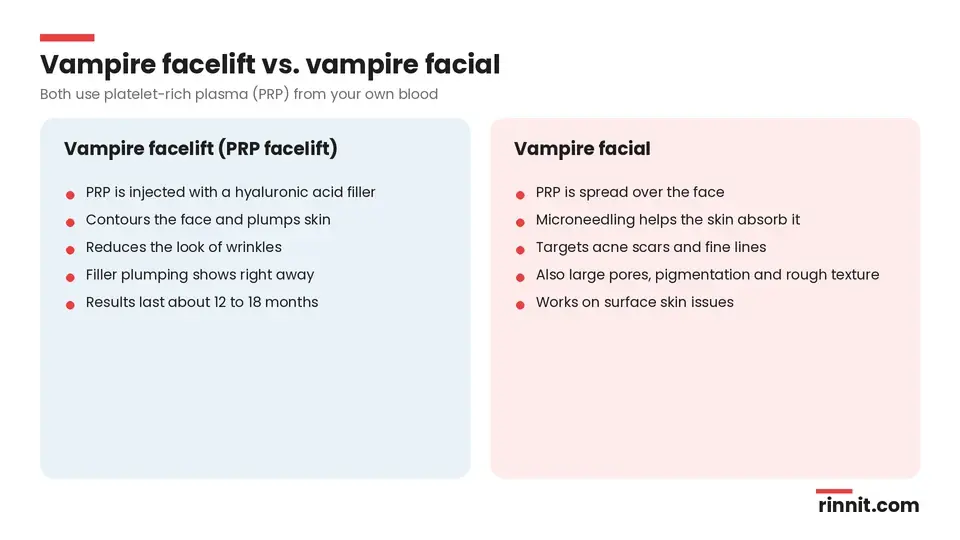
Vampire facelift vs. vampire facial: what's the difference?
Feature | Vampire facelift (PRP facelift) | Vampire facial |
How PRP is used | Injected into the face together with hyaluronic acid filler | Spread over the face, then microneedling (tiny pricks) helps the skin absorb it |
What it targets | Contour, wrinkles and plumpness | Surface issues: acne scars, fine lines, large pores, pigmentation and rough texture |
Sources: [1]
Who shouldn't get a vampire facelift?
Before a PRP facelift, you'll have a consultation so a provider can review your health history and check whether you're a good candidate. A PRP facelift isn't recommended if you: [1]
Have a blood condition that causes excessive bleeding or difficulty clotting
Have hepatitis C or HIV
Have skin cancer
Take a blood thinner
How do you prepare for a vampire facelift?
If you're a good candidate, your provider will examine your skin and talk about what you want to achieve. If you decide to go ahead, you may be asked to: [1]
Minimize sun exposure and avoid tanning for several weeks before the procedure
Avoid blood thinners such as nonsteroidal anti-inflammatory drugs (NSAIDs), aspirin and herbal supplements for a week before
Drink plenty of water in the week before the procedure
Arrive with clean skin and no makeup
What happens during a vampire facelift?
During the procedure, your provider will: [1]
Apply numbing cream to your face.
Draw some blood, usually from your arm.
Spin the blood in a centrifuge to separate the PRP.
Inject specific areas of your face with filler.
Inject the PRP into your face with a small needle.
A PRP facelift usually takes one to two hours. Because your skin is numbed, you shouldn't feel pain during the procedure, though you may feel light to mild pain once the numbing cream wears off. [1]
Vampire facelift at a glance
Item | Typical detail |
Type | Nonsurgical |
Numbing | Numbing cream on the face |
Time | One to two hours |
Bruising and discomfort | A couple of days, up to a week |
Back to normal activities | Usually right away |
Results | Filler plumping right away; PRP smoothing after about two weeks |
How long it lasts | About 12 to 18 months |
Sources: [1]
What happens after a vampire facelift?
You may have mild discomfort and bruising for a couple of days, up to a week, but you should be able to go about your day with caution. You can usually return to your regular activities right away. [1]
Apply ice packs wrapped in a towel as needed to reduce swelling.
Take over-the-counter pain relievers as directed; acetaminophen (Tylenol®) can help with pain.
Sleep on your back with your head raised.
Your provider will give you specific skin-care instructions. These may include avoiding: [1]
Sun exposure
Heavy lifting
Strenuous exercise
Heavy creams or moisturizers
Washing your face or wearing makeup for a day after the procedure

How long does a vampire facelift last?
You'll notice plumping from the filler right away and smoothing from the PRP after about two weeks. The final results can last about 12 to 18 months. Some providers recommend three sets of injections, one a month for three months, to prolong the effects. [1]
What are the benefits and side effects of a vampire facelift?
Benefits
Less pain and a shorter recovery than a surgical facelift
Fewer possible risks than surgery
Quicker results than a traditional facelift
Feeling more confident about your appearance
Sources: [1]
Studies on how well vampire facelifts work are limited. PRP may improve skin texture and wrinkles, but the evidence is weak and researchers haven't yet done extensive studies on PRP for facial rejuvenation. [1]
Side effects
Side effects of a PRP facelift can include: [1]
Swelling
Mild pain and tenderness
Tingling
Changes to your natural skin tone (red or dark brown)
Bruising
Itching
Rarely, you may react to the hyaluronic acid filler, with bumps (nodules) at the injection sites, pain or persistent swelling. A more serious risk is a provider injecting filler into a blood vessel, which can cause tissue in that area to die. An experienced, board-certified plastic surgeon or dermatologist can help minimize complications. [1]
When should you call your doctor after a vampire facelift?
Talk to your healthcare provider if you have any of these symptoms after a PRP facelift: [1]
Bleeding
Excessive bruising
Pain
Swelling that doesn't go away
Conclusion
A vampire facelift combines platelet-rich plasma from your own blood with a hyaluronic acid filler to give your face a fresher, fuller look without surgery. Recovery is short, side effects are usually mild, and results typically last a year or more.
The name may sound like a horror movie, but the treatment itself is a nonsurgical cosmetic procedure. Because the research is still limited, keep expectations realistic and talk with a board-certified plastic surgeon or dermatologist about whether it suits your goals.
Keep learning: Read our guides to wrinkles and your treatment options, PRP injections, facelift surgery and non-surgical facelifts. For more, see the American Academy of Dermatology's article on platelet-rich plasma.
FAQ
What is a vampire facelift?
It's a nonsurgical treatment that injects platelet-rich plasma (PRP) from your own blood plus a hyaluronic acid filler to rejuvenate facial skin.
Why is it called a vampire facelift?
Because its main ingredient, platelet-rich plasma, comes from your own blood.
What is the difference between a vampire facelift and a vampire facial?
A vampire facelift injects PRP with filler, while a vampire facial spreads PRP over the skin and uses microneedling to help it absorb.
Does a vampire facelift hurt?
Your skin is numbed, so you shouldn't feel pain during the procedure. Light to mild pain is possible once the numbing cream wears off.
How long does a vampire facelift take?
It usually takes one to two hours.
When will I see results from a PRP facelift?
Plumping from the filler shows right away, and smoothing from the PRP appears after about two weeks.
How long does a vampire facelift last?
Results last about 12 to 18 months. Some providers suggest three monthly sets of injections to prolong the effects.
What are the side effects of a vampire facelift?
Swelling, mild pain and tenderness, tingling, skin tone changes, bruising and itching. Rarely, the filler causes bumps, pain or persistent swelling.
Who should not get a vampire facelift?
It isn't recommended if you have a bleeding or clotting disorder, hepatitis C or HIV, or skin cancer, or if you take a blood thinner.
Does a vampire facelift really work?
Studies are limited. PRP may improve skin texture and reduce wrinkles, but more research is needed.
How do I prepare for a vampire facelift?
You may be asked to limit sun exposure and avoid tanning for several weeks, avoid blood thinners such as NSAIDs, aspirin and herbal supplements for a week, drink plenty of water in the week before, and arrive with clean skin and no makeup [1].
When should I call my doctor after a vampire facelift?
Talk to your provider if you have bleeding, excessive bruising, pain or swelling that does not go away after a PRP facelift [1].
Related Reading
Vampire Breast Lift (PRP Breast Lift): Results and Risks explains the vampire (PRP) breast lift.
Learn more in our guide to Wrinkles: What Causes Them, How to Slow Them, and Your Realistic Treatment Options.
Learn more in our guide to Healing from Within: A Comprehensive Guide to Platelet-Rich Plasma (PRP) Injections.
References
Cleveland Clinic. Vampire (PRP) Facelift: What It Is, Benefits & Side Effects. Cleveland Clinic. Last updated March 13, 2024. https://my.clevelandclinic.org/health/procedures/vampire-facelift
Alam M, Hughart R, Champlain A, et al. Effect of Platelet-Rich Plasma Injection for Rejuvenation of Photoaged Facial Skin: A Randomized Clinical Trial. JAMA Dermatol. 2018;154(12):1447-1452. PMID 30419125. https://doi.org/10.1001/jamadermatol.2018.3977
Du R, Lei T. Effects of autologous platelet-rich plasma injections on facial skin rejuvenation. Exp Ther Med. 2020;19(4):3024-3030. PMID 32256789. https://doi.org/10.3892/etm.2020.8531
Cruciani M, Masiello F, Pati I, et al. Platelet rich plasma for facial rejuvenation: an overview of systematic reviews. Blood Transfus. 2024;22(5):429-439. PMID 38557322. https://doi.org/10.2450/BloodTransfus.730
Medical disclaimer
This article is for general education only and does not replace advice from a qualified healthcare professional. Talk to your doctor about your own diagnosis and treatment, and seek emergency care right away for severe or sudden symptoms.



Comments