Radiofrequency (RF) Skin Tightening: Benefits, Results and Risks

Updated: 2 days ago
Written and medically reviewed by Dr. Baraa Alnahhal, MD · Last reviewed: November 2026 · How we review
Quick Answer
Radiofrequency (RF) skin tightening is a nonsurgical treatment that uses a handheld device to send heat deep into the skin, stimulating collagen and elastin to firm sagging skin and reduce wrinkles. Each session takes about an hour. Results appear over two to six months and can last one to three years. It works best for mild early aging.
What the research says
One treatment tightened skin around the eyes: in a multicenter study of 86 people, 83.2% of treated eye areas improved by at least one wrinkle-score point 6 months after one RF treatment, 61.5% of eyebrows lifted, and burns occurred in 0.36% of applications (Fitzpatrick R et al., Lasers in Surgery and Medicine, 2003) [2]
Most people saw improvement in face and neck laxity: in a trial of 40 adults ages 30 to 60 with mild to moderate face and neck laxity, 73% showed improvement 6 months after monopolar RF treatment, especially in the jowls and smile-line folds (Angra K et al., Dermatologic Surgery, 2021) [3]
Key takeaways
RF skin tightening uses heat to firm skin without surgery.
It boosts collagen and elastin.
A session takes about an hour with little downtime.
Results appear over two to six months and last one to three years.
It works best for mild, early signs of aging.
What is RF skin tightening?
RF skin tightening uses an electromagnetic device that creates heat. It's offered by dermatologists, plastic surgeons, cosmetic surgeons and licensed aestheticians. More than 188,000 Americans had some type of skin tightening procedure in 2020. Learn about other nonsurgical facelift options. Sources: [1]
What it treats
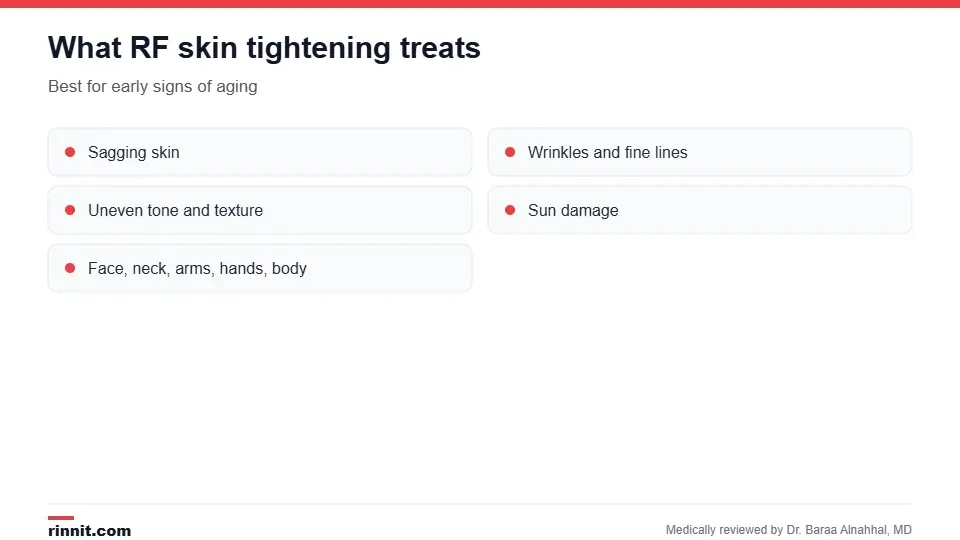
It works best for people just starting to show signs of aging.
Sagging or loose skin.
Wrinkles and fine lines.
Uneven skin tone and texture.
Signs of sun damage. Sources: [1]
It can be used on the face, neck, arms, hands and body, and for vaginal rejuvenation. It's less effective for severely sagging skin. Sources: [1]
How it works

You may feel warmth or tingling during treatment.
The heat reaches deep layers of skin and stimulates new skin cells, collagen and elastin. This helps skin become firmer over time. Sources: [1]
How to prepare
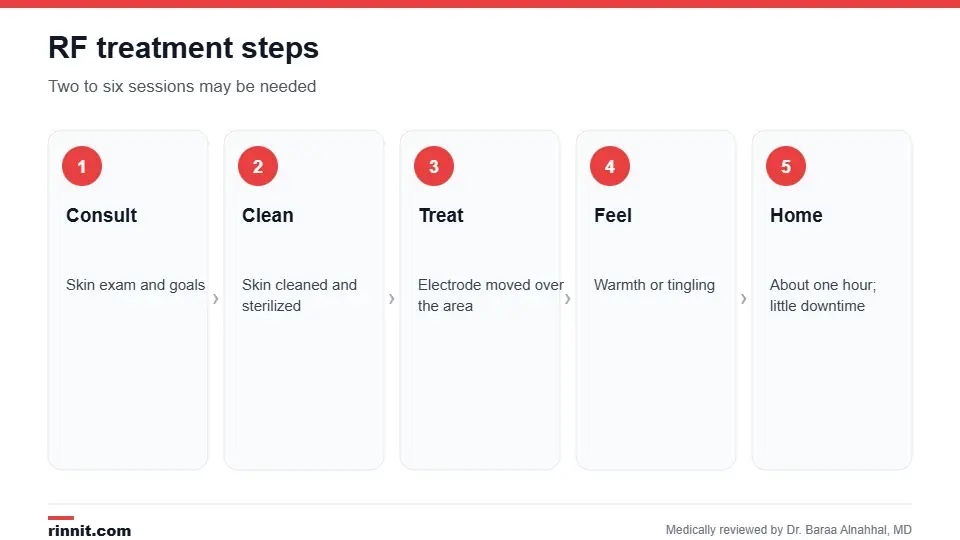
Have a consultation to review your skin and goals.
Tell your provider about any skin disease, other skin treatments or pregnancy.
Ask whether to combine RF with Botox, dermal fillers or microneedling.
Choose a provider who uses an FDA-approved device. Sources: [1]
What happens during treatment
Tell your provider if you feel burning.
Your skin is cleaned and sterilized.
Your provider moves a handheld electrode over the area.
You may feel warmth, tingling or mild discomfort; tell your provider if it burns.
The session takes about an hour, and you go home soon after. Sources: [1]
Some people need two to six treatments. Sources: [1]
Side effects
Side effect | Notes |
Redness and swelling | Mild; goes away within 24 hours |
Burns | Rare; choose an experienced provider |
Peeling or scarring | Rare |
The radio waves used are extremely low and don't appear to raise cancer risk. Sources: [1, 2]
Recovery and results
Most people return to work and activities within a day.
You can wear makeup right away.
Results appear over two to six months.
Effects may last one to three years with good skin care.
Your skin keeps aging, so results are temporary. Sources: [1, 3]
When to call your provider
Redness or swelling that lasts several days.
A skin rash or unexplained skin changes. Sources: [1]
Conclusion
RF skin tightening offers gradual, natural-looking firming without surgery or long recovery. It works best for mild sagging, and good skin care helps results last.
Keep learning: read about nonsurgical facelifts and microneedling.
Frequently asked questions
What is RF skin tightening?
A nonsurgical treatment that uses heat to firm skin.
Does RF skin tightening hurt?
You may feel warmth or tingling; it shouldn't burn.
How long does a session take?
About an hour.
How many treatments will I need?
Some people need two to six.
When will I see results?
Over two to six months.
How long do results last?
One to three years with good skin care.
Is there downtime?
Most people return to activities within a day.
Who is a good candidate?
People with mild, early signs of aging.
Is RF skin tightening safe?
It's relatively safe; burns are rare.
Does it cause cancer?
Studies haven't found a link in people.
Related Reading
LED Light Therapy: Colors, Benefits and Risks explains LED light therapy for skin.
A Comprehensive Guide to Non-Surgical Facelifts other nonsurgical facial treatments.
Microneedling: What It Treats, How It Works, Recovery and Results another collagen-boosting treatment.
Dermal Fillers: Types, Procedure, Results, and Side Effects fillers for lost volume.
Facelift Surgery: A Comprehensive Guide to Facial Rejuvenation surgical facelift.
Wrinkles: What Causes Them, How to Slow Them, and Your Realistic Treatment Options causes and treatment of wrinkles.
References
Cleveland Clinic. Radio Frequency (RF) Skin Tightening: Benefits & Dangers. Cleveland Clinic. Last updated February 4, 2023. https://my.clevelandclinic.org/health/treatments/24683-radio-frequency-rf-skin-tightening
Fitzpatrick R, Geronemus R, Goldberg D, et al. Multicenter study of noninvasive radiofrequency for periorbital tissue tightening. Lasers Surg Med. 2003;33(4):232-242. PMID 14571447. https://doi.org/10.1002/lsm.10225
Angra K, Alhaddad M, Boen M, et al. Prospective clinical trial of the latest generation of noninvasive monopolar radiofrequency for the treatment of facial and upper neck skin laxity. Dermatol Surg. 2021;47(6):762-766. PMID 33899795. https://doi.org/10.1097/DSS.0000000000003005
Medical disclaimer
This article is for general education only and does not replace advice from a qualified healthcare professional. Talk to your doctor about your own diagnosis and treatment, and seek emergency care right away for severe or sudden symptoms.



Comments