LED Light Therapy: Colors, Benefits and Risks

Updated: 2 days ago
Written and medically reviewed by Dr. Baraa Alnahhal, MD · Last reviewed: November 2026 · How we review
Quick Answer
LED light therapy is a noninvasive skin treatment that uses light-emitting diodes to send different colors of light into the skin. Blue light may kill acne-causing bacteria, while red light may calm inflammation and boost collagen. In-office sessions take about 20 minutes and are painless. Avoid it if you take sun-sensitizing medicines or have a history of skin cancer.
What the research says
Red and amber light reduced eye wrinkles: in a split-face trial of 137 women aged 40 to 65, 10 LED sessions over 4 weeks cut crow's-feet wrinkle volume by 31.6% with red light and 29.9% with amber light, though hydration and elasticity didn't improve (Mota LR et al., Photobiomodulation, Photomedicine, and Laser Surgery, 2023) [2]
Daily LED use improved wrinkles: in a double-blind trial of 52 women, daily red or white LED light on the face for 12 weeks significantly improved eye-area wrinkles from baseline, with no difference between the two lights (Nam CH et al., Dermatologic Surgery, 2017) [3]
Key takeaways
LED light therapy uses colored light to improve skin.
Blue light targets acne; red light targets inflammation and collagen.
Sessions are painless with no downtime.
Regular treatments are needed for results.
In-office treatments are stronger than home devices.
What is LED light therapy?
In the 1990s, NASA studied LEDs to help astronauts' wounds heal. Today, dermatologists and estheticians use LED light, often with creams or facials, to treat skin conditions. It's a type of light therapy. Sources: [1]
What it treats

It doesn't treat acne cysts, blackheads or whiteheads.
Mild to moderate acne.
Psoriasis and eczema.
Actinic keratosis and sun damage.
Wrinkles and wounds.
Hair loss. Sources: [1]
It may also treat small, superficial basal cell carcinoma. It doesn't treat acne cysts, blackheads or whiteheads. Sources: [1]
LED colors and what they do
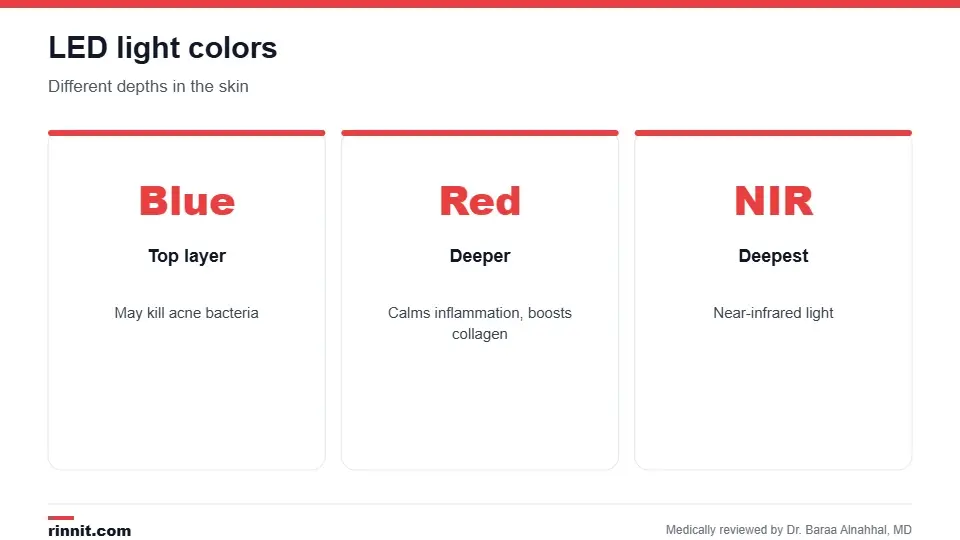
Colors can be combined.
Color | How deep it goes | What it may do |
Blue | Top layer | Destroy acne-causing bacteria |
Yellow | Deeper | Reaches below the top layer |
Red | Deeper still | Reduce inflammation, boost collagen |
Near-infrared | Deepest | Reaches the deepest layers |
Sources: [1, 2]
What happens during treatment

It's painless and uses no UV light.
Arrive with a clean, makeup-free face.
Wear safety goggles.
Lie on your back under the light device.
Stay still for about 20 minutes. Sources: [1]
You may feel some warmth. Treatment is usually weekly for about a month, then every month or few months. Sources: [1]
At-home devices
Masks, wands and handheld devices are available.
Follow the device directions and wear eye protection.
Look for "FDA cleared" or "FDA approved."
Home devices are weaker and likely won't give dramatic results. Sources: [1, 3]
Who shouldn't use it
People taking sun-sensitizing medicines, such as isotretinoin or lithium.
People with a history of skin cancer.
People with certain inherited eye diseases. Sources: [1]
See a dermatologist first, since what looks like aging or a blemish could be skin cancer. Sources: [1]
Side effects
LED light therapy is considered safe, though long-term safety data are limited. Rarely, it can cause more inflammation, rash, redness or pain. Avoid the sun and use extra sunscreen for 48 hours afterward. Sources: [1]
Results
Research suggests LED therapy can improve some skin conditions, but regular treatments are needed. It can be used on any skin type or color. Sources: [1, 2, 3]
When to call your provider
Contact your provider if you get hives, inflammation, pain, rash or redness after treatment. Sources: [1]
Conclusion
LED light therapy is a gentle, painless way to improve acne, inflammation and fine lines. Consistent in-office sessions work best, and a dermatologist can confirm it's right for your skin.
Keep learning: read about acne and photodynamic therapy.
Frequently asked questions
What is LED light therapy?
A skin treatment that uses colored light from light-emitting diodes.
What does blue light do?
It may destroy acne-causing bacteria.
What does red light do?
It may reduce inflammation and boost collagen.
Does LED light therapy hurt?
No. You may feel some warmth.
Does it use UV light?
No, so it doesn't burn the skin.
How long is a session?
About 20 minutes in the office.
How often do I need it?
Usually weekly for a month, then maintenance.
Do home devices work?
They're weaker and give more subtle results.
Who shouldn't use LED therapy?
People on sun-sensitizing medicines or with a history of skin cancer.
Is there downtime?
No, but avoid the sun for 48 hours.
Related Reading
Phototherapy (Light Therapy) other light-based treatments.
Photodynamic Therapy (PDT): Uses, Procedure, Recovery and Risks light combined with medicine.
Acne: Complete Guide to Symptoms, Causes, Diagnosis, and Treatment a common reason for LED therapy.
Understanding Rosacea: Symptoms, Types, and Management Strategies a skin condition it may help.
Radiofrequency (RF) Skin Tightening: Benefits, Results and Risks another nonsurgical skin treatment.
References
Cleveland Clinic. LED Light Therapy: How It Works, Colors, Benefits & Risks. Cleveland Clinic. Last updated December 2, 2021. https://my.clevelandclinic.org/health/treatments/22146-led-light-therapy
Mota LR, Duarte IDS, Galache TR, et al. Photobiomodulation reduces periocular wrinkle volume by 30%: a randomized controlled trial. Photobiomodulation, Photomedicine, and Laser Surgery. 2023;41(2):48-56. PMID 36780572. https://doi.org/10.1089/photob.2022.0114
Nam CH, Park BC, Kim MH, et al. The efficacy and safety of 660 nm and 411 to 777 nm light-emitting devices for treating wrinkles. Dermatologic Surgery. 2017;43(3):371-380. PMID 28195844. https://doi.org/10.1097/DSS.0000000000000981
Medical disclaimer
This article is for general education only and does not replace advice from a qualified healthcare professional. Talk to your doctor about your own diagnosis and treatment, and seek emergency care right away for severe or sudden symptoms.



Comments