Phototherapy (Light Therapy)

Updated: 3 days ago
Medically reviewed by Dr. Baraa Alnahhal, MD · Last reviewed: October 17, 2026
Phototherapy, or light therapy, uses specific wavelengths of ultraviolet (UV) light to treat various skin conditions and newborn jaundice. [1] By utilizing controlled exposure to UVA, UVB, blue, or red light, this treatment reduces inflammation and manages symptoms for conditions like psoriasis and eczema. [1] While generally safe for all ages, it requires medical supervision to prevent skin damage and monitor for side effects like redness or premature aging. [1]
Quick Answer
Phototherapy is a medical treatment that uses ultraviolet light to treat skin conditions by reducing inflammation and slowing rapid cell growth. Types include UVB for surface conditions and UVA for deeper layers. [1] It is also a standard, safe treatment for newborn jaundice using blue light. [1] Most patients improve after six to eight sessions, though a full course requires more. [1]
What the research says
Narrowband UVB and PUVA gave similar vitiligo repigmentation, with fewer side effects for narrowband UVB. A Cochrane review of 96 randomized trials (4,512 participants) found a non-significant 60% higher proportion of people reaching more than 75% repigmentation with narrowband UVB than with PUVA (relative risk 1.60, 95% CI 0.74 to 3.45; 3 studies). The narrowband UVB groups reported less nausea (RR 0.13) and less redness (RR 0.73) than the PUVA groups (Whitton et al., Cochrane Database Syst Rev, 2015) [2].
UV phototherapy was not linked to a higher skin cancer risk in people with vitiligo. A meta-analysis of five retrospective cohorts covering 228,607 people with vitiligo (110,038 treated with UV phototherapy) found no significant increase in nonmelanoma skin cancer (risk ratio 0.95; 95% CI 0.44 to 2.05) or melanoma (1.11; 95% CI 0.33 to 3.82), including with narrowband UVB specifically (Wu et al., Clin Exp Dermatol, 2022) [3].
In children with segmental vitiligo, treatments including phototherapy caused mostly mild side effects. A systematic review of 10 studies (2,085 children, 843 with segmental vitiligo) of treatments including skin grafting procedures, phototherapy, and topical immunosuppressants reported repigmentation above 70% in some studies, especially on the face, and adverse events that were generally mild, mostly redness, burning, blistering, and irritation. The authors rated most of the evidence as moderate to low quality (Ghani et al., Pediatr Dermatol, 2026) [4].
Research summaries are based on article abstracts retrieved from PubMed.
What UV light wavelengths are used in phototherapy?
Phototherapy utilizes different parts of the electromagnetic spectrum depending on the depth and nature of the condition being treated. The two primary types of UV light used in medical procedures are categorized by their wavelengths and how deep they penetrate the skin layers. [1]
UV Type | Wavelength | Skin Penetration | Common Medical Uses |
UVB | Medium [1] | Top layer (Epidermis) [1] | Psoriasis, eczema, and general inflammation. |
UVA | Long [1] | First two layers (Dermis) [1] | Deeper skin conditions; often used with psoralen. [1] |
Blue Light | Short | Surface | Newborn jaundice (bilirubin reduction). [1] |
Red Light | Long | Surface to Deep | Acne, scars, wrinkles, and redness. [1] |

What conditions does phototherapy (light therapy) treat?
Phototherapy treats chronic skin disorders such as psoriasis, eczema and vitiligo, as well as newborn jaundice and some inflammatory conditions. [1] The treatment is effective for both children and adults when prescribed by a healthcare provider. [1]
Psoriasis and Eczema: Reduces the rapid production of skin cells and minimizes inflammation and itching.
Newborn Jaundice: Uses blue light (neoBLUE®) to help infants eliminate excess bilirubin from their systems. [1]
Vitiligo: Assists in repigmenting skin areas that have lost their natural color. [1] [2]
Other Conditions: Treats pruritus (itch), morphea, and mycosis fungoides. [1]
What happens during a phototherapy session?
A phototherapy session is a highly controlled process that varies in duration and method based on the target area. Providers ensure safety through the use of personal protective equipment (PPE) and precise timing.
Preparation and Safety
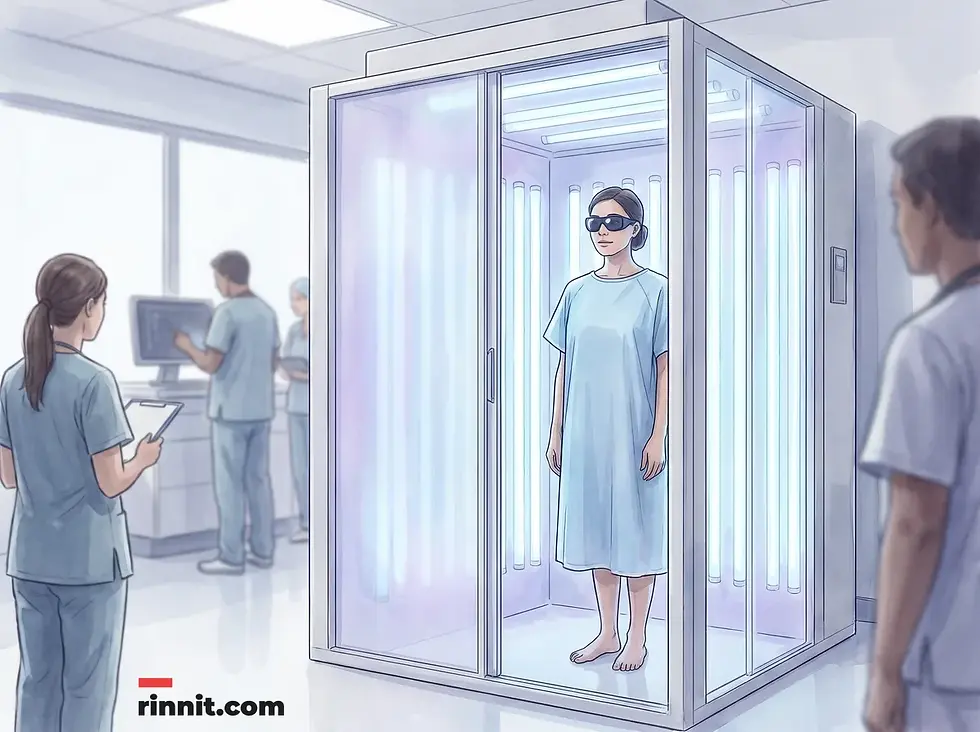
Before the lights are turned on, patients are provided with protective eyewear to prevent ocular damage. Depending on the treatment area, a face shield or blankets may be used to protect unaffected skin. Sunscreen is often applied to areas that do not require UV exposure. [1]
Treatment Methods
The delivery of light depends on the specific technology being used:
UVB Therapy: Patients typically stand in a box-like structure similar to an upright tanning bed. For smaller areas, a hand-held wand may be used. [1]
UVA Therapy (PUVA): Similar to UVB, but may involve “psoralen,” a chemical that makes the skin more sensitive to light. This can be administered via a bath, orally, or topically. [1]
Excimer Laser: Delivers focused UV light to very specific, small areas while the patient lies on a treatment table. [1]
What are the risks and side effects of phototherapy?
Phototherapy is a safe and common treatment, but its controlled exposure to UV radiation carries inherent risks. [1] Providers discuss these potential outcomes to help patients manage their recovery effectively.
Side Effect | Description | Duration/Management |
Skin Redness | Mild irritation similar to a light sunburn. | Usually fades within 24 hours. [1] |
Dry Skin | Loss of moisture in the treated area. | Managed with daily medical-grade moisturizers. [1] |
Burns/Blisters | Overexposure or sensitivity reactions. | Requires immediate provider consultation. |
Premature Aging | Increased wrinkles and fine lines. | Occurs with prolonged, long-term treatment. [1] |
Skin Cancer Risk | Increased risk of melanoma or carcinoma. | Primarily associated with long-term UVA therapy. [1] |
What is recovery and long-term outlook after phototherapy?
Recovery from a single session is immediate, allowing patients to return to normal activities right away. [1] However, consistent protection is vital; patients must wear sunscreen and protective clothing when outdoors and avoid additional UV sources like tanning beds. [1]
Most individuals begin to see visible improvements in their skin condition after approximately six to eight sessions. Achieving full results often requires a more extensive commitment of 15 to 25 treatments. [1] While many patients experience long-term remission, it is possible for symptoms to return, necessitating maintenance sessions or a new course of treatment.
Conclusion
Phototherapy remains a cornerstone of dermatological treatment, offering a non-invasive way to manage complex skin conditions and neonatal health issues. By harnessing the power of specific light wavelengths under strict medical supervision, patients can achieve significant relief from inflammation, itching, and visible symptoms.
If you are struggling with chronic skin conditions or managing newborn care, consult with a healthcare professional to determine if light therapy is the right path for your specific needs.
Frequently Asked Questions
What is phototherapy?
Phototherapy, also known as light therapy, is a common form of treatment that uses bright, ultraviolet (UV) lights on your exposed skin to treat several types of skin conditions, including psoriasis and eczema. [1]
Is phototherapy safe for babies?
Yes, phototherapy is a safe treatment option for babies. It is commonly used to treat newborn jaundice by using blue light to help infants eliminate excess bilirubin from their systems. [1]
How long does a phototherapy procedure take?
Procedure times vary based on the treatment area and light strength. A first session might last only a few seconds, while later sessions can last a few minutes for UVB or up to an hour for UVA therapy. [1]
What are the common side effects of light therapy?
Common side effects include skin redness that fades within 24 hours, dry skin, and mild burns or blisters similar to a sunburn. Long-term use, especially with UVA, may increase the risk of premature aging and skin cancer. [1]
How many treatments are needed to see results?
Most people begin to see improvements in their skin after six to eight treatments, though it typically takes between 15 and 25 sessions to achieve the full therapeutic effect. [1]
What is the difference between UVA and UVB therapy?
UVB uses medium wavelengths that reach the top layer of skin, while UVA uses longer wavelengths that penetrate deeper. UVA is often combined with psoralen (PUVA) to increase skin sensitivity. [1]
What should I do after a phototherapy session?
After treatment, you should wear sunscreen and protective clothing, use daily moisturizers for dry skin, and wear eye protection when outdoors to protect your skin from further UV damage. [1]
Can phototherapy treat vitiligo?
Yes, phototherapy is an effective treatment for vitiligo, helping to repigment areas of the skin that have lost their natural color due to the condition. [1] [2]
Are there any contraindications for phototherapy?
Phototherapy may not be recommended for individuals with sun allergies, certain skin cancers, liver disease, lupus, or those taking medications that increase sun sensitivity. [1]
Does phototherapy hurt?
The procedure itself is generally painless [1], though some patients may experience a warm sensation or mild skin irritation similar to a sunburn following the treatment.
Related Reading
LED Light Therapy: Colors, Benefits and Risks explains LED light therapy for skin.
References
Cleveland Clinic. Phototherapy (Light Therapy). Cleveland Clinic Health Library. Last updated October 28, 2022. https://my.clevelandclinic.org/health/treatments/24385-phototherapy-light-therapy
Whitton ME, Pinart M, Batchelor J, et al. Interventions for vitiligo. Cochrane Database Syst Rev. 2015;2015(2):CD003263. PMID: 25710794. https://doi.org/10.1002/14651858.CD003263.pub5
Wu YH, Chou CL, Chang HC. Risk of skin cancer after ultraviolet phototherapy in patients with vitiligo: a systematic review and meta-analysis. Clin Exp Dermatol. 2022;47(4):692-699. PMID: 34762747. https://doi.org/10.1111/ced.15010
Ghani H, Hoffman V, Shah A, et al. Shining light on treatments: a systematic review of existing therapies for pediatric segmental vitiligo. Pediatr Dermatol. 2026;43(4):848-855. PMID: 41936454. https://doi.org/10.1111/pde.70215
Medical disclaimer
This article is for informational purposes only and is not a substitute for professional medical advice, diagnosis, or treatment. Always seek the advice of your physician or other qualified health provider with any questions you may have about a medical condition.



Comments