Treatments to Reduce Wrinkles: Options, Recovery and Results

Updated: 2 days ago
Written and medically reviewed by Dr. Baraa Alnahhal, MD · Last reviewed: November 2026 · How we review
Quick Answer
Treatments to reduce wrinkles are cosmetic options that smooth skin and soften lines on the face, neck, hands and arms. Wrinkles are a normal part of aging and don't need treatment. Options include retinoid creams, chemical peels, laser resurfacing, wrinkle-relaxing injections, dermal fillers and facelifts. Results last from up to six months to permanent.
What the research says
Botox for wrinkles was mostly safe, with some side effects: a review of 16 trials with 42,405 people found botulinum toxin A for facial wrinkles caused more side effects than placebo, mainly headache and droopy eyelids after frown-line injections, while crow's feet injections mainly caused bruising (Jia Z et al., Aesthetic Plastic Surgery, 2016) [2]
Retinoid creams improved fine and coarse wrinkles: in a network review of 23 trials with 3,905 people, isotretinoin, retinol and tretinoin improved fine wrinkles, tazarotene worked best for coarse wrinkles, and tretinoin had the best safety profile (Lin L et al., Scientific Reports, 2025) [3]
Key takeaways
Wrinkles are normal and don't need treatment.
Options range from creams to injections, lasers and surgery.
Botox-type injections treat frown lines and crow's feet.
Fillers treat deeper lines at rest.
Results last months to years, depending on the treatment.
What causes wrinkles?
Most people notice signs of aging after age 25. Collagen loss, repeated facial expressions, sun damage and smoking all play a role. Learn more about wrinkles. Sources: [1]
Types of wrinkle treatments

Talk with a provider about your skin and goals.
Treatment | Best for |
Fine lines; check with a provider first | |
Boosting collagen and elastin | |
Scarring, discoloration, sun damage | |
Wrinkles and skin depressions | |
Wrinkles, discoloration and scars | |
Laser resurfacing | Fine lines, wrinkles, acne scars |
Frown lines and crow's feet | |
Deeper lines around the mouth, nose and chin | |
Loose skin and deep wrinkles |
Laser resurfacing is generally better for lighter skin because of the risk of dark spots on darker skin. Sources: [1, 3]
How to prepare
Meet with a provider to discuss your history, allergies and goals.
Avoid sun or wear sunscreen as directed.
Your skin is cleansed before treatment, and you may get protective eyewear. Sources: [1]
Recovery time

Most in-office treatments take minutes to hours.
Treatment | Recovery |
Wrinkle-relaxing injections | None |
Micro-needling and fillers | 1 to 3 days |
Dermabrasion, peels, laser | 1 to 3 weeks |
Facelift | 3 weeks or more |
Aftercare may include avoiding strenuous activity, not rubbing injection sites, using ice, moisturizer and sunscreen, and skipping smoking and alcohol. Sources: [1]
How long results last
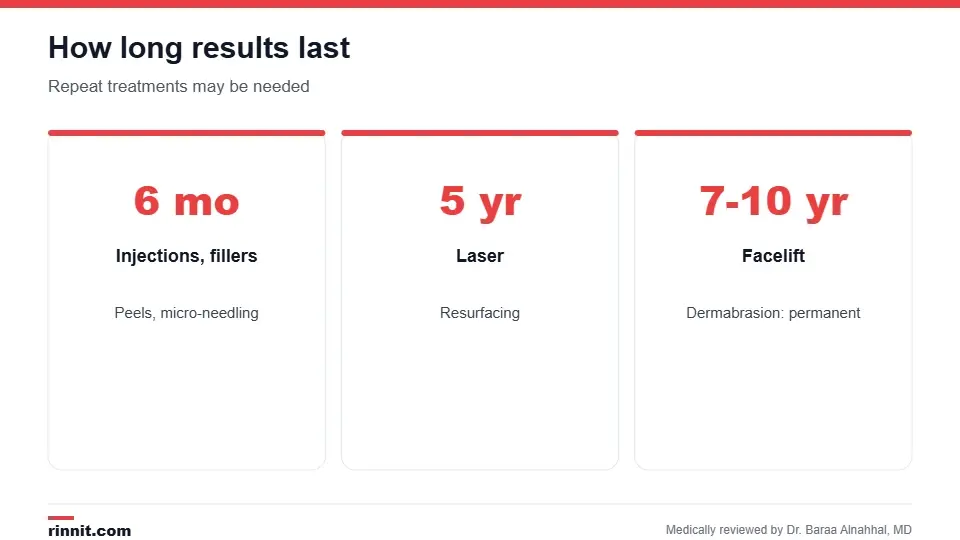
Many people need repeat treatments.
Up to six months: micro-needling, chemical peels, injections and fillers.
Up to five years: laser resurfacing.
Seven to 10 years: facelift.
Permanent: dermabrasion. Sources: [1]
Risks
Allergic reaction.
Changes in skin color or texture.
Permanent bumps.
Temporary facial muscle weakness.
Infection or scarring.
Pain, bruising and swelling. Sources: [1, 2]
When to call your provider
Fever.
Swelling that doesn't improve after a couple of days.
Skin that isn't healing.
Itching.
Pain, bleeding, yellow fluid or crusty scabs at the treatment site. Sources: [1]
Conclusion
Many safe options can soften wrinkles, from creams you use at home to injections and surgery. A qualified provider can match the treatment to your skin and goals.
Keep learning: read about Botox and dermal fillers.
Frequently asked questions
Do wrinkles need treatment?
No. They're a normal part of aging.
What causes wrinkles?
Collagen loss, facial movement, sun damage and smoking.
What's the best treatment for frown lines?
Wrinkle-relaxing injections like Botox.
What do fillers treat?
Deeper lines around the mouth, nose and chin.
Do retinoid creams work?
Yes. Studies show they improve fine and coarse wrinkles.
How long does Botox last?
Up to about six months.
Is there downtime after injections?
Usually none.
Which treatment lasts the longest?
Dermabrasion is permanent; a facelift lasts 7 to 10 years.
Is laser resurfacing safe for dark skin?
It may cause dark spots, so it's generally better for lighter skin.
What are the risks?
Bruising, swelling, skin changes and, rarely, infection or scarring.
Related Reading
Dermalinfusion (DiamondGlow Facial): Benefits and Results explains dermalinfusion (DiamondGlow).
Wrinkles: What Causes Them, How to Slow Them, and Your Realistic Treatment Options why wrinkles form.
Botox Injections: Uses, Results, Side Effects and Aftercare wrinkle-relaxing injections.
Dermal Fillers: Types, Procedure, Results, and Side Effects fillers for deeper lines.
Chemical Peels: Types, Recovery, Risks and What to Expect peeling away damaged skin.
Facelift Surgery: A Comprehensive Guide to Facial Rejuvenation surgical rejuvenation.
References
Cleveland Clinic. How to Get Rid of Wrinkles: Retinol, Fillers & Other Treatments. Cleveland Clinic. Last updated July 27, 2022. https://my.clevelandclinic.org/health/treatments/8411-treatments-to-reduce-wrinkles
Jia Z, Lu H, Yang X, et al. Adverse events of botulinum toxin type A in facial rejuvenation: a systematic review and meta-analysis. Aesthetic Plastic Surgery. 2016;40(5):769-777. PMID 27495260. https://doi.org/10.1007/s00266-016-0682-1
Lin L, Chen X, Liu C, et al. Comparative efficacy of topical interventions for facial photoaging: a network meta-analysis. Scientific Reports. 2025;15(1):26889. PMID 40707570. https://doi.org/10.1038/s41598-025-12597-0
Medical disclaimer
This article is for general education only and does not replace advice from a qualified healthcare professional. Talk to your doctor about your own diagnosis and treatment, and seek emergency care right away for severe or sudden symptoms.



Comments