Dermalinfusion (DiamondGlow Facial): Benefits and Results

Updated: 2 days ago
Written and medically reviewed by Dr. Baraa Alnahhal, MD · Last reviewed: November 2026 · How we review
Quick Answer
Dermalinfusion, also known as the DiamondGlow facial, is a nonsurgical skin resurfacing treatment that exfoliates dead skin, deep-cleans pores and infuses a serum into the skin at once. It takes about 30 minutes with no pain and works for all skin tones. Results are immediate but temporary, and many people get three to six sessions.
What the research says
Coarse diamond microdermabrasion boosted collagen: in a biopsy study of 40 adults aged 50 to 83 with sun-damaged skin, coarse diamond microdermabrasion switched on collagen remodeling, while a medium-grit handpiece didn't (Karimipour DJ et al., Archives of Dermatology, 2009) [2]
Serum-infusing resurfacing improved skin: in a study of 20 women aged 34 to 56, six hydradermabrasion sessions thickened the skin, raised antioxidant levels and reduced fine lines, pore size and pigmentation, while serum applied by hand made no difference (Freedman BM, Journal of Cosmetic Dermatology, 2008) [3]
Key takeaways
Dermalinfusion exfoliates, cleans pores and infuses serum in one step.
It's also called the DiamondGlow facial.
It takes about 30 minutes with no downtime.
It helps tone, texture, fine lines and dark spots.
Results are immediate but temporary.
What is dermalinfusion?
It's a type of microdermabrasion. It's similar to a HydraFacial; the main difference is the wand tip. More than half a million Americans get some type of microdermabrasion each year. Sources: [1]
What it treats
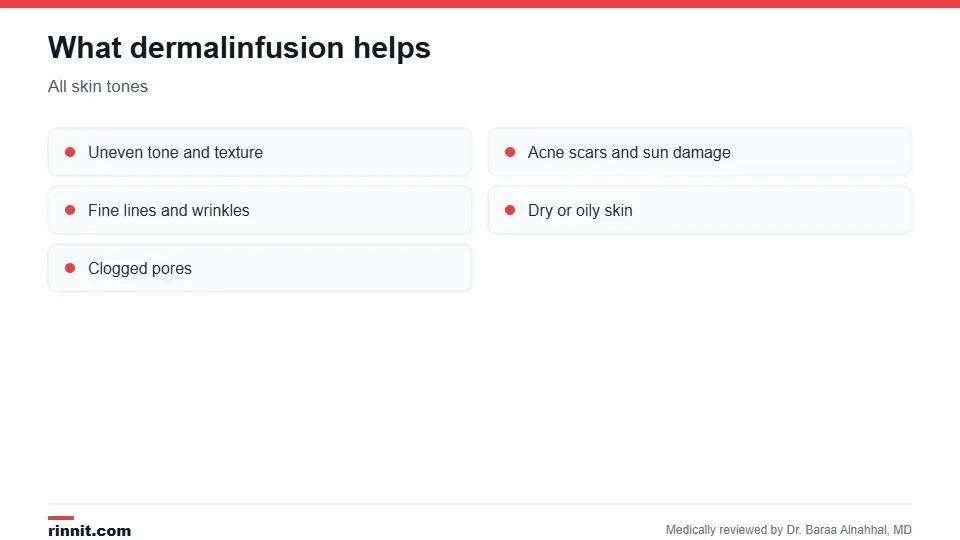
It works on all skin tones.
Uneven tone, texture and volume.
Acne scars, sun damage and age spots.
Fine lines, wrinkles and sagging.
Dry skin.
Oily skin, acne and clogged pores.
Uneven tone from rosacea. Sources: [1]
The three steps

All three happen in one pass of the wand.
Exfoliation: removes dry, damaged surface skin cells and stimulates collagen.
Extraction: deep-cleans your pores.
Infusion: delivers serum into the cleansed pores. Sources: [1]
How to prepare
Have a skin exam and discuss your goals.
Tell your provider about any skin disease or other treatments.
Avoid Botox-type injections for at least two weeks before.
Stop retinoid or AHA products three to five days before.
Use sunscreen and avoid tanning. Sources: [1]
What happens during treatment
A dermatologist, plastic surgeon or licensed aesthetician cleanses your skin, then glides the wand over it. You'll feel mild scratching and vibration, but no pain. Sunscreen is applied at the end. The session takes about 30 minutes. Sources: [1]
Risks
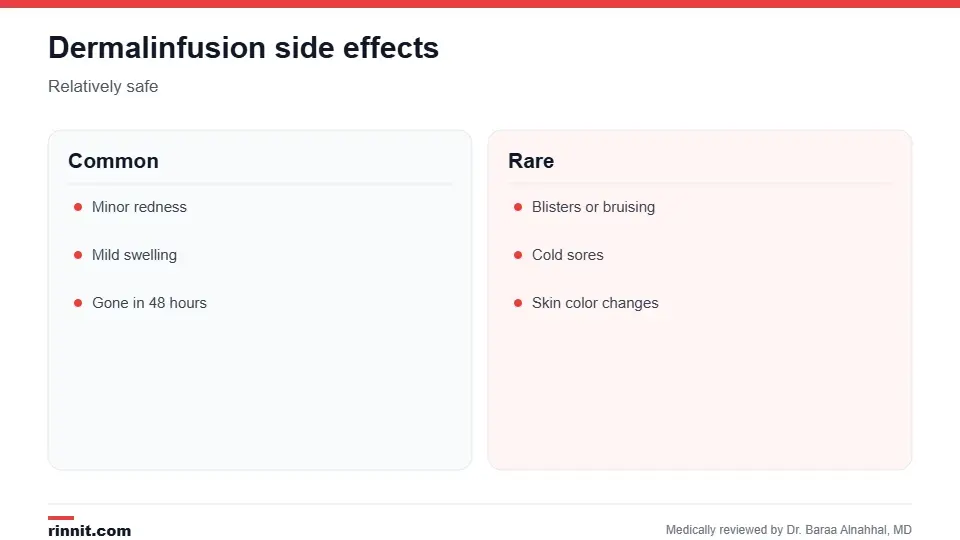
It's considered relatively safe.
How common | Side effects |
Common | Minor redness and swelling, fading within 48 hours |
Rare | Blisters, bruising, skin damage or scarring, cold sores, infection, color changes |
Sources: [1]
Aftercare and results
You'll see brighter tone and volume right away.
Return to work, activities and makeup immediately.
Avoid retinoids and AHAs for three to five days.
Use sunscreen and limit sun for at least two weeks.
Many people need three to six sessions, two to four weeks apart. Sources: [1, 2, 3]
Results are temporary, but anti-aging skin care and sunscreen help them last. It's faster and less expensive than a facelift and avoids the peeling of chemical peels. Sources: [1]
When to call your provider
An allergic reaction, such as an itchy rash.
Bruising, redness or swelling lasting more than a week.
Fever or other signs of infection. Sources: [1]
Conclusion
Dermalinfusion is a quick, painless way to refresh and hydrate your skin with no downtime. Regular sessions and good sun protection keep your glow going.
Keep learning: read about microdermabrasion and treatments to reduce wrinkles.
Frequently asked questions
What is dermalinfusion?
A microdermabrasion facial that exfoliates, cleans pores and infuses serum.
Is it the same as DiamondGlow?
Yes. DiamondGlow is the brand name.
How is it different from a HydraFacial?
Mainly in the wand tip.
Does it hurt?
No. You'll feel mild scratching and vibration.
How long does it take?
About 30 minutes.
Is there downtime?
No. You can wear makeup and return to work right away.
How many sessions do I need?
Often three to six, two to four weeks apart.
How long do results last?
They're temporary; skin care and sunscreen help.
Can it treat acne scars?
It can soften their appearance.
Is it safe for dark skin?
Yes, it works for all skin tones.
Related Reading
Microdermabrasion: Benefits, Side Effects, Results and Recovery a related skin treatment.
Treatments to Reduce Wrinkles: Options, Recovery and Results other anti-aging options.
Chemical Peels: Types, Recovery, Risks and What to Expect a peel-based option.
Dermaplaning: What It Is, Benefits, Risks and Recovery another exfoliation treatment.
References
Cleveland Clinic. Dermalinfusion (DiamondGlow Facial): What It Is & Results. Cleveland Clinic. Last updated July 29, 2022. https://my.clevelandclinic.org/health/treatments/23915-dermalinfusion
Karimipour DJ, Rittié L, Hammerberg C, et al. Molecular analysis of aggressive microdermabrasion in photoaged skin. Archives of Dermatology. 2009;145(10):1114-1122. PMID 19841398. https://doi.org/10.1001/archdermatol.2009.231
Freedman BM. Hydradermabrasion: an innovative modality for nonablative facial rejuvenation. Journal of Cosmetic Dermatology. 2008;7(4):275-280. PMID 19146604. https://doi.org/10.1111/j.1473-2165.2008.00406.x
Medical disclaimer
This article is for general education only and does not replace advice from a qualified healthcare professional. Talk to your doctor about your own diagnosis and treatment, and seek emergency care right away for severe or sudden symptoms.



Comments