Chemical Peels: Types, Recovery, Risks and What to Expect

Updated: 6 days ago
Written and medically reviewed by Dr. Baraa Alnahhal, MD · Last reviewed: October 31, 2026 · How we review
Quick Answer: What is a chemical peel?
A chemical peel is a skin treatment that applies a chemical solution to remove damaged outer layers so smoother, more even skin can grow back. Peels come in light, medium and deep strengths and can improve fine lines, certain acne, mild scars, sun spots and melasma. Recovery ranges from a few days to three weeks. [1]
What the research says
Peels help mild-to-moderate acne. A review of 12 randomized trials (387 participants) found glycolic acid peels gave good or excellent improvement about 2.3 times more often than placebo (RR 2.30), and common peel types worked about equally well (Chen et al., BMJ Open, 2018).
Peels are a safe option for melasma. A systematic review of 24 studies (1,075 participants, followed for 8–36 weeks) found chemical peels safe and effective for melasma, with glycolic acid the safest and most effective agent (Sarkar et al., Dermatologic Surgery, 2024).
Peels plus microneedling ranked best for acne scars. A network meta-analysis of 24 randomized trials (1,546 participants) found microneedling combined with chemical peels gave the greatest improvement and patient satisfaction, with no significant difference in side effects across treatments (Li et al., Archives of Dermatological Research, 2024).
Key takeaways
A chemical peel creates a controlled injury so old skin peels away and newer, smoother skin shows through. [1]
The deeper the peel, the bigger the result — and the longer the recovery. [1]
Light peels can be repeated every 2–5 weeks; a deep peel is done only once on the face. [1]
Avoid tanning and direct sun for 2 weeks before a peel and stay out of the sun until healed. [1]
Peels do not fix sagging skin, bulges, deep scars or severe wrinkles. [1]

How deep light, medium and deep chemical peels reach into the skin. Image: Rinnit.com
How does a chemical peel work?
A chemical peel works by applying a solution that injures the skin's top layers in a controlled way, so they peel off and reveal newer skin underneath. [1]
It is also called chemexfoliation or dermapeeling. The new skin is usually:
Smoother, with fewer lines and wrinkles
More even in color
Brighter in tone
Common solutions include glycolic acid, trichloroacetic acid, salicylic acid, lactic acid and carbolic acid (phenol). Each one reaches a different depth in the skin. [1]
What skin problems can a chemical peel treat?
A chemical peel can treat fine lines, certain acne, mild scarring, uneven skin color and rough, dull skin, most often on the face, neck or hands. [1]
Skin concern | Can a peel help? |
Fine lines under the eyes or around the mouth | Yes |
Wrinkles from sun damage, aging or genetics | Yes (mild to moderate) |
Certain types of acne | Yes |
Mild scarring | Yes |
Sun spots, age spots, freckles, uneven color | Yes |
Rough, scaly or dull skin | Yes |
Melasma (dark patches from pregnancy or birth control pills) | Yes |
Actinic keratosis (precancerous scaly spots) | Yes |
Sagging skin, bulges, deep scars, severe wrinkles | No — other treatments work better |
For concerns peels can't fix, a dermatologic surgeon may suggest laser skin resurfacing, a face lift, a brow or eye lift, or a soft tissue filler. [1]
What are the types of chemical peels?
There are three types of chemical peels — light, medium and deep — and the right one depends on your skin condition and treatment goals. [1]
Light ("lunchtime") peel | Medium peel | Deep peel | |
Layers removed | Outermost layer | Outermost layer + upper middle layer | Down to the lower middle layer |
Best for | Fine wrinkles, acne, uneven color, dry sun-damaged skin | Moderate discoloration, age spots, acne scars, fine-to-moderate wrinkles | Moderate lines, extensive sun damage, deep acne scars, blotchy skin, actinic keratosis |
Results | Subtle, builds over a series | Smooth, fresh look | Most dramatic |
Downtime | Little to none | Some (a week or more) | Significant |
How often | Every 2–5 weeks, usually 3–5 sessions | Every 6–12 months if needed | Once only on the face |
Extra prep | Standard prep | Standard prep | Pretreatment for up to 8 weeks |
You and your dermatologist decide the depth together. [1]
Is a chemical peel safe for all skin types?
A light chemical peel can generally be used on all skin types, but darker skin tones carry a higher risk of darkening after treatment. [1]
This darkening is called post-inflammatory hyperpigmentation. If you have naturally darker skin, ask your dermatologist about gentler options. [1]
A peel may not be recommended if you:
Have a history of abnormal scarring
Have extra coloring in your scars
Have a skin condition or take medicines that make your skin more sensitive
Can't stay out of the sun during healing [1]
How should you prepare for a chemical peel?
You prepare for a chemical peel by avoiding sun and tanning for 2 weeks and following your doctor's skin-prep instructions. [1]
General steps include:
Avoid tanning and direct sun for 2 weeks before each treatment.
Use prep products such as hydroquinone, if your doctor prescribes them.
Stop retinoids (such as tretinoin) 1–2 weeks before, unless told otherwise.
Start prescribed antivirals or antibiotics at least 24 hours before the peel.
Make sure the area is clear of open sores, lesions or skin infections. [1]
Tell your dermatologist if you have a history of keloids, unusual scarring, facial X-rays or cold sores. [1]
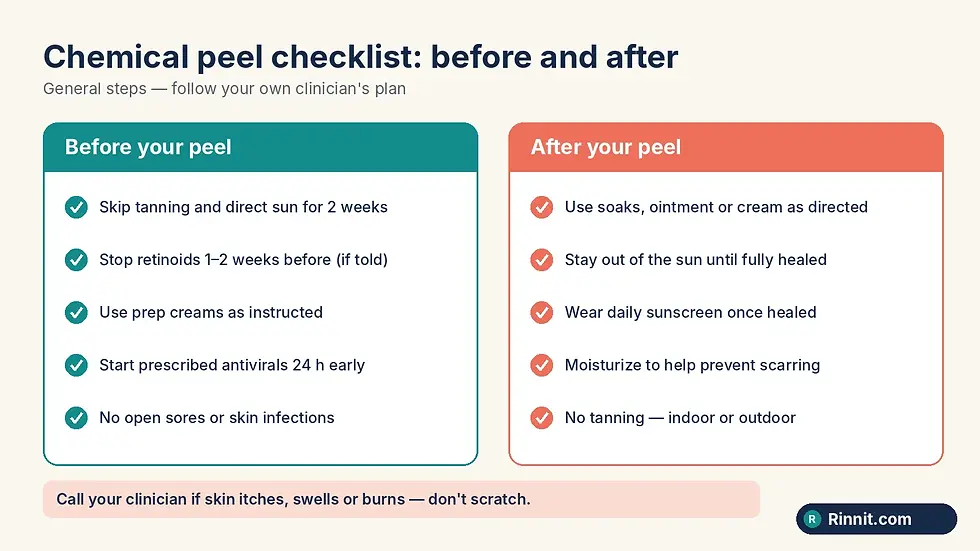
What to do before and after a chemical peel — follow your own clinician's plan. Image: Rinnit.com
What happens during a chemical peel?
During a chemical peel, your skin is cleansed, a chemical solution is applied, and then the solution is washed off or neutralized. [1]
Where: a doctor's office or an outpatient surgery center.
Cleansing: your skin is cleaned to remove oil; your eyes and hair are protected.
Anesthesia: deep peels are done under general anesthesia, so you are asleep. Your heart is monitored during a deep (phenol) peel, because phenol can cause irregular heartbeats; tell your doctor if you have heart, kidney or liver disease.
Sensation: expect warmth or heat for a few minutes, then stinging. A cool compress may ease it. [1]
How long does chemical peel recovery take?
Chemical peel recovery takes about 3–7 days for a light peel, 7–14 days for a medium peel and 14–21 days for a deep peel. [1]
Light peel | Medium peel | Deep peel | |
What to expect | Sunburn-like redness, then scaling | Redness, swelling, stinging, flaking; blisters may form and break | Area is bandaged; bandages removed in a few days |
Healing time | 3–7 days | 7–14 days (swelling can worsen for 48 hours) | 14–21 days |
Skin care | Lotion or cream as directed | Daily soaks, ointment after each soak, daily lotion | Daily soaks, ointment; moisturizer after day 14 |
Antiviral medicine | — | 10–14 days | 10–14 days |
Makeup | Right away or next day | After 5–7 days | After at least 14 days |
Sun | Daily sunscreen once healed | No sun until fully healed | No sun for 3–6 months |

Typical healing time and makeup timing by peel depth. Image: Rinnit.com
How do you care for your skin after a chemical peel?
You care for your skin after a chemical peel by keeping it moist, avoiding the sun and never tanning while it heals. [1]
For every peel depth:
No tanning — no tanning beds, indoor or outdoor, while healing.
Daily sunscreen once your skin has healed (see our guide to UV radiation and skin health).
Daily moisturizer as directed, to help prevent scarring. [1]
New skin is fragile. Your doctor's aftercare plan lowers the chance of color changes and other problems. For everyday habits after you heal, see skin care basics. [1]
What are the risks of a chemical peel?
The main risks of a chemical peel are temporary or permanent skin color changes, a low risk of scarring, cold sore flare-ups and, rarely, infection. [1]
Risk | What raises it | What helps |
Skin color changes | Certain skin types, birth control pills, pregnancy, family history of brown facial patches | Doctor's pre- and post-peel plan |
Scarring | Certain face areas, people prone to scarring, history of keloids | Usually treatable with good results |
Cold sore flare-up | History of herpes outbreaks | Preventive medicine from your dermatologist |
Infection | Scratching healing skin | Rare; don't scratch, follow aftercare |
If you tend to form raised scars, read about hypertrophic scars before your consultation. [1]
When should you call a doctor after a chemical peel?
You should call your doctor after a chemical peel if your skin itches, swells or burns. [1]
Scratching can lead to infection, so get advice instead of scratching. [1]
Is a chemical peel covered by insurance?
A chemical peel is usually not covered by insurance because it is considered a cosmetic treatment. [1]
Conclusion
A chemical peel can smooth fine lines, even out skin color and improve certain acne and mild scars. The key choice is depth: light peels offer quick recovery and gradual results, medium peels need a week or two, and deep peels give the biggest change but require weeks of healing and months of sun avoidance. Darker skin tones, a history of abnormal scarring and cold sores all need to be discussed first. Whatever peel you choose, sun protection before and after is what protects your results.
Ready for your consultation? Save or print the checklist above and bring it to your dermatologist so you can agree on the right peel depth, prep plan and aftercare together. Want to understand your skin concern first? Start with our guides to melasma and hormonal acne.
Frequently asked questions
What does a chemical peel do to your skin?
A chemical peel removes damaged outer skin layers with a chemical solution, revealing smoother, more even and brighter skin underneath. [1]
How long does it take to recover from a chemical peel?
About 3–7 days for a light peel, 7–14 days for a medium peel and 14–21 days for a deep peel. [1]
How many chemical peels do I need?
Light peels usually take 3–5 sessions, spaced every 2–5 weeks. Medium peels can be repeated every 6–12 months. A deep peel is done only once on the face. [1]
Can I wear makeup after a chemical peel?
Yes, but timing depends on depth: right away or the next day after a light peel, after 5–7 days for a medium peel, and after at least 14 days for a deep peel. [1]
Does a chemical peel hurt?
You may feel warmth or heat for a few minutes, then stinging. A cool compress can help. Deep peels are done under general anesthesia. [1]
Can chemical peels help acne scars?
Yes. Light peels can improve mild scarring, medium peels can help acne scarring, and deep peels can help deep acne scars. Some deep scars respond better to other treatments, such as laser resurfacing. [1]
Are chemical peels safe for dark skin?
Light peels can generally be used on all skin types, but darker skin has a higher risk of post-inflammatory hyperpigmentation. Ask your dermatologist about gentler options. [1]
Should I stop retinol before a chemical peel?
Usually yes — stop retinoid products such as tretinoin 1–2 weeks before, unless your doctor tells you otherwise. [1]
How should I care for my skin after a chemical peel?
Keep your skin moist, avoid the sun and never tan while it heals. Follow your doctor's aftercare steps, and call them if your skin itches, swells or burns.
Can a chemical peel fix deep wrinkles or sagging skin?
No. Chemical peels do not fix sagging skin, bulges, deep scars or severe wrinkles, and other treatments may be a better fit.
Related Reading
Dermalinfusion (DiamondGlow Facial): Benefits and Results explains dermalinfusion (DiamondGlow).
Treatments to Reduce Wrinkles: Options, Recovery and Results explains treatments to reduce wrinkles.
CO2 Laser Resurfacing: Uses, Procedure, Recovery and Risks explains CO2 laser resurfacing for skin.
References
Cleveland Clinic. Chemical Peels: Types of Peels, Conditions Treated, What to Expect. Cleveland Clinic. Last updated March 22, 2021. https://my.clevelandclinic.org/health/treatments/11010-chemical-peels
Chen X, Wang S, Yang M, et al. Chemical peels for acne vulgaris: a systematic review of randomised controlled trials. BMJ Open. 2018;8(4):e019607. PMID 29705755. https://doi.org/10.1136/bmjopen-2017-019607
Sarkar R, Lakhani R. Chemical Peels for Melasma: A Systematic Review. Dermatologic Surgery. 2024;50(7):656-661. PMID 38530985. https://doi.org/10.1097/DSS.0000000000004167
Li H, Jia B, Zhang X. Comparing the efficacy and safety of microneedling and its combination with other treatments in patients with acne scars: a network meta-analysis of randomized controlled trials. Archives of Dermatological Research. 2024;316(8):505. PMID 39110247. https://doi.org/10.1007/s00403-024-03256-x
Medical disclaimer
This article is for general education and is not a substitute for medical advice. Talk to a qualified dermatologist before having a chemical peel.



Comments