CO2 Laser Resurfacing: What It Treats, How Recovery Works, and the Risks to Know

Updated: 1 day ago
Written and medically reviewed by Dr. Baraa Alnahhal, MD · Last reviewed: October 31, 2026 · How we review
Quick Answer: What is CO2 laser resurfacing?
Carbon dioxide (CO2) laser resurfacing is an outpatient skin procedure that uses a precise laser to remove thin layers of skin, treating wrinkles, sun damage, scars, warts and some birthmarks. It usually takes 30 minutes to two hours under local anesthesia with sedation. Skin typically heals in 10 to 21 days, while pinkness can last several months. [1]
What the research says
Fractional CO2 tends to beat erbium lasers for acne scars, with more pain. A meta-analysis of 8 studies (418 patients) found fractional CO2 had a significantly higher effective rate than fractional Er:YAG laser (odds ratio 1.81), with about 2.1 days shorter downtime, but higher pain scores and about 1.9 days longer redness. (Liu et al., J Cosmet Dermatol, 2024)
Results are similar to microneedling, but skin darkening is more common. Across 17 studies of facial acne scars, CO2 laser had a slightly higher rate of treatment success (relative risk 1.10) and about three times the risk of post-inflammatory hyperpigmentation compared with standard microneedling (relative risk 3.04). (Batool et al., Lasers Med Sci, 2026)
Temporary darkening is common in medium-to-darker skin. In 82 patients with skin types III–IV treated for acne scars, 73% developed post-inflammatory hyperpigmentation and 32% had it for more than 3 months; new scars from the laser occurred in 2.4%. (Fang et al., Lasers Med Sci, 2022)
Combining CO2 laser with other treatments helped most: a network meta-analysis of 56 trials with 1,488 patients found combination treatments beat single treatments for moderate to severe acne scars, with fractional CO2 laser plus subcision or PRP showing the most consistent benefits (Ou Y et al., Aesthetic Plastic Surgery, 2026)
Key takeaways
CO2 lasers remove very thin layers of skin with little heat damage to the tissue around them.
They treat wrinkles, sun damage, scars, warts, linear birthmarks and rhinophyma.
Treating part of the face takes 30 to 45 minutes; the full face takes 1.5 to 2 hours.
Skin usually heals in 10 to 21 days. Stronger laser settings mean a longer recovery.
Redness usually fades in 2 to 3 months but can last up to 6 months.
Darker skin tones have a higher risk of dark patches after treatment.
Avoid the sun for 4 weeks before treatment, and wear SPF 30+ sunscreen every day after healing.
CO2 laser resurfacing at a glance
Question | Answer |
Where is it done? | Usually as an outpatient procedure |
What anesthesia is used? | Local numbing plus sedative medicine by mouth or through a vein; general anesthesia may be used for the whole face |
How long does it take? | 30–45 minutes (part of the face); 1.5–2 hours (full face) |
How long until skin heals? | 10–21 days |
How long does redness last? | Usually 2–3 months; up to 6 months |
Sun avoidance before? | 4 weeks |
When can retinoid or glycolic acid products restart? | About 6 weeks after the procedure, or as your provider advises |
What is CO2 laser resurfacing and how does it work?
CO2 laser resurfacing is a skin treatment that uses a carbon dioxide laser to remove very thin layers of skin with minimal heat damage to the surrounding structures.
These lasers have been used for many years to treat both non-cancerous (benign) and cancerous (malignant) skin conditions.
Newer CO2 lasers deliver energy in two ways:
Ultrapulsed: very short bursts of light energy.
Scanned continuous beams: a steady beam moved across the skin in a set pattern.
This newer technology has changed how sun-damaged and wrinkled skin can be rejuvenated. If you are new to the wider topic, our guide to laser skin resurfacing explains how the main laser types differ.
What skin problems can CO2 laser resurfacing treat?
CO2 laser resurfacing treats wrinkles, sun damage, scars, warts, linear birthmarks and rhinophyma.
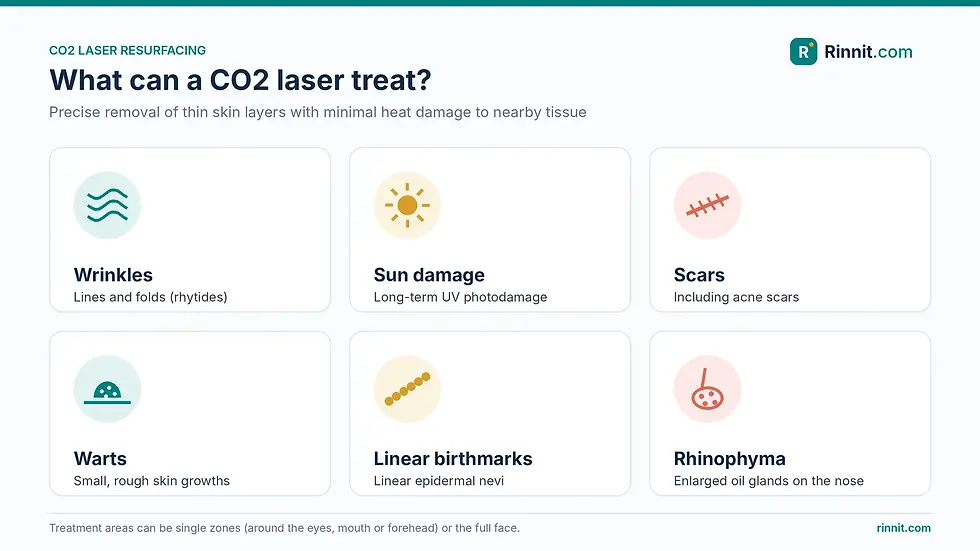
Condition | What it means | Learn more |
Wrinkles (rhytides) | Lines and folds in the skin | |
Photodamage | Skin damage from long-term sun exposure | — |
Scars | Marks left after skin heals, including acne scars | |
Warts | Small, rough skin growths | |
Linear epidermal nevi | A type of birthmark that forms a line on the skin | |
Rhinophyma | Enlarged oil glands on the nose |
Your provider may treat one area, such as the lines around the eyes, mouth or forehead, or the whole face.
How do you prepare for CO2 laser resurfacing?
Preparing for CO2 laser resurfacing means protecting your skin from the sun, planning medicines that prevent infection, and stopping smoking.
Avoid the sun for 4 weeks before treatment. Apply sunscreen generously before and after the procedure.
Ask about a bleaching (lightening) agent. If you have a darker skin tone, using one before treatment may lower the chance of dark patches.
Plan preventive medicines. An antiviral can be started before treatment to prevent a cold sore flare, and an antibiotic can be started to prevent bacterial infection. Both usually continue for 7 to 10 days afterward.
Stop smoking. Smoking harms the healing process, so quitting is strongly recommended.
Choose an experienced provider. Look for a surgeon with documented training and experience in laser surgery.
What happens during CO2 laser resurfacing?
During CO2 laser resurfacing, the treatment area is numbed and the laser removes thin layers of skin in a session lasting 30 minutes to 2 hours.
Numbing. The areas to be treated are numbed with a local anesthetic.
Sedation. You are usually given sedative medicine by mouth or through a vein. General anesthesia may be used when the whole face is treated.
Laser treatment. A partial-face treatment takes 30 to 45 minutes. A full-face treatment takes 1.5 to 2 hours.
Dressing. A non-stick dressing is placed on the treated skin for the first 24 hours.
You usually go home the same day.
What does recovery after CO2 laser resurfacing look like?
Recovery after CO2 laser resurfacing usually takes 10 to 21 days for the skin to heal, followed by redness that fades over 2 to 6 months.

Time | What happens |
4 weeks before | Avoid sun exposure; use sunscreen |
Day of treatment | Laser session; non-stick dressing applied |
First 24 hours | Dressing stays on |
First 24–48 hours | Ice packs help reduce swelling; sleep on an extra pillow |
First 7–10 days | Antiviral and antibiotic courses continue, if prescribed |
Days 10–21 | Treated skin heals; timing depends on the condition and laser strength |
After healing | Oil-free makeup can be used to cover redness |
About 6 weeks | Retinoid or glycolic acid products can usually restart |
2–3 months (up to 6) | Pink-to-red color fades |
Healing time depends on what was treated and how strong the laser settings were. The stronger the settings, the longer the recovery.
Redness tends to last longer in people with blond or red hair.
How should you care for your skin after CO2 laser resurfacing?
Caring for your skin after CO2 laser resurfacing focuses on keeping the area clean and moist while it heals, then protecting it from the sun.
While the skin heals
Clean the treated area 2 to 5 times a day with saline or a dilute vinegar solution, if your provider recommends it.
After cleaning, apply a thick protective ointment, such as petroleum jelly.
This routine helps stop scabs from forming. Scabs can raise the risk of scarring and slow healing.
After the skin heals
Wear a broad-spectrum sunscreen every day that blocks both UVA and UVB rays. Choose one made for the face with SPF 30 or higher.
Apply moisturizer generously.
Use oil-free makeup to hide redness. Green-based makeup works especially well to balance red tones.
Restart retinoid (such as tretinoin) or glycolic acid products after about 6 weeks, or when your provider says it's safe.
What are the risks and side effects of CO2 laser resurfacing?
The main risks and side effects of CO2 laser resurfacing are swelling, milia, acne flares, skin color changes, cold sore flares, infection and, rarely, scarring.

Side effect | What it looks like | How it's prevented or managed |
Swelling | Puffiness after treatment (expected) | Steroid injection into the muscle; extra pillow at night; ice in the first 24–48 hours |
Milia | Small white bumps or cysts | Gentle washcloth cleansing, or removal by a dermatologist |
Acne flare | New breakouts | May clear alone, or treated with usual acne medicines |
Hyperpigmentation | Darker patches | Bleaching cream helps them fade |
Hypopigmentation | Lighter patches (rarer) | Harder to treat |
Cold sore flare | Herpes simplex reactivation, mostly around the mouth | Antiviral before treatment and for 7–10 days after |
Bacterial infection | Infection of treated skin | Antibiotic before treatment and for 7–10 days after |
Scarring | New scar in the treated area (rare) | Careful wound care to prevent scabs |
Milia can be cleared with gentle washcloth cleansing. A dermatologist can also open the surface with a small blade and press the cyst out. Read more in our guide to milia.
Cold sores can return after treatment, especially when the area around the mouth is treated. If you get them, our cold sore guide covers the stages and triggers.
Who has a higher risk of pigment changes after CO2 laser resurfacing?
People with darker skin tones have a higher risk of healing with darker patches (hyperpigmentation) after CO2 laser resurfacing, although anyone can be affected.
The risk can be lowered by:
Using a bleaching agent before the procedure.
Continuing the bleaching agent after the skin heals.
Avoiding the sun for 4 weeks beforehand and using sunscreen before and after.
Lighter patches (hypopigmentation) are less common but harder to treat. If you already live with patchy pigment, such as melasma, raise it at your consultation.
How does CO2 laser resurfacing compare with other skin treatments?
CO2 laser resurfacing is one of several options for reducing facial lines and scars, alongside creams, peels and injectables.
Treatment type | Examples |
Topical products | Tretinoin, vitamin C lotion, alpha hydroxy acids |
Surface treatments | Chemical peels, microdermabrasion |
Fillers | Collagen or fat augmentation |
Injections | Botulinum toxin |
Laser | CO2 laser resurfacing |
The right choice depends on your skin problem, your skin tone and how much downtime you can accept. For scars that need a combination of approaches, see our guide to scar revision.
Conclusion
CO2 laser resurfacing removes thin layers of skin with high precision and can improve wrinkles, sun damage, scars, warts, linear birthmarks and rhinophyma. Expect a session of 30 minutes to 2 hours, about 10 to 21 days of healing, and redness that fades over the following months. Most side effects can be prevented or managed with sun avoidance, preventive medicines, careful wound care and daily sunscreen, and the biggest decision you make is choosing a provider with documented laser training.
Your next step: Save this guide and take the recovery table and risk chart to your consultation. Ask your provider which areas they plan to treat, how strong the settings will be, which preventive medicines you need, and how they will protect your skin tone. Still deciding between treatments? Read our laser skin resurfacing guide or our acne scars guide next.
Frequently asked questions
How long does CO2 laser resurfacing take?
A partial-face treatment takes 30 to 45 minutes. A full-face treatment takes 1.5 to 2 hours.
How long does it take to heal after CO2 laser resurfacing?
Treated skin usually heals in 10 to 21 days. Stronger laser settings lead to a longer recovery.
How long does redness last after CO2 laser resurfacing?
Redness usually fades in 2 to 3 months but can take up to 6 months. It often lasts longer in people with blond or red hair.
Is CO2 laser resurfacing done under anesthesia?
Yes. The skin is numbed with a local anesthetic, usually with sedative medicine by mouth or through a vein. General anesthesia may be used for full-face treatment.
Can I wear makeup after CO2 laser resurfacing?
Yes, once the skin has healed. Oil-free makeup can cover redness, and green-based makeup is especially helpful.
When can I use retinol or glycolic acid again?
About 6 weeks after the procedure, or when your provider tells you it's safe.
Is CO2 laser resurfacing safe for darker skin?
It can be used, but darker skin tones have a higher risk of dark patches afterward. A bleaching agent before and after treatment may lower that risk.
Why do I need an antiviral before CO2 laser resurfacing?
The procedure can trigger a cold sore flare, especially around the mouth. An antiviral taken before treatment and for 7 to 10 days afterward helps prevent it.
References
Cleveland Clinic. Carbon Dioxide Laser Resurfacing. Cleveland Clinic. Last updated November 20, 2020. https://my.clevelandclinic.org/health/treatments/8314-carbon-dioxide-laser-resurfacing
Liu F, Zhou Q, Tao M, et al. Efficacy and safety of CO2 fractional laser versus Er:YAG fractional laser in the treatment of atrophic acne scar: A meta-analysis and systematic review. Journal of Cosmetic Dermatology. 2024;23(9):2768-2778. PMID: 38733085. https://doi.org/10.1111/jocd.16348
Batool A, Abbas MS, Mahin FE, et al. Comparing fractional CO₂ laser and needling-based modalities in facial acne scar treatment: a comprehensive systematic review and meta-analysis. Lasers in Medical Science. 2026;41(1):124. PMID: 42334669. https://doi.org/10.1007/s10103-026-04905-5
Fang F, Yang H, Liu X, et al. Treatment of acne scars with fractional carbon dioxide laser in Asians: a retrospective study to search for predicting factors associated with efficacy. Lasers in Medical Science. 2022;37(6):2623-2627. PMID: 35220459. https://doi.org/10.1007/s10103-022-03528-w
Ou Y, An G, Liang J, et al. Laser, microneedling, and combination therapies for moderate to severe acne atrophic scars: a systematic review and network meta-analysis. Aesthetic Plast Surg. 2026;50(17):7308-7334. PMID 42429955. https://doi.org/10.1007/s00266-026-06165-8
Medical disclaimer
This article is for general education only and does not replace advice from a qualified healthcare provider. Talk to a dermatologist or surgeon trained in laser surgery before starting any skin treatment.



Comments