What Are Birthmarks? Types, Causes, Diagnosis, and Treatment Explained

Updated: 3 days ago
Medically reviewed by Dr. Baraa Alnahhal, MD · Last reviewed: October 2026
Quick Answer: What are birthmarks?
A birthmark is a spot or patch of skin that looks different from the surrounding skin. [1] [2] Birthmarks are very common and are either vascular, made of blood vessels that formed unexpectedly before birth, or pigmented, made of clustered pigment cells. Most are harmless and painless; some fade while others last for life. Never try to remove a birthmark at home. [1]
Key takeaways
Birthmarks are very common skin marks. They are present at birth or appear shortly after, and come in many shapes, sizes, and colors. [1]
There are two main types. Vascular birthmarks come from blood vessels; pigmented birthmarks come from clusters of color-producing melanocyte cells. [1]
Some fade on their own. Salmon patches and strawberry hemangiomas usually disappear over time, but port-wine stains are permanent unless treated. [1]
Most are harmless, but changes matter. Pigmented birthmarks, especially large congenital moles, carry a slightly increased skin cancer risk. [1]
There is no way to prevent birthmarks. They are not caused by anything a parent did or did not do during pregnancy. [1]
Removal is a personal, medical decision. Options include cryotherapy, laser removal, surgery, and cortisone injections, usually after age 6. [1]
What the research says
Oral propranolol can clear many infantile hemangiomas that need treatment. In a randomized, double-blind trial of 460 infants aged 1 to 5 months with proliferating hemangioma, the selected regimen (3 mg per kilogram per day for 6 months) led to complete or nearly complete resolution in 60% of infants versus 4% on placebo at week 24. Known side effects such as low blood sugar, low blood pressure, slow heart rate, and bronchospasm were infrequent and not significantly more common than with placebo. Propranolol is a prescription medicine for specialists to decide on (Léauté-Labrèze et al., N Engl J Med, 2015). [5]
Lasers lighten most port-wine stains. A meta-analysis of 14 studies (714 patients, an average of 6.5 laser sessions, 80% of them pulsed dye laser) found an overall treatment success rate of 97% for head and neck capillary malformations, with success defined as 25% to 100% clearance. Pulsed dye laser had a 96% success rate and a 9% complication rate (Farsi et al., Otolaryngol Head Neck Surg, 2025). [6]
Size drives melanoma risk in moles present at birth. A systematic review found 91 melanomas among 7,915 patients with congenital melanocytic nevi (1.15%, 95% CI 0.93–1.41). Large-to-giant nevi carried about 22 times the melanoma incidence of small-to-medium nevi by age 15 (risk ratio 21.9, 95% CI 8.55–56.3), while the risk for small nevi remains unknown (Scard et al., J Eur Acad Dermatol Venereol, 2023). [7]
What Are Birthmarks?
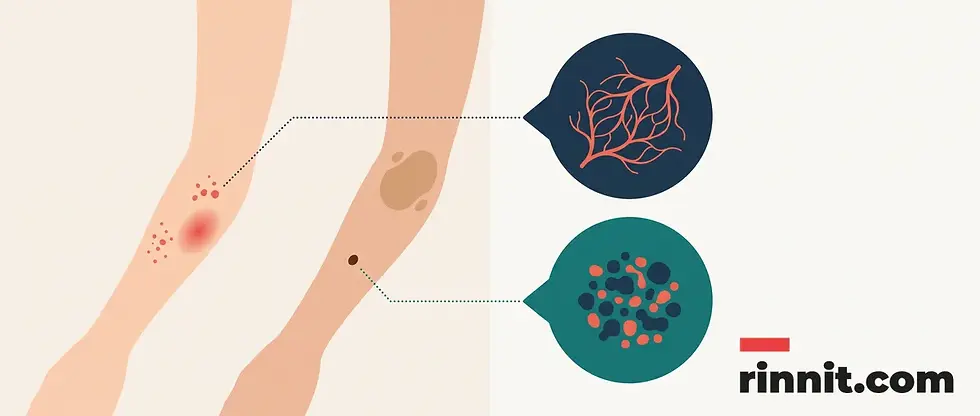
A birthmark is a spot or patch on your skin that looks different from the skin around it. [1] [2] Birthmarks are very common and come in many different shapes and sizes. Most birthmarks are present at birth, which is where they get their name. Some birthmarks fade as you age while others will be with you for your entire life, unless you choose to remove them. [1]
Birthmarks are mostly harmless and painless. Some birthmarks can increase your risk of developing skin cancer, like certain types of moles (congenital nevi). If you notice changes to your birthmarks, contact a healthcare provider. [1]
What Are the Types of Birthmarks?
There are two main categories of birthmarks: vascular birthmarks and pigmented birthmarks. [1]

Types of Vascular Birthmarks
Vascular Type | Other Names | What It Looks Like | What Happens Over Time |
Strawberry hemangioma | Strawberry birthmark, nevus vascularis, capillary hemangioma, hemangioma simplex [1] | Small, closely packed blood vessels; may be absent at birth and develop after several weeks [1] | Grows rapidly, holds a fixed size, then fades; usually disappears by age 9, sometimes leaving slight discoloration or puckering [1] |
Cavernous hemangioma | Angioma cavernosum, cavernoma [1] | Red to blue spongy mass of tissue filled with blood, extending deeper below the skin [1] | Similar to strawberry hemangiomas; some disappear on their own as the child approaches school age [1] |
Port-wine stain | — | Flat, purple-to-red mark made of dilated blood capillaries, most often on the face, varying in size [1] | Permanent unless treated; may thicken or darken over time; can cause self-esteem concerns if prominent [1] |
Salmon patch | Stork bite or angel kiss birthmark [1] | Small capillaries visible through the skin, most common on the forehead, eyelids, upper lip, between the eyebrows, and back of the neck [1] | Appear on 30% to 50% of newborn babies in the U.S.; fade as the child grows [1] |
Strawberry hemangiomas might appear anywhere on your body but are most common on your face, scalp, back, or chest. Port-wine stains are made of dilated blood capillaries and occur most often on the face. [1] Salmon patches are among the most common newborn marks of all, appearing on 30% to 50% of newborn babies in the U.S.
Types of Pigmented Birthmarks
Pigmented Type | What It Looks Like | Key Facts |
Dermal melanocytosis | Bluish marks that look like bruises, often on the buttocks and lower back, sometimes on the trunk or arms [1] | Formerly called Mongolian spots [1] |
Pigmented nevi (moles) | Raised growths the same color as your natural skin tone, or brown or black [1] | Can appear anywhere on the skin, alone or in groups [1] |
Congenital nevi | Moles present at birth [1] | About 1 in 100 people are born with one or more; larger ones (over 20 centimeters) carry a greater skin cancer risk than smaller ones [1] |
Café-au-lait spots | Light tan or light brown, usually oval [1] | One spot is not a concern; multiple spots larger than a quarter may signal neurofibromatosis [1] |
About 1 in 100 people are born with one or more congenital nevi (moles present at birth). These birthmarks have a slightly increased risk of becoming skin cancer, depending on their size. Larger congenital nevi (more than 20 centimeters) have a greater risk of developing into skin cancer than smaller congenital nevi. All congenital nevi should be examined by a healthcare provider, along with any changes to these birthmarks. [1]
One café-au-lait spot is not a cause for concern, but multiple spots larger than a quarter may be a sign of an underlying condition called neurofibromatosis. [1]
Does Everyone Have a Birthmark?
Birthmarks are very common but not everyone has one. An estimated 10% of all babies born around the world have a specific birthmark called a hemangioma. [1]
What Do Birthmarks Look Like?
Birthmarks look different on each person and vary in size, shape, and color. Common features of a birthmark include a flat or raised mark on your skin, a size ranging from a pinhead to the size of your fist, and a color that is different from the skin around it (pink, red, purple, tan, brown, or black). [1]
Pigmented birthmarks might increase in size as you age and change colors, especially after sun exposure and during times of hormone changes. They can become itchy and might occasionally bleed when injured. [1]
What Causes Birthmarks?
The exact cause of why birthmarks develop is unknown. In some cases, birthmarks form because blood vessels do not form as expected during fetal development (vascular birthmarks), melanocyte cells grow in clusters (pigmented birthmarks), a type of birthmark runs in your biological family history (genetic predisposition), or an underlying medical condition causes birthmark development (such as nevus sebaceous syndrome, skin cancer, or neurofibromatosis). [1]
It is worth repeating: birthmarks are not caused by something a parent did or did not do during pregnancy. They are natural additions to your appearance. [1]
Factor | How It Contributes |
Fetal blood vessel formation | Blood vessels that do not form as expected create vascular birthmarks [1] |
Melanocyte cell clusters | Grouped color-producing cells create pigmented birthmarks [1] |
Genetic predisposition | A type of birthmark runs in your biological family history [1] |
Underlying medical conditions | Conditions like nevus sebaceous syndrome, skin cancer, or neurofibromatosis can cause birthmark development [1] |
What Are the Complications of Birthmarks?
Complications of pigmented birthmarks can include psychological effects when the birthmark is located in a prominent area of your body, like on your face. This can affect your self-esteem and how you feel about your appearance. [1]
Pigmented birthmarks also can pose an increased risk of skin cancer. A healthcare provider should check any changes that occur in the color, size, or texture of a mole. See a provider right away if you have any pain, bleeding, itching, or swelling of a birthmark. [1]
How Are Birthmarks Diagnosed?
A healthcare provider can diagnose a birthmark after a physical exam to get a closer look at the mark on your skin. [1]
How Are Birthmarks Treated or Removed?
How Do I Get Rid of a Birthmark?
If you do not like how a birthmark looks on your skin, you can talk to a healthcare provider about removing it. You should not attempt to remove a birthmark at home. A healthcare provider will recommend the removal of certain birthmarks if you are at a higher risk of developing skin cancer. [1]
Treatment to remove a birthmark may include cryotherapy, laser removal, surgical removal, or injections of cortisone. A healthcare provider can review your birthmark and let you know what your best treatment options would be. Providers usually treat childhood birthmarks after a child reaches 6 years old. They might treat them earlier if they affect the function of your child's organs, like their vision or breathing. [1]
Treatment Option | How It Works |
Cryotherapy | Freezing treatment to remove the mark |
Laser removal | Targeted light energy to break down the mark |
Surgical removal | Physical excision of the birthmark |
Cortisone injections | Steroid injections to reduce the mark |

Are There Side Effects of the Treatment?
You may be at risk of scarring if you have a birthmark surgically removed. [1] [3] Surgeons take extra precautions during procedures to reduce your risk of scarring. You may also be at risk of developing an infection after a removal procedure. To avoid these risks, talk to your surgeon or provider about how you can take care of your skin as it heals after treatment. [1]
Can Birthmarks Be Prevented?
There is no way to prevent the development of birthmarks. You can reduce your risk of birthmarks changing color or developing into skin cancer from sunlight exposure by protecting your skin from the sun's ultraviolet rays. [1]
Sun Protection Step | Why It Helps |
Wear sunscreen | Reduces UV exposure that can change a birthmark's color [1] |
Wear protective clothing | Physically blocks ultraviolet rays |
Avoid daytime sun between 10 a.m. and 4 p.m. | The sun is at its brightest and most intense during these hours |
Outlook
What Can You Expect If You Have Birthmarks?
Birthmarks are usually harmless and are only cosmetic. Sometimes they complement your appearance and are called beauty marks. In most cases, you do not need to treat birthmarks. Salmon patches and strawberry hemangiomas will fade over time. [1] [3] Other types of birthmarks will stay with you throughout your life unless you choose to remove them. [1]
Sometimes, large birthmarks can affect your self-esteem, especially if they are located in a prominent place on your body. If you feel uncomfortable in your own skin, you can talk to a mental health professional about your concerns, talk to a healthcare provider about birthmark removal, or wear makeup to hide the birthmark. [1]
When Should You See a Healthcare Provider?
Visit a healthcare provider if you have changes to your existing birthmarks or develop new marks on your skin. Some changes to look out for include bleeding, pain, itchiness, infection, a size increase, or an irregular appearance. [1]
Questions to Ask Your Doctor
Questions you may want to ask include: What type of birthmark do I have? What are my options for birthmark removal? What are the side effects of removing a birthmark? Will my birthmark fade and go away on its own?
Conclusion
Birthmarks are spots or patches on the skin that look different from the surrounding skin, and they are among the most common features a newborn can have. They fall into two broad families: vascular birthmarks, formed from blood vessels that did not develop as expected, and pigmented birthmarks, formed from clusters of the melanocyte cells that give skin its color. Some of the most common varieties, like salmon patches on newborns and strawberry hemangiomas in infants, fade away on their own over time. Others, like port-wine stains, are permanent unless you choose to remove them.
The exact cause of birthmarks remains unknown, and they are never the result of anything a parent did or did not do during pregnancy. What is known is that certain marks deserve closer attention. Moles present at birth (congenital nevi) carry a slightly increased risk of skin cancer that rises with size, and several café-au-lait spots larger than a quarter can point to an underlying condition. Any birthmark that bleeds, itches, hurts, swells, grows, or becomes irregular should be evaluated by a healthcare provider.
When removal makes sense, options include cryotherapy, laser removal, surgical removal, and cortisone injections, with most childhood marks treated after age 6 unless they affect vision or breathing. Since sun exposure can change pigmented birthmarks, sunscreen, protective clothing, and avoiding the brightest midday hours are smart habits for anyone with birthmarks.
Make skin health education simple and visual. If you share dermatology or pediatric health topics with patients, teams, or audiences, Rinnit's ready-made infographic templates can help you present complex skin information clearly, with no design experience required.
Frequently Asked Questions
What is a birthmark?
A birthmark is a spot or patch on your skin that looks different from the skin around it. [1] [2] They are very common, come in many shapes and sizes, and are usually present at birth or develop shortly after. [1]
Are birthmarks common?
Yes. An estimated 10% of all babies born around the world have a hemangioma, and salmon patches appear on 30% to 50% of newborn babies in the U.S. About 1 in 100 people are born with one or more moles (congenital nevi). [1]
What are the two main types of birthmarks?
Vascular birthmarks are made of blood vessels that did not form as expected during fetal development and are often called red birthmarks. Pigmented birthmarks are made of clusters of melanocyte cells and range from brown or black to bluish. [1]
What is a strawberry hemangioma?
A strawberry hemangioma consists of small, closely packed blood vessels, most common on the face, scalp, back, or chest. It may be absent at birth and develop after several weeks, then grow rapidly, hold a fixed size, and fade. In most cases, it disappears by the time a child is 9 years old. [1]
What is a cavernous hemangioma?
A cavernous hemangioma is similar to a strawberry hemangioma but extends deeper below the surface of the skin. It may appear as a red to blue spongy mass of tissue filled with blood, and some of these lesions disappear on their own as the child approaches school age. [1]
What is a port-wine stain?
A port-wine stain is a flat, purple-to-red birthmark made of dilated blood capillaries. It occurs most often on the face, is permanent unless treated, and might thicken or darken over time. It can cause self-esteem concerns if it is in a prominent area. [1]
What is a salmon patch?
A salmon patch (also called a stork bite or angel kiss birthmark) is made of small capillaries visible through the skin. It is most common on the forehead, eyelids, upper lip, between the eyebrows, and back of the neck, and it fades as the child grows. [1]
What is dermal melanocytosis?
Dermal melanocytosis (formerly called Mongolian spots) is a bluish birthmark that looks like a bruise. It often appears on the buttocks and lower back but sometimes appears on the trunk or arms. [1]
What are congenital nevi?
Congenital nevi are moles present at birth. About 1 in 100 people have one or more. They carry a slightly increased risk of becoming skin cancer depending on size, with larger congenital nevi (more than 20 centimeters) having a greater risk than smaller ones. All congenital nevi should be examined by a healthcare provider. [1]
Are café-au-lait spots dangerous?
One café-au-lait spot is not a cause for concern. However, multiple spots larger than a quarter may be a sign of an underlying condition called neurofibromatosis. [1]
Do birthmarks fade on their own?
Some do. Salmon patches and strawberry hemangiomas fade over time. [1] [3] Other types, like port-wine stains and many pigmented marks, stay with you for life unless you choose to remove them. [1]
What causes birthmarks?
The exact cause is unknown. Birthmarks may form when blood vessels do not develop as expected (vascular), when melanocyte cells grow in clusters (pigmented), when a type runs in your family history (genetic predisposition), or when an underlying medical condition triggers development. [1]
Did something I do in pregnancy cause my baby's birthmark?
No. Birthmarks are natural additions to your appearance and are not caused by something a parent did or did not do during pregnancy. [1]
Can birthmarks cause complications?
Birthmarks in prominent areas, like the face, can affect self-esteem and how you feel about your appearance. Pigmented birthmarks can also pose an increased risk of skin cancer, which is why any changes should be checked by a provider. [1]
How are birthmarks diagnosed?
A provider can diagnose a birthmark with a physical exam. If the birthmark sits deep within the skin, imaging tests like an MRI, ultrasound, or CT scan can confirm it. A skin biopsy may be necessary if a birthmark changes in size or shape and may be a sign of skin cancer. [1]
How do you remove a birthmark?
Removal options include cryotherapy, laser removal, surgical removal, and cortisone injections. You should never attempt to remove a birthmark at home. A healthcare provider will recommend the best option after reviewing your birthmark. [1]
When are childhood birthmarks usually treated?
Providers usually treat childhood birthmarks after a child reaches 6 years old. They might treat them earlier if the birthmark affects the function of an organ, such as vision or breathing. [1]
Are there side effects of birthmark removal?
Surgical removal carries a risk of scarring, though surgeons take extra precautions to reduce it. There is also a risk of infection after a removal procedure. Talk to your provider about caring for your skin as it heals. [1]
Can you prevent birthmarks?
No. There is no way to prevent the development of birthmarks. You can, however, reduce the risk of birthmarks changing color or developing into skin cancer by protecting your skin from ultraviolet rays. [1]
How can I protect my birthmarks from the sun?
Wear sunscreen and protective clothing when outside, and avoid sun exposure during the daytime when the sun is at its brightest, between 10 a.m. and 4 p.m. [1]
When should I see a provider about a birthmark?
Visit a healthcare provider if you have changes to existing birthmarks or develop new marks. Warning signs include bleeding, pain, itchiness, infection, size increase, or an irregular appearance. [1]
What questions should I ask my doctor about my birthmark?
Useful questions include: What type of birthmark do I have? What are my options for birthmark removal? What are the side effects of removing a birthmark? Will my birthmark fade and go away on its own?
Related Reading
References
Cleveland Clinic. Birthmarks. Cleveland Clinic Health Library. Medically reviewed; last updated September 15, 2023. https://my.clevelandclinic.org/health/diseases/12159-birthmarks
American Academy of Dermatology. Birthmarks: Overview. AAD. Accessed October 30, 2026. https://aad.org/diseases/a-z/birthmarks-overview
National Health Service (U.K.). Birthmarks. NHS. Page last reviewed April 28, 2023. https://www.nhs.uk/conditions/birthmarks/
National Library of Medicine (U.S.). Birthmarks. MedlinePlus. Last updated October 9, 2024. https://medlineplus.gov/birthmarks.html
Léauté-Labrèze C, Hoeger P, Mazereeuw-Hautier J, et al. A randomized, controlled trial of oral propranolol in infantile hemangioma. N Engl J Med. 2015;372(8):735-746. PMID: 25693013. https://doi.org/10.1056/NEJMoa1404710
Farsi S, Eckard P, Bartels W, et al. Efficacy and safety of lasers in treating head and neck capillary malformations: a systematic review and meta-analysis. Otolaryngol Head Neck Surg. 2025;173(3):566-574. PMID: 40396459. https://doi.org/10.1002/ohn.1309
Scard C, Aubert H, Wargny M, et al. Risk of melanoma in congenital melanocytic nevi of all sizes: a systematic review. J Eur Acad Dermatol Venereol. 2023;37(1):32-39. PMID: 36149403. https://doi.org/10.1111/jdv.18581
Medical disclaimer
This article is for general informational purposes only and is not a substitute for professional medical advice, diagnosis, or treatment. Always seek the advice of a qualified healthcare provider with any questions you may have about a medical condition. Never disregard professional medical advice or delay seeking care because of content you have read here.



Comments