Port-Wine Stain: Clinical Characteristics, Risks, and Management

Updated: 2 days ago
Medically reviewed by Dr. Baraa Alnahhal, MD · Last reviewed: September 2026
A port-wine stain is a permanent, smooth, flat birthmark caused by abnormally formed capillaries under the skin. While typically harmless, these marks can darken, thicken, and become raised over time. Management primarily involves monitoring for complications like glaucoma or associated syndromes, with laser therapy serving as a common option for fading the mark.
Quick answer: A port-wine stain is a permanent birthmark appearing as a smooth, flat, pink, red, or purple patch, typically on the face or neck. It results from dilated capillaries and affects approximately 3 in 1,000 infants. Unlike other birthmarks, it does not fade and may become darker or bumpy with age. While usually cosmetic, it requires evaluation for associated syndromes. Treatment often involves laser therapy to shrink blood vessels and fade the mark.
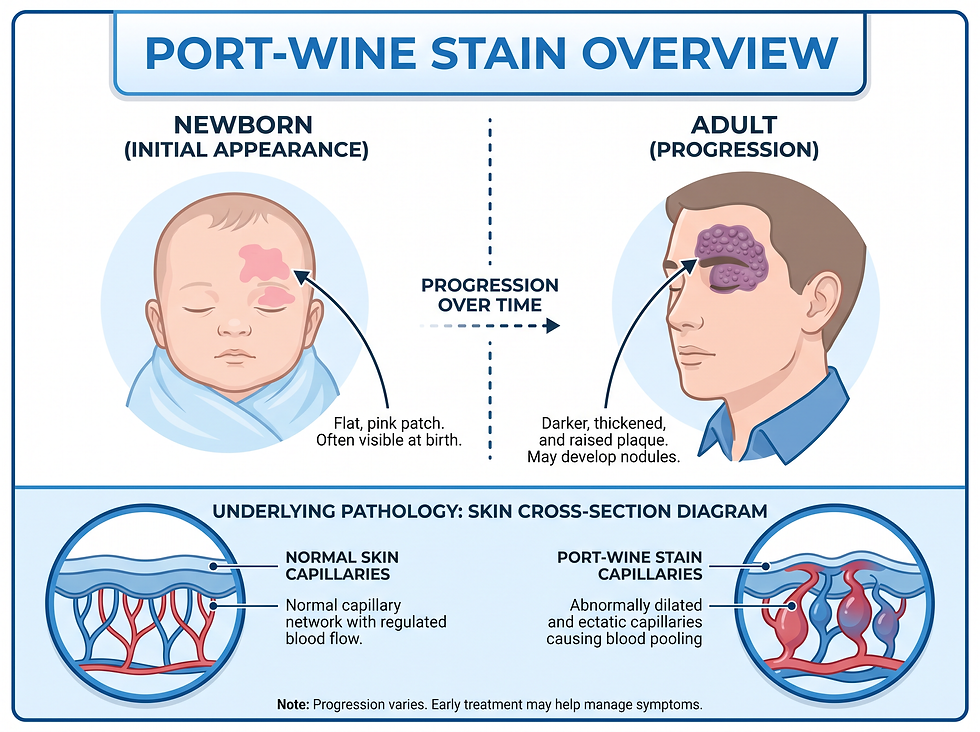
Port-wine stains, clinically known as nevus flammeus, represent a vascular malformation involving the capillaries. These tiny blood vessels under the skin become abnormally dilated or stretched out, leading to the characteristic wine-like appearance. While the exact cause remains unknown, they are present at birth and grow in proportion with the individual, often becoming a lifelong characteristic.
Clinical Appearance and Progression
At birth, a port-wine stain typically appears as a flat, smooth patch with distinct borders. As the child matures, the mark undergoes predictable changes in texture and color.
Characteristic | Early Childhood | Adulthood |
Texture | Smooth and flat | May become raised, bumpy, or pebbly |
Color | Pink, light red, or pale purple | Dark red or deep purple |
Thickness | Thin and flush with skin | May become significantly thicker |
Bleeding Risk | Low | Higher, especially if bumped or injured |
These birthmarks most commonly affect the face, neck, and scalp, though they can appear anywhere on the body. While they do not cause physical pain, the thickening of the skin in later years can lead to disfigurement if left untreated.
Potential Health Complications
For most individuals, a port-wine stain is purely a cosmetic concern. However, specific locations and characteristics can indicate underlying medical issues.
"People born with one of these syndromes have abnormally developed blood vessels in other parts of their body and should be evaluated for potentially serious complications." [1]
Rarely, these marks are associated with Sturge-Weber syndrome or Klippel-Trenaunay syndrome. Furthermore, port-wine stains located around the eyes are linked to an increased risk of glaucoma, a condition that increases pressure within the eye and can lead to vision loss.
Diagnostic and Treatment Pathways
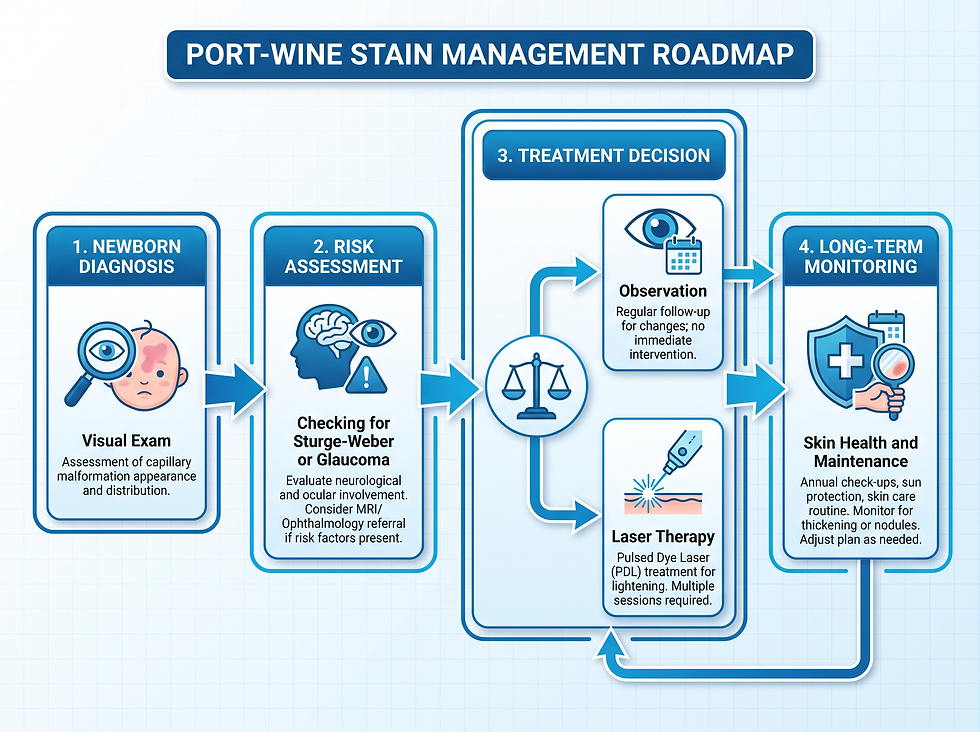
Diagnosis is primarily achieved through visual examination and a review of family history. In cases where a syndrome is suspected, providers may utilize imaging or specialized eye tests.
Diagnostic Tool | Purpose |
Visual Exam | Initial identification of borders and color |
Eye Pressure Test | Screening for glaucoma (if mark is near eyes) |
Imaging (MRI/CT) | Checking for internal vascular abnormalities |
Skin Biopsy | Confirming vessel structure if diagnosis is unclear |
Management is often a personal choice unless medical complications arise. The most effective treatment is laser therapy, which uses light energy to shrink the abnormally formed capillaries. This process is most successful in younger patients whose blood vessels are smaller and less complex.
Living with a Port-Wine Stain
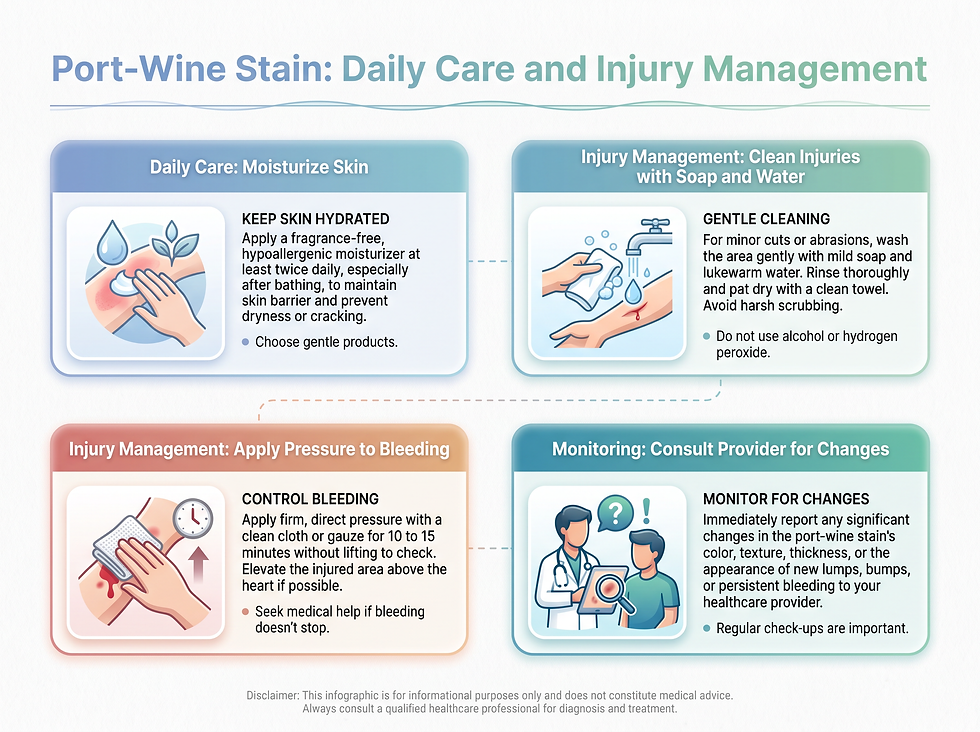
Maintaining the health of the skin in the affected area is essential. Because the skin can become dry, regular moisturizing is recommended. If the mark becomes raised, it may bleed more easily than surrounding skin; such injuries should be cleaned with soap and water and managed with firm pressure.
For children, coping with a visible birthmark involves open communication and supportive social environments. Parents are encouraged to discuss the mark as a unique personal characteristic, similar to eye color, to help build self-esteem.
Conclusion
Port-wine stains are permanent vascular birthmarks that require long-term observation rather than immediate medical intervention in most cases. By understanding the progression from flat patches to raised marks and recognizing the potential for associated complications like glaucoma, individuals and parents can make informed decisions regarding treatment. Laser therapy remains a viable and effective option for those seeking to minimize the mark's appearance and prevent future skin thickening.
If you or your child has a port-wine stain, schedule a baseline evaluation with a healthcare provider to rule out associated syndromes. Regular monitoring, particularly for marks located near the eyes, is vital for maintaining long-term health and preventing complications.
Frequently Asked Questions
Do port-wine stains ever disappear on their own?
No, port-wine stains are permanent and will not fade without medical treatment like laser therapy.
What causes these birthmarks to form?
They are caused by abnormally dilated capillaries under the skin, though the exact reason for this malformation is unknown.
Are they hereditary?
While most cases are sporadic, there are instances where multiple family members are affected.
Is a port-wine stain painful?
No, the birthmark itself does not cause physical pain or discomfort.
Why do some marks become bumpy?
Over time, the blood vessels may continue to dilate, causing the skin to thicken and develop a pebbly texture.
Can they be prevented during pregnancy?
No, they are not caused by any specific actions or exposures during pregnancy.
When is the best time to start laser treatment?
Treatment is often most effective in infancy or early childhood when blood vessels are smaller.
What is Sturge-Weber syndrome?
It is a rare condition involving port-wine stains and abnormal blood vessels in the brain or eyes.
How does laser therapy work?
The laser generates heat that shrinks the dilated blood vessels, causing the mark to fade over multiple sessions.
Do the marks always come back after treatment?
Fading is common, but the mark can sometimes darken again years later, requiring maintenance treatments.
What should I do if the birthmark bleeds?
Clean the area with soap and water and apply firm pressure with a clean bandage until bleeding stops.
Is there a risk of infection?
Yes, if the thickened skin is broken or injured, it may be more susceptible to infection.
Can makeup cover a port-wine stain?
Yes, specialized cover-up makeup is a common non-medical option for minimizing the mark's appearance.
How common is this condition?
It affects approximately 3 out of every 1,000 newborns.
Should I see an eye doctor?
If the birthmark is on the eyelid or near the eye, a regular eye exam is necessary to check for glaucoma.
Medical Disclaimer: The information provided in this article is for educational purposes only and should not be considered medical advice. Always seek the guidance of a qualified healthcare professional regarding any medical condition or treatment.
Comments