Klippel-Trenaunay Syndrome: Symptoms, Causes, and Treatment Guide

Updated: 2 days ago
Medically reviewed by Dr. Baraa Alnahhal, MD · Last reviewed: September 2026
TL;DR: Klippel-Trenaunay syndrome (KTS) is a rare condition present at birth that affects how blood vessels, soft tissue, and bone develop — most often in one leg. It shows up as a pink-to-reddish-purple birthmark, enlarged or twisted veins, and a limb that grows larger or longer than the other. There is no cure, but a wide range of treatments — from compression therapy and laser therapy to surgery and newer medications — can manage symptoms and prevent serious complications like blood clots. Care is lifelong and usually involves a team of specialists.
Quick Answer
KTS is a rare condition found at birth where blood vessels, soft tissues, bones, and sometimes the lymphatic system develop abnormally.
It most often affects one leg, showing up as a pink-to-reddish-purple birthmark (port-wine stain), varicose veins, and a larger or longer limb.
It is caused by a random gene change, most often in the PIK3CA gene, that happens before birth and is not usually inherited from parents.
There is no cure; treatment focuses on relieving symptoms and preventing complications such as blood clots, skin ulcers, and infections.
Doctors confirm it with a physical exam plus tests like ultrasound, MRI, CT angiography, and genetic studies.
Twelve treatment approaches are available, including compression therapy, laser therapy, embolization, and orthopedic procedures.
Regular appointments matter: untreated KTS can lead to blood clots that may travel to the lungs, so contact your doctor early for pain or swelling.
What Is Klippel-Trenaunay Syndrome?
Klippel-Trenaunay (klih-PEL tray-no-NAY) syndrome — usually shortened to KTS — is a rare congenital disorder, meaning it is present at birth. “Congenital” simply describes a condition that develops before or during birth rather than one a person catches later in life.
In KTS, certain blood vessels, soft tissues (such as skin and muscles), bones, and sometimes the lymphatic system develop abnormally. The lymphatic system is the body's drainage and defense network — it moves fluid through its own set of vessels and helps protect against infection and disease.

The Three Main Features
KTS is defined by a recognizable combination of features, which can range from mild to extensive:
Feature | What It Looks Like |
Port-wine stain | A pink-to-reddish-purple birthmark caused by extra tiny blood vessels (capillaries) in the top layer of skin. It often covers part of one leg but can appear anywhere on the skin, and it may darken or lighten with age. |
Vein malformations | Swollen, twisted varicose veins on the leg surfaces, plus deeper malformed veins in the arms, legs, abdomen, and pelvis. Spongy tissue filled with small veins may form in or under the skin, and veins can become more prominent with age. |
Bone and soft tissue overgrowth | A limb — most often one leg — that grows larger and longer than the other. This begins in infancy and can rarely affect the trunk or face, or cause fused or extra fingers and toes. |
A fourth feature, lymphatic system malformations, may also appear. Extra lymphatic vessels that do not work properly can leak fluid into the surrounding tissue and cause swelling.
The good news to carry into everything below: treatment exists to improve symptoms and prevent complications, even though there is no cure.
What Are the Symptoms of Klippel-Trenaunay Syndrome?
KTS symptoms vary widely from person to person — some cases are mild, while others are more extensive. The features below are the ones to look for:
Symptom | What You May Notice |
Port-wine stain birthmark | Pink, red, or reddish-purple patch of skin, often on part of one leg |
Varicose veins | Swollen, twisted veins, usually on the surface of the legs |
Deeper malformed veins | Veins in the arms, legs, abdomen, or pelvis that don't look or work normally |
Spongy tissue | Soft, spongy areas filled with small veins in or under the skin |
Larger or longer limb | One leg (or arm) that grows bigger and longer than the other, starting in infancy |
Swelling | Fluid leaking into tissue from faulty lymphatic vessels |
Eye findings | Cataracts or glaucoma in some cases |
Other signs | Hip dislocation at birth, purple-red skin coloring when cold, blood-clotting problems |
When to See a Doctor
KTS is usually identified at birth. What matters most is getting a prompt, accurate diagnosis and appropriate care, which treats symptoms and prevents complications before they start.
For a newborn, this means raising concerns with your pediatrician at well-baby visits rather than waiting. For an older child or adult, it means booking an appointment if you notice a birthmark combined with enlarged veins or a limb that grows differently.
When to act urgently: KTS raises the risk of blood clots. If you or your child develop sudden leg pain or swelling, chest pain, or shortness of breath, seek medical care right away — these can be signs of a clot that needs immediate treatment.
What Causes Klippel-Trenaunay Syndrome?
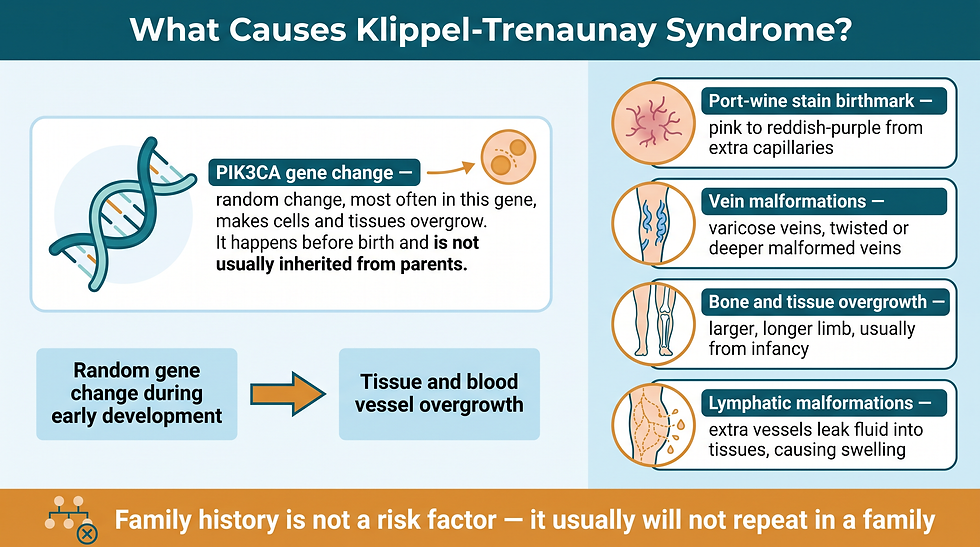
KTS is a genetic disorder. It involves genetic changes, or mutations — alterations in the DNA instructions that tell cells how to grow and behave. In KTS, the change most commonly occurs in the PIK3CA gene, which is responsible for cell growth and tissue development. When this gene changes, tissues overgrow.
Two points deserve emphasis, because they shape how families think about this condition:
The change happens randomly during cell division in early development before birth. It is not something a parent caused or could have prevented.
KTS is not usually inherited. It arises during the child's own development rather than being passed down.
Risk Factors: The Surprising Answer
The most important thing to know about KTS risk factors is what does not raise risk. Family history does not seem to be a risk factor. It is unlikely that parents of one child with KTS will have another child with the disorder — even if one of the parents has KTS.
Factor | Effect on KTS Risk |
Family history | Not a risk factor; KTS rarely repeats in a family |
Parent with KTS | Child still unlikely to have KTS |
Parent's actions during pregnancy | No known link |
This matters emotionally for parents. A KTS diagnosis is not a verdict about your family's future pregnancies, and it is not a consequence of anything you did.
What Complications Can Klippel-Trenaunay Syndrome Cause?
Because KTS affects blood vessels, soft tissues, bones, and the lymphatic system, complications can arise in several body systems. Understanding them explains why regular monitoring is so important:
System Affected | Possible Complications |
Skin (port-wine stain) | Thickened areas, blisters (blebs) prone to bleeding and infection, skin ulcers, poor wound healing |
Veins | Pain and skin ulcers from poor circulation; deep vein thrombosis; pulmonary embolism — a life-threatening event if a clot dislodges and travels to the lungs; internal bleeding from pelvic or abdominal malformations; painful surface clots (superficial thrombophlebitis) |
Bones and soft tissue | Pain, heaviness, limb enlargement, movement problems; walking problems, hip and back problems from leg length differences |
Lymphatic system | Lymphedema (fluid buildup and swelling in arms or legs), skin breakdown and ulcers, fluid leakage, cellulitis (infection of the layer under the skin) |
Overall | Chronic pain — a common problem resulting from infections, swelling, bone involvement, or vein problems |
The blood clot pathway deserves special attention. Varicose and malformed veins slow blood flow, which makes clots more likely. A clot that breaks loose and reaches the lungs (pulmonary embolism) is life-threatening. This is why “contact your doctor about new pain or swelling” is not a casual suggestion in KTS care — it is one of the condition's most important safety habits.
How Is Klippel-Trenaunay Syndrome Diagnosed?
Diagnosis begins with a physical exam, and a referral to a vascular malformations specialist is helpful for both evaluation and treatment recommendations.
During the evaluation, your healthcare provider:
Asks questions about your family and medical history
Examines the body for swelling, varicose veins, and port-wine stains
Visually evaluates the growth of bones and soft tissues
Several diagnostic tests then identify the type and severity of the condition and help determine treatment:
Test | What It Does |
Duplex ultrasound scanning | Uses high-frequency sound waves to create detailed images of blood vessels and blood flow |
MRI and MR angiography | Differentiates between bone, fat, muscle, and blood vessels; identifies malformations |
Scanogram (scanner photography) | An X-ray technique that images bones and measures their lengths |
CT scan or CT angiography | Creates 3D images of the body; helps show blood clots in veins |
Contrast venography | Injects dye into veins and takes X-rays to reveal atypical veins, blockages, or clots |
Coagulation studies | Evaluates how the blood clots |
Genetic studies | Identifies the characteristic gene signature that may explain why the condition occurred |
Most cases are found at birth. If a doctor suspects KTS, diagnostic tests and treatment will likely begin before your child leaves the hospital. Your child's doctor will also look for developmental problems at regular checkups — which is why keeping every well-baby visit and annual appointment matters.
How Is Klippel-Trenaunay Syndrome Treated?
Although there is no cure for KTS, a wide menu of treatments manages symptoms and prevents complications. Because KTS can affect many body systems, care usually involves a team of specialists: vascular medicine and surgery, dermatology, interventional radiology, orthopedic surgery, physical therapy and rehabilitation, and other areas as needed.
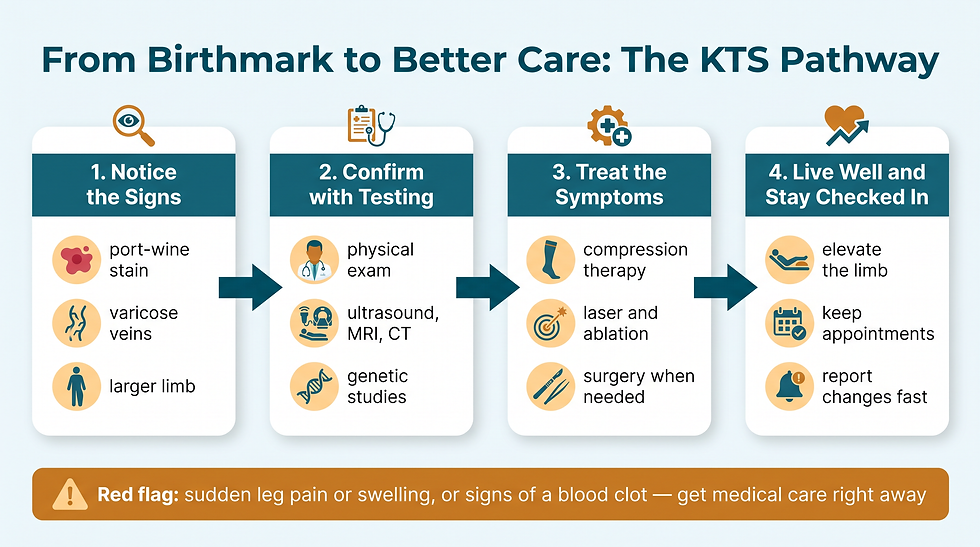
The Full Range of Treatment Options
Your doctor will work with you to choose the approaches most appropriate for your situation:
Treatment | How It Works | What It Targets |
Compression therapy | Custom-fit bandages or elastic garments around affected limbs; intermittent pneumatic compression devices | Prevents swelling, varicose vein problems, and skin ulcers |
Skin care | Hygiene of the affected limb | Reduces infection risk; treats superficial bleeding |
Physical therapy | Massage, compression, and limb movement as appropriate | Relieves lymphedema and blood vessel swelling |
Orthopedic devices | Orthopedic shoes or shoe inserts | Compensates for leg length differences |
Epiphysiodesis | An orthopedic surgical procedure that stops length overgrowth of the lower limb | Excess limb growth |
Embolization | Small catheters block blood flow to certain vessels | Problematic blood vessels |
Laser therapy | Light-based treatment | Removes or lightens port-wine stains; treats leaking and bleeding blebs |
Laser or radiofrequency ablation of veins | Minimally invasive procedure to close off malformed veins | Malformed veins |
MR-guided ablation | Blood vessels treated with a laser or cautery under MRI guidance | Blood vessels needing precise treatment |
Sclerotherapy | A solution injected into a vein creates scar tissue that closes the vein | Malformed veins |
Surgery | Removal or reconstruction of affected veins, removal of excess tissue, correction of bone overgrowth | Severe malformations and overgrowth |
Medication | Oral medications for complex malformations; topical sirolimus for superficial malformations | Complex malformations causing symptoms |
Two honest caveats come with the medication category. Oral medications may have significant side effects that require monitoring, and topical sirolimus may help relieve symptoms — the word “may” matters, because studies are ongoing to determine the effectiveness and safety of these medications in people with KTS.
Treatment may also be needed for complications as they arise — bleeding, infection, blood clots, or skin ulcers — and special care may be needed during pregnancy to prevent complications.
Lifestyle and Home Remedies
Day-to-day habits play a genuine supporting role in KTS management:
Home Strategy | Why It Helps |
Keep appointments | Regular visits let your doctor identify and address problems early |
Use orthopedic shoes, if recommended | May improve physical function |
Follow your doctor's guidance on physical activity | Appropriate use of affected limbs may relieve lymphedema and blood vessel swelling |
Elevate affected limbs | Raising the leg or affected limb when possible can reduce lymphedema |
Notify your doctor of changes | Report symptoms of blood clots or infection, or increased pain or swelling, without delay |
Coping and Living with KTS
Living with KTS can be a challenge, and that challenge is both physical and emotional. Support and advocacy groups provide connection with other people who have KTS — groups such as the K-T Support Group offer educational materials, resources, and information about connecting with others. Ask your doctor whether a local support group exists in your area.
Talking with a psychologist, psychiatrist, or another mental health professional also may be helpful to many people with KTS. Chronic pain, lifelong appointments, and visible differences are legitimate burdens, and professional support for them is part of good care — not a sign of weakness.
Preparing for Your Appointment
Most cases of KTS are found at birth, and if the doctor suspects the syndrome, diagnostic tests and treatment will likely begin before your child leaves the hospital. It is important to take your child to all regularly scheduled well-baby visits and annual appointments so developmental problems can be caught early.
Questions to Ask Your Doctor
Your Question | Why It Matters |
What diagnostic tests will be needed? | Understand the plan before it starts |
When will I get the results of the tests? | Sets expectations and reduces anxious waiting |
What specialists might be needed? | KTS care is multidisciplinary; know who is on the team |
What conditions related to this syndrome need to be addressed right now? | Prioritizes the most urgent issues |
How will you help me monitor my child's health and development? | Builds a long-term monitoring plan |
Can you suggest educational materials and local support services? | Connects you to community resources early |
What Your Doctor Will Ask
Doctor's Question | Why It Matters |
What symptoms does your child have that concern you? | Captures your firsthand observations |
Has your child had any procedures or treatments for these symptoms? | Avoids repeating or conflicting treatments |
Has your child had any previous difficulty with infections or blood clots? | Flags the highest-risk complication areas |
Did you have any problems with your pregnancy or your child's birth? | Context for congenital conditions |
Can you tell me about your family's medical history? | KTS is rarely inherited, but history still informs care |
Is your child having problems with family, social activities, or school? | Catches the emotional and social burden of living with KTS |
Preparing and anticipating questions will help you make the most of your time with the doctor.
Conclusion: Care That Stays Ahead of the Condition
Klippel-Trenaunay syndrome is rare, lifelong, and not curable — but it is highly manageable. A birthmark, enlarged veins, or a growing limb difference is the beginning of a story, not the whole of it. With an accurate diagnosis, a specialist team, and a treatment menu that ranges from simple compression garments to advanced ablation procedures, most people with KTS live with well-controlled symptoms.
The three habits that matter most: keep every appointment, elevate and move the affected limb as your doctor recommends, and report new pain, swelling, or clot symptoms immediately.
If you or your child has a port-wine stain birthmark combined with enlarged veins or limb overgrowth, do not wait for it to become a problem. Book an appointment with a healthcare provider today, and ask for a referral to a vascular malformations specialist.
Frequently Asked Questions About Klippel-Trenaunay Syndrome
Is Klippel-Trenaunay syndrome genetic?
Yes. KTS is a genetic disorder involving changes, or mutations, in genes — most commonly the PIK3CA gene, which controls cell growth and tissue development. The change happens randomly during cell division in early development before birth.
Is Klippel-Trenaunay syndrome inherited?
Usually not. The gene changes occur randomly before birth and are not typically passed from parent to child. Family history does not seem to be a risk factor, and parents of one child with KTS are unlikely to have another child with the disorder — even if one parent has KTS.
Is Klippel-Trenaunay syndrome curable?
No. There is no cure for KTS. Treatment goals are to improve symptoms and prevent complications, using approaches such as compression therapy, laser therapy, ablation, orthopedic procedures, and medications.
What does a KTS birthmark look like?
A port-wine stain — a pink-to-reddish-purple birthmark caused by extra tiny blood vessels (capillaries) in the top layer of skin. It often covers part of one leg but can appear on any portion of the skin, and it may get darker or lighter with age.
Does Klippel-Trenaunay syndrome cause blood clots?
It can raise the risk. Deeper malformed veins increase the chance of deep vein thrombosis. If a clot dislodges and travels to the lungs, it can cause a life-threatening pulmonary embolism. Superficial veins can also develop painful clots and inflammation. Contact your doctor immediately about symptoms of blood clots.
What is epiphysiodesis, and when is it used?
Epiphysiodesis is an orthopedic surgical procedure that effectively stops the length overgrowth of the lower limb. It is one of the surgical options for managing the bone overgrowth that makes one leg longer than the other.
Do medications work for Klippel-Trenaunay syndrome?
Some people have benefited from oral medications that may help treat complex vascular and lymphatic malformations, and topical sirolimus may relieve symptoms of superficial malformations. However, these drugs may have significant side effects requiring monitoring, and studies are ongoing to confirm their effectiveness and safety in KTS.
How is Klippel-Trenaunay syndrome diagnosed?
Diagnosis begins with a physical exam — checking for swelling, varicose veins, and port-wine stains — plus questions about family and medical history. Tests such as duplex ultrasound, MRI, CT angiography, contrast venography, coagulation studies, and genetic studies then identify the type and severity of the condition.
References
Klippel-Trenaunay syndrome — Symptoms and causes (Published February 12, 2022)
Klippel-Trenaunay syndrome — Diagnosis and treatment (Published February 12, 2022)
Rinnit.com provides general health information for educational purposes. This content does not replace professional medical advice — always consult a qualified healthcare provider for diagnosis and treatment.
Health information, not medical advice. This article is for general education and is not a substitute for professional diagnosis or treatment. Always consult a qualified healthcare provider about your own health, and seek emergency care for urgent symptoms.
Comments