Milia (Milk Spots): Causes, Symptoms, and Skin Care

Updated: 3 days ago
Medically reviewed by Dr. Baraa Alnahhal, MD · Last reviewed: October 2026
Editorial note: This article is provided for educational purposes only. It is not medical advice. Always consult a qualified healthcare professional about your individual health situation.
Quick Answer: What Are Milia?
Milia, often called milk spots, are small white cysts that form when dead skin cells become trapped beneath the skin surface. [1] They are very common in newborns but can occur at any age. [1] They are harmless, non-contagious and often mistaken for acne, and usually clear on their own within a few weeks. [1] Avoid squeezing them, which can cause scarring. [1]
What the research says
Milia are among the most common newborn skin findings. In a survey of 420 Australian neonates examined during the first week of life, skin lesions were seen in 99.3% of babies and milia in 36% (Rivers et al., J Am Acad Dermatol, 1990) [2].
How often milia are seen varies between populations. A prospective study of 1,000 consecutive newborns in Ahvaz, Iran found milia in 7.5%, and the authors noted that differences between studies may reflect racial differences and study method (Moosavi & Hosseini, Pediatr Dermatol, 2006) [3].
Milia come in several forms, including rare inherited variants. A dermatology review noted that few studies have examined the origin of milia, described the various forms including rare genodermatosis-associated variants, and presented an updated classification (Berk & Bayliss, J Am Acad Dermatol, 2008) [4].
What are milia (milk spots)?
Milia, commonly referred to as "milk spots," are small, white to yellow cysts that develop under the surface of the skin. [1] A single cyst is known as a milium. [1] These pockets are filled with trapped keratin, a protein found in skin cells, and are most frequently observed on the face, particularly around the eyes and nose.
While they may resemble whiteheads, milia are not a form of acne. [1] They are entirely harmless and primarily affect the cosmetic appearance of the skin. [1] In most cases, milia are temporary and resolve spontaneously as the skin naturally sheds its dead cells.
What are the types of milia?
There are several classifications of milia based on their cause and the age group they affect.
Type | Characteristics |
Neonatal Milia | Present at birth in nearly 50% of newborns; usually found on the nose. [1] |
Primary Milia | Common on eyelids, forehead, and cheeks; affects both children and adults. [1] |
Secondary Milia | Also called traumatic milia; occurs after skin damage from burns, blisters, or sun. [1] |
Juvenile Milia | Linked to inherited genetic conditions; can appear at birth or later. [1] |
Milia en Plaque | Rare; clumping of cysts on a raised patch of skin, often behind ears or on the jaw. |
Multiple Eruptive Milia | Rare; itchy groups of cysts forming over weeks on the face and arms. [1] |

What are the symptoms of milia, and where do they appear?
The primary symptom of milia is the appearance of small, firm, white to yellow bumps. These cysts are typically asymptomatic, meaning they do not cause pain or discomfort, although some rare types can be itchy. [1]
Milia can appear almost anywhere on the body, but the most common locations include:
What causes milia, and who is at risk?
The fundamental cause of milia is the trapping of dead skin cells. [1] Normally, the body sheds these cells to make room for new growth, but when they fail to fall off, new skin grows over them, hardening them into tiny cysts. [1]
Additional factors that can contribute to the development of milia include:

How are milia diagnosed and managed?
Healthcare providers typically diagnose milia through a simple visual examination of the skin. [1] In rare or complex cases, a skin biopsy may be performed to confirm the diagnosis under a microscope.
Professional Treatment Options
While milia usually resolve on their own within weeks for babies and a few months for adults, professional removal is an option if the appearance is bothersome:
Topical Treatments: Over-the-counter adapalene or prescription tretinoin creams. [1]
Surgical Extraction: Puncturing the cyst with a sterile needle to remove the contents. [1]
Cryotherapy: Freezing the cysts to remove them. [1]
Antibiotics: Minocycline may be used for specific rare types like milia en plaque. [1]
Home Care and Prevention
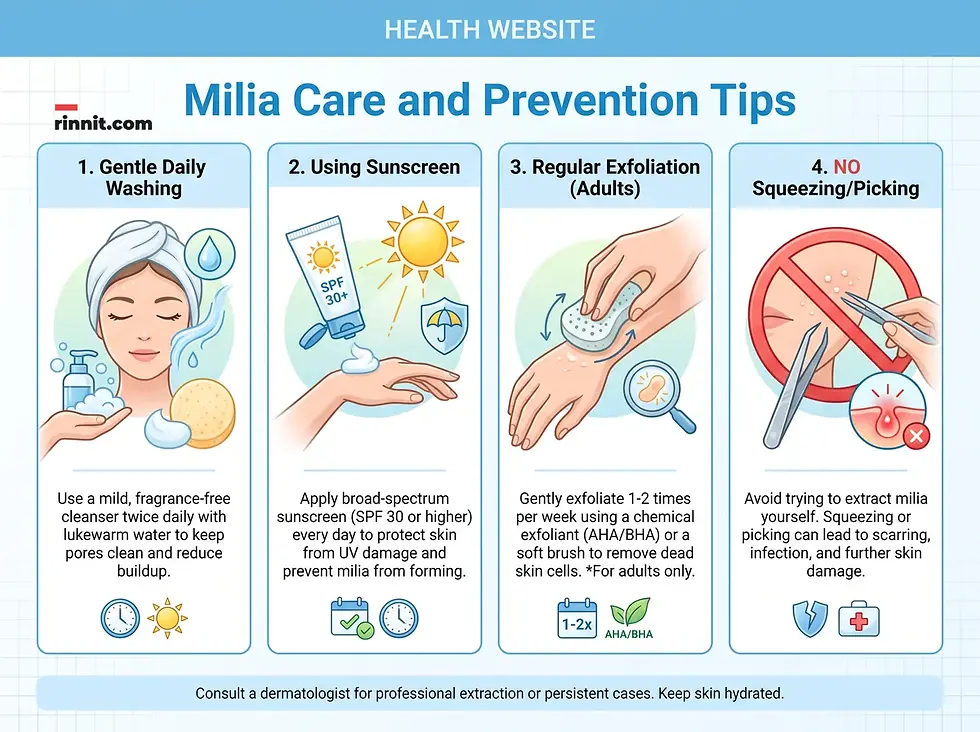
It is critical to avoid squeezing or picking at milia, as this can lead to permanent scarring or infection. Prevention strategies include using sunscreen, gentle daily cleansing, and regular exfoliation for adults.
Conclusion
Milia are a common and benign skin condition that affects a significant portion of the population, particularly newborns. [1] While their appearance may cause concern, they are harmless and typically resolve without treatment. [1] By practicing gentle skin care and avoiding the temptation to pick at the bumps, individuals can ensure their skin heals naturally and remains free of scars.
When should you see a dermatologist about milia?
If you or your child have skin bumps that do not clear up after several months, or if you are concerned about their appearance, consult a dermatologist. A professional evaluation can provide an accurate diagnosis and ensure safe, effective management for your skin health.
Sources: Cleveland Clinic — Milia | Rivers et al., 1990 | Moosavi & Hosseini, 2006 | Berk & Bayliss, 2008
Frequently Asked Questions
1. What are milk spots?
Milk spots is the common name for milia, which are small white cysts filled with trapped dead skin cells.
2. Are milia contagious?
No, milia are not contagious and cannot be spread from person to person.
3. How long do milia last in newborns?
In babies, milia typically clear up on their own within a few weeks after birth.
4. Can I pop a milium like a pimple?
No, you should never squeeze or scrape milia at home, as this can cause scarring or infection.
5. What is the difference between milia and baby acne?
Milia are present at birth and are white cysts; baby acne usually appears two weeks after birth as red bumps or pustules.
6. Where are milia most commonly found?
Milia are most frequently found on the face, specifically the nose, cheeks, and around the eyelids.
7. Can sun damage cause milia?
Yes, secondary or traumatic milia can form after skin damage from sunlight exposure.
8. Are milia painful?
No, milia are typically asymptomatic and do not cause any pain or physical discomfort.
9. What is milia en plaque?
Milia en plaque is a rare type where cysts clump together on a raised patch of skin, often affecting women.
10. Does exfoliating help with milia?
Yes, for adults, frequent exfoliation can help prevent dead skin cells from becoming trapped and forming cysts.
Related Reading
What Is Baby Acne? What It Looks Like, Causes, and Care Tips explains another common newborn skin bump and how it differs.
Epstein Pearls in Newborns: What They Are, Why They Appear and What to Do — What You Need to Know describes similar tiny white cysts that appear in a baby's mouth.
What are Keratin Plugs? explains small skin bumps caused by trapped keratin.
Sebaceous Cysts (Epidermal Inclusion Cysts): What They Are, When to Treat Them, and When to Leave Them Alone — A Complete Guide covers larger skin cysts and when they need removal.
References
Cleveland Clinic. Milia (Milk Spots). Cleveland Clinic. August 10, 2022. https://my.clevelandclinic.org/health/diseases/17868-milia
Rivers JK, Frederiksen PC, Dibdin C. A prevalence survey of dermatoses in the Australian neonate. J Am Acad Dermatol. 1990;23(1):77-81. PMID 2365880. https://doi.org/10.1016/0190-9622(90)70190-s
Moosavi Z, Hosseini T. One-year survey of cutaneous lesions in 1000 consecutive Iranian newborns. Pediatr Dermatol. 2006;23(1):61-63. PMID 16445415. https://doi.org/10.1111/j.1525-1470.2006.00172.x
Berk DR, Bayliss SJ. Milia: a review and classification. J Am Acad Dermatol. 2008;59(6):1050-1063. PMID 18819726. https://doi.org/10.1016/j.jaad.2008.07.034
Medical disclaimer
The information provided in this article is for educational purposes only and should not be used as a substitute for professional medical advice, diagnosis, or treatment. Always seek the advice of your physician or other qualified health provider with any questions you may have regarding a medical condition. Never disregard professional medical advice or delay in seeking it because of something you have read here.



Comments