Sebaceous Cysts (Epidermal Inclusion Cysts): What They Are, When to Treat Them, and When to Leave Them Alone — A Complete Guide

Updated: 2 days ago
Medically reviewed by Dr. Baraa Alnahhal, MD · Last reviewed: October 2026
An epidermal inclusion cyst — the lump most people call a "sebaceous cyst" — is a fluid-filled pocket under the skin filled with keratin and cell debris, not sebum [1]. It is the most common type of skin cyst and usually causes no symptoms [1]. It most often appears between ages 20 and 60 and is more common in men [1]. If it becomes inflamed, infected, or ruptured, it can cause pain, swelling, and drainage. Treatment ranges from watchful waiting and warm compresses to steroid injections, antibiotics, or surgical removal. Never pop or drain the cyst at home [1].
Quick Answer: What is a sebaceous cyst?
A sebaceous cyst, more accurately called an epidermal inclusion cyst, is a pocket under the skin filled with keratin and cell debris. It is the most common type of skin cyst and appears as a round, dome-shaped lump, often with a dark central dot. Most need no treatment, and infected cysts should be treated by a provider, never popped [1].
What the research says
Cancer arising inside a cyst is rare, but long-standing or recurring cysts deserve attention. In a case series of 9 patients with squamous cell carcinoma arising from epidermal cysts, the average age at diagnosis was 57.3 years and the average latency was 15.4 years. Five patients had previously had the cyst excised or drained, with an average of 2.3 recurrences, and four had immune dysregulation. All were treated with surgical excision and none had a recurrence during follow-up (Kim et al., Annals of Plastic Surgery, 2024 [2]).
Removing the cyst wall along with its contents keeps recurrence low. In a small series of 32 patients with 33 cysts (12 infected and 21 uninfected), a minimally invasive technique that removed both the contents and the cyst wall was followed by recurrence in 2 of 33 cysts (6.0%): none of the 21 uninfected cysts and 2 of the 12 infected cysts (16.7%). The series had no comparison group (Wang et al., Lasers in Surgery and Medicine, 2020 [3]).
What Is a Sebaceous Cyst?
An epidermal inclusion cyst (also called an epidermoid cyst) is a fluid-filled pocket under the surface of your skin. It looks and feels like a lump or bump [1].
Many people call these cysts "sebaceous cysts," but that name is misleading. The cyst is not filled with sebum. Sebum is an oily substance created by your sebaceous glands that keeps your skin moist. Instead, these cysts are filled with keratin (a protein) and cell debris [1].
Healthcare providers usually reserve the term "sebaceous cysts" for cysts linked to a skin condition called steatocystoma multiplex. Cysts from that condition genuinely fill with sebum, so they are true "sebaceous cysts." True sebaceous cysts are not common. Epidermal inclusion cysts are [1].
These cysts form under the top layer of your skin, called the epidermis.
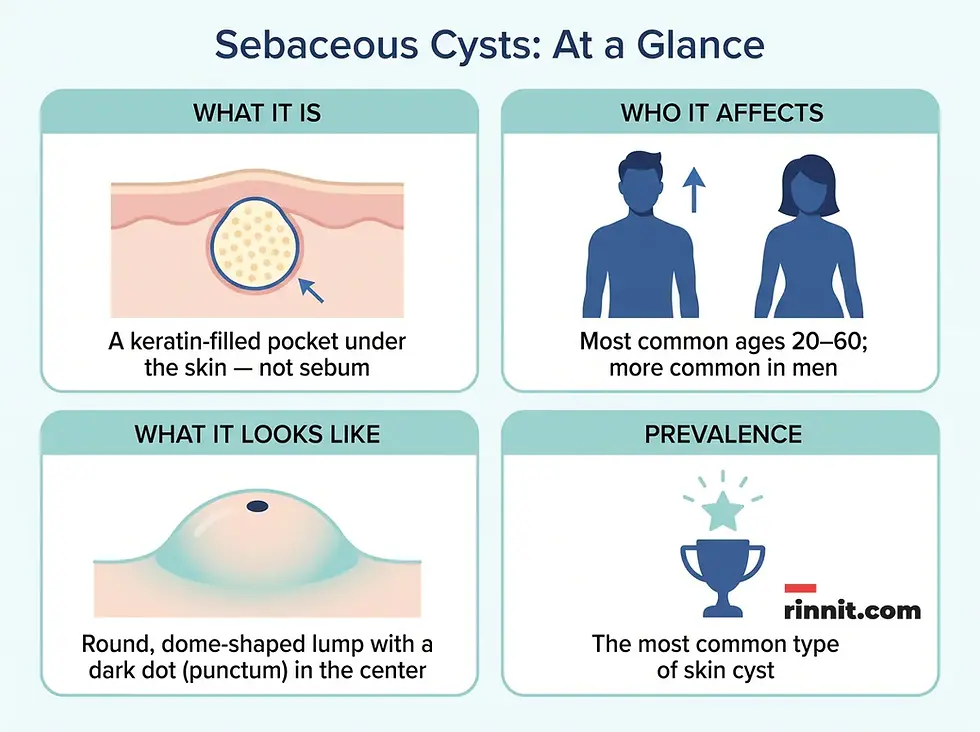
Epidermal inclusion cysts are the most common type of skin cyst [1].
Key Terms
Term | What it means |
Epidermal inclusion cyst (epidermoid cyst) | A fluid-filled pocket under the skin filled with keratin and cell debris |
Sebaceous cyst | A cyst filled with sebum; the term is often misused for epidermal inclusion cysts |
Sebum | An oily substance from sebaceous glands that keeps skin moist |
Keratin | A protein, plus cell debris, that actually fills epidermal inclusion cysts |
Epidermis | The top layer of your skin, where these cysts form |
Punctum | A dark dot in the center of the cyst |
What Does a Sebaceous Cyst Look Like?
An epidermal inclusion cyst may show the following features.
Feature | What you may notice |
Shape | A round bump or dome-shaped lump |
Center dot | A dark dot (punctum) in the center of the cyst |
Size | From .25 inches to greater than 2 inches; it can grow slowly |
Color | Skin discoloration, usually pink to red or darker than your natural skin tone |
Feel | Tenderness or warmth to the touch |
Movement | It can move easily |
What Fills the Cyst?
A keratin and cell debris substance fills epidermal inclusion cysts. When a dermatologist drains the cyst, this substance looks thick and yellow and has a foul odor [1].
Is It Painful?
An epidermal inclusion cyst is not usually painful. Sometimes the cyst can inflame (swell) and feel tender when you touch it. As the cyst grows, you may experience skin irritation and pain if it ruptures (breaks open). Occasionally you will experience itching at the site of the cyst [1].
See your healthcare provider if you develop pain on or near a cyst or have other concerning symptoms.

Where Do These Cysts Form?
Epidermal inclusion cysts can form anywhere on your body, but they are most common on these areas.
Body area | How common |
Face | Most common site |
Scalp | Most common site |
Back | Most common site |
Chest | Most common site |
Neck | Common site |
Legs | Common site |
Arms | Common site |
Genitalia | Common site |
Causes: What Causes a Sebaceous Cyst?
Epidermal inclusion cysts form after a blockage to a hair follicle — the opening in your skin where hair grows out — at the follicular infundibulum (the top part of the hair follicle) [1].
Your body naturally sheds skin cells when they reach the end of their life cycle. If you have a skin injury, such as a scratch or surgical wound, or a skin condition like acne or chronic sun damage, it can disrupt the path your skin cells take to leave your body. This traps those cells and other components like keratin, so they collect under the surface of your skin. This is how a cyst forms.
On areas of your body where you don't have hair follicles, a cyst can also form after an injury or trauma to your skin. The injury pushes your skin cells below the top layer of your skin into the second layer (the dermis). This creates a pocket where keratin collects and forms a cyst [1].
Risk Factors
Risk factor | Why it matters |
Age 20 to 60 | Cysts most frequently occur in this age range |
Rare before puberty | Cysts rarely appear before puberty |
Sex | More common in men than women |
Gardner syndrome (familial adenomatous polyposis) | Can lead to multiple cysts |
Gorlin syndrome (basal cell nevus syndrome) | Can lead to multiple cysts |
Favre-Racouchot syndrome | Can lead to multiple cysts |
Human papillomavirus (HPV) | Can lead to multiple cysts |
BRAF inhibitors (medication) | May increase your risk |
Imiquimod (medication) | May increase your risk |
Cyclosporine (medication) | May increase your risk |
Although cysts can appear at any age, they most frequently occur between ages 20 and 60. They rarely appear before puberty, and they are more common in men than women [1].
Some rare genetic conditions and other conditions can lead to the development of multiple epidermal inclusion cysts, including Gardner syndrome, Gorlin syndrome, Favre-Racouchot syndrome, and HPV. Certain medications — BRAF inhibitors, imiquimod, and cyclosporine — may also increase your risk [1].
Is It Contagious?
No, epidermal inclusion cysts are not contagious [1].
Complications: What Can Go Wrong?
Sebaceous cysts are rarely harmful, but rare cases of cancer, specifically squamous cell carcinoma and basal cell carcinoma, have been found forming within these cysts [1].
Complication | What happens |
Inflamed cyst | The cyst is swollen and tender |
Infected cyst | Your body fights harmful bacteria within the cyst, causing swelling, pain, and skin discoloration |
Ruptured cyst | The cyst breaks open, causing swelling, pain, skin discoloration, and yellow (often stinky) fluid drainage |
Is a Sebaceous Cyst a Sign of Cancer?
Epidermal inclusion cysts are rarely harmful. However, researchers have found rare cases where malignancy (cancer) formed within the cyst, specifically squamous cell carcinoma and basal cell carcinoma [1].
An epidermal inclusion cyst may be concerning if it has any of these characteristics.
Warning characteristic | Why it matters |
Signs of infection | Pain, skin discoloration, swelling, and/or drainage |
Fast rate of growth | Faster growth is more concerning than slow growth |
Larger than 5 centimeters | A diameter larger than 5 cm is a warning threshold |
Talk to your healthcare provider if you notice changes to your cyst.
Diagnosis: How Is It Diagnosed?
A healthcare provider can diagnose an epidermal inclusion cyst during a physical exam simply by looking at it and learning more about your symptoms, if you have any [1].
Although not usually necessary, testing can confirm a diagnosis. It may include the following.
Test | What it does |
Physical exam | Provider looks at the cyst and reviews your symptoms; usually enough for diagnosis |
Ultrasound | Helps determine the contents of the cyst |
CT scan | Confirms the diagnosis of a large cyst and helps your provider plan the best removal |
Biopsy | Provider removes a small amount of tissue from the cyst to examine it |
Should You See a Specialist?
If you notice changes to your skin, contact a healthcare provider. You might start with a primary care physician (PCP), who can refer you to a dermatologist. Only certain providers can remove epidermal inclusion cysts. Your provider may refer you to a specialist trained to remove cysts, such as a dermatologist, a general surgeon, or a plastic surgeon [1].

Treatment: How Is It Treated?
In many cases, a healthcare provider may recommend monitoring the cyst and not treating it if it doesn't cause symptoms [1].
If the cyst swells or causes discomfort, use a warm compress over the cyst to reduce symptoms at home. If your symptoms continue or get worse, contact a provider. They may recommend removing the cyst, or they may inject a steroid medication into it to temporarily reduce swelling [1].
Antibiotics can treat an infected epidermal inclusion cyst [1].
Cyst Removal Procedures
Procedure | What happens | Key point |
Incision and drainage | Provider makes a small opening over the cyst and releases the fluid collection | Won't resolve the cyst because the capsule (outer portion) isn't removed; helps with inflammation and swelling |
Surgical excision | A surgical procedure that removes the cyst under a local anesthetic | Removing the capsule prevents the cyst from growing back |
Don't try popping or draining the cyst yourself. This could cause an infection, and the cyst will likely grow back (recur) [1].
Are There Side Effects of Treatment?
Risks of surgical excision of a cyst are rare but may include infection, bleeding, scars, pain, and recurrence [1].
Outlook: What Can I Expect?
Once you have a diagnosis, you can wait and see if the cyst improves on its own or discuss treatment options with your healthcare provider.
Most cysts don't cause symptoms. But it can be challenging if your cyst forms on a very visible part of your body, like your face or scalp, or if it causes pain. Talk to a healthcare provider about cyst removal if the cyst bothers you [1].
Question | What to expect |
Does it go away? | Some cysts decrease in size, while others continue to grow until you get treatment |
Without treatment? | You may have the cyst for the rest of your life |
Can it get worse? | Cysts sometimes remain small and asymptomatic for several years, but can increase in size and become uncomfortable or irritated |
Is it dangerous? | Most are not dangerous; infection is possible and dangerous if left untreated; very rarely some turn into cancer |
Prevention: Can It Be Prevented?
Epidermal inclusion cysts typically form randomly. However, avoiding injury or trauma to your skin and treating skin conditions may be helpful to reduce your risk [1].
Prevention step | Why it helps |
Avoid skin injury and trauma | Injuries push skin cells below the top layer and create the pocket where cysts form |
Treat skin conditions | Conditions like acne and chronic sun damage can disrupt how skin cells leave the body |
What is living with a sebaceous cyst like, and when should you seek care?
Always see your healthcare provider if you find a lump on your skin. It might be an epidermal inclusion cyst, another type of cyst, or something else. Don't try to diagnose it yourself. See your healthcare provider for a clear diagnosis and specialized treatment [1].
Questions to Ask Your Provider
Question | Why it helps |
Do I have an epidermal inclusion cyst or another type of cyst? | Confirms the correct diagnosis |
Will this go away on its own, or will it need treatment? | Sets expectations |
Do you think the cyst will get bigger? | Helps you plan ahead |
What treatment options do you recommend? | Reviews your choices |
Do I need to see a specialist or a surgeon? | Gets you to the right provider |
What should I do if the cyst comes back after the procedure? | Prepares you for recurrence |
Conclusion
An epidermal inclusion cyst — the lump most people call a sebaceous cyst — is the most common type of skin cyst. It is a keratin-filled pocket under the skin, not a sebum-filled one. Most cause no symptoms, appear between ages 20 and 60, and can be safely monitored. If one becomes inflamed, infected, ruptured, or simply bothersome, effective treatments exist, from warm compresses and steroid injections to antibiotics and surgical excision. Removing the cyst capsule is the key to stopping it from growing back [1]. Never pop or drain a cyst at home — it risks infection and recurrence.
Next step: If you've found a new lump or bump on your skin, don't try to diagnose or treat it yourself. Contact a healthcare provider for a clear diagnosis. If you're in a mental health crisis, the 988 Suicide and Crisis Lifeline is available 24/7 by call or text at 988.
Frequently Asked Questions
What is a sebaceous cyst?
The lump people call a sebaceous cyst is usually an epidermal inclusion cyst — a fluid-filled pocket under the skin filled with keratin and cell debris, not sebum. It is the most common type of skin cyst, most often appearing between ages 20 and 60, and is usually symptom-free unless inflamed, infected, or ruptured.
Why is the name "sebaceous cyst" misleading?
The cyst is not filled with sebum, the oily substance that keeps skin moist. It is filled with keratin and cell debris. True sebaceous cysts only occur with a skin condition called steatocystoma multiplex and are uncommon.
What do sebaceous cysts look like?
Sebaceous cysts appear as a round, dome-shaped lump with a dark dot (punctum) in the center, ranging from .25 inches to over 2 inches. They may be pink to red or darker than your skin tone, feel tender or warm, and move easily. Drained fluid is thick, yellow, and foul-smelling.
Where do sebaceous cysts most often form?
Sebaceous cysts can form anywhere on the body but are most common on the face, scalp, back, chest, neck, legs, arms, and genitalia.
What causes sebaceous cysts?
A blockage at the top part of a hair follicle traps skin cells and keratin under the skin. Skin injuries like scratches or surgical wounds, and skin conditions like acne or chronic sun damage, can also trap cells and start a cyst.
Who is most at risk for sebaceous cysts?
Sebaceous cysts most frequently occur between ages 20 and 60, rarely before puberty, and are more common in men. Rare genetic conditions (Gardner syndrome, Gorlin syndrome, Favre-Racouchot syndrome, HPV) and medications like BRAF inhibitors, imiquimod, and cyclosporine can increase risk.
Are sebaceous cysts contagious?
No, epidermal inclusion cysts are not contagious.
Are sebaceous cysts dangerous?
Most are not dangerous and cause no symptoms. Infection is possible and dangerous if left untreated. Very rarely, malignancy such as squamous cell carcinoma or basal cell carcinoma can form within a cyst, so report any skin changes to your provider.
When should a sebaceous cyst be treated?
Treatment is considered when the cyst becomes inflamed, infected, ruptured, rapidly growing, larger than 5 centimeters, or simply bothersome. Options include monitoring, warm compresses, steroid injections, antibiotics, incision and drainage, or surgical excision.
Why should I never pop a sebaceous cyst at home?
Popping or draining the cyst yourself can cause infection, and the cyst will likely grow back. Only a provider removing the cyst capsule through surgical excision reliably prevents recurrence.
Will a sebaceous cyst go away on its own?
Some decrease in size, but others keep growing until treated. Without treatment, you may have the cyst for the rest of your life, though some remain small and symptom-free for years.
Related Articles
External Resources
Related Reading
Cyst Removal: Drainage vs. Surgery, What to Expect and Recovery explains how a cyst is drained or surgically removed, what to expect on the day and how recovery goes.
References
Cleveland Clinic. Epidermal Inclusion Cyst (Sometimes Called Sebaceous Cyst). Cleveland Clinic. Last updated November 15, 2023. https://my.clevelandclinic.org/health/diseases/14165-sebaceous-cysts
Kim JY, Min S, Park JK, et al. Squamous cell carcinoma arising from epidermal cyst: a case series of 9 patients with a literature review. Annals of Plastic Surgery. 2024;92(5):575-579. PMID 38669586. https://doi.org/10.1097/SAP.0000000000003880
Wang ZC, Zhao WY, Fang QQ, et al. CO2 laser punch-assisted minimally invasive surgery for sebaceous cysts. Lasers in Surgery and Medicine. 2020;52(8):743-746. PMID 31943261. https://doi.org/10.1002/lsm.23216
Medical disclaimer
The information provided in this article is for educational purposes only and should not be used as a substitute for professional medical advice, diagnosis, or treatment. Always seek the advice of your physician or other qualified health provider with any questions you may have regarding a medical condition.



Comments