Dermabrasion: Uses, Procedure, Recovery, Risks and Results

Updated: 6 days ago
Written and medically reviewed by Dr. Baraa Alnahhal, MD · Last reviewed: October 2026 · How we review
Quick Answer: What is dermabrasion?
Dermabrasion is an outpatient skin-resurfacing procedure in which a dermatologist or plastic surgeon uses a high-speed rotary tool to sand away the top layers of skin, revealing smoother new skin. It treats acne and surgical scars, fine lines, sun damage and precancerous patches. Healing takes about 10 to 14 days, and darker skin carries a higher discoloration risk. [1]
What the research says
Dermabrasion works in fewer sessions than microneedling, but with more redness. In a randomized study of 20 people with facial scars, dermabrasion needed about 1.2 sessions versus 3.2 for microneedling. Marked scar reduction was seen in 53% of the dermabrasion group and 73% of the microneedling group, and dermabrasion caused more skin redness. (Thomas et al., J Maxillofac Oral Surg, 2026)
Timing around isotretinoin matters. A systematic review and expert consensus covering 32 publications and 1,485 procedures found too little evidence to delay manual dermabrasion for people on or recently off isotretinoin, but advised against mechanical dermabrasion while a person is taking the drug. (Spring et al., JAMA Dermatol, 2017)
High-quality evidence on dermabrasion is limited. A 10-year systematic review of acne-scar treatments found 36 relevant studies, and only 1 of them looked at dermabrasion. (Kravvas et al., Scars Burn Heal, 2017)
Key takeaways
Dermabrasion removes the top layers of skin with a rotating diamond wheel or wire brush so smoother skin can grow back. [1]
It is done by a dermatologist or plastic surgeon, usually under local numbing, and you go home the same day. [1]
It gives the best results on fair skin; darker skin tones have a higher risk of permanent discoloration or scarring. [1]
Skin usually heals in 10 to 14 days, but the pink color takes about three months to fade, and full results can take months. [1]
Strict sun protection before and after treatment is essential to avoid uneven skin color. [1]
Dermabrasion at a glance
Question | Short answer |
Who performs it? | A trained dermatologist or plastic surgeon [1] |
Where is it done? | Office, surgery center or hospital; outpatient (no overnight stay in most cases) [1] |
Anesthesia | Numbing spray, topical gel or local injection; general anesthesia only sometimes [1] |
How long it takes | A few minutes to more than 90 minutes, depending on the area treated [1] |
Healing time | About 10 to 14 days [1] |
Back to normal activities | Most people in 7 to 14 days [1] |
Time off work | At least two weeks is often advised [1] |
A "good" result | About a 50% improvement in the skin's condition [1] |
What is dermabrasion and how does it work?
Dermabrasion is a procedure that "sands" the skin with a specialized instrument to scrape away its top layers and improve the skin's contour. [1] It is also called surgical skin planing.
The name explains the idea: "derm" means skin, and "abrasion" means scraping something away. [1]
Once the old surface is removed, new skin grows in its place. This new skin is smoother and more even than what was there before. [1]
Dermabrasion also stimulates collagen, the protein that keeps skin firm. In a small tissue study, it produced more new collagen than a trichloroacetic acid peel. [5]

Dermabrasion removes the outer skin layers so smoother skin can form during healing.
What skin problems can dermabrasion treat?
Dermabrasion can improve scars, fine lines, sun damage, dark patches and some skin growths. [1] It was first developed to soften acne scars and pox marks. Today it is also used for wrinkles, sun damage and tattoo removal. [1]
Dermabrasion can improve | Dermabrasion can't improve |
Scars from acne, accidents or surgery | Birthmarks |
Fine lines, crow's feet and wrinkles | Burns and burn scars |
Sun damage and age (liver) spots | Moles |
Melasma and other dark patches | |
Pox marks and tattoos | |
Red, thickened nose skin (rhinophyma) | |
Benign (noncancerous) skin growths and precancerous patches | |
Source: [1]
If you're weighing several ways to soften a scar, our guide to scar revision explains the wider set of options.
Who is a good candidate for dermabrasion?
A good candidate for dermabrasion has fair skin, no active skin infection or ongoing acne, and realistic expectations about healing. [1]
People of all ages, including children, can have dermabrasion. Older adults may heal more slowly than expected. [1]
Skin tone matters most. People with darker complexions, including many Asian and Black patients, face a higher risk of permanent discoloration, so another resurfacing method may give better results. [1]
You also need to be ready for how your skin will look while it heals. It will be very pink and raw, may ooze, and needs careful daily care. [1]
Who should avoid dermabrasion?
Dermabrasion is not ideal for people with certain skin conditions, recent procedures or medicines that slow healing or raise the risk of infection. [1]
Condition or factor | Why it's a concern |
Ongoing (active) acne | Higher risk of infection [1] |
Higher risk of infection [1] | |
Herpes simplex, cold sores or fever blisters | Can flare and complicate healing with infection and scarring [1] |
Allergic rashes or skin reactions | Risk of a flare-up [1] |
Blood, immune or skin disorders | Can slow healing [1] |
Keloid-forming skin (raised scars) | Higher risk of scarring [1] |
Dark skin tone | Higher chance of permanent discoloration or scarring [1] |
Recent facelift or browlift | Not ideal timing [1] |
Past bad burn, chemical peel or radiation treatment | Higher risk of infection [1] |
Isotretinoin or skin-thinning medicines in recent months | Can affect healing; timing should be discussed with your doctor [1][3] |
Blood thinners | Higher bleeding risk [1] |
Cold-sensitive skin | Not ideal for the procedure [1] |
One more thing to know: freckles in the treated area may disappear after dermabrasion. [1]
How should you prepare for dermabrasion?
Preparation for dermabrasion starts with a consultation and includes avoiding sun, certain medicines and smoking beforehand. [1]
At the consultation, your surgeon will explain the type of anesthesia, the steps of the procedure and realistic results. They will also take photos before and after treatment to track your progress. [1]
Be ready to share: [1]
Your medical conditions and past treatments, including surgeries
Drug allergies
Current medicines, vitamins and supplements
Tobacco, alcohol and drug use
Before the procedure, your provider may ask you to:
Stay out of the sun. Recent sun exposure can cause permanent discoloration after dermabrasion. [1]
Pause certain medicines. This includes blood thinners and drugs that can darken the skin (hyperpigmentation). Ask how long to stop each one. [1]
Stop smoking for at least two weeks. Smoking reduces blood flow and slows healing. [1]
Plan your ride home. You won't be able to drive yourself after the procedure. [1]
What happens during a dermabrasion procedure?
During dermabrasion, the provider numbs the skin and then uses a high-speed rotary instrument to scrape away its outer layers. [1]
Cleaning. The skin is cleansed with an antiseptic.
Numbing. You receive a numbing spray, a topical anesthetic gel, a local anesthetic injection or a combination. You stay awake, though general anesthesia is sometimes used, for example when dermabrasion is combined with a facelift.
Sanding. The provider uses a rotary tool fitted with an abrasive diamond wheel or wire brush to remove the outer skin layers.
Dressing. A moist dressing is applied to protect the skin while it heals. [1]
The procedure can take a few minutes or more than 90 minutes, depending on how much skin is treated. [1] In rare cases with extensive work, you may be admitted to the hospital for monitoring. [1]
Is dermabrasion painful?
Dermabrasion itself is not painful because the skin is numbed with local anesthesia or a freezing spray. [1]
Afterward, the treated skin can feel like a bad sunburn for a few days. If stinging is severe, your provider may prescribe pain medicine. [1]
What is dermabrasion recovery like?
Dermabrasion recovery usually takes 10 to 14 days for the skin to heal, with about three months for the new skin to reach a normal color. [1]
Before you leave, you'll get dressing instructions and a follow-up date. Your provider will usually prescribe an antiviral and an antibiotic to prevent infection, and may suggest a vitamin A (retinoid) ointment to support skin renewal. [1] Learn more about how this vitamin A family works in our guide to retinol.

A typical dermabrasion healing timeline. Your provider's instructions always come first.
Time after treatment | What to expect |
First 48 hours | No alcohol [1] |
First few days | Sunburn-like feeling; follow-up visit to check the skin and replace the dressing [1] |
First week | Avoid aspirin and ibuprofen [1] |
Days 7 to 14 | Skin heals; most people return to normal activities; makeup can be used once skin has healed [1] |
First month | Avoid swimming in chlorinated pools [1] |
Weeks 4 to 6 | Avoid vigorous sports [1] |
About 3 months | Pink, tender new skin gradually returns to a normal color [1] |
3 to 6 months | Stay out of direct sunlight; wear SPF 30 sunscreen every day [1] |
Daily aftercare checklist
Clean the skin several times a day to remove crusting and prevent infection. [1]
Keep the area moist by reapplying a healing petroleum-jelly dressing as directed. Letting a crust form can delay healing and worsen the result. [1]
Take all prescribed antiviral or antibiotic medicines. [1]
Don't smoke, because it reduces blood flow and delays healing. [1]
Go to every follow-up visit so your provider can check for infection. [1]
Keep using sunscreen every day even after you heal. [1]
What are the risks and side effects of dermabrasion?
Side effects of dermabrasion are uncommon, but the most common complications are acne flare-ups, color changes, scarring, swelling and infection. [1]
Side effect | What to know |
Acne flare-ups and milia | Tiny white spots (milia) can appear, especially with acne rosacea, and fade as skin heals [1] |
Uneven skin color | Can be temporary or permanent [1] |
Darker skin patches | Usually linked to sun exposure in the days and months after treatment; can be temporary or permanent [1] |
Enlarged pores | Usually temporary [1] |
Scarring | Higher risk with keloid-prone or darker skin [1] |
Swelling | One of the most commonly listed complications [1] |
Infection | Lowered by cleansing, dressing care and prescribed medicines [1] |
Research also suggests dermabrasion causes more redness than microneedling, even though it needs fewer sessions. [2]
How does dermabrasion compare with microdermabrasion and other skin resurfacing options?
Dermabrasion is a deeper treatment than microdermabrasion and suits deeper problems such as scars and wrinkles, while microdermabrasion is a lighter option with almost no downtime. [1]
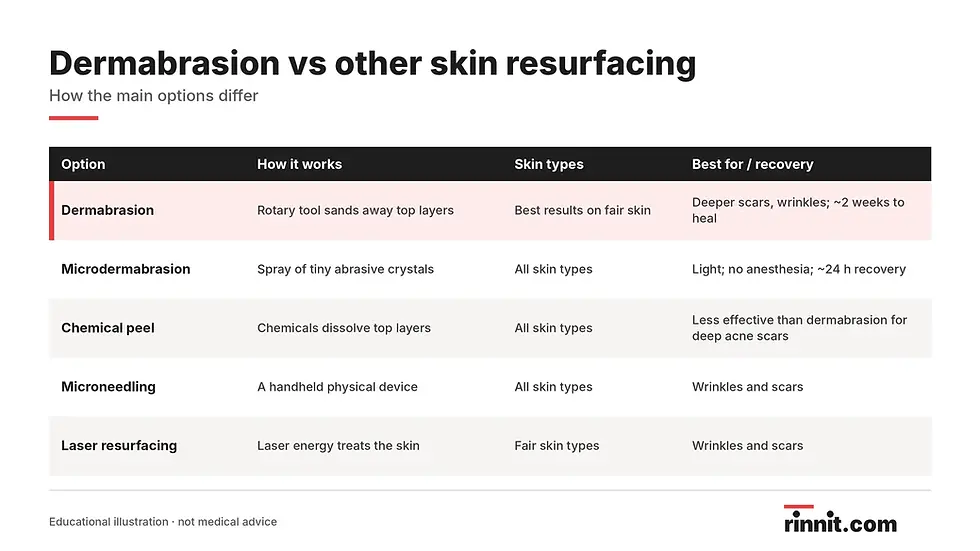
How dermabrasion compares with other common skin resurfacing treatments.
Treatment | How it works | Skin types | Notes |
Dermabrasion | Rotary tool sands away top layers | Best on fair skin | Treats deeper scars and wrinkles; about 2 weeks to heal |
Microdermabrasion | Spray of tiny abrasive crystals | All skin types | Lighter; not for deep scars, wrinkles or stretch marks; no anesthesia; skin recovers in about 24 hours |
Chemical peel | Chemicals dissolve top layers | All skin types | Less effective than dermabrasion for deeper acne scars |
Microneedling | A physical device | All skin types | Reduces wrinkles or scars |
A laser | Fair skin types | Reduces wrinkles or scars |
Source: [1]
What are the benefits of dermabrasion over a chemical peel?
Dermabrasion offers three main benefits over a chemical peel: stronger collagen stimulation, lower discoloration risk in medium skin tones and better results for deep acne scars. [1]
More collagen. Dermabrasion boosts collagen production more than a chemical peel. [1][5]
Better for medium skin tones. Dermatologists report less discoloration risk in medium skin tones with dermabrasion than with chemical peels. [1]
Deeper scar reduction. Dermabrasion is more effective at reducing deep acne scars. [1]
Are dermabrasion results permanent?
Dermabrasion permanently removes tattoos, and its smoothing effects build gradually over several months. [1]
Expect a gradual reveal rather than an instant change. It can take several weeks, or even months, to see the full result. [1] Daily sunscreen helps protect the new skin and the evenness of its color. [1]
When should you contact a healthcare provider about dermabrasion?
You should contact a dermatologist as soon as you notice skin concerns such as wrinkles, sun damage, melasma or scars that you'd like treated. [1]
After dermabrasion, call your provider if you notice signs of infection or severe stinging, and keep every follow-up appointment so healing can be checked. [1]
Conclusion
Dermabrasion is an established way to resurface the skin and soften scars, fine lines, sun damage and dark patches. It works best on fair skin, needs about two weeks of careful healing, and depends heavily on strict sun protection for an even result. [1]
The right choice depends on your skin type, medical history and goals. A dermatologist or plastic surgeon can tell you whether dermabrasion or a gentler option, such as microdermabrasion or microneedling, fits you best.
Thinking about smoother skin? Bring this guide to your consultation, and explore our related guides on acne scars, melasma and laser skin resurfacing to compare your options with confidence. For a deeper look at the procedure, see the patient pages on dermabrasion from plastic surgeons and dermatologic surgeons.
FAQ
What is dermabrasion used for?
Dermabrasion is used to smooth acne, surgical and accident scars, fine lines, wrinkles, sun damage, melasma and precancerous patches. It can also remove tattoos and treat thickened nose skin (rhinophyma). [1]
How long does it take to recover from dermabrasion?
Skin usually heals in 10 to 14 days, and most people return to normal activities within 7 to 14 days. The new pink skin takes about three months to return to a normal color. [1]
Is dermabrasion safe for dark skin?
Dermabrasion carries a higher risk of permanent discoloration or scarring in darker skin tones. People with darker complexions may get better results from other resurfacing treatments, such as chemical peels or microneedling, which suit all skin types. [1]
What is the difference between dermabrasion and microdermabrasion?
Dermabrasion uses a rotary tool to remove deeper skin layers and needs about two weeks to heal. Microdermabrasion uses a spray of fine crystals, needs no anesthesia and lets skin recover in about 24 hours, but it won't treat deep scars or wrinkles. [1]
Does dermabrasion hurt?
Dermabrasion doesn't hurt during the procedure because the skin is numbed. Afterward, it can feel like a bad sunburn for a few days, and your provider may prescribe pain medicine if stinging is severe. [1]
Can I do dermabrasion at home?
No, dermabrasion should only be performed by a trained dermatologist or plastic surgeon. It is a surgical procedure that removes layers of skin and needs professional care and follow-up. [1]
How long should I avoid the sun after dermabrasion?
You should stay out of direct sunlight for three to six months after dermabrasion and wear SPF 30 sunscreen every day. Sun exposure during healing can cause uneven or darker skin color. [1]
Can I have dermabrasion if I've taken isotretinoin?
Isotretinoin taken in recent months can make dermabrasion less suitable. Research advises against mechanical dermabrasion while you are on isotretinoin, so discuss timing with your dermatologist. [1][3]
How many dermabrasion treatments will I need?
Many people need only one treatment, but deeper scars or large areas may need more than one. Your provider will tell you what to expect for your skin.
How do I care for my skin after dermabrasion?
Follow your provider's dressing instructions, clean the area gently and keep it moist with the ointment they recommend. Do not pick at scabs, and call your provider if you notice signs of infection.
Related Reading
Microdermabrasion: Benefits, Side Effects, Results and Recovery explains a gentler, no-downtime skin resurfacing treatment.
Chemical Peels: Types, Recovery, Risks and What to Expect describes how chemical peels improve skin tone and texture.
Acne Scars: Types, Causes, Diagnosis, and Treatment (2026 Guide) covers acne scar types and the treatments that help.
CO2 Laser Resurfacing: What It Treats, How Recovery Works, and the Risks to Know explains laser skin resurfacing for wrinkles and scars.
References
Cleveland Clinic. Dermabrasion: What Is It, Side Effects, Procedure & Benefits. Cleveland Clinic. Last updated September 15, 2020. https://my.clevelandclinic.org/health/treatments/8309-dermabrasion
Thomas NP, Lakshmi S, Bharani KSNS, et al. Comparative evaluation of the effectiveness of dermabrasion and micro-needling therapy in the management of facial scars—a clinical study. J Maxillofac Oral Surg. 2026;25(2):624-633. PMID 41971506. https://doi.org/10.1007/s12663-025-02783-y
Spring LK, Krakowski AC, Alam M, et al. Isotretinoin and timing of procedural interventions: a systematic review with consensus recommendations. JAMA Dermatol. 2017;153(8):802-809. PMID 28658462. https://doi.org/10.1001/jamadermatol.2017.2077
Kravvas G, Al-Niaimi F. A systematic review of treatments for acne scarring. Part 1: Non-energy-based techniques. Scars Burn Heal. 2017;3:2059513117695312. PMID 29799567. https://doi.org/10.1177/2059513117695312
El-Domyati MB, Attia SK, Saleh FY, et al. Trichloroacetic acid peeling versus dermabrasion: a histometric, immunohistochemical, and ultrastructural comparison. Dermatol Surg. 2004;30(2 Pt 1):179-188. PMID 14756647. https://doi.org/10.1111/j.1524-4725.2004.30061.x
Medical disclaimer
This article is for general education only and is not medical advice, diagnosis or treatment. Dermabrasion is a surgical procedure with real risks. Always consult a qualified dermatologist or plastic surgeon about your own skin, medical history and treatment options before making any decision.



Comments