Stretch Marks: Symptoms, Causes, Diagnosis, and Treatment Explained

Updated: 2 days ago
Medically reviewed by Dr. Baraa Alnahhal, MD · Last reviewed: October 2026
When to see a doctor: Stretch marks that cover large areas of your body are rare and can signal corticosteroid use or a condition such as Cushing syndrome. See a health care provider to find the cause.
Quick Answer: What are stretch marks?
Stretch marks are indented streaks caused by skin stretching, common in pregnancy, adolescence, rapid weight change and corticosteroid use. They are harmless, painless and don't require treatment. Retinoid creams, light and laser therapy and microneedling may improve their appearance. See a doctor if marks cover large areas, which can signal steroid use or an underlying condition.
What the research says
Creams have not been shown to prevent stretch marks in pregnancy. A Cochrane review of 6 trials involving 800 women found no statistically significant difference in the development of stretch marks between topical preparations with active ingredients and placebo or no treatment (risk ratio 0.74; 95% CI 0.53 to 1.03; 5 trials, 474 women). The authors found no high-quality evidence to support any topical preparation for prevention (Brennan et al., Cochrane Database Syst Rev, 2012) [3].
No treatment is completely effective, and the evidence is limited. A systematic review identified 92 articles (74 eligible for quality assessment). Most treatments aim to increase collagen production, and vascular lasers can reduce redness in newer marks. No treatment proved completely effective, and the studies were limited by low-quality evidence and small sample sizes (Hague and Bayat, J Am Acad Dermatol, 2017) [4].
Energy-based devices are safe and potentially effective, but results vary. A review of 41 articles on devices such as radiofrequency and lasers found that, for older pale marks, the best results came from a combination of radiofrequency, platelet-rich plasma, and ultrasound (excellent or very good results in 71.9%). No treatment offered consistent, complete resolution (Kravvas et al., J Dermatolog Treat, 2019) [5].
What Are Stretch Marks?
Stretch marks (striae) are indented streaks that appear on the abdomen, breasts, hips, buttocks, or other places on the body. They're common in pregnant women, especially during the last trimester. [1]
Stretch marks aren't painful or harmful, but some people don't like the way they make their skin look.
Some people are prone to develop stretch marks on the upper arms, abdomen, buttocks, and thighs. [1] New stretch marks are bright pink, red, blue, black, or purple. Older stretch marks fade. [1]
Stretch marks don't require treatment. They often fade over time, with or without treatment, and they may never disappear completely. [1]
Do Stretch Marks Look Different From Person to Person?
Stretch marks don't all look alike. They vary depending on how long you've had them, what caused them, where they are on your body, and the type of skin you have. Common variations include:
Variation | Description |
|---|---|
Indented streaks or lines | On the abdomen, breasts, hips, buttocks, or other places on the body |
Colored streaks | Pink, red, discolored, black, blue, or purple streaks |
Fading streaks | Bright streaks that fade to a lighter color |
Widespread streaks | Streaks covering large areas of the body; rare, and can result from corticosteroid medicine use or a disease such as Cushing syndrome [1] |
Stretch marks are common in pregnancy, especially during the last trimester. They often fade but don't usually disappear. [1]

What Causes Stretch Marks?
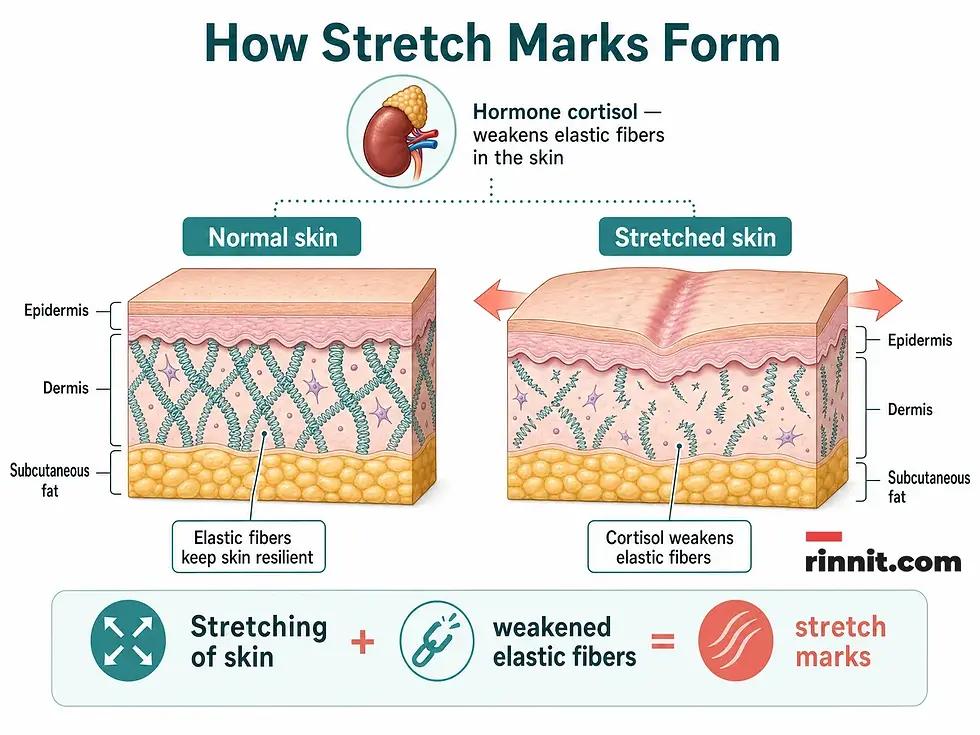
The cause of stretch marks is stretching of the skin. Their severity is affected by several factors, including your genetics and the degree of stress on the skin. [1]
Your level of the hormone cortisol also might play a role. Cortisol is a hormone produced by the adrenal glands, and it weakens elastic fibers in the skin. [1]
Who Is Most Likely to Get Stretch Marks?
Anyone can develop stretch marks, but some factors increase your likelihood of getting them:
Risk Factor | Details |
|---|---|
Being female | Women are more likely to develop stretch marks |
Personal or family history | Having stretch marks yourself or in your family raises the odds |
Pregnancy | Especially if you're young |
Rapid growth in adolescence | Growth spurts stretch the skin quickly |
Rapidly gaining or losing weight | Fast size changes stress the skin |
Using corticosteroids | Corticosteroid medicines are a risk factor |
Breast enlargement surgery | Having had the procedure raises the risk |
Exercising with anabolic steroids | Exercising while using anabolic steroids raises the risk [1] |
Genetic disorders | Such as Marfan syndrome or Ehlers-Danlos syndrome; hormone conditions such as Cushing syndrome also raise the risk [1] |
When Should You See a Doctor About Stretch Marks?
See your health care provider if you're concerned about the appearance of your skin or if the stretch marks cover large areas of your body. [1] Your health care provider can help determine the cause of the stretch marks and discuss treatment options.
Widespread stretch marks covering large areas are rare and can result from corticosteroid medicine use or a disease such as Cushing syndrome. That is the scenario where a doctor visit matters most.
How Are Stretch Marks Diagnosed?
Stretch marks don't usually need to be diagnosed. Your health care provider might examine your skin and review your medical history. If your health care provider suspects an increase in your level of the hormone cortisol, you might be offered more tests. [2]
Do Stretch Marks Need Treatment?
Stretch marks don't require treatment. They are harmless and often fade over time. Treatment can make them fade, but they may never completely disappear.
The following treatments are among those available to help improve the appearance and texture of stretch marks. None has been proved to be more consistently successful than the others. [2]
Treatment | How It Works | Key Considerations |
|---|---|---|
Retinoid cream | Derived from vitamin A. Tretinoin applied to the skin may improve stretch marks less than a few months old. When it works, it helps rebuild collagen, a protein in the skin, making the marks look more like normal skin. [2] | Can irritate the skin. If you're pregnant or nursing, discuss other options, because possible side effects may affect the baby. [2] |
Light and laser therapies | Various therapies might stimulate collagen growth or promote elasticity. [2] Your provider can help pick the right technique. | Some techniques require repeated clinic visits. |
Microneedling | A hand-held device with tiny needles stimulates collagen growth. | Less risk of skin color changes than laser therapy, so it is the preferred first approach for people with darker skin. [2] |

How do you choose a treatment?
Work with your health care provider to choose the right treatment or combination of treatments. Factors to consider include:
How long you've had the stretch marks
Your skin type
Convenience, because some therapies require repeated visits to the clinic
Cost, because cosmetic therapies often aren't covered by medical insurance [2]
What you expect your skin to look like after treatment
Do Over-the-Counter Creams and Lotions Work?
Many creams, ointments, and other products claim to prevent or treat stretch marks. These include products made of cocoa butter, vitamin E, and glycolic acid. They aren't harmful, but they probably won't help much either. [2]
Stretch marks usually fade over time and don't need self-care or home therapy.
The idea that you can prevent or treat stretch marks by rubbing creams, oils, or lotions on your skin is not supported by strong evidence. [2] [3] If you're pregnant, check with your health care provider before using alternative products that claim to treat or prevent stretch marks.
How Should You Prepare for the Appointment?
If you seek treatment for stretch marks, prepare for your appointment by listing some basic questions to ask your health care provider:
What is likely causing my stretch marks?
Other than the most likely cause, what are other possible causes for my symptoms?
What are my treatment options and the pros and cons for each?
What results can I expect?
Your health care provider is likely to ask you several questions, such as:
When did you first notice the stretch marks?
Do you have other symptoms?
What medicines are you taking?
Do you regularly use cortisone skin creams?
Conclusion and Next Steps
Stretch marks are one of the most common skin experiences there is, and one of the most misunderstood. They are not a disease, not painful, and not harmful. They are the visible record of skin stretching through pregnancy, growth spurts, weight changes, surgery, or medication effects, with genetics and cortisol influencing how severe they become. The most useful fact is that they usually fade over time, with or without treatment, though they may never disappear completely.
That also frames the treatment decision honestly. Over-the-counter creams and lotions such as cocoa butter, vitamin E, and glycolic acid are safe but unlikely to do much, and the evidence behind them is weak. If appearance genuinely matters to you, the options to discuss are retinoid cream (for marks less than a few months old, and not during pregnancy or nursing), light and laser therapies, and microneedling, which is the preferred first approach for darker skin because of its lower risk of color changes. None has been proved consistently better than the others, so the choice is personal: skin type, age of the marks, clinic visits, cost, and your expectations.
When to seek help: If your stretch marks worry you, or if they cover large areas of your body, which can point to corticosteroid use or an underlying condition such as Cushing syndrome, see your health care provider to discuss the cause and your options. If you're pregnant, run any stretch mark product past your provider first, even the ones that claim to prevent them.
Frequently Asked Questions
What are stretch marks?
Stretch marks (striae) are indented streaks that appear on the abdomen, breasts, hips, buttocks, or other places on the body. They are common in pregnant women, especially during the last trimester. They aren't painful or harmful, but some people don't like how they make their skin look.
What causes stretch marks?
The cause is stretching of the skin. Severity is affected by several factors, including genetics and the degree of stress on the skin. The hormone cortisol also might play a role: it's produced by the adrenal glands and weakens elastic fibers in the skin.
Do stretch marks go away completely?
They often fade over time, with or without treatment, but they may never disappear completely.
What do new stretch marks look like?
New stretch marks are bright pink, red, blue, black, or purple. Older stretch marks fade. They vary depending on how long you've had them, what caused them, where they are on your body, and your skin type.
Why do stretch marks appear in pregnancy?
Stretch marks are common in pregnancy, especially during the last trimester, as the skin stretches. They often fade but don't usually disappear.
Do stretch marks hurt?
No. Stretch marks aren't painful or harmful.
Who is most likely to get stretch marks?
Anyone can develop them, but risk is higher if you're female; have a personal or family history; are pregnant (especially if young); have rapid growth in adolescence; rapidly gain or lose weight; use corticosteroids; have had breast enlargement surgery; exercise while using anabolic steroids; or have a genetic disorder such as Marfan syndrome or a hormone condition such as Cushing syndrome.
Do cocoa butter, vitamin E, or other creams prevent stretch marks?
Many creams, ointments, and products, including those made of cocoa butter, vitamin E, and glycolic acid, claim to prevent or treat stretch marks. They aren't harmful, but they probably won't help much. The idea that rubbing creams, oils, or lotions on your skin prevents or treats stretch marks is not supported by strong evidence.
Do stretch marks need treatment?
No. They are harmless and often fade over time. Treatment can make them fade, but marks may never completely disappear.
What treatments can improve stretch marks?
Retinoid cream (tretinoin) may improve marks less than a few months old by helping rebuild collagen, though it can irritate skin and shouldn't be used in pregnancy or nursing without discussing other options. Light and laser therapies might stimulate collagen growth or promote elasticity. Microneedling uses a hand-held device with tiny needles to stimulate collagen and carries less risk of skin color changes than laser therapy. None has been proved consistently more successful than the others.
Is retinoid cream safe during pregnancy?
If you're pregnant or nursing, talk with your health care provider about other treatment options, because possible side effects of retinoid cream may affect the baby.
Why is microneedling preferred for darker skin?
Microneedling has less risk of skin color changes than laser therapy, so it is the preferred first approach for people with darker skin.
How do I choose a stretch mark treatment?
Work with your provider, considering how long you've had the marks, your skin type, convenience (some therapies need repeated clinic visits), cost (cosmetic therapies often aren't covered by insurance), and what you expect your skin to look like afterward.
Are stretch mark treatments covered by insurance?
Treatments that improve how the skin looks (cosmetic therapies) often aren't covered by medical insurance.
Do retinoid creams work on old stretch marks?
Retinoid creams may improve the appearance of stretch marks less than a few months old, so their benefit is tied to newer marks.
Can medicines cause stretch marks?
Using corticosteroids is a risk factor. Widespread stretch marks covering large areas are rare and can result from corticosteroid medicine use or a disease such as Cushing syndrome.
When should I see a doctor about stretch marks?
See your health care provider if you're concerned about the appearance of your skin or if the stretch marks cover large areas of your body. Widespread marks can signal corticosteroid use or an underlying condition, and your provider can help determine the cause and discuss treatment options.
Does my doctor need to run tests for stretch marks?
Stretch marks don't usually need to be diagnosed. A skin exam and medical history review are typical, but if your provider suspects an increased level of the hormone cortisol, you might be offered more tests.
Can a genetic condition cause stretch marks?
Yes. Having a genetic disorder such as Marfan syndrome increases the likelihood of developing stretch marks; the hormone condition Cushing syndrome does too.
Should I try to prevent stretch marks during pregnancy?
There's no strong evidence that creams, oils, or lotions prevent stretch marks. If you're pregnant, check with your health care provider before using alternative products that claim to treat or prevent them.
Related Reading
Cushing Syndrome: What High Cortisol Does to Your Body and How It Is Treated explains high cortisol, a cause of wide purple stretch marks.
Understanding Retinol: Benefits, Side Effects, and Best Practices explains retinoid skin care, its benefits and safe use.
Microneedling: What It Treats, How It Works, Recovery and Results explains a collagen-boosting treatment used for scars and stretch marks.
CO2 Laser Resurfacing: What It Treats, How Recovery Works, and the Risks to Know explains a laser treatment for scars and skin texture and its recovery.
References
Mayo Clinic Staff. Stretch marks: symptoms and causes. Mayo Clinic. January 12, 2023. https://www.mayoclinic.org/diseases-conditions/stretch-marks/symptoms-causes/syc-20351139
Mayo Clinic Staff. Stretch marks: diagnosis and treatment. Mayo Clinic. January 12, 2023. https://www.mayoclinic.org/diseases-conditions/stretch-marks/diagnosis-treatment/drc-20351144
Brennan M, Young G, Devane D. Topical preparations for preventing stretch marks in pregnancy. Cochrane Database Syst Rev. 2012;11(11):CD000066. PMID 23152199. https://doi.org/10.1002/14651858.CD000066.pub2
Hague A, Bayat A. Therapeutic targets in the management of striae distensae: a systematic review. J Am Acad Dermatol. 2017;77(3):559–568.e18. PMID 28551068. https://doi.org/10.1016/j.jaad.2017.02.048
Kravvas G, Veitch D, Al-Niaimi F. The use of energy devices in the treatment of striae: a systematic literature review. J Dermatolog Treat. 2019;30(3):294–302. PMID 30049244. https://doi.org/10.1080/09546634.2018.1506078
Medical Disclaimer
This article is for informational purposes only and does not constitute medical advice. Always consult a qualified healthcare professional for diagnosis and treatment decisions.



Comments