Ileostomy: Types, Surgery, Recovery, Stoma Care and Reversal

Updated: 2 days ago
Written and medically reviewed by Dr. Baraa Alnahhal, MD · Last reviewed: November 2026 · How we review
Quick Answer: What is an ileostomy?
An ileostomy is surgery that disconnects the end of the small intestine (the ileum) and connects it to a new opening in the abdomen called a stoma. Stool then leaves the body through the stoma and collects in an ileostomy bag. Recovery takes six to eight weeks, and a temporary ileostomy may be reversed three to 12 months later.
What the research says
Early closure of a temporary ileostomy has trade-offs. A meta-analysis of 7 randomized trials with 599 patients after rectal cancer surgery found that closing the ileostomy within 30 days, rather than after 60 days or more, raised wound complications (risk ratio 2.56) but lowered small bowel obstruction (risk ratio 0.46) and stoma-related complications (risk ratio 0.26). (Podda et al., International Journal of Colorectal Disease, 2022) [2]
Ileostomies and colostomies cause different problems. In a meta-analysis comparing loop ileostomy with loop transverse colostomy to protect a bowel join, colostomies were about 6 times more likely to prolapse, while ileostomies had more high-output stomas; closing a colostomy led to more wound infections and incisional hernias. (Gavriilidis et al., Surgery Today, 2019) [3]
Timing of reversal affects surgical complications. Across 5 randomized trials with 387 rectal cancer patients, early closure of a defunctioning ileostomy did not significantly change overall morbidity but increased surgical complications (odds ratio 2.63) compared with late closure. (Chan et al., BMC Gastroenterology, 2025) [4]
Key takeaways
An ileostomy brings the end of the small intestine to a stoma on the belly so stool bypasses the colon. [1]
A loop ileostomy is usually temporary; an end ileostomy is often permanent. [1]
It treats conditions such as bowel obstruction, colorectal cancer, diverticulitis and inflammatory bowel disease. [1]
Most people spend several days in hospital and recover in about six to eight weeks. [1]
An ileostomy does not affect how you pee and has no impact on lifespan. [1]
What is an ileostomy?
An ileostomy is a surgical operation that changes the way stool leaves your body. Surgeons do it when your colon (large intestine) can't be used to store and move digestive waste. [1]
During the operation, the surgeon creates an opening in your abdominal wall called a stoma and attaches the end of your small intestine, the ileum, to it. Digestive waste then exits through the stoma, bypassing the large intestine, and collects in a pouch or bag. [1] An ileostomy is one kind of ostomy; our guide to ostomy surgery types, procedure and recovery explains how it compares with the others, including the colostomy.
Types of ileostomy
There are two main types of ileostomy: loop and end. [1]

A loop ileostomy keeps the bowel connection; an end ileostomy removes it.
Feature | Loop ileostomy | End ileostomy |
Usual duration | Usually temporary | Often permanent |
How it is made | A loop of ileum is brought through the belly and opened on one side | The ileum is disconnected from the large intestine and its end forms the stoma |
Bowel connection | Kept, in case it can be used again | Removed |
Small intestine length | Preserved | Full length saved |
Sources: [1]
Why would you need an ileostomy?
You might need an ileostomy if a condition in your colon or the end of your ileum makes it unusable for now or for good. Often, the ileostomy is part of a larger operation to treat that condition. [1] Conditions include:
Bowel obstruction
Bowel perforation (see gastrointestinal perforation)
Colorectal cancer
Diverticulitis
Hereditary polyposis syndromes, such as FAP and juvenile polyposis syndrome
Inflammatory bowel diseases, such as ulcerative colitis and Crohn's disease
Sometimes the bowel only needs a temporary rest to heal from a disease or from surgery. If part of your colon must be removed, as in a colectomy, you might need a permanent ileostomy. [1]
Are there alternatives to an ileostomy?
If you need to stop using your bowel temporarily, a loop ileostomy is the only way. If your colon is being permanently removed, the two options are an end ileostomy or an internal ileal pouch. An ileal pouch collects waste inside the body instead of in an external bag, but it is only an option in select cases. [1] Read more about J-pouch surgery and the Kock pouch (K-pouch).
How do you prepare for an ileostomy?
You will need to clean out your bowels before surgery, and your healthcare provider will tell you how. They may prescribe an enema or a laxative formula (bowel prep). You will usually follow a restricted eating plan for a few days before the clean-out. [1]
What happens during an ileostomy?
You are under general anesthesia for the operation. The surgeon creates an opening in your abdomen, locates your ileum and, using either the end or the loop technique, pulls the ileum up to the opening and stitches the two together. An ileostomy bag is then attached to the opening. [1]

The main steps of ileostomy surgery.
Item | Typical detail |
Anesthesia | General anesthesia |
Approach | Open surgery (laparotomy) with one long incision, or minimally invasive laparoscopic surgery with several very small incisions |
Technique | Loop or end ileostomy |
Hospital stay | Several days |
Sources: [1]
What happens after ileostomy surgery?
You will spend several days recovering in the hospital. During that time you meet a specialized ostomy nurse (a wound ostomy continence nurse, or WOCN) who coaches you on living with an ostomy, including caring for your stoma and using your ileostomy bag. [1]
Do you still poop with an ileostomy?
Yes, but differently. Stool no longer comes out of your anus. Instead, it comes out of your stoma and collects in the ileostomy bag, and you won't control when this happens. An ileostomy does not change the way you pee; it only affects your bowels. [1]
How long is recovery from an ileostomy?
An ileostomy is major surgery. On average, recovery takes about six to eight weeks, and you may also be recovering from another bowel surgery or disease at the same time. [1]
You will be on a soft diet after surgery, and your provider will tell you when and how to reintroduce foods. Some people need to adjust their eating plans permanently. [1]
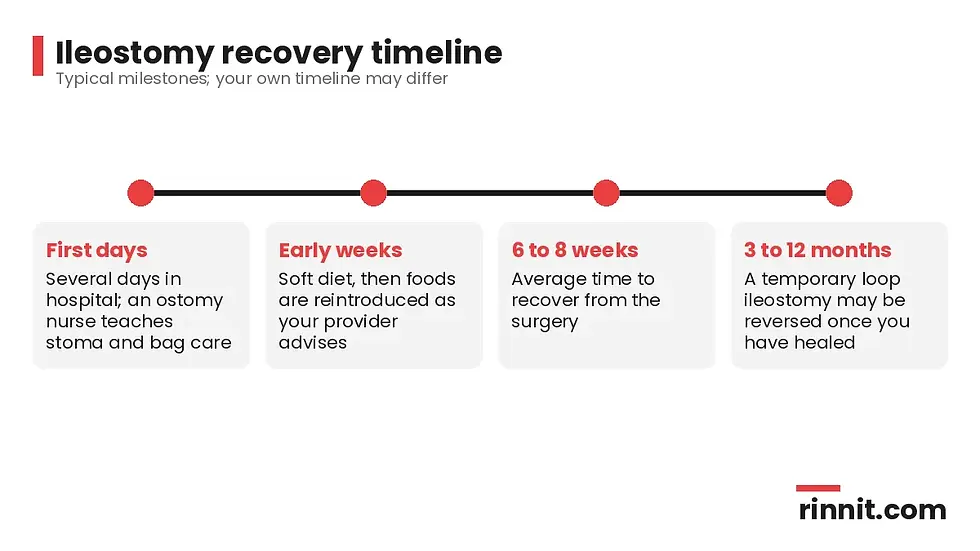
A typical ileostomy recovery timeline.
When can an ileostomy be reversed?
If you had a temporary loop ileostomy, your provider will consider whether an ostomy reversal is safe once you have healed. This may take three to 12 months, depending on your condition. [1] Our guide to ostomy reversal surgery explains what that operation involves.
What are the benefits and risks of an ileostomy?
An ileostomy gives you another way to pass stool when the normal way isn't working. That can let your bowel rest and recover, or allow a diseased colon to be removed, which can improve quality of life and in some cases save your life. [1]
Risk | What it means |
Bleeding | Blood loss during or after surgery |
Infection | Germs entering the surgical area |
Abnormal scarring | Scar tissue that may cause a blockage |
Poor nutrient absorption | Not absorbing enough nutrients from food |
Sources: [1]
What is life expectancy after an ileostomy?
An ileostomy has no impact on your lifespan. All surgery carries risks, but an ileostomy treats far more dangerous conditions and is likely to improve your quality of life. [1]
When should you call a doctor after an ileostomy?
Contact your healthcare provider if you have: [1]
An unpleasant odor coming from your stoma
Injury, bleeding or irritation around your stoma
Ongoing cramps, nausea or vomiting
More than six hours without any stool coming out. Also call if your output is very watery or heavy and you have signs of dehydration, such as strong thirst, dark or little urine, dizziness or weakness
Conclusion
An ileostomy reroutes the end of the small intestine to a stoma on the abdomen so stool can leave the body when the colon can't do its job. Whether it is a temporary loop ileostomy that may be reversed in three to 12 months or a permanent end ileostomy, most people recover in about six to eight weeks and go on to live full lives. [1]
Adjusting to an ileostomy can feel isolating, even when it is temporary. Be patient with yourself, consider talking to a counselor or joining a support group, and ask your care team about resources for life with an ostomy. [1]
Keep learning: Explore our guide to surgery for ulcerative colitis to see where an ileostomy fits among the surgical options.
FAQ
What is an ileostomy?
An ileostomy is surgery that connects the end of the small intestine (ileum) to a new opening in the abdomen called a stoma, so stool leaves the body through the stoma into a bag.
What are the types of ileostomy?
The two main types are a loop ileostomy, which is usually temporary, and an end ileostomy, which is often permanent.
Why would someone need an ileostomy?
An ileostomy is used when the colon cannot store and move waste, for example with bowel obstruction or perforation, colorectal cancer, diverticulitis, polyposis syndromes, ulcerative colitis or Crohn's disease.
Is an ileostomy permanent?
It can be temporary or permanent. A loop ileostomy is usually temporary, while an end ileostomy is often permanent.
How do you prepare for an ileostomy?
You clean out your bowels before surgery with an enema or laxative bowel prep, usually after a few days of a restricted eating plan.
How long does it take to recover from an ileostomy?
On average, recovery takes about six to eight weeks.
Do you still poop with an ileostomy?
Yes, but stool comes out of the stoma into the ileostomy bag instead of the anus, and you cannot control when this happens.
When can an ileostomy be reversed?
A temporary loop ileostomy may be reversed after you heal, usually three to 12 months after surgery depending on your condition.
Does an ileostomy shorten life expectancy?
No. An ileostomy has no impact on lifespan and may be lifesaving.
When should I call my doctor about my ileostomy?
Call for an unpleasant odor from the stoma, injury, bleeding or irritation around it, ongoing cramps, nausea or vomiting, or more than six hours with no output.
Does an ileostomy hurt, and what anesthesia is used?
You're under general anesthesia for the operation, so you're asleep and feel no pain while the surgeon creates the stoma [1]. An ileostomy is major surgery: you spend several days recovering in the hospital, and full recovery takes about six to eight weeks [1].
Related Reading
Small Bowel Resection: Surgery, Risks and Recovery explains small bowel resection surgery.
Ulcerative Colitis: Symptoms, Causes, Diagnosis, and Treatment Explained explains the inflammatory bowel disease that most often leads to an ileostomy.
Crohn's Disease: Symptoms, Causes, Flares vs. Remission and Treatment — What You Need to Know covers how Crohn's affects the bowel and when surgery is considered.
Colon Cancer: Symptoms, Screening, Diagnosis, Treatment and Support describes colorectal cancer treatment, which can include a temporary or permanent ileostomy.
Diverticulitis: Symptoms, Causes, Treatment & Diet — Complete Guide explains when complicated diverticulitis needs bowel surgery.
Familial Adenomatous Polyposis (FAP): Symptoms, Causes, Types, Diagnosis, Treatment and Outlook — What You Need to Know covers the inherited polyp condition that can require colon removal.
References
Cleveland Clinic. Ileostomy: What Is It, Types, Bags, Surgery & Complications. Cleveland Clinic. Last updated April 15, 2024. https://my.clevelandclinic.org/health/procedures/21726-ileostomy
Podda M, Coccolini F, Gerardi C, et al. Early versus delayed defunctioning ileostomy closure after low anterior resection for rectal cancer: a meta-analysis and trial sequential analysis of safety and functional outcomes. Int J Colorectal Dis. 2022;37(4):737-756. PMID 35190885. https://doi.org/10.1007/s00384-022-04106-w
Gavriilidis P, Azoulay D, Taflampas P. Loop transverse colostomy versus loop ileostomy for defunctioning of colorectal anastomosis: a systematic review, updated conventional meta-analysis, and cumulative meta-analysis. Surg Today. 2019;49(2):108-117. PMID 30151626. https://doi.org/10.1007/s00595-018-1708-x
Chan DKH, Lau J, Kah-Hwee Tan J, et al. Post-surgical morbidity in early versus late closure of defunctioning ileostomy after rectal cancer surgery: A systematic review and meta-analysis of randomised controlled trials. BMC Gastroenterol. 2025;25(1):491. PMID 40597683. https://doi.org/10.1186/s12876-025-04090-9
Medical disclaimer
This article is for general education only and does not replace advice from a qualified healthcare professional. Talk to your doctor about your own diagnosis and treatment, and seek emergency care right away for severe or sudden symptoms.



Comments