Kock Pouch (K-pouch): An Internal Alternative to the Ileostomy Bag

Updated: 3 days ago
Medically reviewed by Dr. Baraa Alnahhal, MD · Last reviewed: October 2026
Quick Answer: What is a Kock pouch?
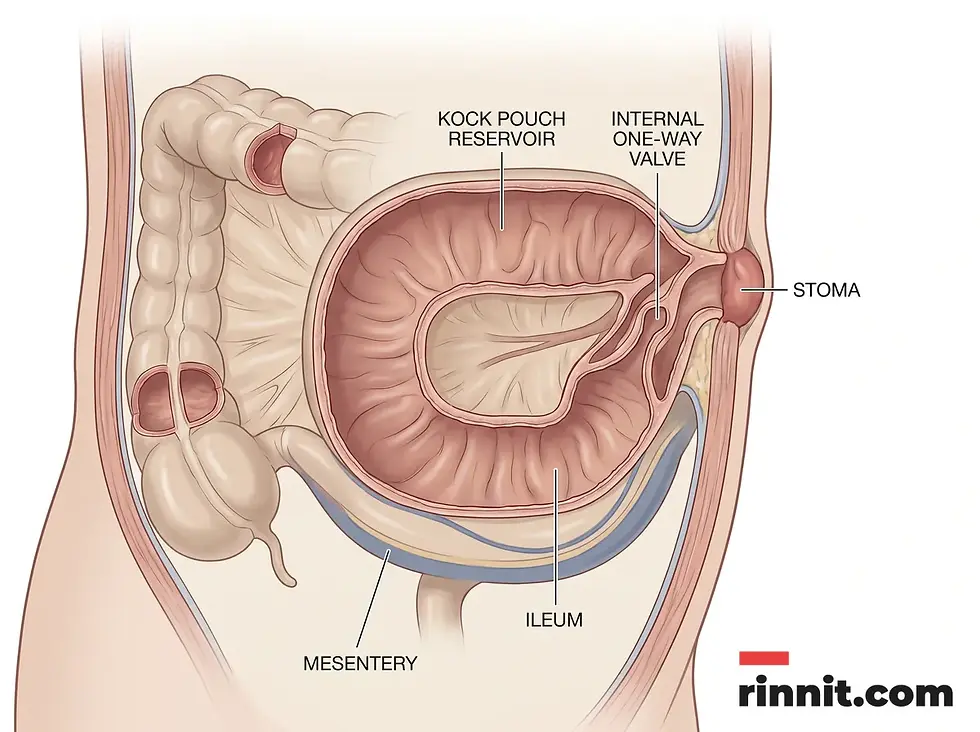
A Kock pouch, or K-pouch, is an internal reservoir made from approximately 18 inches of small intestine, attached to a stoma inside the abdominal wall [1]. Unlike a standard ileostomy with an external bag, it holds stool inside the body until drained through a one-way valve with a catheter [1]. This continence ileostomy lets the stoma be covered with a simple bandage [1].
How is a Kock pouch (K-pouch) constructed?
Constructing a Kock pouch is a delicate process that involves measuring and folding loops of the small intestine, specifically the ileum [1]. The surgeon creates a "U" shape with the tissue, stitching the lining together to form a secure reservoir [1]. A critical component of the K-pouch is the one-way valve, which is fashioned by folding a "tail" of the intestinal tissue into a flap [1]. This valve is designed to close automatically as the pouch fills, preventing unwanted leaks and ensuring that waste only exits when the patient initiates drainage [1].
Feature | Description |
Material | Approximately 18 inches of the small intestine (ileum). |
Structure | Internal reservoir folded into a "U" shape and stitched. |
Valve System | One-way flap valve created from intestinal tissue. |
Drainage Method | Manual intubation using a catheter inserted into the stoma. |
Appearance | Discreet stoma covered by a gauze pad or bandage. |
What are the benefits of a Kock pouch for quality of life?
The primary appeal of the Kock pouch is the elimination of the external ileostomy bag [1]. This provides patients with a more discreet physical profile and greater confidence in social and professional settings. Additionally, the K-pouch allows for controlled elimination, meaning patients can choose when to empty their bowels rather than dealing with the continuous drainage characteristic of a Brooke ileostomy [1]. Many users also report easier sleep, as the internal reservoir does not require emptying during the night [1].
What are the possible risks and complications of a Kock pouch?
The Kock pouch has a higher rate of revision surgery than other ileal pouches, with up to 30% of patients needing follow-up procedures [1]. The most common issue is valve failure, where the internal flap slips or weakens, leading to leaks or difficulty inserting the catheter [1]. Other potential complications include pouchitis (inflammation of the pouch lining), fistulas, and parastomal hernias [1]. Patients must be aware of these risks and maintain regular follow-ups with their surgical team.
What do recovery and long-term management of a Kock pouch involve?
Recovery from K-pouch surgery typically involves a hospital stay of three to five days, followed by several weeks of healing at home [1]. Initially, a catheter remains in the stoma to ensure continuous drainage while the internal wounds heal [1]. Once fully recovered, patients begin a routine of draining the pouch, which usually starts at eight times per day and gradually decreases to two to four times daily as the reservoir expands [1]. A balanced diet and proper hydration are essential for maintaining optimal pouch function and stool consistency.

How is a K-pouch different from a J-pouch?
The K-pouch differs from the J-pouch, another common internal reservoir, in how it is connected and who it is used for. While both are made from the ileum, the J-pouch is connected directly to the anal canal, allowing for elimination through the rectum [1]. The K-pouch, conversely, is used when the anal sphincter is no longer functional or has been removed, necessitating a stoma [1]. The K-pouch remains a vital option for those who must have a permanent ileostomy but desire an internal alternative to the traditional bag [1].

Conclusion
The Kock pouch is a sophisticated surgical solution that offers a path to greater independence and discretion for those living with a permanent ileostomy. By understanding the procedure, its benefits, and the associated risks, patients can work with their healthcare providers to determine if this internal reservoir is the right choice for their needs. With proper care and support, the K-pouch can significantly enhance long-term well-being and confidence.
For more information on managing your digestive health and exploring advanced surgical options, visit our dedicated health resource center. We are committed to providing the guidance you need to live your healthiest, most empowered life.
Frequently Asked Questions
1. What is the main difference between a K-pouch and a standard ileostomy?
A standard ileostomy requires an external bag to collect waste, while a K-pouch stores waste internally in a reservoir that you drain manually with a catheter.
2. Is the Kock pouch procedure permanent?
Yes, a Kock pouch is typically designed as a permanent solution for waste management after the removal of the large intestine.
3. How often do I need to drain the K-pouch?
Initially, you may need to drain it about eight times a day. After a few months of healing, this frequency usually decreases to two to four times per day.
4. Can I still leak with a Kock pouch?
While the internal valve is designed to prevent leaks, valve failure or slipping can occur, which may lead to some leakage and require surgical revision.
5. Does the stoma for a K-pouch look different?
The stoma is similar to a standard ileostomy but is often more discreet since it only needs to be covered by a small bandage rather than a large bag.
6. What is pouchitis?
Pouchitis is an inflammation of the internal reservoir's lining, often caused by bacteria, and is usually treated effectively with antibiotics.
7. Can I eat a normal diet with a K-pouch?
Most patients can enjoy a broad, balanced diet, though a dietitian may recommend adjustments to manage stool thickness and hydration.
8. Is the Kock pouch surgery performed at the same time as the colectomy?
Kock pouch surgery can be performed during the same operation or later as a separate revision surgery if you already have an ileostomy.
9. How do I drain the K-pouch?
You insert a thin, flexible tube called a catheter through the stoma and into the pouch, allowing the waste to flow directly into the toilet.
10. What are the signs that my K-pouch valve might be failing?
Difficulty inserting the catheter, unexpected leakage of stool or gas, and skin irritation around the stoma are common signs of valve issues.
Related Reading
Ileal Pouch (J-Pouch): Types, Surgery and Life After explains ileal pouch surgery.
References
Cleveland Clinic. Kock Pouch. Cleveland Clinic. May 18, 2023. https://my.clevelandclinic.org/health/treatments/24996-kock-pouch
Medical Disclaimer
This article is for informational purposes only and does not constitute medical advice. Always seek the advice of your physician or other qualified health provider with any questions you may have regarding a medical condition. Never disregard professional medical advice or delay in seeking it because of something you have read here.



Comments