Ileal Pouch (J-Pouch): Types, Surgery and Life After

Updated: 2 days ago
Written and medically reviewed by Dr. Baraa Alnahhal, MD · Last reviewed: November 2026 · How we review
Quick Answer
An ileal pouch is an internal reservoir made from the small intestine after surgery to remove the colon and rectum. It lets you pass stool through the anus, so you don't need a permanent ostomy bag. It's the most common surgery for ulcerative colitis when medicines fail. Long-term success is about 95%, though pouchitis is common.
What the research says
Probiotics and antibiotics helped treat pouchitis: a meta-analysis found probiotics cut pouchitis risk by over 80% for prevention, antibiotics helped about 65% of people with pouchitis, and advanced therapies helped about 50% whose pouchitis didn't respond to antibiotics (Syal G et al., American Journal of Gastroenterology, 2025) [2]
K-pouches had high complication rates: across 19 studies of 2,042 people with a Kock pouch (K-pouch), 60.4% had complications, 46.6% needed pouch revision and 12.9% had pouch failure (Emile SH et al., Techniques in Coloproctology, 2024) [3]
Probiotics helped prevent pouchitis in trials: a review of randomized trials found that, across 7 trials, probiotics lowered the risk of pouchitis (risk ratio 0.26) (Emile SH et al., Journal of Gastrointestinal Surgery, 2023) [4]
Pouch fistulas are an uncommon but stubborn complication: a meta-analysis of 34 studies with 770 patients found pouch-related fistulas in 1.5% to 12% of patients, and they came back in about half after surgical repair (Pellino G et al., Digestive and Liver Disease, 2023) [5]
Key takeaways
An ileal pouch replaces the colon and rectum with an internal reservoir.
It's the most common surgery for ulcerative colitis.
The J-pouch is the most common type.
Long-term success is about 95%.
Pouchitis is the most common complication.
What is an ileal pouch?
After a proctocolectomy, the surgeon forms a pouch from the end of the small intestine (ileum). It's also called an ileal pouch-anal anastomosis (IPAA) or ileoanal pouch. Sources: [1]
Who it's for
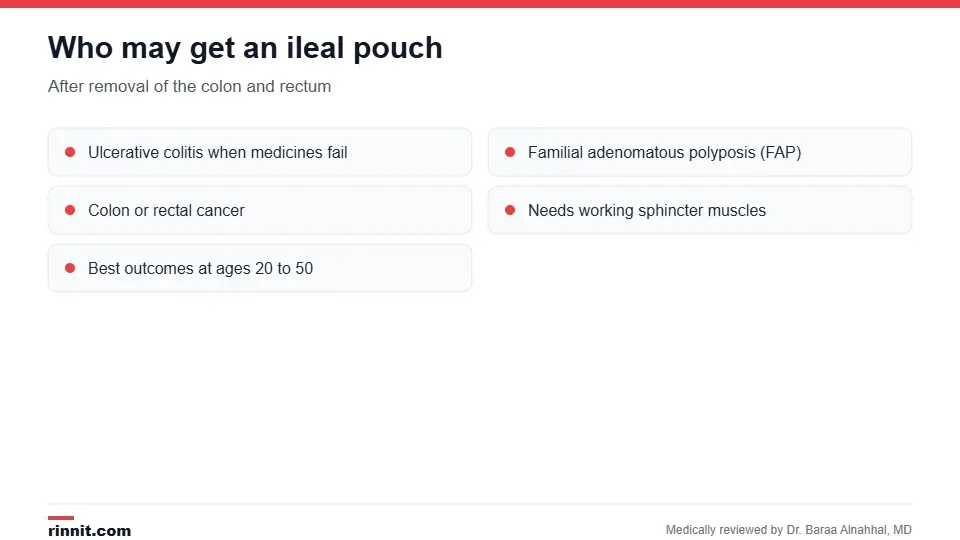
People aged 20 to 50 typically have the best outcomes.
Ulcerative colitis when medicines fail.
Colon or rectal cancer. Sources: [1]
You need working intestines, pelvic nerves and anal sphincter muscles. People aged 20 to 50 typically have the best outcomes, but many over 50 qualify. It may not be an option with Crohn's disease, fecal incontinence, class III obesity or low rectal cancer. Sources: [1]
Types of ileal pouches

The K-pouch has a higher complication rate.
Sources: [1, 3]
What happens during surgery
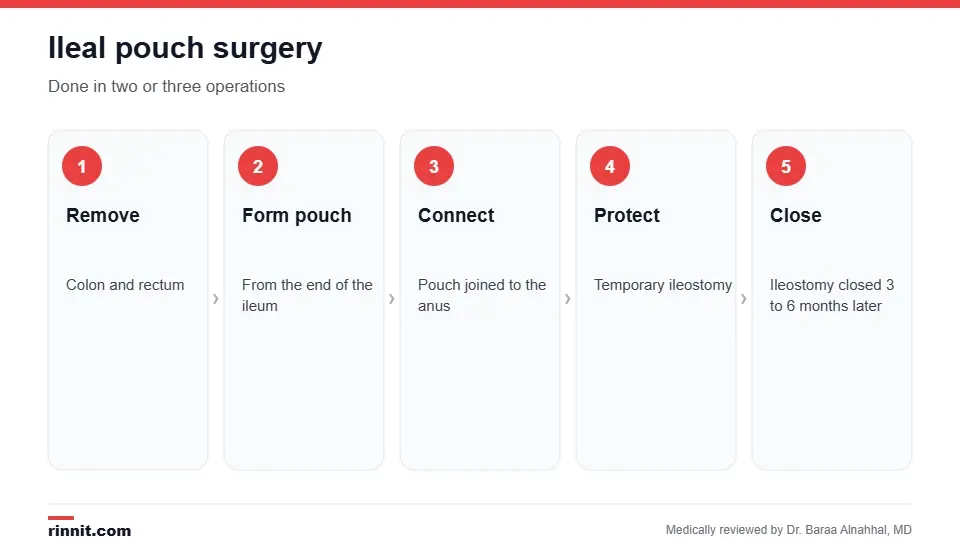
It's done in two or three operations.
The surgeon removes the colon and rectum.
A pouch is formed from the end of the ileum.
The pouch is connected to the anus.
A temporary ileostomy lets the pouch heal.
The ileostomy is usually closed three to six months later in a small operation. Sources: [1]
The hospital stay is typically about a week. Sources: [1]
Risks
Pouchitis, the most common complication, in about 81% of people with IPAA.
Leakage during healing.
Blood clots or bleeding.
Narrowing (stricture), fistula or abscess.
Pelvic infection (sepsis).
Small bowel obstruction. Sources: [1, 2]
The pouch fails in 5% to 10% of people, who may need a new pouch or a stoma. Sources: [1]
Recovery
Return to work and normal activities in about four to eight weeks.
Your diet may need some adjustment at first, but most people eat what they want.
Some people take medicine to slow bowel movements or fiber to thicken stool.
Your pouch is checked every year or two, with a pouchoscopy every several years. Sources: [1]
Outlook
Long-term success is about 95%, and quality of life usually improves. Most people have about seven bowel movements a day, plus or minus one at night. Many have no accidents, though some have seepage during deep sleep. Most people can get pregnant and have a healthy pregnancy. Sources: [1]
When to call your provider
Belly swelling or cramping lasting more than two or three hours.
Bleeding.
Stoma changes or injury.
Trouble passing stool or a lot of leakage.
Pain, or severe nausea, vomiting or diarrhea.
Any new or unusual symptoms. Sources: [1]
Conclusion
An ileal pouch lets many people with ulcerative colitis or FAP live without a permanent bag. Regular checkups and quick treatment of pouchitis help your pouch work well for years.
Keep learning: read about the J-pouch and pouchitis.
Frequently asked questions
What is an ileal pouch?
An internal reservoir made from the small intestine to store stool.
Why is an ileal pouch made?
Most often for ulcerative colitis when medicines fail.
What is a J-pouch?
The most common type of ileal pouch.
Will I need an ostomy bag?
Usually only temporarily while the pouch heals.
How many surgeries are needed?
Two or three.
How long is recovery?
About four to eight weeks.
What is pouchitis?
Inflammation of the pouch, the most common complication.
How many bowel movements will I have?
About seven a day.
How successful is the surgery?
Long-term success is about 95%.
Can I get pregnant with a pouch?
Most people can.
Related Reading
J-Pouch Surgery: An Internal Alternative for Colon and Rectum Replacement the most common pouch.
Pouchitis: Symptoms, Causes, and Treatment After J-Pouch Surgery the most common complication.
Ulcerative Colitis: Symptoms, Causes, Diagnosis, and Treatment Explained the main reason for pouch surgery.
References
Cleveland Clinic. Ileal Pouches: What They Are, Types, Surgery, What to Expect. Cleveland Clinic. Last updated October 28, 2023. https://my.clevelandclinic.org/health/treatments/15549-ileal-pouches
Syal G, Barnes E, Raffals L, et al. Medical therapies for prevention and treatment of inflammatory pouch disorders: a systematic review and meta-analysis. Am J Gastroenterol. 2025;120(1):135-150. PMID 39466277. https://doi.org/10.14309/ajg.0000000000003136
Emile SH, Garoufalia Z, Mavrantonis S, et al. Complications and failure after Kock continent ileostomy: a systematic review and meta-analysis. Tech Coloproctol. 2024;28(1):135. PMID 39354167. https://doi.org/10.1007/s10151-024-03018-x
Emile SH, Horesh N, Freund MR, et al. A systematic review and meta-analysis of randomized clinical trials on the prevention and treatment of pouchitis after ileoanal pouch anastomosis. J Gastrointest Surg. 2023;27(11):2650-2660. PMID 37815701. https://doi.org/10.1007/s11605-023-05841-3
Pellino G, Celentano V, Vinci D, et al. Ileoanal pouch-related fistulae: a systematic review with meta-analysis on incidence, treatment options and outcomes. Dig Liver Dis. 2023;55(3):342-349. PMID 35688686. https://doi.org/10.1016/j.dld.2022.05.009
Medical disclaimer
This article is for general education only and does not replace advice from a qualified healthcare professional. Talk to your doctor about your own diagnosis and treatment, and seek emergency care right away for severe or sudden symptoms.



Comments