J-Pouch Surgery: An Internal Alternative for Colon and Rectum Replacement

Updated: 2 days ago
Medically reviewed by Dr. Baraa Alnahhal, MD · Last reviewed: October 2026
J-pouch surgery, also called ileal pouch-anal anastomosis (IPAA), builds an internal pouch from the end of the small intestine and connects it to the anal canal after the colon and rectum are removed. It lets you pass stool through the anus in the usual way, without a permanent external ileostomy bag [1].
Quick Answer: What is J-pouch surgery?
J-pouch surgery is a procedure in which a surgeon builds an internal reservoir from the end of the small intestine to replace the colon and rectum, so stool can leave through the anus. It usually happens in two to three stages with a temporary ileostomy and is commonly done for ulcerative colitis. The estimated long-term success rate is 95%. [1] [2]
What the research says
Most people do well long term. In 3,707 patients who had a primary ileal pouch at one center between 1984 and 2010 (79.7% with ulcerative colitis), functional outcomes and quality of life were good or excellent in 95%. Pouch failure occurred in 5.3% over a median follow-up of 84 months, and 3.2% needed the pouch removed. Early perioperative complications occurred in 33.5% of patients, and mortality was 0.1%. This was a single-center cohort study (Fazio et al., Annals of Surgery, 2013 [2]).
Complications can be serious, so careful selection and prompt treatment matter. A review of the history and outcomes of ileal pouches describes pelvic sepsis as a common early complication that can lead to long-term pouch dysfunction, though prompt radiological or surgical treatment lowers the risk of pouch failure. Pouchitis is a common cause of long-term dysfunction that remains incompletely understood and can be difficult to manage, and about 10% of patients are reported to have pouch failure. The authors stress that patient selection and a structured management plan are key (Ng et al., World Journal of Gastroenterology, 2019 [3]).
What Is a J-Pouch?
A J-pouch is one type of ileal pouch that a surgeon can create inside your body to replace your colon and rectum. It acts as a reservoir for stool that connects to your anus, the way your rectum once did, and it empties itself through the anus when you feel the urge to go [1].
J-Pouch vs. Ileostomy
The J-pouch is an alternative to a permanent ileostomy. If your anus still works, the J-pouch replaces the colon and rectum internally and reconnects the ileum to the anus. An ileostomy instead diverts the ileum to an opening in the abdomen called a stoma, and stool collects in an external bag that you empty [1].
Feature | J-pouch | Permanent ileostomy |
Location | Internal, inside the pelvis | External stoma on the abdomen |
How stool leaves the body | Through the anus, using normal toilet habits | Into an ostomy bag that you empty |
Needs a stoma and bag? | No, once the temporary stoma is closed | Yes |

The J-pouch is made from the end of the small intestine and connected to the anal canal.
Who is a candidate for J-pouch surgery, and how are they evaluated?
J-pouch surgery may be an option for people who have had or need a total proctocolectomy, which removes the colon and rectum when disease has made them unusable. Not everyone is a candidate. Your surgeon will discuss the following with you before and after the proctocolectomy [1]:
Requirement | Description |
Functional anus | The muscles and nerves in your anus must work well enough to control bowel movements. Your surgeon evaluates this after you have healed. |
Surgical fitness | You must be healthy enough to be safe for multiple surgeries. Other conditions and medications are taken into account. |
What are the stages of J-pouch surgery?
J-pouch surgery usually happens in two to three stages, beginning with a total proctocolectomy that removes the colon and rectum. You will have a temporary ileostomy after it, which stays until the pouch is ready to use. The surgeon will [1]:
Find the end of the small intestine and measure out two loops, each about 6 inches long. Fold this length in half like a “U,” open the inside seam and sew the edges together to make a pouch.
Pull the pouch down into the pelvis and connect its bottom to the anal canal, usually with staples and sometimes with stitches. This is called ileal pouch-anal anastomosis (IPAA).
Divide the small intestine above the pouch to create a temporary loop ileostomy, so stool bypasses the pouch for several months while it heals.
After eight to 12 weeks, test the pouch with a pouchogram to make sure it has healed and does not leak.
Once the pouch passes the leak test, reverse the temporary ileostomy and close the stoma so stool goes through the healed J-pouch.
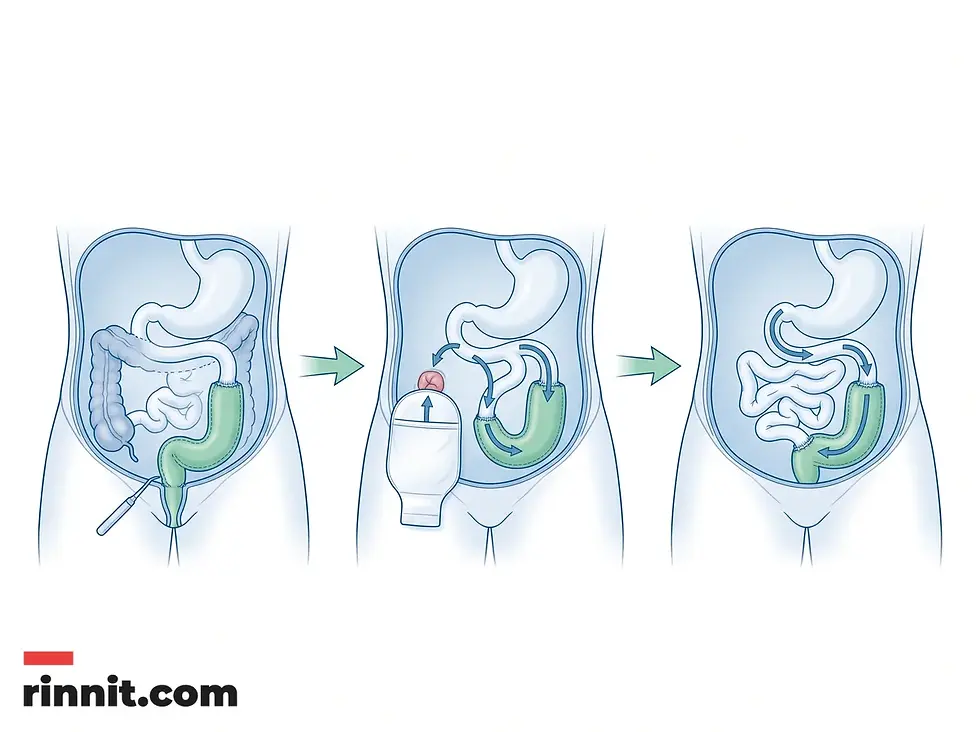
The staged J-pouch process, from pouch creation and a temporary ileostomy to the final ileostomy reversal.
How do people adapt to a new J-pouch?
Your body needs time to adapt. The pouch is small at first, so you cannot hold much stool and will probably go more often during the day and a few times at night. As the pouch gradually stretches over the following months, this improves. Your anal muscles may also be weak from lack of use, and your provider might suggest Kegel exercises to retrain them [1].
Stool will also be wetter than before because it travels a much shorter distance, and your body cannot reabsorb as much fluid. Staying hydrated matters, and replacing lost electrolytes with salted broths, sports drinks or oral hydration formulas can help. There is no single prescribed diet, but starting with bland, easy-to-digest foods, adding new foods gradually, and following a balanced eating pattern such as the Mediterranean diet may help with healing and inflammation [1].

How the internal J-pouch takes over the storage function of the removed colon and rectum.
What are the risks of J-pouch surgery, and how is it managed long term?
Most people do well, but J-pouch surgery carries risks [1]:
Anastomotic leak: bacteria can leak into the abdomen or pelvis and cause infection, an abscess, or sepsis.
Abdominal adhesions: scar tissue can obstruct the small intestine and may affect the female reproductive organs and fertility.
Sexual dysfunction: nerve damage can cause pain or sensitivity with sex or erectile dysfunction, though symptoms often improve over time.
Pouchitis: inflammation of the pouch lining that causes pain, urgency or bleeding; about half of people develop it, and antibiotics usually relieve it, but some people develop persistent pouchitis that needs further treatment.
Stricture: scar tissue at the connection narrows the passage and may need dilation.
Twisted pouch syndrome: a rare complication in which the pouch is rotated, causing obstruction and requiring another operation.
Signs that a pouch may be failing include long-lasting pain in or just above the anus, heat, swelling or irritation when you pass stool, blood in the stool, and a constant feeling of needing to go without being able to [1].
What is the bottom line on J-pouch surgery?
J-pouch surgery is an effective internal alternative for people who have lost their colon and rectum to disease. It restores the body's natural route for passing stool and spares you a permanent external bag. The path involves several surgeries and a period of adjustment, and complications such as pouchitis are common, but most people report an improved quality of life and long-term success is high.
Your next step: if you are considering a J-pouch, ask your surgeon whether your anal muscles and overall health make you a candidate, how many stages you would need, and what to expect during recovery and follow-up.
Frequently Asked Questions
How many times a day will I have a bowel movement with a J-pouch?
At first it can be more than 10 times a day. As the pouch stretches over the following months, most people settle at between five and 10 bowel movements a day.
Can a J-pouch fail?
Most J-pouches work well long term, but a small number fail because of persistent complications. A failed pouch may need to be removed or replaced, and some people return to a permanent ileostomy.
What is pouchitis?
Pouchitis is inflammation of the J-pouch lining. About half of people with a J-pouch develop it at some point. It is usually thought to be caused by a bacterial infection, and antibiotics usually relieve it quickly.
How long is the recovery between surgical stages?
The healing period between creating the pouch and reversing the temporary ileostomy usually lasts about eight to 12 weeks.
Will I need to follow a special diet?
There is no single prescribed diet. A balanced, healthy diet helps you heal well. Start with bland, easy-to-digest foods in small portions, stay hydrated, and avoid foods that cause gas or irritation.
Can I still get pregnant with a J-pouch?
Abdominal surgery can cause scar tissue (adhesions) that may affect the female reproductive organs and fertility. Discuss family planning with your surgeon before the procedure.
Is the J-pouch visible from the outside?
No. The J-pouch is entirely internal. After the temporary stoma is closed, you do not need an external bag or device.
What is a pouchogram?
A pouchogram is an X-ray test in which a contrast solution is placed in the pouch through a tube in the anus to check that it has healed and does not leak before the ileostomy is reversed.
Does J-pouch surgery cause sexual dysfunction?
Surgery near the anus and rectum can sometimes damage nerves involved in sexual function, which may cause pain or sensitivity with sex in women or erectile dysfunction in men. These symptoms often improve over time.
How do I strengthen my muscles for a J-pouch?
Your anal muscles may be weak after surgery. Kegel exercises are commonly suggested to help retrain them and improve control.
Related Reading
Ileal Pouch (J-Pouch): Types, Surgery and Life After explains ileal pouch surgery.
References
Cleveland Clinic. J-pouch surgery. Cleveland Clinic. July 26, 2023. https://my.clevelandclinic.org/health/treatments/21062-j-pouch-surgery
Fazio VW, Kiran RP, Remzi FH, et al. Ileal pouch anal anastomosis: analysis of outcome and quality of life in 3707 patients. Annals of Surgery. 2013;257(4):679-685. PMID 23299522. https://doi.org/10.1097/SLA.0b013e31827d99a2
Ng KS, Gonsalves SJ, Sagar PM. Ileal-anal pouches: a review of its history, indications, and complications. World Journal of Gastroenterology. 2019;25(31):4320-4342. PMID 31496616. https://doi.org/10.3748/wjg.v25.i31.4320
Medical disclaimer
This article is for informational purposes only and is not a substitute for professional medical advice, diagnosis, or treatment. The clinical information in this guide reflects source material last reviewed in July 2023.



Comments