Gastrointestinal Perforation: Symptoms, Causes, and Emergency Care

Updated: 3 days ago
Medically reviewed by Dr. Baraa Alnahhal, MD · Last reviewed: October 2026
Quick Answer
Gastrointestinal perforation is a hole in the digestive tract that requires immediate emergency care. [1] It can result from trauma, swallowed objects, Crohn's disease or peptic ulcers. [1] The most common symptom is sudden, severe abdominal pain, often with fever. It is diagnosed with CT or X-rays and almost always needs emergency surgery plus antibiotics. Do not treat it at home.
What the research says
A faster-recovery care pathway after ulcer-perforation surgery reduced hospital stay and complications. A meta-analysis of 12 studies (963 patients) comparing enhanced recovery after surgery (ERAS) with standard care for peptic ulcer perforation found a significantly shorter hospital stay (P = .003) and lower rates of venous thromboembolism (P < .0001) and of superficial and deep surgical site infections (P < .0001 and P = .008) (Majid and Elkomos, J Gastrointest Surg, 2026). [2]
Not every perforated ulcer is explained by H. pylori or NSAIDs. In a meta-analysis of 92 studies (60,816 patients), the pooled share of peptic ulcer disease with neither H. pylori nor NSAID use was 22.0% (95% CI 13.1%–34.7%) among perforated ulcers, compared with 13.0% (95% CI 10.4%–16.2%) in peptic ulcer disease overall (Watanabe et al., Aliment Pharmacol Ther, 2026). [3]
What is a Gastrointestinal Perforation?
A gastrointestinal perforation occurs when a hole develops in any part of the gastrointestinal (GI) tract. [1] The GI tract is a continuous series of hollow organs responsible for moving, digesting, and absorbing nutrients from food and liquids. [1] When a breach occurs, the contents of these organs—including stomach acid, partially digested food, or fecal matter—leak into the sterile abdominal cavity. [1]
Affected Organs
The impact of a perforation depends largely on its location within the digestive system.
Organ | Specific Name | Impact of Leakage |
Esophagus | Esophageal Rupture | Leakage of saliva and food into the chest or neck. |
Stomach | Gastric Perforation | Leakage of highly acidic digestive fluids. |
Small Intestine | Intestinal Perforation | Leakage of digestive enzymes and nutrients. |
Large Intestine | Bowel Perforation | Leakage of stool and bacteria into the abdomen. |

Symptoms and Warning Signs
The symptoms of a GI perforation are typically sudden and intense. Because the leakage of waste into the abdomen causes immediate irritation, the body reacts quickly.
Common Symptoms
Severe Abdominal Pain: Often described as sharp, sudden, and debilitating.
Abdominal Tenderness: The area may be extremely painful to the touch. [1]
Bloating: The abdomen may appear visibly swollen or feel firm.
Fever and Chills: Signs that the body is reacting to a developing infection. [1]
Nausea and Vomiting: A general systemic response to the internal injury. [1]
If left untreated, a perforation can lead to sepsis, a life-threatening systemic infection, or peritonitis, which is the inflammation of the abdominal lining. [1] Both conditions require intensive, immediate hospital care.
Causes and Risk Factors
Gastrointestinal perforations are generally caused by either physical trauma or the progression of an underlying medical condition.
Trauma and Injury
Physical damage to the GI tract can occur through various means:
Swallowed Objects: Accidentally ingesting sharp items, magnets, or corrosive batteries. [1]
Forceful Vomiting: Intense pressure can tear the lining of the esophagus.
Wounds: Gunshot or knife wounds, or blunt force trauma from car accidents. [1]
Medical Complications: In rare instances, procedures like colonoscopies or abdominal surgeries can result in an accidental tear. [1]
Underlying Medical Conditions
Chronic illnesses can weaken the walls of the GI tract over time, making them susceptible to rupture.
Category | Specific Conditions |
Inflammatory | Appendicitis, Diverticulitis, Crohn’s Disease, Ulcerative Colitis |
Obstructive | Bowel Obstruction, Gallstones, Bowel Impaction |
Malignant | Colorectal Cancer, Stomach Cancer, Esophageal Cancer |
Ulcerative | Peptic Ulcer Disease |

Diagnosis and Emergency Testing
When a perforation is suspected, healthcare providers prioritize rapid diagnosis to prevent the onset of sepsis. A physical examination and a review of vital signs—such as blood pressure and heart rate—are the first steps. [1]
Diagnostic Tools
Imaging: X-rays are used to detect air in the abdominal cavity, which is a definitive sign of a GI tear. A CT scan provides a more detailed view to pinpoint the exact location of the hole. [1]
Endoscopy: Procedures like upper endoscopy or colonoscopy may be used to visualize the damage directly. [1]
Blood Tests: These help clinicians assess the severity of infection and check the function of vital organs like the kidneys and liver. [1]
Treatment and Surgical Options
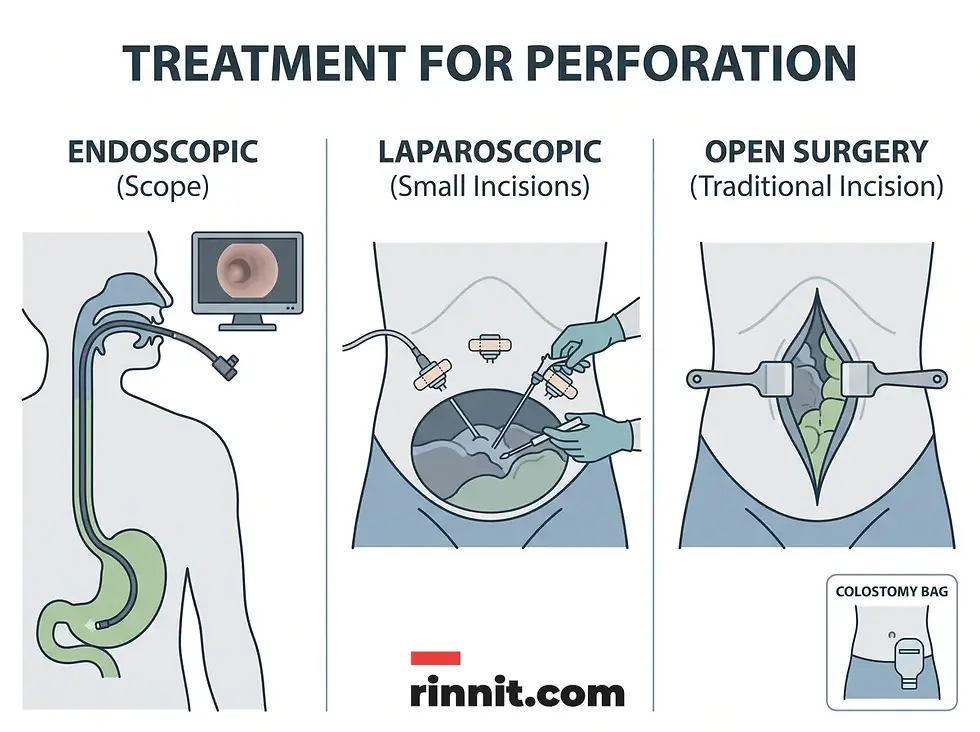
Nearly all cases of gastrointestinal perforation require emergency surgery. The goal of the procedure is to close the hole, stop any internal bleeding, and clean the abdominal cavity of leaked waste.
Surgical Methods
Endoscopic Repair: A minimally invasive approach where instruments are guided through the digestive tract using a camera. [1]
Laparoscopic Surgery: Small incisions are made in the abdomen to allow for repair with a camera and specialized tools. [1]
Open Surgery: A traditional approach requiring a larger incision, typically used for severe or complex perforations.
Recovery and Management
In some cases, a surgeon may perform a temporary colostomy. [1] This involves creating a stoma (a small hole in the abdomen) and attaching a colostomy bag to collect waste, allowing the injured part of the colon to rest and heal. [1] Most patients also receive a course of intravenous (IV) antibiotics to eliminate any bacteria that entered the bloodstream or abdominal cavity. [1]
Prevention and Outlook
While not all perforations can be prevented, maintaining digestive health can reduce your risk. [1] A high-fiber diet helps prevent constipation and bowel impactions, while regular checkups allow for the management of chronic conditions like IBD or ulcers. For those who receive prompt treatment, the outlook is generally positive, with many patients achieving a full recovery within several weeks. [1]
When to Seek Emergency Care
Gastrointestinal perforation is a medical emergency that can be fatal if ignored. [1] If you experience sudden, severe abdominal pain or notice a swollen, tender abdomen accompanied by fever, seek emergency medical care immediately.
Frequently Asked Questions
Can a perforated bowel heal on its own?
While very small perforations may occasionally heal with intensive monitoring and IV antibiotics, you cannot determine this at home. [1] A professional medical diagnosis is always required, and most cases need emergency surgery.
What happens if a GI perforation is not treated?
Without treatment, a perforation leads to the leakage of waste into the abdomen, causing peritonitis and sepsis. [1] These conditions are life-threatening and can lead to organ failure and death.
Is a bowel perforation the same as a stomach perforation?
Bowel and stomach perforations are both types of gastrointestinal perforations. A bowel perforation occurs in the large intestine (colon), while a gastric perforation occurs specifically in the stomach. [1]
What is the most common cause of a perforated bowel?
In many adults, diverticulitis is a leading cause. In cases of trauma, swallowed objects or sharp force injuries are common triggers.
How long is the recovery after surgery?
A full recovery typically takes several weeks. [1] During this time, patients are closely monitored for signs of infection and may need to follow a specific diet as their GI tract heals.
What does the pain of a perforation feel like?
Most patients describe it as a sudden, "knifelike" pain that is so severe it makes moving or breathing deeply difficult.
Can a colonoscopy cause a perforation?
While it is a known risk, it is extremely rare. Modern endoscopic techniques are highly refined to minimize the chance of accidental injury.
What is peritonitis?
Peritonitis is the inflammation of the peritoneum, the thin silk-like tissue that lines your inner abdominal wall and covers the organs within your abdomen. It is a serious complication of a GI perforation. [1]
Should I take pain relievers if I suspect a perforation?
No. You should not take any medication or eat/drink anything if you suspect a perforation. Seek emergency medical help immediately.
Content reviewed and produced following the Rinnit editorial framework. Last updated: October 8, 2026.
Can a stomach ulcer cause a perforation?
Yes. A peptic ulcer can wear all the way through the wall of the stomach or small intestine. Sudden, severe belly pain in someone with ulcer symptoms needs emergency care, so call 911.
Related Reading
Peritonitis: Symptoms, Causes & Treatment — Belly Inflammation Explained explains the dangerous belly lining infection a perforation can cause.
Peptic Ulcer Disease: Causes, Symptoms, Diagnosis, and Treatment covers stomach and duodenal ulcers, a leading cause of perforation.
Diverticulitis: Symptoms, Causes, Treatment & Diet — Complete Guide explains colon pouch inflammation that can lead to a bowel perforation.
Colostomy: Procedure, Types, and Recovery explains the stoma some people need while the colon heals.
References
Cleveland Clinic. Gastrointestinal Perforation. Cleveland Clinic Health Library. Medically reviewed; last updated July 11, 2022. https://my.clevelandclinic.org/health/diseases/23478-gastrointestinal-perforation
Majid A, Elkomos B. Enhanced recovery after surgery (ERAS) vs standard care in peptic ulcer perforation: a systematic review and meta-analysis. J Gastrointest Surg. 2026;30(11):102530. PMID 42612945. doi:10.1016/j.gassur.2026.102530
Watanabe J, Sekiguchi H, Kanno T, et al. Meta-analysis: prevalence of non-Helicobacter pylori, non-NSAID peptic ulcer disease. Aliment Pharmacol Ther. 2026;64(8):1034-1045. PMID 42572812. doi:10.1111/apt.70906
Medical disclaimer
The information provided in this article is for educational purposes only and should not be used as a substitute for professional medical advice, diagnosis, or treatment. Always seek the advice of your physician or other qualified health provider with any questions you may have regarding a medical condition.



Comments