Chelation Therapy: What It Treats, How It Works, and When It's Unsafe

Updated: 6 days ago
Written and medically reviewed by Dr. Baraa Alnahhal, MD · Last reviewed: October 31, 2026 · How we review
Quick Answer: What is chelation therapy?
Chelation therapy is a prescription treatment for heavy metal poisoning that uses medicines called chelating agents to bind metals such as lead, mercury, iron, copper, or arsenic so the body can remove them through urine or stool. It is given by injection or pills under medical supervision and is not approved for heart disease, autism, or "detox." [1]
What the research says
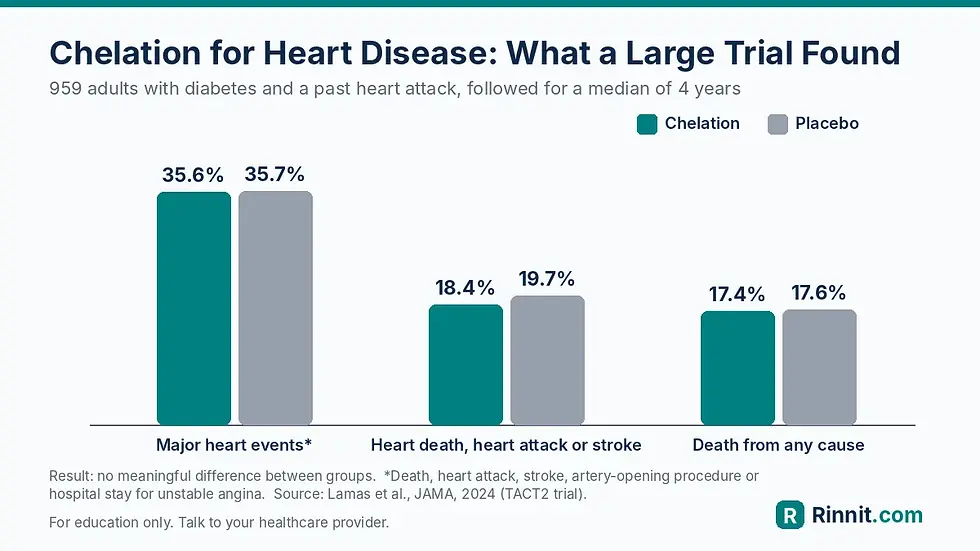
Chelation did not prevent heart attacks or deaths in a large trial. Among 959 adults with diabetes and a past heart attack, major heart events happened in 35.6% of the chelation group and 35.7% of the placebo group over a median of 4 years — even though chelation cut blood lead levels by more than half. (Lamas et al., JAMA, 2024)
Pooled trials show no clear benefit for clogged arteries. A review of 5 trials with 1,993 people found no difference in death from any cause between chelation and placebo in the two heart-disease trials (risk ratio 0.97), and the overall evidence was rated low to very low certainty. (Villarruz-Sulit et al., Cochrane Database Syst Rev, 2020)
There's no trial evidence that chelation helps autism. Only one small trial qualified (77 children, 49 in the main phase), and it showed no effect on autism symptoms; reviewers concluded the risks — including low calcium, kidney harm, and reported deaths — outweigh any proven benefit. (James et al., Cochrane Database Syst Rev, 2015)
Key takeaways
Chelation therapy treats heavy metal poisoning — and in the U.S., that is the only FDA-approved use.
It always needs a prescription and medical monitoring.
Over-the-counter "chelation" or "detox" products — supplements, nasal sprays, clay baths, suppositories — are not approved and not safe.
It does not treat heart disease, autism, Alzheimer's disease, Parkinson's disease, or diabetes.
Side effects range from nausea and headache to kidney damage, seizures, and heart failure.
Chelation therapy at a glance
Question | Short answer |
What it does | Removes toxic heavy metals from the body |
Metals it can remove | Arsenic, copper, iron, gold, lead, mercury |
How it's given | Injection into a vein or muscle, or pills by mouth |
Who prescribes it | A healthcare provider, after testing shows harmful metal levels |
How metals leave the body | Through urine or stool |
How long treatment lasts | Short or long term, depending on the cause |
Approved uses (U.S.) | Heavy metal poisoning only |
Safe at home? | Only with prescribed medicine and clear instructions |
What is chelation therapy?
Chelation therapy is a medical treatment that removes harmful heavy metals from your body before they can damage your organs.
Heavy metals become toxic once they reach certain levels. At that point, they can harm your brain, liver, and other organs.
If a heavy metal test shows unhealthy levels, your provider may recommend treatment. Chelation is one option — but not the first step for everyone.
Often, the first step is avoiding further exposure. Chelation becomes the next step when avoiding exposure isn't possible or doesn't lower your levels enough.
How does chelation therapy work?
Chelation therapy works by giving you a medicine that latches onto metal in your body so the metal can leave through your urine or stool.
These medicines contain chelating agents — substances that bind tightly to specific metals. Once bound, the metal can no longer do harm and is carried out of your body.

Several approved medicines exist. Each targets a different metal:
Metal that builds up | Can chelation remove it? |
Lead | Yes |
Mercury | Yes |
Iron | Yes |
Copper | Yes |
Arsenic | Yes |
Gold | Yes |
Your provider chooses the medicine based on which metal is building up. They also set the dose to give the most benefit with the fewest side effects — and may adjust it during treatment.
What conditions does chelation therapy treat?
Chelation therapy treats conditions caused by a buildup of heavy metals, which is the only use approved in the U.S. as of December 2024.
These conditions include:
Left untreated, these metals can damage organs and lead to life-threatening problems.

Why do heavy metals build up in the body?
Heavy metals build up in the body for three main reasons: exposure, repeated blood transfusions, or a genetic condition.
Cause | Example |
Home or work exposure | Higher contact with lead or mercury |
Long-term blood transfusions | Many transfusions add extra iron to the body |
Genetic conditions | Some people are born with conditions that cause metals like copper to build up |
Exposure to arsenic is another cause of heavy metal poisoning that may need treatment.
What are the unapproved uses of chelation therapy?
The unapproved uses of chelation therapy include heart disease, autism, Alzheimer's disease, Parkinson's disease, and diabetes — none of which it has been shown to treat.
Some providers, companies, and websites still promote chelation for:
Alzheimer's disease
Autism spectrum disorder
Diabetes
Heart disease and its risk factors, including atherosclerosis, high cholesterol, and high blood pressure
Parkinson's disease
U.S. regulators have issued warnings about unapproved chelation products.
Most healthcare providers consider these uses misleading and even dangerous. Chelation used for the wrong reason can harm you. It can also delay treatments that truly work — and that may save your life.
Does chelation therapy work for heart disease?
Chelation therapy does not work for heart disease, and it should not be used to treat it.
Supporters claimed the medicines could clear plaque from clogged arteries the same way they clear metals. There's no proof this is true, and most heart doctors strongly disagree.
An earlier study that suggested a benefit had serious design flaws, so its results can't be trusted. Think of putting a cup in your garden to measure rain while running the hose at the same time — you can't tell where the water came from.
The same research team then ran a second, larger trial. Published in 2024, it found no benefit from chelation for heart disease.
For more on what does help, see our guides to heart disease in women and hypertensive heart disease, and the federal overview on chelation for coronary heart disease.
Can chelation therapy treat autism?
Chelation therapy cannot treat autism, and it is not safe or appropriate for autistic children.
There is no scientific evidence that chelation helps autistic people. There is evidence that misusing chelation has caused serious side effects and even death.
Autism is a difference in how a child's brain works, present from birth. It is not a disease, so there is no "cure." Qualified providers offer therapies that help a child build skills — and chelation has no place among them.
What happens during chelation therapy?
During chelation therapy, you receive a prescribed medicine — either as an injection or as pills — that pulls the harmful metal out of your body.
Treatment may involve:
An injection into a vein or a muscle, usually in a provider's office
Pills by mouth, taken at home with careful instructions
How long does chelation therapy take?
Chelation therapy can last a short time or much longer, depending on what is causing the metal to build up.
You may need regular tests to see how well it's working. For example, people on iron chelation may have a yearly liver MRI to check iron levels. This helps your provider set the dose and decide when to stop.
What are the benefits of chelation therapy?
The main benefit of chelation therapy is removing toxic heavy metals that could otherwise cause serious or life-threatening organ damage.
For some people, it is the best — or the only — way to get these metals out of the body.
What are the side effects of chelation therapy?
Chelation therapy can cause side effects ranging from mild problems like nausea and headache to severe reactions like kidney damage, seizures, and heart failure.
Common side effects | Severe reactions |
Fever | Heart failure |
Headache | Kidney damage |
High or low blood pressure | Low blood pressure |
Muscle pain | Trouble breathing |
Nausea and vomiting | Respiratory failure |
Pain at the injection site | Seizures |
Your provider will explain the side effects of the specific medicine you receive.
Is it safe to do chelation therapy at home?
Chelation therapy at home is safe only when your provider prescribes the medicine to treat heavy metal poisoning, such as iron overload.
It is never safe to use chelation products you can buy without a prescription. These include:
Dietary supplements
Nasal sprays
Clay baths
Suppositories
None of these products are FDA-approved.
How long does recovery from chelation therapy take?
Recovery from chelation therapy depends on the type of heavy metal poisoning you have and what caused it.
Your healthcare provider is the best person to tell you what to expect.
When should you call your healthcare provider?
You should call your healthcare provider if you have any side effects from chelation therapy or questions about your treatment plan.
Conclusion
Chelation therapy is a valuable, sometimes lifesaving treatment — but only for one job: removing toxic heavy metals.
If your provider prescribes it, follow their plan closely and report any side effects. If someone offers chelation as a "detox," or as a fix for heart disease or autism, there's no science behind it. It's unsafe and can delay the care that truly helps.
Worried about heavy metal exposure? Start with our guide to heavy metal poisoning symptoms, sources, and treatment, then save or share this page to bring to your next doctor's visit.
FAQ
What is chelation therapy used for?
Chelation therapy is used to treat heavy metal poisoning, such as lead or mercury poisoning, iron overload from hemochromatosis or thalassemia, and copper buildup from Wilson disease.
Is chelation therapy FDA-approved?
Chelation therapy is FDA-approved only for treating heavy metal poisoning. It is not approved for heart disease, autism, Alzheimer's disease, Parkinson's disease, or diabetes.
How is chelation therapy given?
Chelation therapy is given as an injection into a vein or muscle, usually in a provider's office, or as prescribed pills taken by mouth at home.
How do metals leave the body during chelation?
During chelation, the medicine binds to the metal, and the bound metal leaves the body through urine or stool.
Can I buy chelation products over the counter?
No. Over-the-counter chelation products — including supplements, nasal sprays, clay baths, and suppositories — are not FDA-approved and are never safe to use.
Does chelation therapy clear clogged arteries?
No. There is no proof chelation therapy removes artery plaque, and a 2024 trial found it did not reduce heart attacks, strokes, or deaths.
Is chelation therapy safe for children with autism?
No. Chelation therapy is not safe or appropriate for autism. There is no evidence it helps, and misuse has caused serious side effects and death.
What are the most serious risks of chelation therapy?
The most serious risks of chelation therapy include heart failure, kidney damage, low blood pressure, trouble breathing, respiratory failure, and seizures.
How do I know if I have heavy metal poisoning?
Your doctor can check for heavy metal poisoning with blood or urine tests, along with your symptoms and possible exposures. Chelation is only given when tests confirm a problem that needs it.
Can chelation remove good minerals too?
Yes. Chelating agents can lower healthy minerals, such as calcium and zinc. This is one reason chelation should only be done under medical supervision with regular tests.
Related Reading
Heavy Metal Test: Lead, Mercury and Arsenic Testing Explained explains the blood and urine tests for lead, mercury, arsenic and other metals.
References
Cleveland Clinic. Chelation Therapy. Cleveland Clinic Health Library. Last updated February 12, 2025. https://my.clevelandclinic.org/health/treatments/chelation-therapy
Lamas GA, Anstrom KJ, Navas-Acien A, et al. Edetate Disodium-Based Chelation for Patients With a Previous Myocardial Infarction and Diabetes: TACT2 Randomized Clinical Trial. JAMA. 2024;332(10):794-803. PMID 39141382. https://doi.org/10.1001/jama.2024.11463
Villarruz-Sulit MV, Forster R, Dans AL, et al. Chelation therapy for atherosclerotic cardiovascular disease. Cochrane Database of Systematic Reviews. 2020;5(5):CD002785. PMID 32367513. https://doi.org/10.1002/14651858.CD002785.pub2
James S, Stevenson SW, Silove N, et al. Chelation for autism spectrum disorder (ASD). Cochrane Database of Systematic Reviews. 2015;(5):CD010766. PMID 26106752. https://doi.org/10.1002/14651858.CD010766
U.S. Food and Drug Administration. Questions and Answers on Unapproved Chelation Products. FDA. Content current as of February 2, 2016. https://www.fda.gov/drugs/medication-health-fraud/questions-and-answers-unapproved-chelation-products
National Center for Complementary and Integrative Health. Chelation for Coronary Heart Disease: What You Need To Know. NCCIH. Last updated August 2024. https://www.nccih.nih.gov/health/chelation-for-coronary-heart-disease-what-you-need-to-know
Medical disclaimer
This article is for general education only and is not a substitute for professional medical advice, diagnosis, or treatment. Always talk to your healthcare provider about your health and before starting or stopping any treatment.



Comments