Heavy Metal Test: Lead, Mercury and Arsenic Testing Explained

Updated: 2 days ago
Written and medically reviewed by Dr. Baraa Alnahhal, MD · Last reviewed: November 2026 · How we review
Quick Answer
A heavy metal test measures the levels of potentially toxic metals in the body, most often lead, mercury, arsenic, cadmium and chromium. It's ordered for symptoms of heavy metal poisoning or after a known exposure. It usually uses blood or a 24-hour urine sample. Avoid seafood for 48 hours and imaging contrast for 96 hours beforehand.
What the research says
Hair tests from commercial labs can be unreliable: when the same hair sample was sent to six US labs, results for 12 minerals differed more than 10-fold and the labs' normal ranges conflicted, leading researchers to advise against using commercial hair analysis to judge toxic exposures (Seidel S et al., JAMA, 2001) [2]
Even low blood lead levels matter in children: a pooled analysis of 1,333 children from seven cohort studies linked a rise in blood lead from 2.4 to 30 µg/dL with a loss of about 6.9 IQ points, with the steepest drop at the lowest levels (Lanphear BP et al., Environ Health Perspect, 2005) [3]
Key takeaways
Checks for toxic metals such as lead, mercury, arsenic and cadmium.
Ordered for symptoms of poisoning or known exposure.
Blood and 24-hour urine are the most common samples.
Avoid seafood for 48 hours and imaging contrast for 96 hours before.
High levels are treated by avoiding exposure and sometimes chelation.
Which metals are tested?
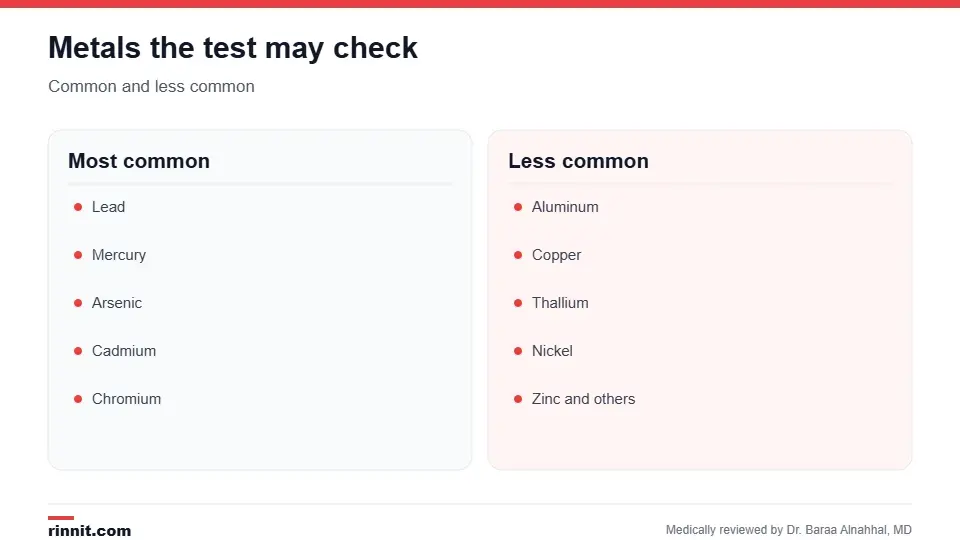
Lead, mercury, arsenic, cadmium and chromium are tested most often.
Most common: arsenic, cadmium, chromium, lead and mercury.
Less common: aluminum, copper, iron, manganese, nickel, selenium, silicon, thallium and zinc. Sources: [1]
Heavy metals can enter the body through the skin, breathing or swallowing. Small amounts are usually harmless, but large amounts can cause heavy metal poisoning, which can be life-threatening without treatment. Sources: [1]
Why is it done?
Symptoms often overlap with other conditions, so testing helps sort out the cause. Sources: [1]
Sample types
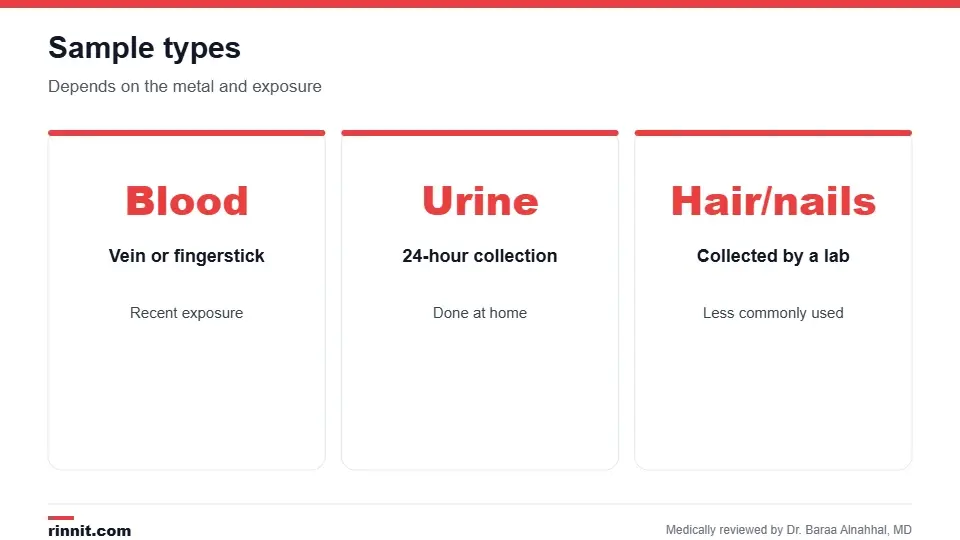
The sample depends on the metal and timing of exposure.
Sample | How it's collected |
Blood | From a vein or a fingerstick, in a few minutes |
Urine | Collected at home over 24 hours in a special container |
Hair or nails | Collected by a lab professional; used less often |
The best sample depends on which metals are being checked and whether exposure was recent or long-term. Sources: [1, 2]
How do I prepare?
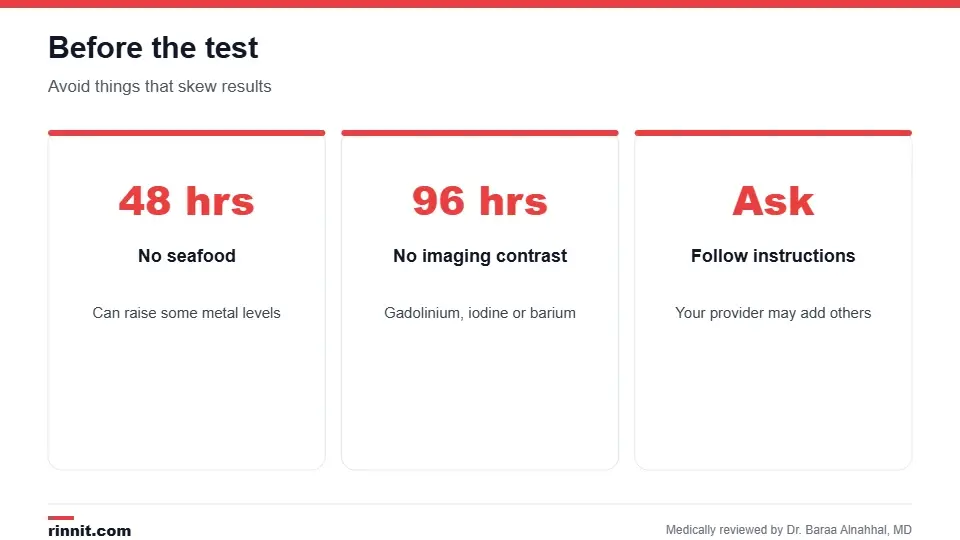
Seafood and contrast dyes can affect results.
Avoid seafood for 48 hours, since it can temporarily raise some metal levels.
Avoid gadolinium, iodine or barium contrast used in imaging for at least 96 hours.
Follow any other instructions from your provider. Sources: [1]
Understanding your results
Low or normal levels: heavy metal poisoning is unlikely; if symptoms continue, your provider will look for other causes.
High levels: may mean heavy metal poisoning. Sources: [1, 3]
Results are usually back within a few days. Sources: [1]
Treatment for high levels
The first step is avoiding the source of exposure. If levels stay high, your provider may recommend chelation therapy, which uses medicines by mouth or injection to bind metals so the body can remove them, under medical supervision. Sources: [1]
Conclusion
A heavy metal test helps confirm or rule out toxic metal exposure when symptoms or history raise concern. Blood and urine tests ordered by a provider are the most reliable, and results guide whether you need to remove an exposure or start treatment.
Keep learning: read about heavy metal poisoning and lead poisoning.
Frequently asked questions
What does a heavy metal test check?
Levels of toxic metals such as lead, mercury and arsenic.
Why would I need one?
For symptoms of poisoning or a known exposure.
What samples are used?
Usually blood or a 24-hour urine sample.
Are hair tests reliable?
Commercial hair tests can be unreliable; blood and urine are preferred.
How do I prepare?
Avoid seafood for 48 hours and contrast dye for 96 hours.
Why avoid seafood?
It can temporarily raise some metal levels.
What does a high result mean?
It may mean heavy metal poisoning.
How is poisoning treated?
By avoiding exposure and sometimes chelation therapy.
How long do results take?
Usually a few days.
Can children be tested?
Yes. Blood lead testing is common in children.
Related Reading
Heavy Metal Poisoning: Symptoms, Sources, and Treatment the condition this test checks for.
Lead Poisoning: What Parents and Adults Need to Know the most commonly tested toxic metal.
Understanding Mercury Poisoning: Symptoms, Causes, and Clinical Care mercury exposure and its effects.
What Is Arsenic Poisoning? A Plain-Language Guide to Exposure, Symptoms, Treatment, and Prevention arsenic exposure from water and food.
Chelation Therapy: What It Treats, How It Works, and When It's Unsafe treatment for high metal levels.
References
Cleveland Clinic. Heavy Metal Test: What It Is, Purpose, Procedure & Results. Cleveland Clinic. Last updated April 15, 2022. https://my.clevelandclinic.org/health/diagnostics/22797-heavy-metal-test
Seidel S, Kreutzer R, Smith D, et al. Assessment of commercial laboratories performing hair mineral analysis. JAMA. 2001;285(1):67-72. PMID 11150111. https://doi.org/10.1001/jama.285.1.67
Lanphear BP, Hornung R, Khoury J, et al. Low-level environmental lead exposure and children's intellectual function: an international pooled analysis. Environ Health Perspect. 2005;113(7):894-899. PMID 16002379. https://doi.org/10.1289/ehp.7688
Medical disclaimer
This article is for general education only and does not replace advice from a qualified healthcare professional. Talk to your doctor about your own diagnosis and treatment, and seek emergency care right away for severe or sudden symptoms.



Comments