Wilson's Disease: Symptoms, Causes, Diagnosis, and Lifelong Treatment

Updated: 2 days ago
Medically reviewed by Dr. Baraa Alnahhal, MD · Last reviewed: October 2026
Wilson's disease is a rare inherited condition (about 1 in 30,000 people) caused by mutations in the ATP7B gene. The body cannot remove extra copper, so it accumulates in the liver, brain, and eyes, most often producing symptoms between ages 3 and 40. Diagnosis combines blood, urine, eye, and genetic tests, often scored with the Leipzig criteria. Treatment means lifelong copper-removing chelators or zinc, and with early diagnosis most people live a full life with a typical life expectancy.
Quick Answer
Wilson's disease is a rare genetic disorder in which copper builds up in the liver, brain and eyes because the body cannot remove it properly [2]. Early signs include fatigue, tremors, mood changes and Kayser-Fleischer rings in the eyes. It is treated with lifelong chelating medicines or zinc [1]. Untreated, it can cause liver failure, but early treatment allows a full life [2].
What the research says
Staying on treatment during pregnancy is linked to fewer complications. A meta-analysis of 16 studies found that 37% of pregnancies in people with Wilson disease had at least one adverse pregnancy outcome (spontaneous abortion 20%), and that treatment during pregnancy was associated with lower odds of any adverse outcome (OR 0.53, 95% CI 0.37-0.76) (Brown et al., Liver Int, 2024) [3].
Hundreds of ATP7B variants exist, and exon 8 is especially variable. A meta-analysis of 40 studies found that exon 8 had the most diverse mutations (53 unique variants across 18 studies, 81% missense), and estimated that the variant p.R778Q/L accounted for 14.19% of variants on pooled analysis (Lao and Le, Biomark Insights, 2024) [4].
What Is Wilson's Disease?
Wilson's disease, also called hepatolenticular degeneration, is a rare inherited condition that causes copper to build up in the body, especially in the liver, brain, and eyes [2]. It affects about 1 in 30,000 people worldwide [2].
Copper is important for healthy nerves, bones, collagen, and the skin pigment melanin. Normally, the liver makes bile that removes extra copper from the body. In Wilson's disease, copper is not removed properly and instead builds up [2].
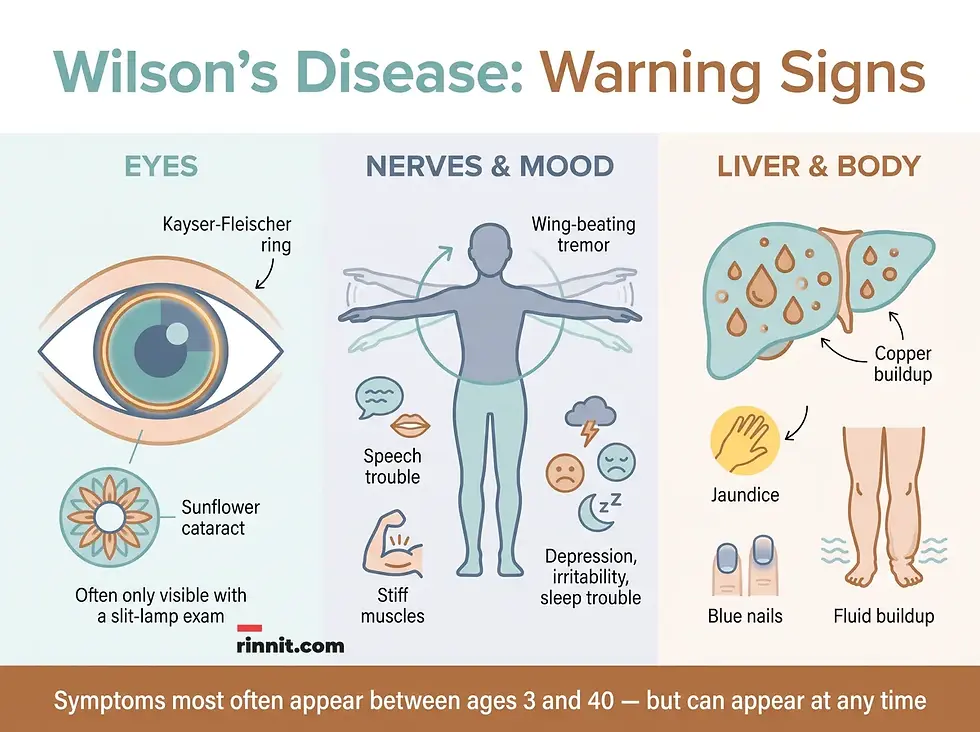
Symptoms most often appear between ages 3 and 40, but they can appear at any time. If not treated, the condition can sometimes become life-threatening. When diagnosed early, Wilson's disease is treatable, and many people with the condition live full lives [2].
Key Fact | Detail |
Alternate name | Hepatolenticular degeneration |
Frequency | About 1 in 30,000 people worldwide |
Cause | Mutations in the ATP7B gene (inherited) |
Where copper builds up | Liver, brain, eyes, and other organs |
Typical symptom onset | Between ages 3 and 40, but any age is possible |
Untreated outcome | Can become life-threatening |
With early treatment | Treatable; many live full lives |
What are the symptoms of Wilson's disease?
Wilson's disease is present at birth, but signs and symptoms appear later, after copper levels build up in the brain, liver, eyes, or another organ. Early symptoms can be subtle and vary depending on which parts of the body the disease affects. They may include tiredness, loss of appetite, mood or personality changes, tremors, or trouble with coordination [2].
Eye Symptoms
Kayser-Fleischer rings are golden-brown or copper-colored rings around the outside edge of the iris. They are caused by copper buildup in the Descemet membrane of the cornea. The rings usually appear first at the top and bottom of the iris and may eventually form a full circle. They are usually only visible with a special light called a slit-lamp during an eye exam [2].
Sunflower cataracts are patterns of radiating lines on the lenses of the eyes caused by copper buildup. They are also visible with a slit lamp [2].
Yellowing of the eyes (jaundice) can happen in advanced Wilson's disease if the liver is damaged [2].
Neurological Symptoms
Wilson's disease can cause copper buildup in areas of the brain that control movement and mood, leading to several signs and symptoms.
Tremor. A classic Wilson's tremor looks like a slow wing-beating motion when the arms are stretched out to the sides [2].
Other muscle and movement changes. These include trouble with speech, swallowing, or physical coordination, as well as uncontrolled movements and stiff muscles [2].
Psychiatric and mood changes. These can include depression, irritability, and trouble falling or staying asleep. Wilson's disease can also cause psychosis, a loss of touch with reality, and serious behavior changes similar to symptoms of schizophrenia. It does not cause psychopathy [2].
Face of the giant panda sign. A pattern of lighter and darker colors resembling a panda's face appears on a brain MRI in about 10% to 15% of people with Wilson's disease, mainly in those with neurological symptoms where the midbrain is damaged [2].
Liver Symptoms
If copper has built up in the liver, symptoms can include yellowing of the skin and eyes (jaundice) and swelling or fluid buildup in the legs or stomach. These symptoms of liver damage may not appear right away. Sometimes liver damage is found through blood tests showing abnormal liver function rather than symptoms [2].
Wilson's disease can also cause liver damage with normal liver function and typical test results. This is called compensated liver disease. When liver damage is not obvious on tests and causes no liver symptoms, neurological symptoms can sometimes lead to the diagnosis [2].
Skin, Nail, and Other Symptoms
Copper buildup in other areas may cause blue fingernails or toenails, sometimes called "Wilson's disease nails," and darkened skin on the front of the lower legs [2]. Other possible signs and symptoms include:
Affected Area | Possible Signs |
Bones and joints | Arthritis, especially in the knee |
Kidneys | Kidney stones |
Reproductive health | Loss of fertility, miscarriage, loss of sexual function |
When to See a Doctor
If you notice symptoms that concern you, make an appointment with a healthcare professional. This is especially important if Wilson's disease runs in your family.
What causes Wilson's disease, and how is it inherited?
Wilson's disease is caused by a changed gene (mutation) inherited from each parent. This is called autosomal recessive inheritance [2]. Inheriting a changed gene from just one parent rarely affects a person's health; that person has one changed gene and one typical gene.
The ATP7B gene provides instructions for making a protein that transports copper out of the liver into bile so it can be removed from the body. When mutations occur in the ATP7B gene, this copper transport process is disrupted. The disruption leads to a buildup of excess copper in the liver and eventually in other organs such as the brain, kidneys, and eyes. The copper buildup is what causes the symptoms, including Kayser-Fleischer rings [2].
When two carriers of the same changed gene have a child, the chances for that child are:
Inheritance Outcome | Chance |
Child inherits two typical genes | 25% |
Child is a carrier but not affected | 50% |
Child has Wilson's disease | 25% |
A child can inherit Wilson's disease if each parent passes along the same disease-causing mutation in the ATP7B gene or if each parent passes on a different mutation in the ATP7B gene [2].
While many mutations in the ATP7B gene are possible, one of the most common is the p.H1069Q mutation [1] [2]. Wilson's disease is not related to mutations in the PTP1B gene, which may play a role in type 2 diabetes and some blood cancers [2].

What are the risk factors for Wilson's disease?
Your risk of Wilson's disease is higher if you have parents or siblings who have the condition. If you know that Wilson's disease runs in your family, ask a healthcare professional if you need genetic testing to find out whether you are at risk [2]. Diagnosing Wilson's disease early increases the chances of successful treatment [2].
Risk Factor | Why It Matters |
Parents with Wilson's disease | Each child of two affected or carrier parents carries elevated risk |
Siblings with Wilson's disease | Shared ATP7B mutations mean siblings should be screened |
Known family history | Genetic testing can find the condition before symptoms start |
What complications can Wilson's disease cause?
Without treatment, copper builds up over time in the liver, brain, and other organs, causing damage that cannot be reversed. Untreated Wilson's disease can cause permanent liver damage, liver failure, lasting neurological problems, and sometimes death [2]. Treatment can ease symptoms and prevent more damage [2].
Complication | What Happens |
Cirrhosis | Scar tissue forms as liver cells try to repair copper damage; the scarring may not be fully reversible even with treatment |
Liver failure | Can happen suddenly (acute liver failure) or slowly over years; life-threatening; a liver transplant might be a treatment option |
Nervous system issues | Tremors, involuntary movements, unsteady walking, and speech trouble usually improve with treatment, though some neurological symptoms can last |
Kidney problems | Kidney stones or changes in how kidneys filter waste, leading to extra amino acids in the urine |
Mental health conditions | Personality changes, depression, irritability, bipolar disorder, or psychosis |
Blood problems | Damage to red blood cells (hemolysis) leading to anemia and jaundice |
Heart conditions | Weakness of the heart muscle (cardiomyopathy) and irregular heartbeats (arrhythmias), including atrial fibrillation |
Brain MRI patterns can also show this damage. If the midbrain is damaged, a "face of the giant panda" pattern may appear; damage just below it (the pons) may look like a small panda's face ("face of miniature panda" sign) or like a trident ("trident" sign) [2].
How is Wilson's disease diagnosed?
Diagnosing Wilson's disease can be hard because its symptoms resemble other liver diseases, such as hepatitis. Symptoms may also appear slowly over time, and gradual behavior changes can be especially hard to link to Wilson's disease [1].
Healthcare professionals diagnose Wilson's disease based on a combination of symptoms, lab values, and imaging or genetic tests. A structured scoring tool such as the Leipzig diagnostic criteria helps combine these findings. A Leipzig score of 4 or higher means Wilson's disease is highly likely [1].
Blood and Urine Tests
Test | What It Shows |
Ceruloplasmin | A protein that binds copper in the blood; typically low in Wilson's disease. Below 20 mg/dL (0.2 g/L) is often considered low. Some people with Wilson's disease do not have low levels, and low levels can occur without it (for example, from other liver disease) |
Serum copper | Total serum copper is usually low due to low ceruloplasmin, but free (unbound) copper is often higher than usual. By itself, the test is not used to diagnose Wilson's disease |
24-hour urinary copper | Measures copper removed in urine over 24 hours; typically high in Wilson's disease (higher than 40 to 100 mcg a day is usually considered high) |
Other liver tests | Liver function tests may be abnormal, though Wilson's disease can also cause damage with normal results (compensated liver disease) |
Eye Exam
During an eye exam, a specialist uses a slit-lamp to check for Kayser-Fleischer rings and sunflower cataracts. Kayser-Fleischer rings are seen in most people with neurological symptoms and about half of people with liver-only symptoms [1].
Liver Biopsy
In a liver biopsy, a healthcare professional inserts a thin needle through the skin into the liver to take a small tissue sample. A laboratory tests the tissue for extra copper. A copper level higher than 250 micrograms per gram of dry liver weight is a sign of Wilson's disease [1].
Genetic Testing and MRI
A blood test can look for mutations in the ATP7B gene, of which hundreds are known (p.H1069Q is one of the most common) [1]. If you have the changed gene, siblings and children should get genetic testing too, since early detection lets them begin treatment before symptoms start [1]. A brain MRI in people with neurological symptoms may show changes in affected areas, including the face of the giant panda sign [1].
Conditions With Similar Symptoms
Healthcare professionals also rule out other conditions caused by different gene changes:
Similar Condition | How It Differs |
Hemochromatosis | Involves too much iron, not copper |
Huntington's disease | Causes similar movement and behavior symptoms but affects the brain only |
Aceruloplasminemia | Leads to iron buildup in the liver, not copper |
Menkes disease | Leads to low copper in the liver and brain, the opposite of Wilson's disease |
How is Wilson's disease treated?
Treatment protects the body from further damage and can improve some symptoms. A healthcare professional may first recommend copper chelating agents, medicines that attach to copper and cause the organs to release it into the bloodstream so the kidneys can filter it into urine. Treatment then focuses on stopping copper from building up again, often with a zinc medicine [1]. For severe liver damage, a liver transplant might be needed [1].
Can Wilson's disease be cured? Medicines do not cure Wilson's disease, and a liver transplant cannot cure the gene change. But a donated liver lacks the mutated gene, so it processes copper properly without more treatment [1]. If detected early and treated, a person with Wilson's disease can live a full life with a typical life expectancy [1].
If you take medicines for Wilson's disease, you will need to continue them for life unless you have a liver transplant [1].
Medicines
Medicine | How It Works | Key Considerations |
Penicillamine (Cuprimine, Depen) | Removes extra copper from the body; often used first to lower copper quickly | Serious side effects include skin and kidney issues; can cause or worsen neurological symptoms; may lower the bone marrow's ability to make red blood cells and platelets; use carefully with a penicillin allergy; reduces vitamin B6, so a small B6 supplement is needed |
Trientine (Cuvrior, Syprine) | Removes extra copper, works like penicillamine | Usually causes fewer side effects, though neurological symptoms can worsen |
Zinc acetate (Galzin) | Stops the body from absorbing copper from food | Usually maintenance therapy after initial chelation; may be the main treatment if penicillamine or trientine cannot be taken or there are no symptoms; most common side effect is stomach upset |
Surgery
If the liver is so damaged that you are in liver failure or the damage cannot be reversed with medicine, a liver transplant may be needed. A surgeon removes the damaged liver and replaces it with a healthy liver from a donor [1]. Most transplanted livers come from donors who have died. Sometimes a living donor, such as a family member, gives a portion of their liver; surgeons remove about 40% to 70% of the donor liver and place it into the recipient [1].

How can people live well with Wilson's disease?
Wilson's disease is managed with lifelong medicine to remove and block extra copper, plus self-care to keep too much copper out of the diet. Your healthcare team may recommend limiting copper found in water, supplements, and food [1].
Water. If your home has copper pipes, run the water until it turns cool before using it for cooking or drinking. If you use well water, have it tested for copper or use a filter that removes trace elements [1].
Supplements. Stay away from multivitamins or supplements that contain copper [1].
Food. How much copper is acceptable depends on your treatment stage and personal health. You might initially be asked to have no more than 1 mg of copper per day, then up to about 2 mg or less per day on a maintenance plan [1].
Copper Level | Examples |
High (avoid or limit) | Liver and organ meats, shellfish and shrimp, lamb, goose, duck, quail, tofu and soy products, dried beans, mushrooms, potatoes with skin, dried fruits, bran cereals and corn grain, nuts and seeds, chocolate, mineral water |
Low (can form a diet base) | White meat chicken and turkey, cod, scallops, halibut, tuna, trout, eggs, butter, margarine, cheese, cottage cheese, sour cream, milk and yogurt (not chocolate-flavored), Brussels sprouts, broccoli, cabbage, cauliflower, spinach, green peppers, onions, shiitake and enoki mushrooms, many fruits, coffee, carbonated beverages |
Some healthy foods have moderate copper and may be allowed in small amounts [1]. Ask your healthcare team what dietary guidelines are right for you.
It is common to worry about whether you can live a normal life with Wilson's disease. Starting lifelong medicine and learning new eating habits can feel like a lot to manage. Give yourself time to adjust, and share your concerns with your healthcare team. With early diagnosis, proper medical treatment, and self-care, most people with Wilson's disease live healthy lives.
How should you prepare for a Wilson's disease appointment?
You will likely first see your primary healthcare professional, who may refer you to a liver specialist called a hepatologist [1].
What you can do. When you make the appointment, ask if you need to prepare, such as changing your diet before blood tests. It helps to make a list of your symptoms and when they began, important personal information (major stresses, other conditions, family history of Wilson's disease), all medicines, vitamins, and supplements with doses, and your questions. Bring someone to help remember the information you receive [1].
Helpful questions to ask include:
What tests do I need to confirm Wilson's disease?
What family history details do you need?
How is Wilson's disease treated and monitored long-term?
What treatment do you recommend, and what are its side effects?
How can I best manage Wilson's disease with my other health conditions?
Do I need to limit the types of food I eat?
Should I see a specialist, and what kind?
Should my siblings or children be tested, and what specialist should they see?
Tell your healthcare professional if anyone in your family has Wilson's disease or unexplained liver, neurological, or mental health symptoms, since the disease runs in families. Expect your doctor to ask whether symptoms occur all the time or come and go, how severe and long-lasting they are, what makes them better or worse, and whether anyone else in your family has Wilson's disease [1].
Conclusion
Wilson's disease is rare, but it is one of the most treatable inherited metabolic conditions when found early. Because its symptoms mimic ordinary fatigue, mood changes, or other liver diseases, the condition is easy to miss, especially in families where it has not appeared before. The Kayser-Fleischer ring, the wing-beating tremor, and unexplained liver problems in anyone under 40 are worth mentioning to a healthcare professional, since simple blood, urine, and eye tests can open the door to diagnosis. Treatment is lifelong, but it works: most people with early-diagnosed Wilson's disease live a full life with a typical life expectancy.
Take action today. If Wilson's disease runs in your family, or if you or a loved one has unexplained tremors, mood changes, or liver problems, ask your healthcare professional about Wilson's disease testing. Early screening for siblings and children can begin treatment before symptoms ever start.
Frequently Asked Questions
What is the earliest sign of Wilson's disease?
Early signs include tiredness, loss of appetite, mood or personality changes, tremors, and trouble with coordination. These are subtle and can appear slowly, which is why the condition is often missed at first. A healthcare professional can run copper, liver, and genetic tests to investigate.
At what age does Wilson's disease usually appear?
Symptoms most often appear between ages 3 and 40, but they can appear at any time. Because onset spans childhood through mid-adulthood, Wilson's disease should be considered at any age when unexplained liver or neurological problems occur.
What is the Kayser-Fleischer ring?
The Kayser-Fleischer ring is a golden-brown or copper-colored ring around the outer edge of the iris, caused by copper buildup in the cornea's Descemet membrane. It is usually visible only with a slit-lamp during an eye exam and appears in most people with neurological symptoms.
Is Wilson's disease curable?
Medicines do not cure Wilson's disease, and a liver transplant cannot cure the gene change. However, a donated liver lacks the mutation and processes copper properly, and early treatment lets most people live a full life with a typical life expectancy.
How long do people with Wilson's disease take medicine?
If you take medicines for Wilson's disease, you will need to continue them for life unless you have a liver transplant. Lifelong treatment protects the body from further copper damage.
What does the "face of the giant panda" sign mean?
The "face of the giant panda" sign is a lighter-and-darker pattern on a brain MRI that resembles a panda's face, seen in about 10% to 15% of people with Wilson's disease, mainly those with neurological symptoms where the midbrain is damaged. Related patterns include the "face of miniature panda" sign and the "trident" sign.
Can you eat chocolate or nuts with Wilson's disease?
Chocolate, nuts, and seeds are high-copper foods that people with Wilson's disease are usually asked to avoid or limit, especially early in treatment. Low-copper foods such as chicken, most fish, eggs, and fresh vegetables can form the base of the diet instead.
Does Wilson's disease affect the heart?
Yes. It can cause heart conditions such as cardiomyopathy (weakness of the heart muscle) and arrhythmias, including atrial fibrillation.
If my siblings are carriers, should they be tested?
Yes. Anyone found to have the ATP7B gene change should have close family members, including siblings and children, screened with genetic testing. Finding the condition early allows treatment to begin before symptoms start.
What is the most common Wilson's disease gene mutation?
Hundreds of ATP7B mutations cause Wilson's disease. One of the most common is the p.H1069Q mutation. Genetic testing can identify the specific mutation in a family.
Additional Resources
Related Reading
Liver Function Tests (LFTs): What They Measure, Normal Ranges and Results explains the blood tests used to check liver health in this condition.
Ceruloplasmin Test: Wilson Disease, Copper and What Results Mean explains the copper-carrying protein blood test used to check for Wilson disease.
References
Mayo Clinic Staff. Wilson's disease: Diagnosis and treatment. Mayo Clinic. December 27, 2025. https://www.mayoclinic.org/diseases-conditions/wilsons-disease/diagnosis-treatment/drc-20353256
Mayo Clinic Staff. Wilson's disease - Symptoms and causes. Mayo Clinic. Dec. 27, 2025. https://www.mayoclinic.org/diseases-conditions/wilsons-disease/symptoms-causes/syc-20353251
Brown AN, Lange MM, Aliasi-Sinai L, et al. Adverse pregnancy outcomes and effect of treatment in Wilson disease during pregnancy: Systematic review and meta-analysis. Liver Int. 2024;44(11):3020-3030. PMID 39206599. https://doi.org/10.1111/liv.16072
Lao TD, Le TAH. Systematic Analysis and Insights Into the Mutation Spectrum and Ethnic Differences in ATP7B Mutations Associated With Wilson Disease. Biomark Insights. 2024;19:11772719241297169. PMID 39502306. https://doi.org/10.1177/11772719241297169
Medical disclaimer
The information provided in this article is for educational purposes only and should not be used as a substitute for professional medical advice, diagnosis, or treatment. Always seek the advice of your physician or other qualified health provider with any questions you may have regarding a medical condition.



Comments