Ceruloplasmin Test: Wilson Disease, Copper and What Results Mean

Updated: 2 days ago
Written and medically reviewed by Dr. Baraa Alnahhal, MD · Last reviewed: November 2026 · How we review
Quick Answer
A ceruloplasmin test is a blood test that measures ceruloplasmin, a protein made by the liver that carries copper through the body. It's mainly used to check for Wilson disease, an inherited condition in which copper builds up in the liver and brain, and to look for copper deficiency. No preparation is needed.
What the research says
The cutoff used matters: in a study of genetically confirmed patients, family members and 690 healthy people, only about half of people with a ceruloplasmin below the usual 0.20 g/L (20 mg/dL) cutoff actually had Wilson disease, while a lower cutoff of 0.14 g/L gave 100% sensitivity and specificity in a validation group (Mak CM et al., Clin Chem, 2008) [2]
Low ceruloplasmin is found in most people with Wilson disease: in a large series of 842 people with Wilson disease, about 97% had a ceruloplasmin level below the diagnostic cutoff on either enzyme-based or standard immune-based testing (Yang Y et al., Parkinsonism Relat Disord, 2024) [3]
Key takeaways
Measures the main copper-carrying protein in blood.
Mainly used to screen for Wilson disease and copper deficiency.
Low levels: Wilson disease, liver or kidney disease, malnutrition or Menkes disease.
High levels: pregnancy, estrogen, inflammation or infection.
Results are read with copper tests and liver tests.
What is ceruloplasmin?
Ceruloplasmin is a protein made in the liver. It binds copper and carries it through the blood to where it's needed. It also helps move iron and supports melanin, your skin pigment. When ceruloplasmin is low, copper handling can be disrupted. Sources: [1]
Why is it done?
To check for Wilson disease, especially with a family history or symptoms such as tremors, trouble walking, trouble swallowing, belly pain, jaundice or anemia.
To check for copper deficiency, with symptoms such as fatigue, pale skin, weak bones or numbness and tingling in the hands or feet.
In children, to help diagnose Menkes disease. Sources: [1]
Copper deficiency can come from malabsorption, malnutrition, IV feeding or taking too much zinc, which blocks copper absorption. Sources: [1]
How the test is done
No special preparation is needed; drinking water beforehand can make the draw easier. A phlebotomist takes blood from a vein in your arm or hand in a few minutes. The lab usually tests the plasma, the liquid part of the blood. You may have mild soreness or bruising that fades within a day. Sources: [1]
Normal ranges
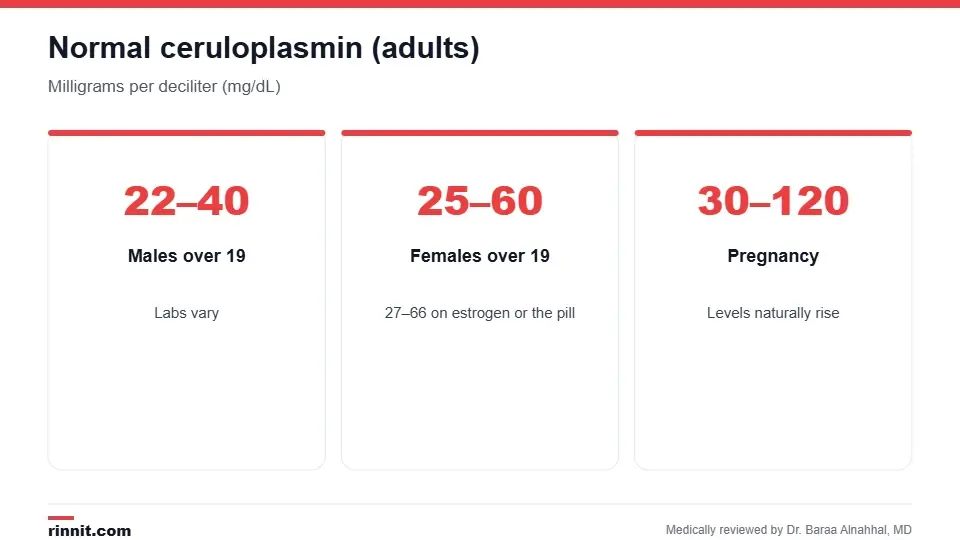
Ranges vary between labs.
Group | Typical range (mg/dL) |
Males 13–19 years | 15–37 |
Females 13–19 years | 22–50 |
Males over 19 | 22–40 |
Females over 19, no estrogen | 25–60 |
Females over 19, on estrogen or the pill | 27–66 |
Pregnancy | 30–120 |
A result outside the range doesn't always mean illness. Sources: [1]
Causes of low ceruloplasmin
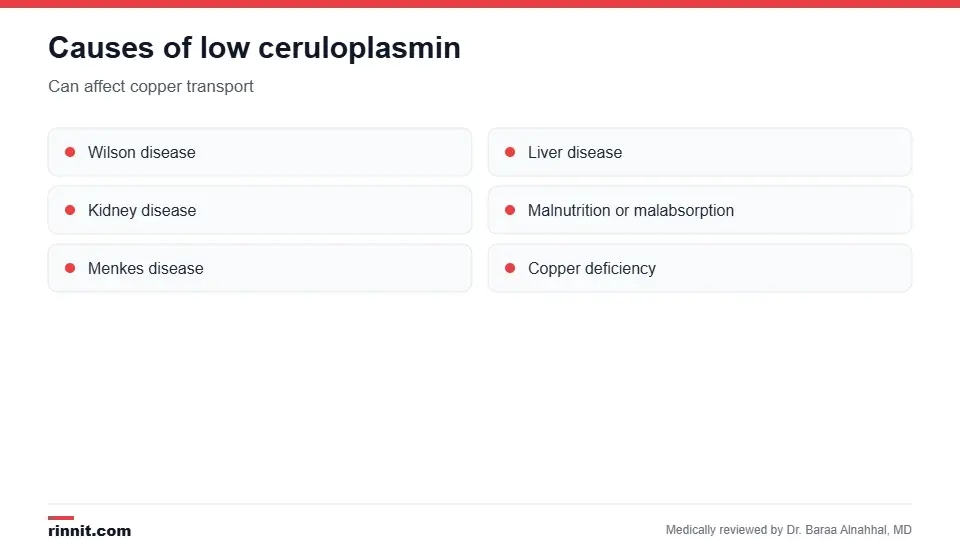
Low levels can point to copper problems.
Wilson disease.
Liver disease.
Kidney disease.
Malnutrition or malabsorption.
Menkes disease.
Copper deficiency with no other disease. Sources: [1, 2, 3]
Causes of high ceruloplasmin
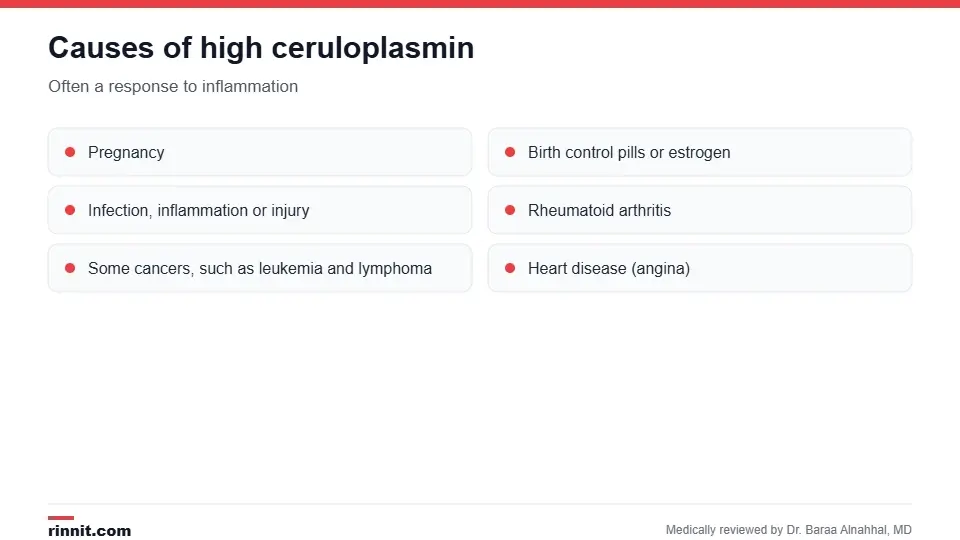
Ceruloplasmin rises with inflammation.
Pregnancy, birth control pills or estrogen.
Inflammation, infection or injury.
Rheumatoid arthritis.
Some cancers, such as leukemia, Hodgkin lymphoma and lung cancer.
Angina and Alzheimer's disease.
Sometimes with no medical condition at all. Sources: [1]
What happens next?
If results suggest Wilson disease, your provider may order urine copper testing through a urinalysis, more blood tests, liver function tests and sometimes a liver biopsy to measure liver copper. Sources: [1]
Conclusion
The ceruloplasmin test is a simple first step in checking how your body handles copper. Low levels are an important clue to Wilson disease, but the diagnosis is confirmed with other copper, liver and genetic tests.
Keep learning: read about Wilson disease and copper deficiency.
Frequently asked questions
What does a ceruloplasmin test measure?
The protein that carries copper in your blood.
Why is it ordered?
Mainly to check for Wilson disease or copper deficiency.
What is a normal level?
About 22–40 mg/dL for adult males and 25–60 mg/dL for adult females.
What does low ceruloplasmin mean?
It can suggest Wilson disease, liver disease or copper deficiency.
What does high ceruloplasmin mean?
Often pregnancy, estrogen use or inflammation.
Do I need to fast?
No special preparation is needed.
Can birth control pills affect results?
Yes. They can raise ceruloplasmin.
Does low ceruloplasmin always mean Wilson disease?
No. Other tests are needed to confirm it.
What tests come next?
Urine copper, liver tests and sometimes a liver biopsy.
Is the test risky?
No. Risks are limited to mild soreness or bruising.
Related Reading
Wilson's Disease: Symptoms, Causes, Diagnosis, and Lifelong Treatment the main condition this test screens for.
Copper Deficiency: What It Is, Symptoms, Causes, and Treatment another cause of low ceruloplasmin.
Understanding Menkes Disease: Symptoms, Causes, and Clinical Care a rare inherited copper disorder.
Liver Function Tests (LFTs): What They Measure, Normal Ranges and Results blood tests often done alongside.
Liver Biopsy: Procedure, Types, Risks, and Benefits may be used to measure liver copper.
References
Cleveland Clinic. Ceruloplasmin Test: What It Is, Purpose, Procedure & Results. Cleveland Clinic. Last updated December 10, 2024. https://my.clevelandclinic.org/health/diagnostics/22153-ceruloplasmin-test
Mak CM, Lam CW, Tam S. Diagnostic accuracy of serum ceruloplasmin in Wilson disease: determination of sensitivity and specificity by ROC curve analysis among ATP7B-genotyped subjects. Clin Chem. 2008;54(8):1356-1362. PMID 18556333. https://doi.org/10.1373/clinchem.2008.103432
Yang Y, Cheng T, Yang W, et al. Serum ceruloplasmin oxidase activity: a neglected diagnostic biomarker for Wilson disease. Parkinsonism Relat Disord. 2024;127:107105. PMID 39178787. https://doi.org/10.1016/j.parkreldis.2024.107105
Medical disclaimer
This article is for general education only and does not replace advice from a qualified healthcare professional. Talk to your doctor about your own diagnosis and treatment, and seek emergency care right away for severe or sudden symptoms.



Comments